

Lighter's protocol held firm on November 16, 2026. The vulnerability was not in the platform itself but in a third-party signing tool a trader was using to authorize orders. According to the post-mortem Lighter published at 18:20 UTC, the external software reused cryptographic nonces, allowing anyone observing the resulting signatures to reconstruct the trader's private API keys.
On the same day, Lighter, a perpetual derivatives platform built as an Ethereum Layer 2, reopened withdrawals after suspending them that morning. According to Bitquery data cited by CoinDesk and Cointelegraph, an on-chain withdrawal of 10,393,057 USDC was verified. The Lighter Security Council later returned approximately 5 million USDC to the affected trader.
This report draws on The Defiant, TokenPost, CoinDesk, Cointelegraph, and crypto.news. Lighter's posts on X were reviewed through post identifiers. The Bitquery analysis was not directly accessible and is cited through CoinDesk and Cointelegraph.
— Lighter (@Lighter_xyz) November 16, 2026
Deposits and withdrawals are back to normal following the deactivation of Guardian Mode by the Lighter Security Council.
, Lighter (@Lighter_xyz) November 16, 2026
More details on what happened: https://t.co/HLIw6E7UdO https://t.co/rYf8oXx7Du
The Protocol Held. The Client Software Did Not.
Lighter attributed the incident to insecure signing code used by the affected accounts, not to its own SDKs. According to the company, the protocol, smart contracts, and core infrastructure were untouched. A nonce is a secret value designed to be used exactly once when generating a digital signature. When the same nonce appears in two different signatures, the underlying math allows anyone watching to extract the private key. Nonce reuse is a well-documented cryptographic failure with decades of precedent in applied cryptography.
Exactly who was affected remains unclear. The Defiant reported that one trader and that trader's API keys were compromised. CoinDesk reported Lighter had warned users whose accounts were linked to market maker APIs. Researchers cited by crypto.news had described two large market maker accounts as the targets. The name of the third-party signing software has not been disclosed publicly.
A Restricted Key Found a Side Door
There's a second layer to this story. Lighter's API keys cannot directly withdraw funds to an external wallet. Per documentation cited by Cointelegraph, they're authorized for trading, managing positions. Moving funds between sub-accounts within the same wallet. Transfers to other wallet owners require a full wallet signature. That rule worked as intended, but there was a gap in the architecture.
According to Lighter's own reconstruction, as reported by The Defiant, a public pool created by an account was counted as that account's sub-account. With a stolen API key, the attacker could move funds into that pool. The attacker bought pool shares from a separate account, transferred funds into the pool without issuing new shares, then redeemed and withdrew. Following the incident, transfers to public pools now require wallet-level signatures, and API key signatures are no longer public.
Ten Million USDC Became Ether Within Minutes
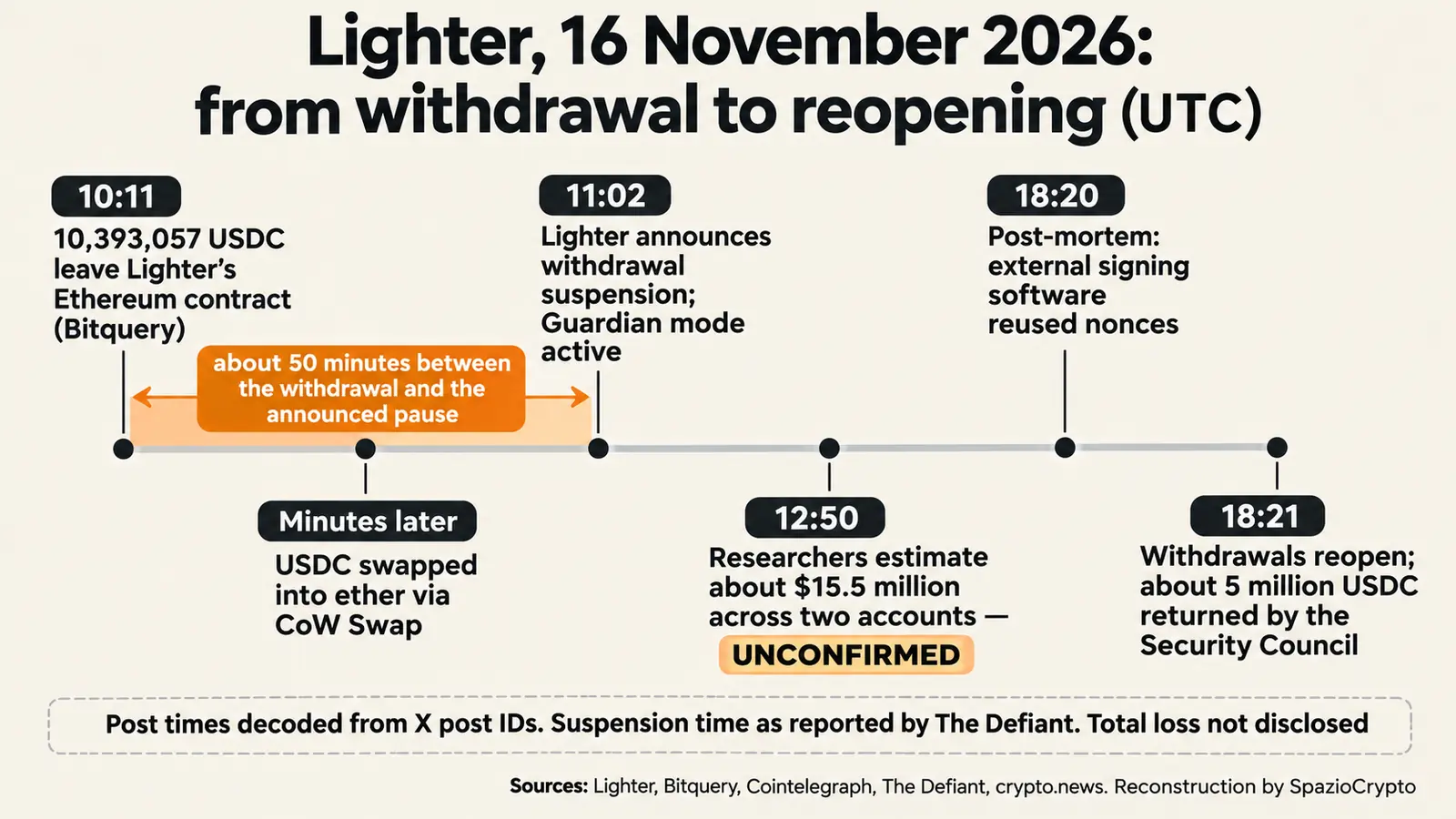
According to Bitquery data cited by Cointelegraph, 10,393,057 USDC left Lighter's Ethereum contract at 10:11 UTC, moving to a wallet address beginning with 0xb3f that Lighter subsequently linked to the attacker. Within minutes, those USDC were converted into ether via CoW Swap. Crypto.news reported the conversion yielded approximately 5,400 ETH. According to CoinDesk, roughly 1,920 ETH, worth approximately 3.5 million dollars at the time, then moved from 12 wallets to Hyperliquid to purchase XMR1, a token referencing Monero.
The speed of that conversion was not coincidental. USDC can be frozen by its issuer, Circle; ether cannot. That difference in issuer control is one of the key fault lines between stablecoins, a topic explored in our comparison of USDT and USDC. The power issuers hold to freeze funds is also part of the broader tension around stablecoin stability and trust.
The Brake Came After the Theft
Lighter's Guardian system suspended withdrawals and blocked the creation of new pools. According to The Defiant, Lighter announced the suspension at 6:02 AM New York time (11:02 UTC), roughly fifty minutes after the 10.39 million USDC had already left the contract. The Guardian mode protected what remained. It did not recover what was already gone.
That evening, the Security Council deactivated Guardian mode and returned approximately 5 million USDC to the affected trader. The Defiant described this as a council-led recovery during the pause, not a voluntary return by the attacker. At 18:21 UTC, Lighter confirmed via a post on X that deposits and withdrawals had returned to normal, with pending requests still being processed. According to TokenPost, the company also plans to introduce IP allowlists, per-key permissions and rate limits, and monitoring to revoke at-risk keys proactively.
The Numbers That Are Still Missing
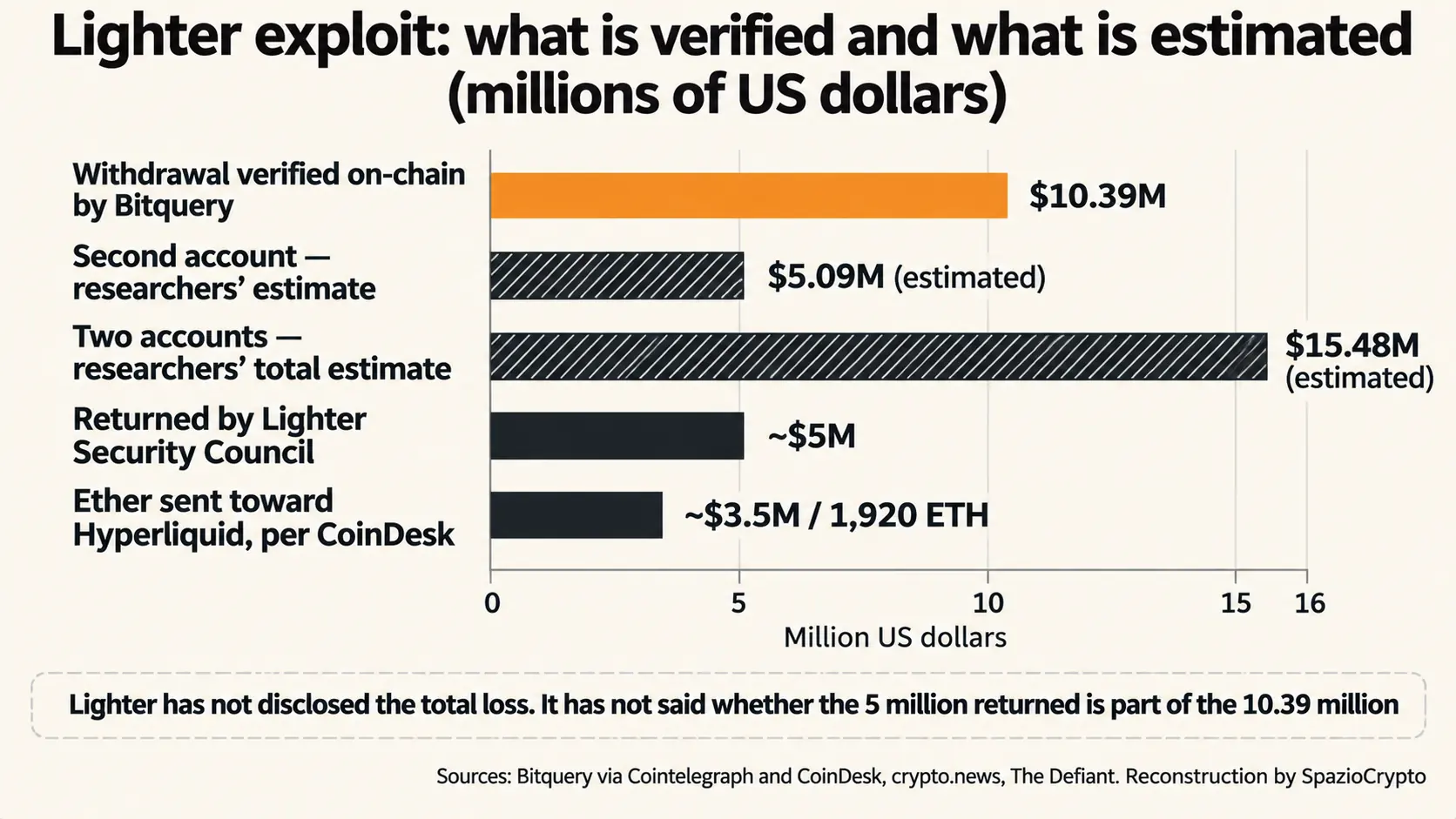
Lighter has not disclosed the total loss. The figure verified on-chain is the 10,393,057 USDC withdrawal, confirmed by Bitquery data cited in CoinDesk and Cointelegraph. Researchers cited by crypto.news estimated approximately 15.5 million dollars across two accounts: 10.39 million plus roughly 5.09 million. CoinDesk noted that Lighter has not confirmed that estimate. The 5 million returned is close to the estimated second-account figure, but the company has not stated whether those two amounts overlap or whether the returned funds are a subset of the 10.39 million withdrawn.
Markets responded quickly. According to CoinDesk, the LIT token dropped more than 10%, falling below 2.48 dollars, before recovering to 2.62 dollars. Crypto.news reported that Upbit and Bithumb suspended LIT deposits and withdrawals. Reading these moves requires understanding the token's total market capitalization, which shapes the significance of any percentage swing.
What This Means for Anyone Using API Keys
Lighter has asked anyone using custom or third-party signing software to rotate all API keys immediately. The company added that anyone who cannot confirm their nonces aren't being reused should switch to official SDKs. That warning extends well beyond Lighter. An API key is a key in every practical sense, even when it carries limited permissions. It deserves the same custody discipline as a wallet's seed phrase, the same kind of discipline covered in guides on self-custody, exchange accounts, and wallet security.
The Lighter Incident in Brief
What is confirmed, what is not
- Confirmed: on-chain withdrawal of 10,393,057 USDC at 10:11 UTC, withdrawals suspended by the Guardian system, approximately 5 million USDC returned by the Security Council, withdrawals reopened at 18:21 UTC on November 16.
- Not disclosed: total loss amount, name of the signing software, relationship between the 5 million returned and the 10.39 million withdrawn, confirmation of the 15.5 million estimate.
- To watch: outcome of pending withdrawal requests, new per-key permissions and rate limits, fate of the converted ether, any additional accounts found to be exposed.
The Bigger Picture
An editorial observation, stated as such: in decentralized finance, the weakest link is shifting from the contract to the client. Lighter's smart contracts held, but a professional trader lost funds because of a flaw in their own signing software. That pattern, a key compromised outside the platform, recurs across many theft cases, from large-scale protocol breaches to phishing campaigns that impersonate exchanges and regulators.
The second point concerns the Security Council. It halted withdrawals and returned 5 million USDC, protecting other traders on the platform. It also illustrates that the system has an emergency brake with specific people authorized to pull it. Anyone using Lighter, or any DeFi platform with a similar governance structure, should understand who holds that authority and under what conditions they can act. Three signals are worth watching: whether Lighter publishes a full loss disclosure, whether it clarifies the mechanics of the fund return, and whether any additional accounts using custom signing software turn out to be exposed.