

On Monday, November 16, 2026, visitors to some of the world's most recognizable websites were silently served code capable of swapping crypto addresses and copying payment card data. The Optimizely attack moved through Web Experimentation, the A/B testing service that thousands of companies use to run experiments on their own pages. According to researcher Scott Helme of Report URI, the malicious code appeared in 188 snippets linked to 178 organizations, including Zoom, BBC, CNN, HSBC, Salesforce, Ikea, and Ledger.
This account draws on the technical analysis published by StepSecurity, reconstructions by Help Net Security, The Hacker News, The Register, and CSO Online, plus corporate statements gathered by KPRC and Reuters. Optimizely's official report dated November 17, Helme's original analysis, and those of Unit 42 and Netskope were not directly accessible to our tools: their contents are reflected here only where cited by multiple secondary sources.
What Optimizely Admits
Optimizely, a New York-based marketing and experimentation software company, confirmed that “an unauthorized party exploited a vulnerability in Experimentation” to inject malicious JavaScript into certain customer projects. In an email to customers cited by CSO Online, the company identified the entry point as the account registration flow, which was used to “impersonate a user” and modify projects belonging to other organizations.
Optimizely says it blocked the vulnerable path, deployed a fix, terminated active sessions, revoked tokens, and removed the injected code. According to our editorial brief, based on the November 17 report, the company places the attack window between 08:51 and 23:24 Central European Time, has engaged Mandiant for the investigation, and has so far found no definitive evidence of personal data exfiltration. These details could not be verified against the original document.
This is not the company's first incident of the year. In February 2026, as reported by BleepingComputer, Optimizely disclosed that attackers had gained access to its internal systems through a phone-based social engineering attack, with the company saying the breach was limited to business contact data.
The Code: Three Targets in One Script
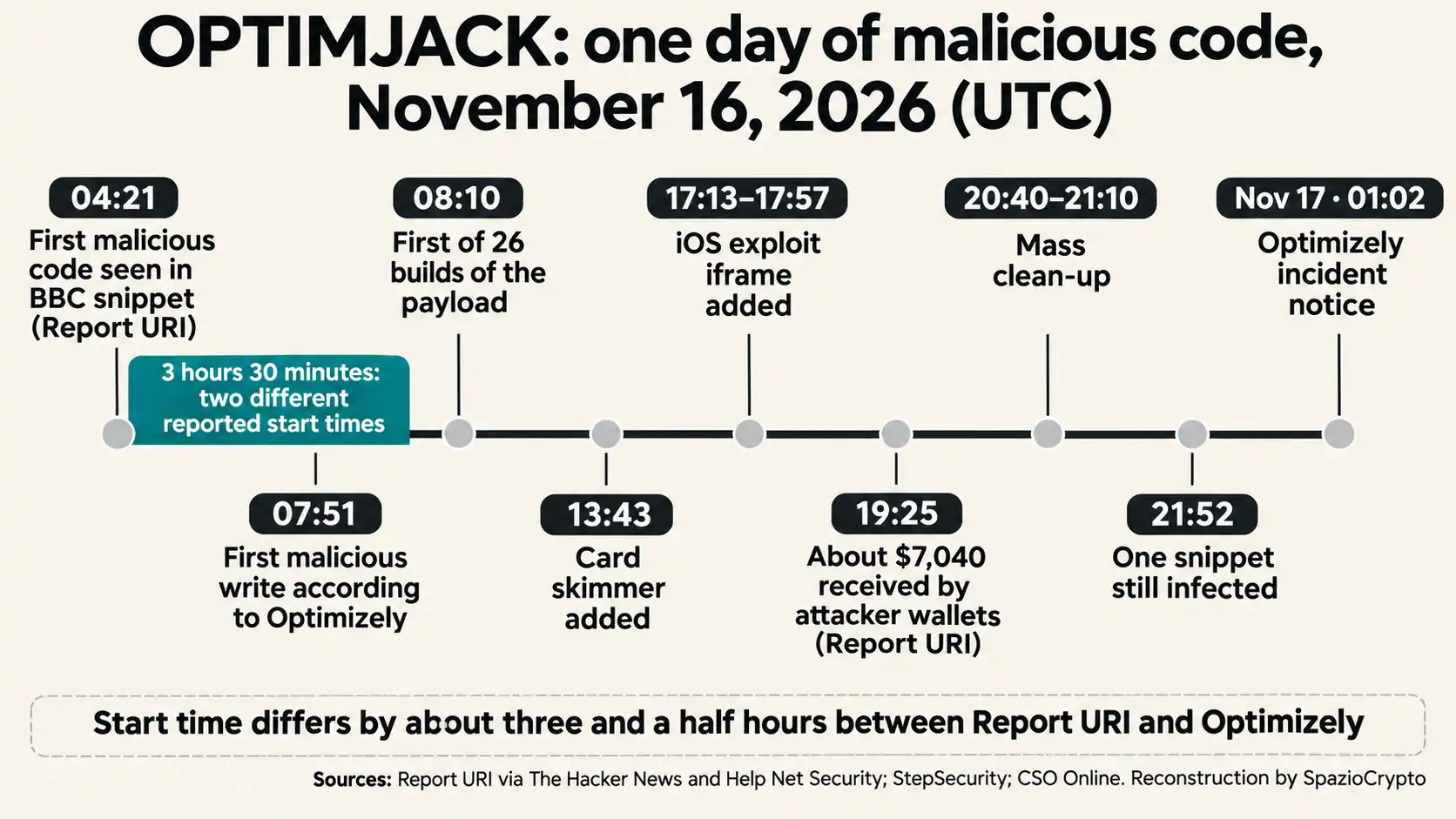
The mechanism is straightforward, which is precisely what made it effective. The attacker wrote a small loader into the Project JavaScript field of customer projects, leaving the rest of each snippet intact. The file continued to be served from Optimizely's own servers with their certificate, so browsers treated it as trusted. StepSecurity counted 26 distinct versions of the code on November 16 alone.
The first function replaced crypto wallet addresses with those belonging to the attacker, targeting eight networks including Bitcoin, Ethereum, Tron, and Solana, but only when triggered near keywords like “wallet”, “deposit”, or “send”. A second function, added during the afternoon, skimmed card numbers, expiry dates, and security codes from forms on the affected sites. A third fired after any successful address swap: it sent a page snapshot and any script-readable cookies back to the attacker. On unpatched iPhone and iPad devices, known exploit kits labeled Coruna and DarkSword were also loaded.
There are clear limits to what the code could do. According to StepSecurity, it could not read card data entered into forms hosted by external payment processors such as Stripe or Adyen, nor could it access cookies protected with the HttpOnly attribute. Report URI found no confirmed cases of iPhone compromise. StepSecurity's standing advice applies here: anyone copying a crypto address from a webpage should always verify it on the wallet screen, not from the clipboard. The same principle applies to clipboard-hijacking malware flagged by Microsoft.
The Victims: Major Brands, Banks Top the List
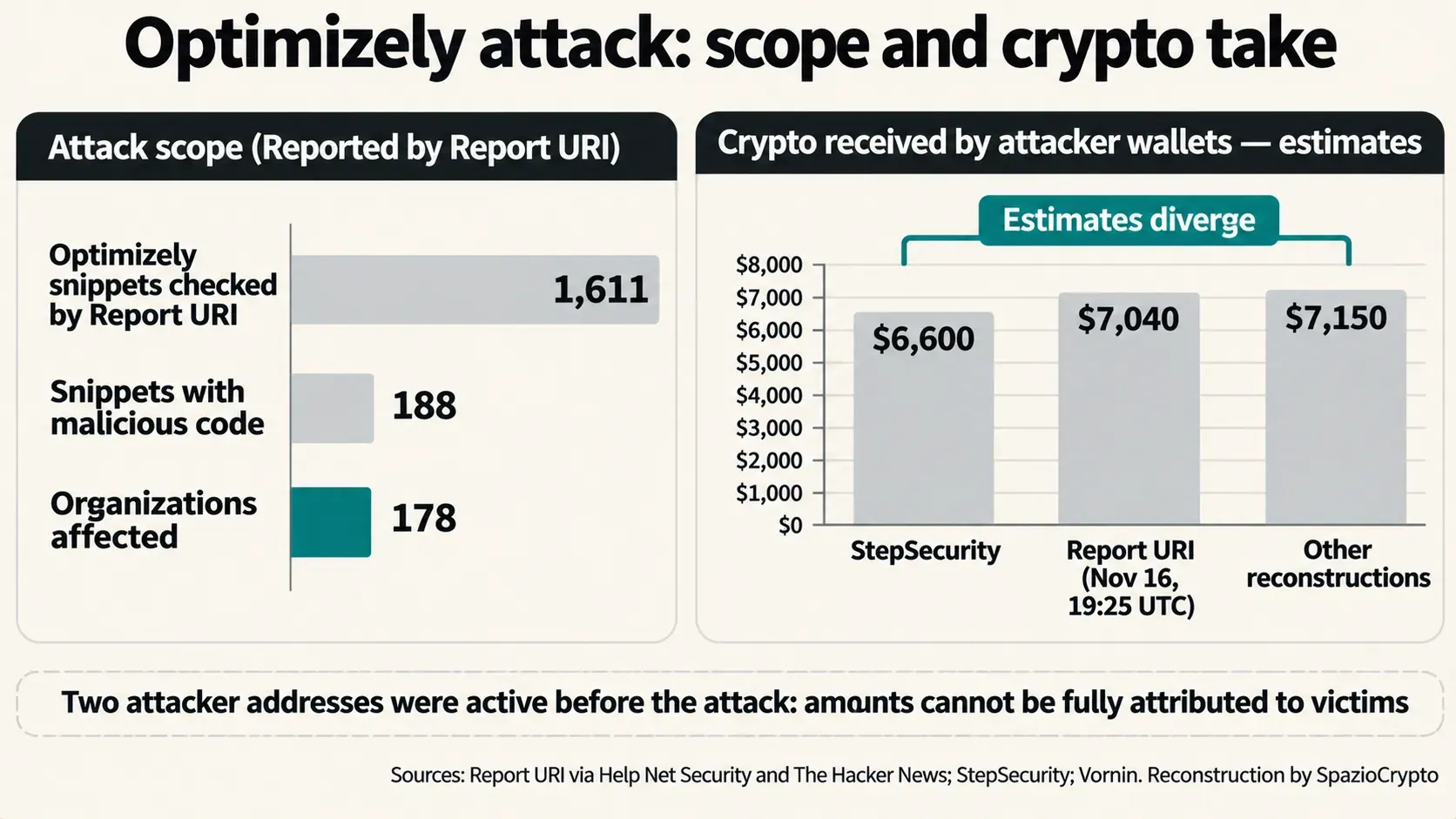
Report URI scanned 1,611 Optimizely snippets and found 188 infected, belonging to 178 organizations. According to Help Net Security, the largest affected category was banks and financial firms, with 32 organizations. Names cited across media outlets include GitLab, Equifax, Air France-KLM, Peacock. TalkTalk, as well as Optimizely's own sites, including its login page. Helme cautions that the real number is probably higher. His sample does not cover the full Optimizely customer base.
Corporate responses remain incomplete. Salesforce told Reuters it was investigating unauthorized modifications to scripts and had disabled them. Equifax told KPRC it found no “evidence of compromise of our systems or impact to our data” and stopped using Optimizely. Ikea told Reuters it was assessing potential effects on its services. No statement from Ledger has been found.
The Haul: Figures That Don't Line Up
How much was stolen in crypto remains unclear, and that ambiguity deserves precision. Report URI estimated roughly $7,040 had reached the attacker's wallets by 19:25 UTC on November 16. StepSecurity, examining the same addresses, arrived at approximately $6,600 across Bitcoin, Litecoin, Ethereum, and stablecoins on Tron. Other reconstructions cite $7,150. Two of the attacker's addresses were already active before the attack, and as The Hacker News notes, “the blockchain does not show which transfers came from victims.”
The crypto figure is small relative to the scale of the operation. The more serious potential damage involves the card data and cookies, but Report URI cannot quantify how much was actually collected. For the stablecoin portion, freezing by the issuer remains a theoretical option, as happened when Tether froze 72 million USDT in a prior case, but according to Helme those funds were already moved on the afternoon of November 16.
The Timeline: Two Conflicting Clocks
There is also a timing discrepancy. Optimizely places the first malicious write at 07:51 UTC. Report URI observed the BBC's snippet loading attacker code as early as 04:21 UTC, roughly three and a half hours earlier. “The forensic report should reconcile this discrepancy,” analyst Frank Dickson told CSO Online, because the exposure window depends entirely on which start time is correct. Mass cleanup took place in the evening; according to The Hacker News, only a single snippet remained infected at 21:52 UTC.
Italy and GDPR: The Compliance Dimension
The Italian source section on Italy is reproduced faithfully here, as the facts concern Italian users and Italian law. Anyone who sent crypto by copying an address from one of the affected sites on November 16 should check the transaction. Anyone who entered card details directly into a site form should ask their bank to monitor the card. The basic rules for recognizing a crypto scam and protecting against scams that impersonate regulated exchanges remain valid.
Our editorial read, stated as such: for Italian and European companies using Optimizely, this incident opens a compliance review. If personal data belonging to visitors was exposed, the GDPR requires the data controller to notify the Italian data protection authority (the Garante per la protezione dei dati personali) within 72 hours of discovery where there is a risk to individuals, and requires the data processor to notify the controller without delay. For payment pages, PCI DSS 4.0 already mandates a script inventory and change-control process: that is exactly the control gap this attack exploited. MiCA applies across all EU member states, so European crypto-asset service providers face an overlapping set of obligations under both GDPR and their CASP license conditions.
Optimizely Attack: What Is Confirmed and What Is Not
What is confirmed, what is not
- Confirmed: Optimizely acknowledges the vulnerability in Experimentation, the fix deployed, and the removal of injected code. Report URI found malicious code in 188 snippets belonging to 178 organizations. The script replaced crypto addresses and skimmed card data.
- Reported: the investigation assigned to Mandiant and the absence, so far, of definitive evidence of personal data exfiltration, contained in the Optimizely report we were unable to review; crypto amounts between $6,600 and $7,150, not attributable with certainty to specific victims.
- To watch: the outcome of the forensic investigation; the actual start time of the attack; communications from the affected companies to their own users.
- Our own reading, stated as such: the Optimizely incident shows that a website's security no longer depends solely on the website itself. A marketing vendor with write access to the pages of hundreds of companies becomes a single point of failure, and a flaw in account registration turns into a malware distribution channel reaching millions of visitors. We've seen this pattern in smaller attacks, from cryptojacking on macOS to AI voice-cloning scams that ended up draining Bitcoin wallets: the weak link is usually somewhere in the supply chain, not at the final endpoint.
- Three signals deserve close attention. First is the forensic report, which must explain how a single account registration granted access to other clients' projects and for how long. Second are any breach notifications issued by the affected companies, which will reveal whether personal data was actually stolen. Third is the market response: how many organizations will cut third-party scripts from sensitive pages and adopt stricter security policies going forward. Per Help Net Security, only 24 of the affected organizations had a policy tight enough to block the attack.
- Company report: Optimizely, Security Incident Report, November 17, 2026 (not reviewed). Technical analysis: StepSecurity; Scott Helme, Report URI (not reviewed); Unit 42 (not reviewed). Press: Help Net Security; The Hacker News; The Register; CSO Online; KPRC 2; Reuters (not reviewed); BleepingComputer, February 23, 2026.