

The Chainflip hack of November 21, 2026 hit vaults on both Bitcoin and Ethereum, with losses estimated by The Block at around $12 million. Chainflip Labs published an on-chain offer to the attacker: keep 10% and return 90% by 18:38 UTC on November 23. That deadline has now passed while the protocol remains in security mode, and no concrete plan for affected users has been announced.
This report draws on the official message published by Chainflip Labs, The Block’s coverage from November 21 and 22, and Bitquery’s analysis of the Ethereum transactions. Original posts on X were not directly accessible to our tools: their content is cited only where corroborated by those sources. The definitive technical cause has not been published.
We have sent an on-chain message to the address holding the BTC taken from Chainflip on 21 November.
— CHAINFLIP (@Chainflip) November 21, 2026
Offer: return 90% of the funds, keep 10% as a bounty. Terms and return addresses: https://t.co/hspHwh43lw
Tx: https://t.co/NrYEeZFMxD
The offer is open until 18:38 UTC on 23…
What Assets Were Taken from the Vaults
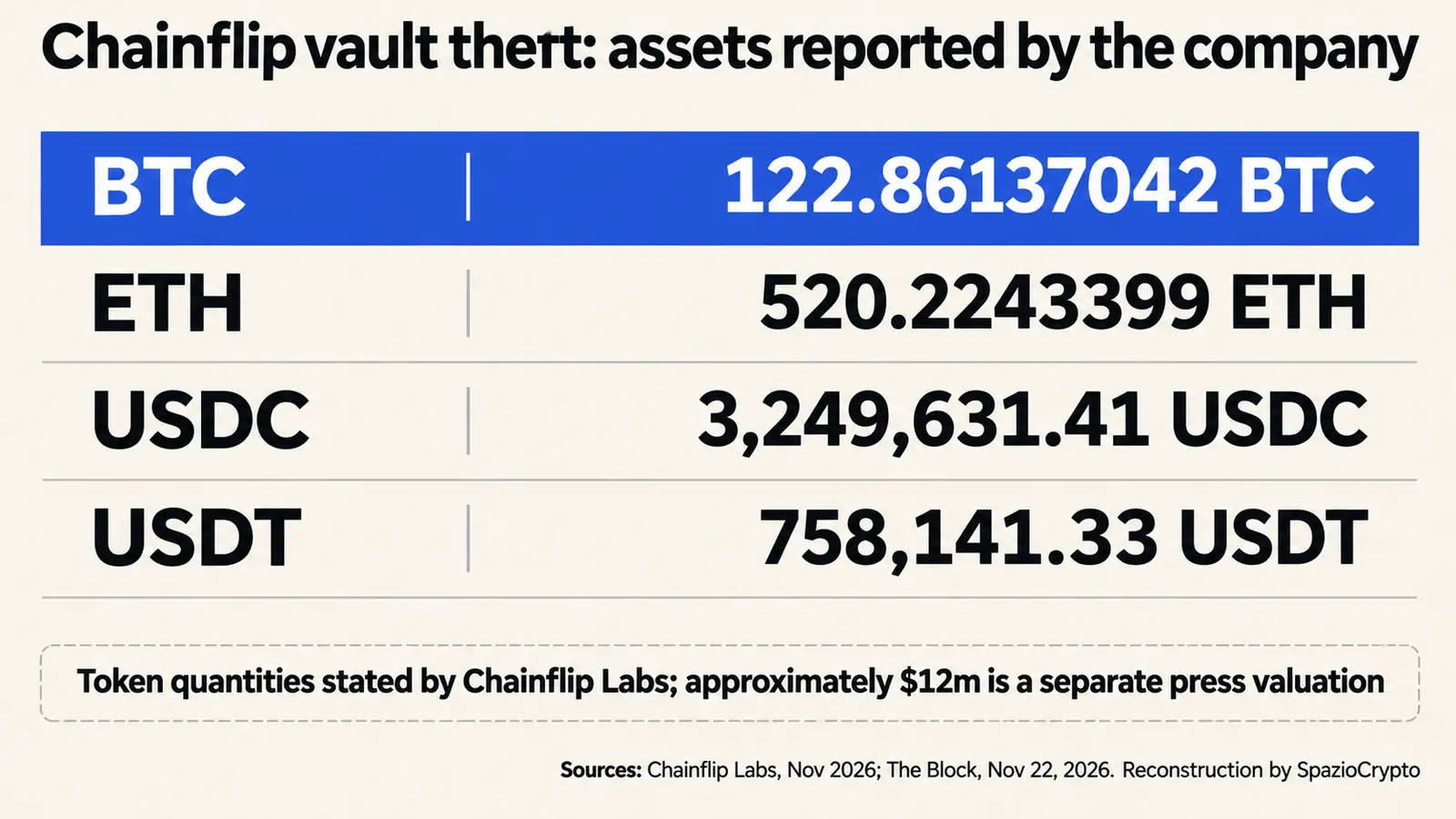
In its message to the attacker, Chainflip Labs lists 122.86137042 BTC, 520.2243399 ETH, 3,249,631.41 USDC, and 758,141.33 USDT as withdrawn on November 21. These figures are the company’s own disclosure, not an independent estimate. The roughly $12 million total cited by multiple outlets is a market valuation: the official communication names the assets and quantities but does not assign an overall dollar value to the theft.
Early coverage focused on the approximately $4.86 million drained from the Ethereum vault, which held ether and stablecoins. On November 22, with confirmation of more than 122 bitcoin stolen, the picture expanded to include the Bitcoin vault. That the breach spanned two custody systems on separate networks, sharing a common transfer-authorization infrastructure, matters more than any single headline figure.
Chainflip enables native asset swaps across blockchains without necessarily relying on wrapped representations. For background on the risks introduced by cross-chain transfers, our analysis of crypto bridge vulnerabilities is relevant context. That said, attributing this incident to a bridge code flaw would be premature: the mechanism remains under investigation.
The 10% Offer and Its Deadline
Chainflip Labs put a conditional return proposal to the attacker, requesting that 110.57523337 BTC and 2,618.1 ETH reach the addresses listed on its website by 18:38 UTC on November 23, 2026. If both amounts arrived on time, the company stated it would treat the case as a white-hat recovery and withdraw all reports and complaints filed with law enforcement. This is Chainflip’s stated position, not an independent legal guarantee of outcome.
The currency breakdown deserves attention. The 110.57523337 BTC requested represents roughly 90% of the bitcoin listed as stolen, while the 2,618.1 ETH demanded far exceeds the 520.2243399 ETH originally itemized. Chainflip is therefore expressing the stablecoin portion of the recovery in ether rather than asking separately for USDC, USDT, and ETH. No conversion rate is spelled out in the message, and we do not reconstruct one without further information.
The deadline was an expiry for the offer, not an announced date for reopening the protocol. If the funds were not returned, the message signaled that tracing efforts would continue, but it gives no basis for inferring amounts recovered, legal timelines, or any compensation for affected customers. Users should read return addresses exclusively from the official Chainflip communication: in situations like this, the risk of fraudulent refund messages rises sharply.
What We Know About the Signing Keys
Chainflip Labs says it has identified the mechanism by which a key was exposed and has prevented the same attack type from recurring. The message does not yet describe the specific technical step that enabled the withdrawal. The distinction matters: a containment declaration is not the same as a verifiable forensic report published for third-party review.
According to Bitquery’s analysis, the Ethereum vault executed a transfer accompanied by a valid signature, but with a signing nonce outside the normal sequence. Bitquery states it reviewed 299,677 signatures accepted by the contract since 2023 and found only one anomalous case: exactly the transaction that drained the vault. The finding points to an irregular authorization path, but it does not establish who accessed the cryptographic material or how.
According to technical documentation cited by Bitquery, Chainflip uses threshold signatures: up to 150 validators share the authorization process, and at least 100 are required to sign a transfer under normal conditions. Observing a signature recognized by the contract is therefore not sufficient to claim that 100 validators consciously approved that specific transaction. This is a separate issue from the multisig key custody problems seen in prior incidents, which illustrate how declared architecture and actual key management can diverge in practice.
Tracing the Attack and the Limits of On-Chain Forensics
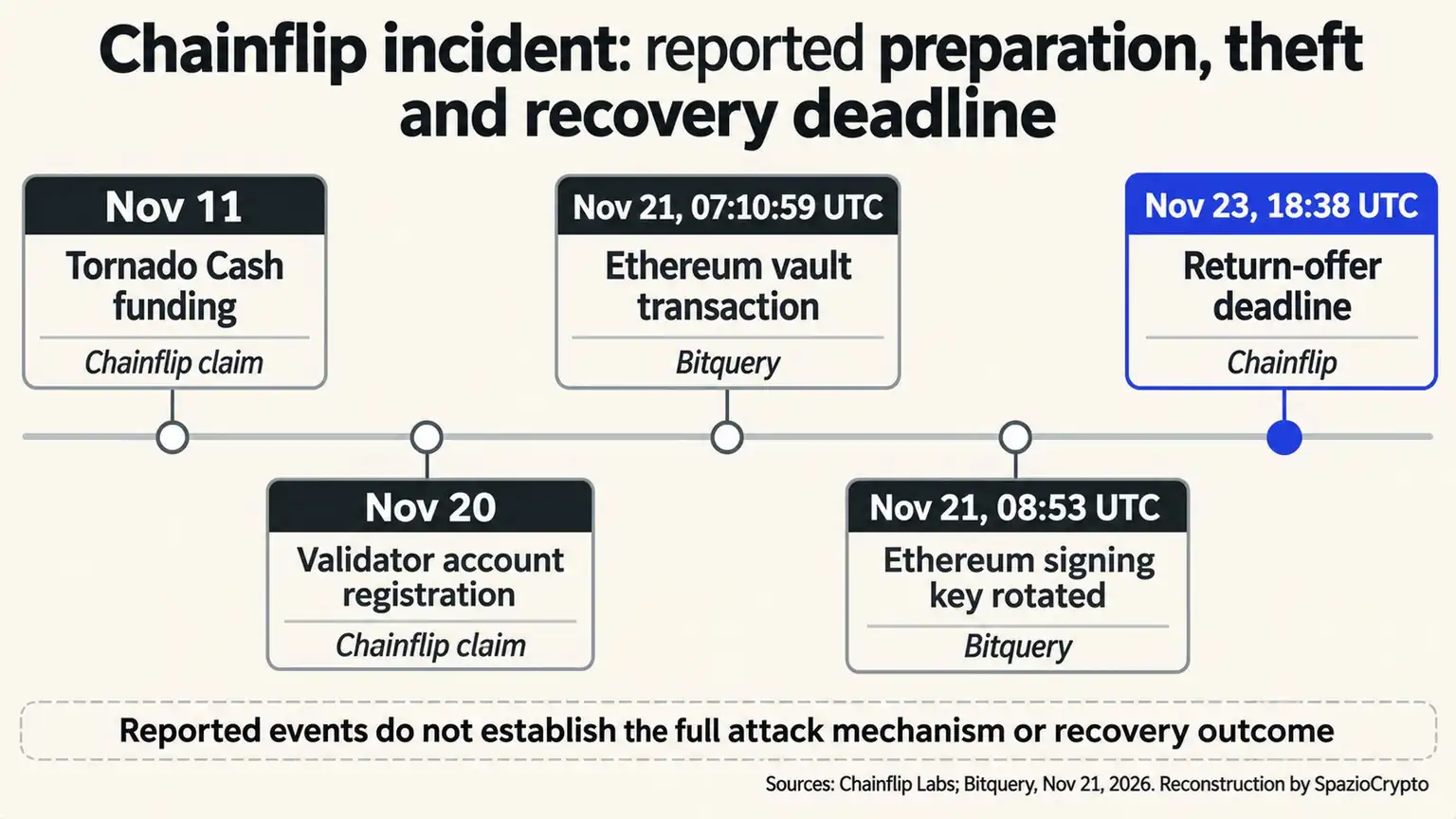
Chainflip Labs claims to have reconstructed the preparation of the operation: funds from Tornado Cash on November 11, a purchase of FLIP tokens, a validator account registered on November 20, and the associated server. The company also says it collected metadata that could help law enforcement identify the perpetrator. These are claims by the affected party: until further evidence is published, they neither identify a person nor establish criminal liability.
On the Ethereum side, Bitquery places the main transfer at 07:10:59 UTC on November 21 and traces the subsequent conversion of stablecoins into ether. Bitquery’s report states that 2,909 ETH reached Tornado Cash within minutes, through 38 separate deposits. The report notes that the mixer’s use severs direct traceability of the outflow, and that the blockchain does not automatically reveal who controls the observed addresses.
Investigations into a signing system are distinct from those targeting individual wallets. In the Lighter API key exploit, the published finding involved external signing software and reused nonces. In the Chainflip case the on-chain sequence is different, and no equivalent explanation has been confirmed. The comparison helps explain why the presence of a valid signature alone does not close a technical investigation.
Protocol Halted: What Guarantees Users Are Missing
After the November 21 alert, Chainflip announced a move to full security mode, disabling deposits, withdrawals, swaps, and pricing. Bitquery notes that the Ethereum vault’s signing system was rotated at 08:53 UTC, approximately one hour and 42 minutes after the disputed transfer. An early key rotation is a sign of operational response, not sufficient proof that all functions and all vaults have returned to a safe state.
No verified reopening date has been communicated. The sources reviewed do not indicate any per-user loss quantification, a refund procedure, or a general restitution guarantee from the company. For users who relied on the service, the distinction between assets stolen from the vault, funds potentially still held there, and claims against the protocol will depend on an accounting that had not been made public in the material consulted.
Subsequent decisions can't be inferred from prior incidents. The Kelp DAO case and the suspension of linked services shows how the effects of an exploit can reach intermediaries and users well beyond the single contract targeted. Even a partial recovery of crypto assets wouldn't automatically clarify how losses are distributed or when withdrawals might resume.
Italian Users: Custody Chain Matters
This incident has no direct link to Italian regulatory action, and the sources reviewed give no indication of how many Italy-based users may be affected. The practical distinction is between the risk carried by your own wallet and the vault risk of a cross-chain service. A personal wallet that holds its own keys still carries temporary exposure to any protocol where assets are sent for a swap.
The same principle surfaced in the Web3Auth and Keplr wallet recovery case, where security depended on components outside the user's device. For Chainflip, pending new official communications, the sources to monitor are the protocol's official site and authenticated protocol notices. No verified instructions authorizing users to enter seed phrases or sign transactions in exchange for a refund have been identified.
Chainflip: What's Confirmed and What Isn't
A quick summary of the current picture
- Confirmed: Chainflip Labs states that BTC, ETH, USDC, and USDT were taken from its vaults, and is offering 10% for their return by 18:38 UTC on November 23.
- Not yet disclosed: a complete forensic cause, an official dollar total, a service reopening date, and a reimbursement schedule.
- To monitor: arrival of funds at the official addresses, the signature and validator report, and an accounting statement for affected users.
The Bigger Picture
Our reading, stated explicitly as such, is that the Chainflip case shifts the central question away from a single smart contract vulnerability toward the verifiability of the infrastructure authorizing asset transfers. A distributed signature system can offer sophisticated protections, but its resilience must hold up against operational procedures, key rotation, and the potential involvement of a hostile validator. That's precisely why cross-chain interoperability security can't be measured by swap speed or cost alone.
Three concrete checks matter more than any forecast on the FLIP token: whether both requested transfers arrive before the deadline, what technical evidence Chainflip publishes on the key exposure, and under what conditions deposits and withdrawals will be reactivated. Only a full accounting of remaining funds and any restitution will allow a real estimate of the economic impact on users. Until then, a contained incident and a resolved incident remain two different things.
Sources
Chainflip Labs, official message to the attacker, for quantities, addresses, conditions, and the deadline of the offer. The Block, November 22, 2026, for the overall loss estimate of approximately $12 million and the update on the bitcoin theft. The Block, November 21, updated November 22, for the service suspension and the preliminary signature analysis. Bitquery, on-chain analysis dated November 21, for the Ethereum vault tracing and the limits of attribution. The original posts on Chainflip's X account and by Simon Harman could not be accessed directly due to a login error.