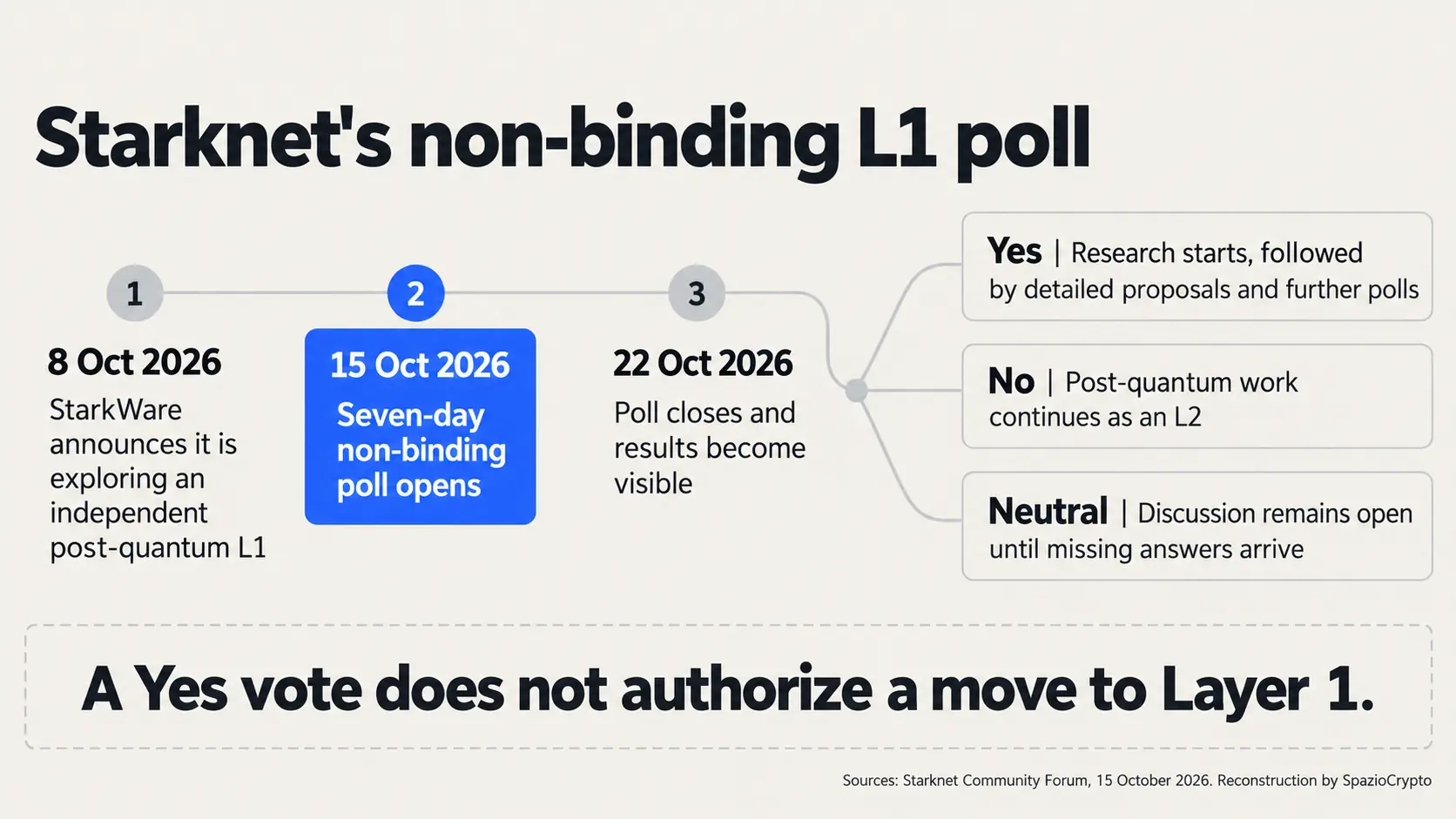
On October 15, 2026, Starknet opened a non-binding vote to gauge whether its community wants to explore transforming the network from an Ethereum layer 2 into an independent blockchain. The vote on Starknet’s post-quantum L1 direction closes October 22 and, even if “yes” wins, it triggers only a research phase. No separation from Ethereum has been approved. No new chain exists yet.
We reviewed the governance forum proposal, StarkWare’s Quantum Hub technical register, Ethereum’s published post-quantum roadmap, and NIST materials. Snapshot’s dynamic page did not expose live vote counts to our tools, so we are not reproducing percentages or tallies circulated on secondary sources.
The future of today's blockchains is becoming increasingly uncertain.
— StarkWare (@StarkWareLtd) October 10, 2026
That means we need to act as quickly as possible to address that uncertainty.
Starknet becoming an independent L1 is our clearest path forward. pic.twitter.com/zNpGF8b4Xr
The Vote Decides a Study, Not an Exit from Ethereum
The proposal offers three directions: support further research, reject the idea outright, or stay neutral pending more information. According to the governance forum, the poll runs for seven days and results become visible only at closing. A “yes” outcome does not modify the network, does not create a new blockchain. Does not trigger an automatic move to layer 1. It would require analyses, specifications, additional proposals, and new binding votes.
That distinction is the first editorial point worth making. Headlines describing Starknet as ready to leave Ethereum are getting ahead of an outcome that does not yet exist. It’s the same governance problem that arises whenever a network must prepare for quantum risk without knowing the Q-Day date: decide the architecture and responsibilities first, don’t react only when the threat is already concrete.
Why Ethereum Dependency Drives the Debate
Starknet uses STARK proofs built on hash functions and programmable accounts. According to StarkWare’s Quantum Hub, these two properties make it comparatively straightforward to swap signature schemes and keep the proving layer outside the cryptographic assumptions that Shor’s algorithm directly threatens. The advantage is real, but it applies to specific components rather than the entire system.
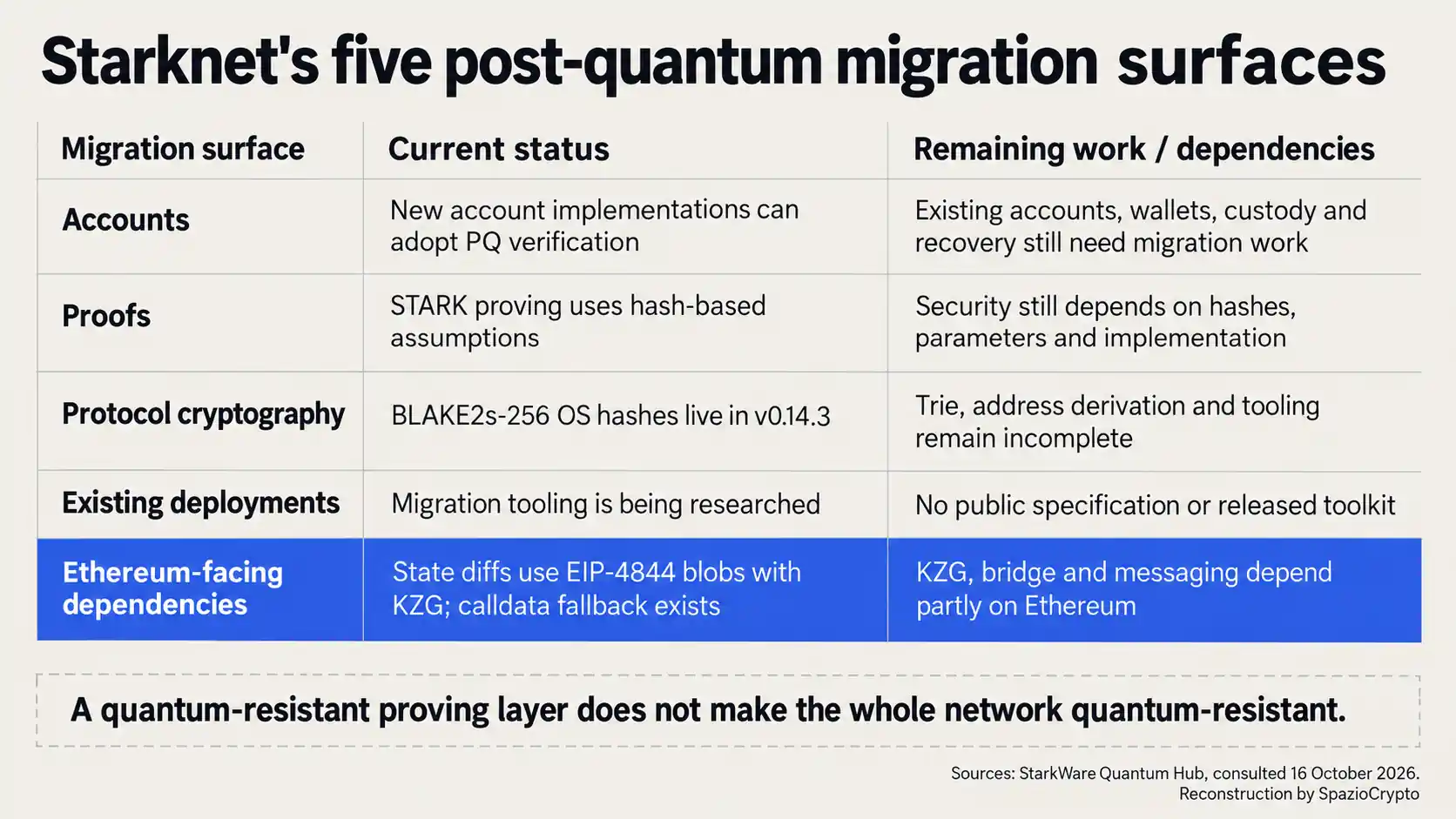
StarkWare’s technical register identifies five migration surfaces: accounts, proofs, protocol cryptography, existing contracts, and Ethereum-facing dependencies. That last category creates the binding constraint. Under normal conditions, Starknet posts state differences to Ethereum via EIP-4844 blobs, which rely on KZG commitments. Bridges and cross-chain messaging also depend on components outside Starknet’s direct control.
The real question is therefore not whether blockchains are generically immune or vulnerable. Every network combines signatures, proofs, data availability, bridges, and applications. Making one element resistant does not automatically protect every other layer.
What Is Already Ready and What Still Needs Building
StarkWare’s Quantum Hub states that a new Starknet account can adopt a post-quantum signature verifier without requiring a breaking change to the entire protocol. The proving layer uses hash-based commitments. Version 0.14.3 also replaced Pedersen with a BLAKE2s-256 construction for program hashes and OS configuration hashes.
StarkWare’s published register sets clear limits, though. Existing accounts do not upgrade themselves. Wallets, custody systems, recovery flows, audits, and broader adoption all require separate work. For contracts using Pedersen-based storage maps, no complete public specification, released toolkit, or operational developer workflow yet exists. Ethereum-facing dependencies also remain outside Starknet’s unilateral control.
This level of granularity avoids a common mistake in discussions about the post-quantum cryptography race: confusing a technical demonstration, an optional feature, and a full migration that is already available to everyone.
Ethereum Is Moving, But on a Different Schedule
Ethereum formed a dedicated post-quantum security working group in January 2026. The official roadmap identifies four areas requiring updates: BLS validator signatures, KZG commitments, ECDSA account signatures, and proof systems that rely on elliptic curves. The Ethereum Foundation cites roughly 2029 as a planning target for core infrastructure, noting that deadlines and upgrade names may shift.
 henrli
Ethereum’s own documentation states that no quantum computer today can break the network’s cryptography. NIST confirms current machines are too small and unstable to threaten these systems, while recommending early migration because replacing algorithms, products, and procedures takes years.
The difference, then, is primarily about control over timing. StarkWare wants to know whether the community would prefer to remove certain external dependencies to move faster. Ethereum is already working on its own transition. A recent analysis by the Bank of Italy on quantum risk for public networks illustrates why supervisors treat migration as a systemic process rather than a single patch.
The Cost of Independence Goes Beyond the Technical
Becoming an autonomous layer 1 would mean defining Starknet’s own consensus model, economic security, and new data availability rules. The current proposal presents neither a specification nor a timeline. The forum states that STRK would remain the network’s token and that bridges from Ethereum would stay open, but those points don’t yet explain how consensus, finality, and cross-chain messaging would be secured.
The governance question is broader: how much value does Starknet place on the security inherited from Ethereum versus the freedom to modify its own cryptography? A network can gain decision-making speed and give up a portion of shared guarantees. The dilemma is not unlike the one Bitcoin faces when debating whether to freeze or migrate funds exposed to quantum risk: a mathematical solution does not replace social consensus.

What Users and Developers Should Watch
There is no migration to execute right now. Users should not move funds based on this poll. Developers, on the other hand, can track four concrete signals: the October 22 result, whether a research working group opens, publication of an architectural proposal, and the definition of new binding votes.
Precision in language will matter too. “Post-quantum” can describe a proof system, an optional signature scheme, or a fully hardened network. Security levels need to be stated surface by surface. This is the same care required when evaluating post-quantum adoption on Algorand: a live feature is a fact, total ecosystem protection is a much broader claim.
Starknet at a Glance
What is confirmed, what is not
- Confirmed: the non-binding vote runs October 15 to 22 and measures interest in further research.
- Not yet defined: no specification, timeline, or final vote exists to transform Starknet into a layer 1.
- To watch: poll outcome, technical research progress, and new governance proposals.
The Bigger Picture
Our read, stated plainly, is that this vote isn’t only about quantum computing. It concerns the structural ceiling of every layer 2: a rollup can innovate quickly as long as its fundamental dependencies move in the same direction. When those schedules diverge, shared security also becomes a governance constraint.
The concrete signals to watch will be verifiable specifications, code, testing, economic analysis of the consensus model, and clear rules for bridges and data availability. Until those appear, talk of leaving Ethereum is premature. The October 15 poll opens a question. It has not yet chosen an answer.