
The Clearing House and Quant are building tokenized deposit infrastructure for 25 of America's largest banks, settling over $2 trillion daily across the US payments system, according to the official announcement published on September 24, 2026. This isn't a startup experiment. The Clearing House owns and operates the payment rails that underpin US financial markets, and its choice of Quant as the technology layer for its On-Chain Money Initiative signals that the pilot phase is over for a significant portion of the American banking system.
There's a detail buried in this story that makes it considerably more significant than a routine vendor selection: the same company chosen by The Clearing House is simultaneously powering the equivalent tokenized deposit infrastructure in the United Kingdom. Both announcements dropped on the same day. Here's what the deal covers, and why that transatlantic coincidence reframes the whole picture.
What the Deal Covers
Quant will provide the interoperability, orchestration, and transaction management layer that coordinates the clearing and settlement of tokenized bank deposits across member institutions. Crucially, the network will connect directly with existing traditional payment systems, including the RTP and CHIPS networks, preserving continuity with the infrastructure US banks already depend on. The project itself isn't new: it was publicly announced in June 2026, backed by major institutions including BNY, Citi, PNC, Regions, Santander, and Wells Fargo. Yesterday's news is specifically about the technology vendor selected after a competitive evaluation process. The network is expected to become available to participating institutions in the first half of 2027.


The Clearing House's chief strategy officer stated, as reported in the official press release, that building interbank infrastructure for tokenized deposits requires proven technology capable of scaling, emphasizing that Quant brings the experience needed to give financial institutions of every size a concrete pathway to participate. Quant's founder and CEO, in the same announcement, described the partnership as a step marking the global transition toward programmable money, adding that The Clearing House's central role in the US banking system means this collaboration sets a standard the rest of the world will follow. One indirect indicator of the market's reaction: Quant's native token hit its annual high in the hours immediately following the news, per CoinGecko data.
 Matthew Braithwaite
The Discovery: One Vendor, Two Sides of the Atlantic
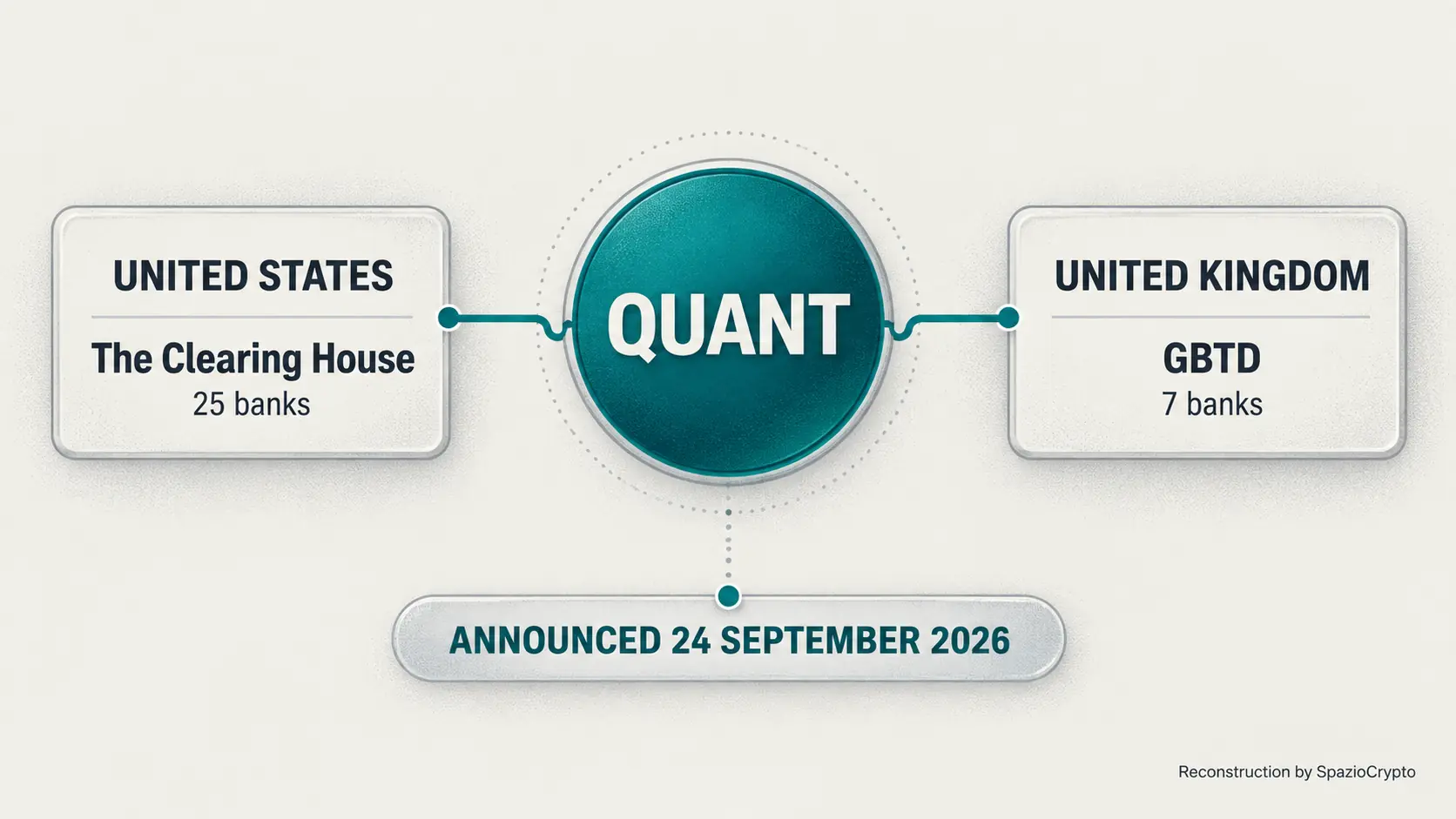
Here's where the story gets considerably more interesting. As SpazioCrypto reported earlier, major UK banks, including Lloyds, Barclays, NatWest, and HSBC, had already completed the first live interbank transactions using tokenized deposits as part of the Great British Tokenised Deposit (GBTD) project, coordinated by UK Finance. That same British platform was built by Quant, the identical company chosen by The Clearing House for the American network. Both announcements were published on September 24, 2026.


This isn't simply a case of two major markets experimenting in parallel with different architectures. It's also a story about technological concentration. A single private vendor now underpins tokenized deposit settlement infrastructure in both the UK and, potentially, the United States: two of the world's most systemically important financial markets. That detail only became apparent by cross-referencing two separate press releases, published by different organizations, at a moment when media attention was naturally focused on each domestic story individually rather than on the combined picture.
One Vendor, Both Sides of the Atlantic
What cross-referencing the sources reveals. Source: The Clearing House, UK Finance, Quant, September 24, 2026
- USA: Quant selected as the interoperability layer for 25 banks via The Clearing House.
- UK: the same Quant built the platform powering the GBTD project.
- Same day: both announcements published September 24, 2026.
The US Has No Single Model Either
It's worth putting the Clearing House initiative in context: even within the United States, no single model has emerged for bringing bank money on-chain. While The Clearing House builds a collectively owned shared network of tokenized deposits, SoFi took a different route, issuing its own proprietary bank stablecoin to settle its card program. Bank stablecoins and shared tokenized deposit networks are developing in parallel, within the same country, which tells you the industry hasn't converged on a single answer to the underlying question: how to put bank money on the blockchain while preserving its regulatory protections.
One technically important distinction, emphasized by The Clearing House itself, concerns exactly that regulatory dimension. The tokenized deposits on the new network will retain the protections and supervisory oversight typical of ordinary bank deposits, while also becoming programmable and movable around the clock according to predefined rules. That combination of automation and regulatory continuity is designed primarily for use cases like corporate treasury management, liquidity optimization, and cross-border payments.

The Bigger Picture
Banks are no longer asking whether to put money on the blockchain. They're deciding, concretely, which infrastructure they'll use and who they'll build it with. The Clearing House's vendor selection, the outcome of a competitive process among multiple candidates, signals that the pilot phase is behind a significant portion of the American banking system. The real contest now is about building shared infrastructure capable of scaling across the entire sector, not isolated proofs of concept.
For anyone watching this space, two observations stand out. First, the fact that a single private technology vendor now supports the settlement infrastructure of two of the world's most important financial systems simultaneously raises a question worth tracking over time: how much systemic concentration risk is acceptable when critical financial infrastructure depends on a very short list of technology providers, however capable and reliable they may be? Second, the variety of approaches currently in play, from shared tokenized deposits to proprietary bank stablecoins, to central bank money on-chain as seen with the ECB's Pontes initiative in Europe, suggests the sector is still actively exploring which combination of models will prove dominant. Convergence, in all probability, is still several years away. The date to watch in the meantime: the first half of 2027, when The Clearing House network is scheduled to open to participating institutions.