

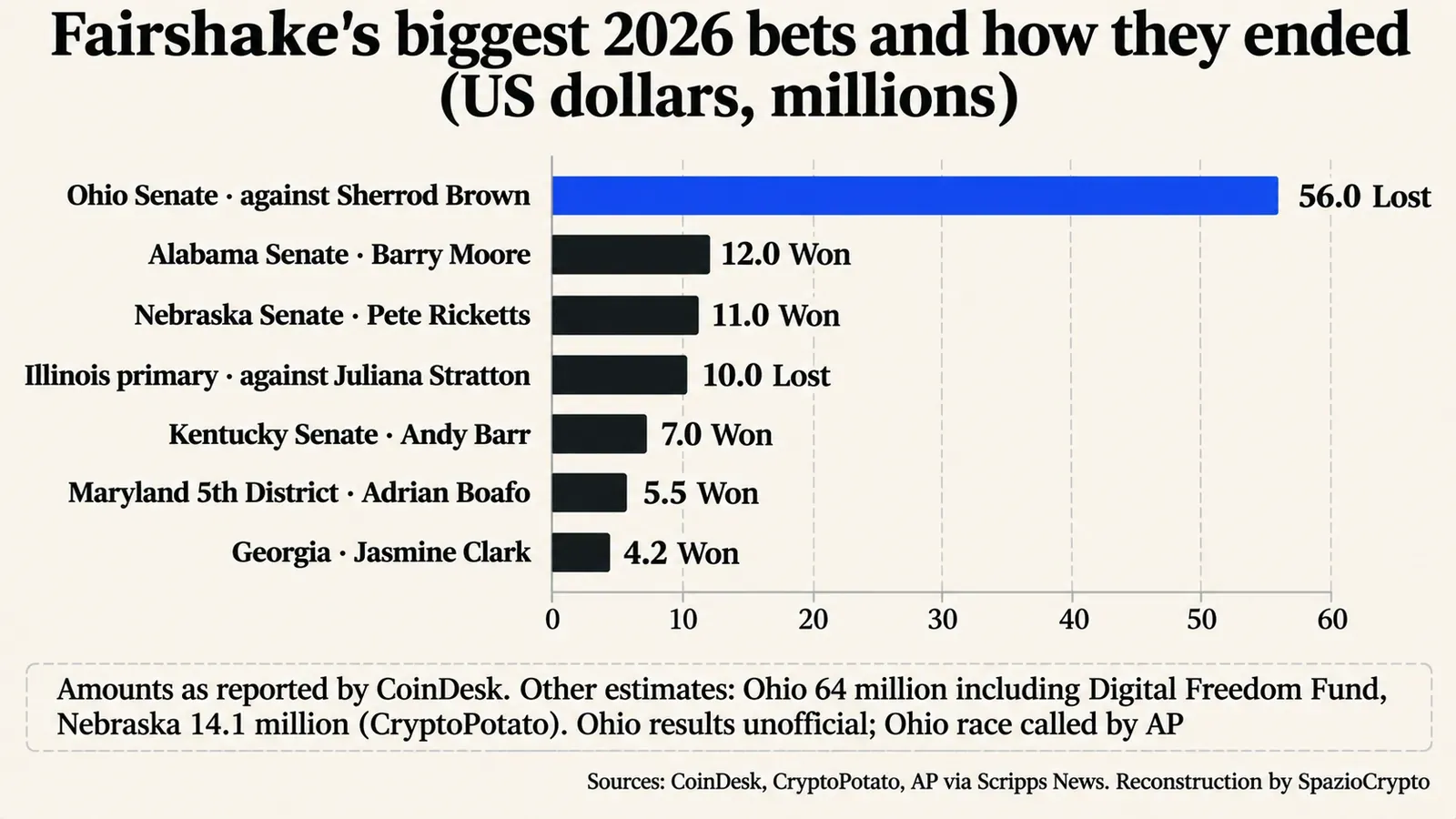
Fairshake, the crypto industry's largest-ever political action committee, claimed favorable outcomes in 29 of 34 contested races by November 4, according to Reuters as cited by crypto.news. The win that mattered most slipped away: in Ohio's special Senate election, Democrat Sherrod Brown defeated Republican Jon Husted despite crypto-aligned PACs spending over $60 million to stop him, according to Forbes. The industry's most expensive electoral campaign in history secured almost everything it targeted, except the result it paid most dearly for.
This report draws on Scripps News for the Associated Press call, analysis from CoinDesk, Forbes, crypto.news, CryptoPotato, and official Federal Election Commission filings for both committees. Reuters did not load with our tools and the Ohio Secretary of State's website returned an error at publication time. The story is ordered by theme: the Ohio vote, the overall scorecard, spending figures, the incoming Congress, reactions, and what remains unconfirmed.
The Ohio Vote: Brown Holds the Seat
The seat in play was the one vacated by JD Vance when he became vice president. Jon Husted had been appointed in January 2025, and Brown, who had lost the same seat in 2024, will now hold it until January 2029, according to Scripps News. CoinDesk reported a margin of nearly 5 percentage points, on results still not officially certified at the time of publication.
The 2026 campaign was not the first time Fairshake targeted Ohio. In 2024, according to Wikipedia, the PAC spent over $40 million backing Brown's then-opponent Bernie Moreno. This time the stakes were even higher. Ron Hammond of Wintermute, cited by CoinDesk, noted that as chair of the Senate Banking Committee, Brown had opposed stablecoin legislation, a market where the differences between issuers matter considerably, as illustrated by the ongoing debate between USDT and USDC issuers.
The Scorecard: 29 of 34
Outside Ohio, the picture looked far more favorable for the crypto PACs. According to CoinDesk, Fairshake backed Pete Ricketts in Nebraska, spending $11 million, and Barry Moore in Alabama, spending $12 million, with both winning. Andy Barr in Kentucky received $7 million in support, Adrian Boafo in Maryland $5.5 million, and Jasmine Clark in Georgia $4.2 million. CryptoPotato puts the Ricketts figure higher, at $14.1 million.
Beyond Ohio, the losses were concentrated in two notable cases. The $10 million Fairshake spent against Juliana Stratton in the Illinois Democratic primary failed to stop her, and Stratton went on to win the November general election as well. Republicans Bryan Steil and Bill Huizenga, both considered friendly to the crypto sector, lost their House seats.
Spending Figures: What the FEC Data Actually Shows
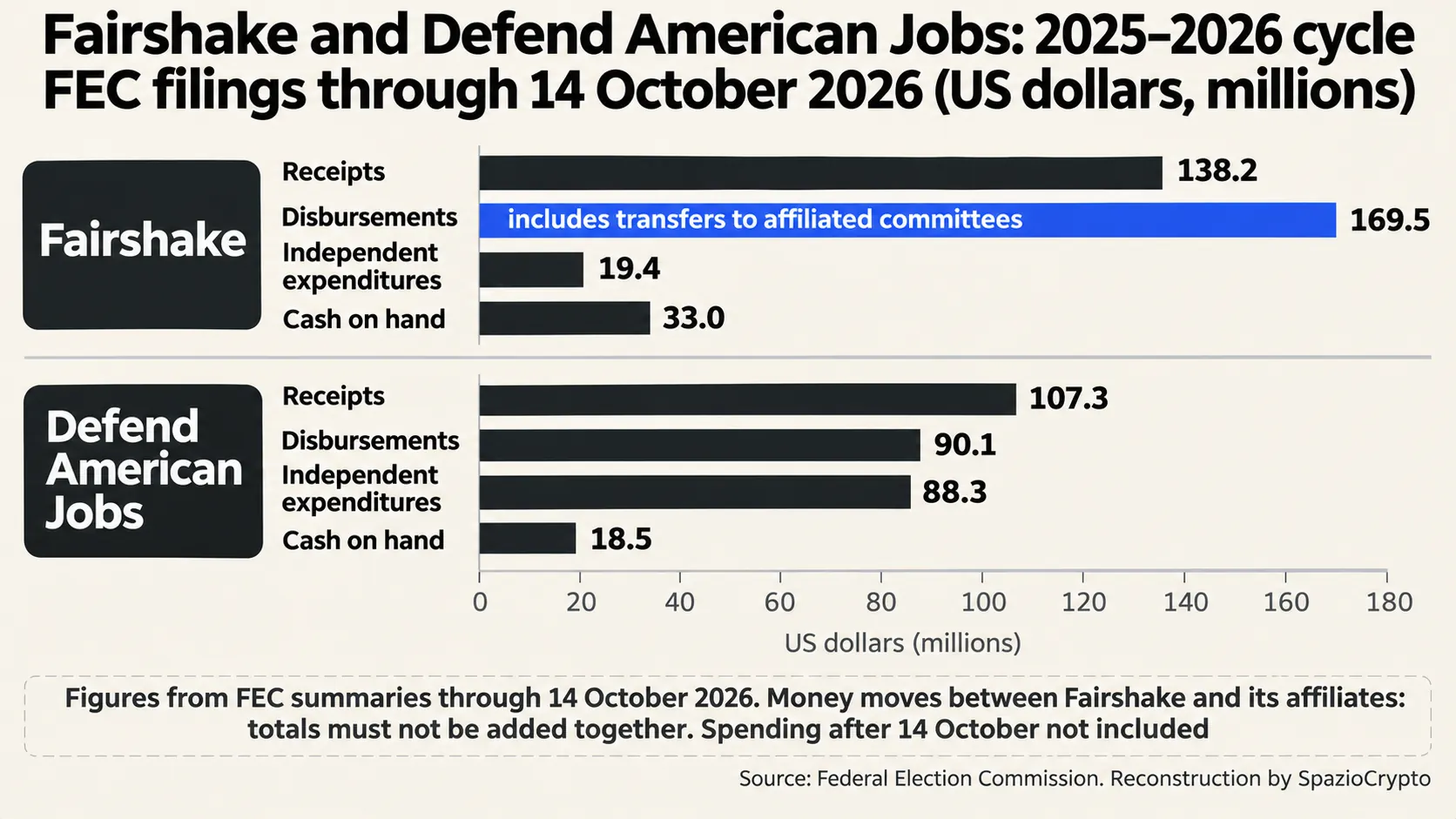
The total depends heavily on what gets counted. Forbes put the figure at nearly $200 million spent by crypto-aligned PACs across the cycle. CryptoPotato counted over $176 million across more than one hundred races. Official FEC filings, updated through October 14, show Fairshake reporting $138.2 million in receipts and $169.5 million in disbursements, but only $19.4 million in direct independent expenditures. Its affiliate Defend American Jobs, which intervenes in Republican primaries, reported $107.3 million in receipts and $88.3 million in independent expenditures.
The gap between those numbers reflects the committee structure. According to Wikipedia, Fairshake operates with two affiliates: Defend American Jobs for Republican primaries and Protect Progress for Democratic ones. Funds flow between the entities, so figures from each committee should not simply be added together. Among the cycle's major donors, Wikipedia identifies $52.46 million from Coinbase, $48 million from Ripple, and $23.8 million combined from Ben Horowitz and Marc Andreessen. Coinbase remains one of the sector's most regulation-sensitive actors, as reflected in its decisions around USDC and the Noble network.
The Incoming Congress and the CLARITY Act
According to CoinDesk and Forbes, Democrats are set to hold the majority in both chambers from 2027. Neither source specified who called the overall chamber control, and several races remained uncalled at the time of publication. The AP seat-count tables provide the running tally.
For the crypto sector, the central legislative question is the CLARITY Act, which would establish a market structure framework for crypto assets. According to crypto.news, the Senate failed in September to reach the votes needed to open debate, with a procedural vote ending 49 to 50. CoinDesk reports that critics including Representative Maxine Waters in the House and Senator Elizabeth Warren could block broad legislation. Some in the industry are hoping for narrower measures, particularly on taxes. The stablecoin regulatory framework is already law under the GENIUS Act, which has prompted issuers to reorganize their strategies.
Reactions from Both Sides
Fairshake is already thinking about the next cycle. “We’ll do it again in 2028,” Fairshake spokesperson Geoff Vetter told CoinDesk, while a committee statement noted that 2028 would bring “a new map.” Ripple CEO Brad Garlinghouse wrote on X that the new Congress carries “the same mission: clear rules, built in America.” Ripple's chief legal officer Stuart Alderoty claimed victories across both parties, according to crypto.news.
Critical readings were equally sharp. Mark Hays of Americans for Financial Reform, cited by CoinDesk, called Ohio a heavy defeat for the sector's political strategy. Hammond of Wintermute took the opposing view, arguing that targeting Brown was justified given the senator's opposition to stablecoin legislation.
What Remains to Be Confirmed
Three points are still open. Ohio's official certification of results, which remained pending at publication. The races not yet called, including several where crypto-aligned committees were active. And the next round of FEC disclosures, which will show how much was actually spent in the final weeks before the election, covering the period after October 14.
Fairshake and the U.S. Vote: What Is and Is Not Confirmed
What is confirmed, and what is not
- Confirmed: AP has called the Ohio special Senate election for Sherrod Brown. FEC data through October 14 shows tens of millions raised and spent by Fairshake and Defend American Jobs.
- Not confirmed: Official Ohio results. The complete list of the 34 races Fairshake claims to have influenced. Spending in the final weeks before the election.
- To watch: Ohio result certification, races still uncalled, the CLARITY Act's timeline in the new Congress, and FEC filings covering post-election period.
The Bigger Picture
Ohio suggests that money has limits, not just weight. Fairshake demonstrated real capacity to back winning candidates across primaries and lower-profile races. But in the most visible contest of the cycle, spending at record levels did not deliver the target result. For an industry that needs Congress to pass rules, the action now shifts from campaign ads to committee rooms, where votes are counted on legislative text rather than on ad impressions.
The contrast with Europe is instructive for investors on both sides of the Atlantic. The EU's MiCA framework is already in force, and the debate there centers on enforcement and compliance, including how to identify fraudulent entities imitating licensed exchanges. In the United States, the GENIUS Act settled the stablecoin question, but broader market structure under the CLARITY Act remains contested while competition between issuers, including Fidelity, Tether, and Circle, intensifies. Watch which party members chair the relevant Senate and House committees in the new session, and which legislative text reaches the floor first.