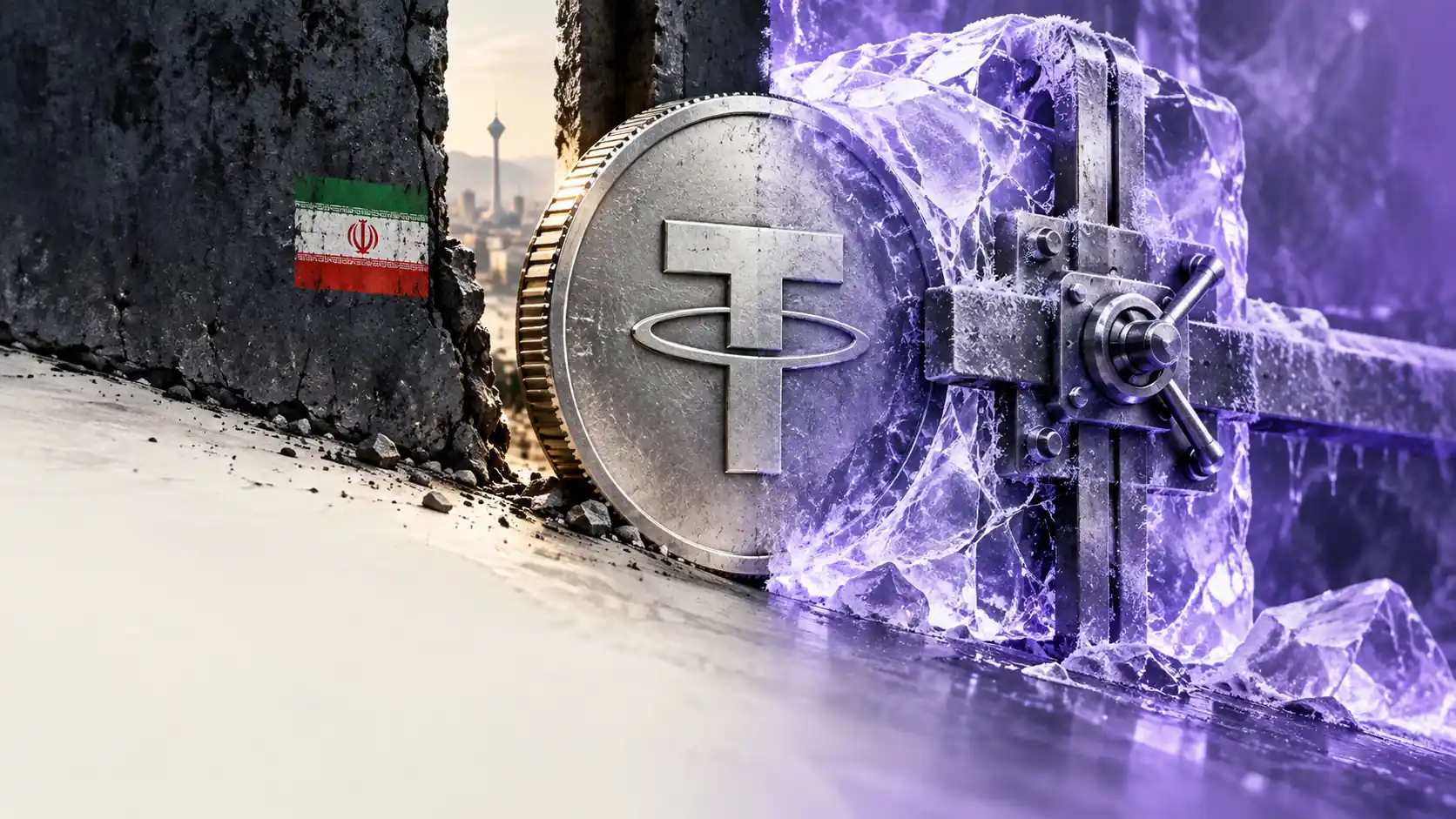
International sanctions are designed to cut a country off from the global financial system. A Reuters investigation published in late July shows just how hard that has become in the crypto era. At the center is a ghost exchange based in Dubai, Shelbit, which investigators say moved roughly $4 billion linked to Iran, with hundreds of millions allegedly reaching Binance, the world's largest crypto exchange.
The real story, though, isn't the name of the company involved. It's a deeper and more troubling mechanism: the networks built to circumvent sanctions have become faster than the regulators trying to shut them down. That's a challenge for the entire industry.
🇮🇷 A Reuters investigation traced at least $4 billion through Shelbit, an unlicensed Dubai exchange that connected Iran's central bank, IRGC-linked wallets and a 2,000-site gambling network to global crypto markets. At least $676 million of it allegedly reached Binance.…
— Laura Shin (@laurashin) August 3, 2026
What the Investigation Found
The facts, as reported by Reuters and attributed to the blockchain investigators who conducted the analysis, are striking. Shelbit was an unlicensed cryptocurrency exchange operating out of Dubai from May 2024 onward, founded by an Iranian expatriate. According to the data examined, it functioned as a central hub connecting a network of more than 2,000 Farsi-language gambling sites, Iran's central bank, and wallets that some analysts associate with the Islamic Revolutionary Guard Corps (IRGC), a sanctioned military body.
The total volume moved was at least $4 billion, according to Reuters. Of that, investigators traced roughly $676 million to Binance wallets. The most significant detail, though, is the timing: around $540 million allegedly arrived after Dubai's financial regulator had already fined Shelbit in January 2025 for operating without a license. In other words, the flows continued even after regulatory intervention.
An illicit Iranian gambling network helped move at least $4 billion through an unlicensed Dubai-based cryptocurrency exchange that also handled funds for sanctioned Iranian institutions, a Reuters investigation found.
, Iran International English (@IranIntl_En) July 31, 2026
Blockchain data reviewed by Reuters showed the exchange,… pic.twitter.com/5CzAx44Or2
Binance's Response
Good journalism requires giving the accused party a fair hearing. These are allegations based on an investigation, not findings established in court. Binance rejected the account, stating that Shelbit never held an official account on its platform and was never a sanctioned entity.
The company said that when users associated with Shelbit interacted with the platform, its compliance program worked as intended: it investigated, froze the accounts involved, and reported them to law enforcement. Binance also stated it was unable to reconcile the figure cited in the investigation. For context, Binance paid $4.3 billion in fines to U.S. authorities in November 2023, settling charges of money laundering and sanctions violations that included conduct related to Iran. That history makes every new allegation especially consequential for the company.
The Real Mechanism: Networks That Relocate
This is the heart of the story, and it matters well beyond any single case. What the investigation describes isn't an isolated event. It's the latest link in a chain. Watching the sequence of the past few years reveals a clear and instructive pattern.
When U.S. authorities applied pressure to Binance in 2022 and 2023, Iran-linked flows migrated to a different exchange, CoinEx. When analysts exposed CoinEx in June 2026, another node, Shelbit, had already been running for more than a year. The network doesn't collapse when one node is taken down: it relocates. Closing one node doesn't stop the system, because the system already has another one ready. It's a structure designed to be resilient against exactly this kind of regulatory action.
Anatomy of a Relocating Network
How sanctions evasion shifts nodes. Source: Reuters, TRM Labs, 2026
- 2022-2023: Pressure on Binance drives Iranian-linked flows to CoinEx.
- June 2026: CoinEx is exposed, but Shelbit had already been operating for more than a year.
- The pattern: the network doesn't collapse when a node falls. It builds new nodes faster than regulators can shut them down.
Why This Is a Problem for the Whole Sector
Here's the uncomfortable part for the entire crypto industry. The characteristics that make crypto genuinely revolutionary, its speed, its borderless nature, its resistance to being blocked by any single authority, are the same ones that make it attractive to anyone trying to evade controls. That's the other side of decentralization. There's no easy fix.
For legitimate exchanges, this creates an enormous and growing burden. They must invest ever-larger sums in compliance systems capable of detecting and blocking illicit flows, often disguised through dozens of intermediate steps. Every case like this one feeds regulatory pressure for stricter rules across the board, hitting honest operators alongside bad actors. It's precisely why the EU, through MiCA and related frameworks, has imposed stringent traceability requirements and reserved the right to ban entire third-country platforms that don't comply.
Binance stated that:
Shelbit did not have an official account on Binance and was not a sanctioned entity. When users associated with Shelbit used the platform, Binance investigated, froze the relevant accounts, and reported the cases to the relevant authorities.

The Bigger Picture
Whatever its legal outcome, this case spotlights perhaps the hardest challenge crypto poses to the world: how to reconcile a technology designed to be free and borderless with the need of states to enforce territorial boundaries and sanctions regimes. It's a structural tension with no single-point solution.
U.S. and European authorities are responding with increasingly sophisticated investigations and blockchain analytics capable of following money across complex transaction chains. But the Shelbit case makes clear that the adversary on the other side is agile, learns fast, and reorganizes quickly. The real contest of the coming years won't be closing the individual guilty exchange. It'll be building a surveillance architecture fast enough to keep pace with networks that move faster than legislation can follow. For a sector that wants to earn legitimacy in the eyes of regulators and institutions, keeping illicit flows out isn't optional. It's the basic condition for survival. Anyone seeking to understand the broader regulatory framework can start with our guide to crypto regulation in Europe.