

A report from the Democratic minority staff of the U.S. Senate Permanent Subcommittee on Investigations has reignited scrutiny on Tether, claiming that 84% of 846 crypto wallets previously sanctioned by the United States or Israel in connection with Iran conducted transactions almost exclusively in USDT, according to the document published Monday. Before drawing conclusions, two clarifications change how these numbers should be read.
First: this is not a bipartisan Senate report, nor a judicial finding against Tether. The document was produced by the Democratic minority staff led by Senator Richard Blumenthal, and the report itself describes its own findings as “preliminary.” Second, and perhaps more important for interpreting the statistics accurately: the 84% figure refers to a sample of wallets already selected because they were previously sanctioned, not a random sample of global USDT usage. It does not mean that 84% of all USDT transactions are connected to Iran.


What the Report Actually Says
The 28-page document analyzed 846 wallets designated by the U.S. Office of Foreign Assets Control (OFAC) or Israel's financial counterterrorism unit between June 2021 and August 2026, finding that the majority operated almost exclusively through Tether's stablecoin. The report describes USDT as a “significant financial lifeline” within Iran's shadow banking system, alleging it helped finance groups including Hezbollah. As one example, the document cites two sanctioned Iranian nationals who reportedly received a combined $603 million in USDT between 2021 and 2025 through addresses only later designated by authorities.
On the basis of these findings, Blumenthal called on the U.S. Treasury and Justice Departments to open an investigation into Tether's anti-money-laundering controls and sanctions compliance. To be precise: this is a request for an investigation, not a formal charge, and no legal proceedings against the company have been announced.
Tether is a preferred payment system for terrorist organizations, operating as a superhighway for the Iranian government to evade sanctions, carry out hostile drone & missile campaigns, & commit human rights abuses. I joined @SquawkCNBC to discuss my new report. pic.twitter.com/Nnl20M589I
, Richard Blumenthal (@SenBlumenthal) September 29, 2026
The Paradox: Evasion Tool and Freezing Mechanism at Once
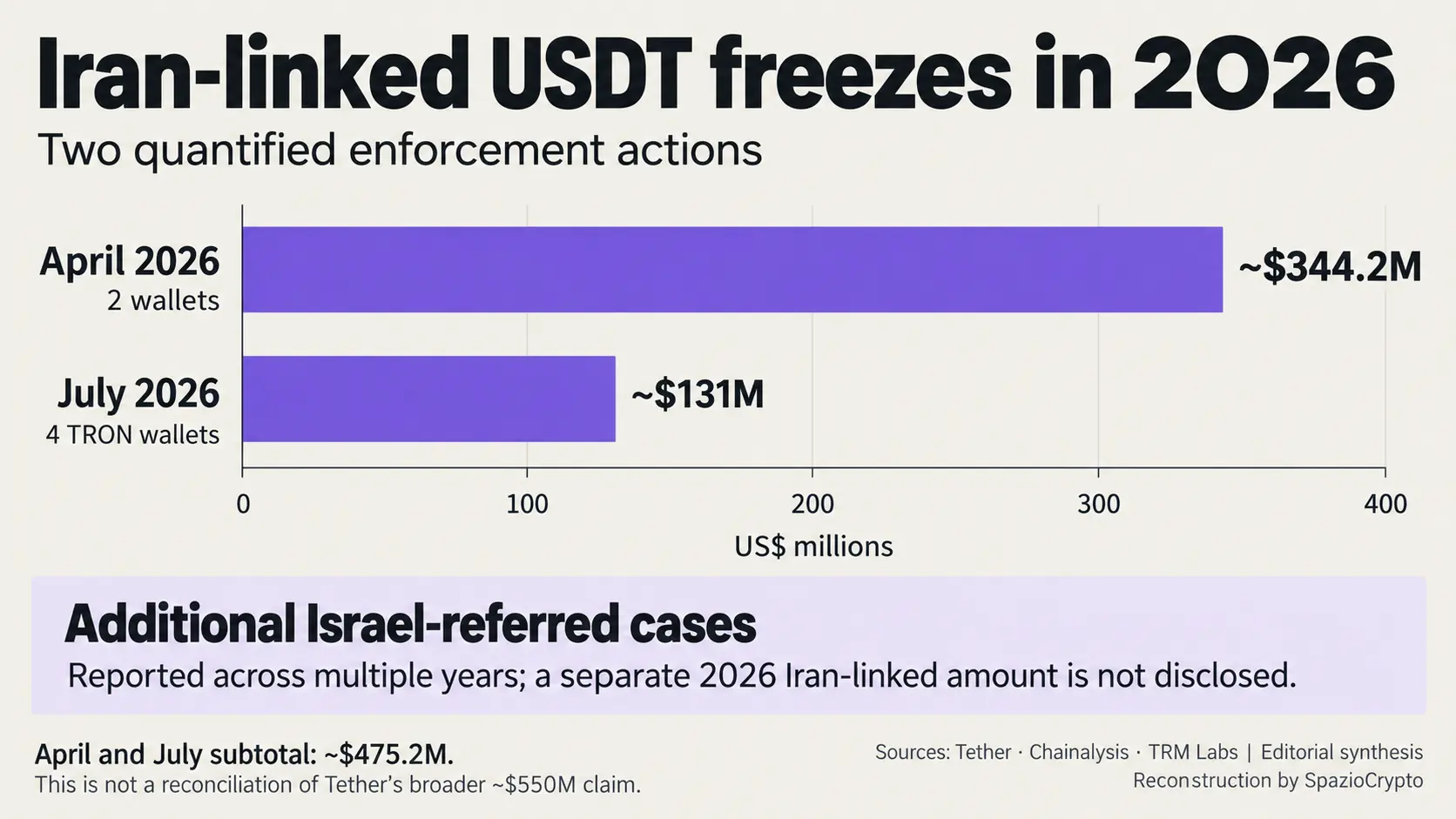
Here is the most genuinely interesting dimension of this story. Tether responded publicly through CEO Paolo Ardoino, rejecting the report's framing and stating that the company “has consistently demonstrated that USDT is not a haven for sanctioned entities, terrorist organizations, or criminal networks.” To support that position, Tether said it cooperated in freezing nearly $550 million in Iran-linked USDT in 2026 alone: over $344 million across two wallets designated by OFAC in April, and more than $131 million across four TRON network wallets tied to the Central Bank of Iran, identified in July according to analysis by blockchain analytics firm Chainalysis, with additional cases flagged by Israeli authorities covering more than 640 addresses and $22 million.
This creates a genuine paradox worth telling accurately rather than flattening in one direction. The same report that identifies USDT as the preferred tool for circumventing international sanctions also implicitly acknowledges the other side of the coin. Precisely because Tether is a centralized issuer capable of unilaterally freezing specific addresses at the request of authorities, the very stablecoin the report says helped Iran move money also enabled, in the same period, the freezing of hundreds of millions of dollars tied to that country. This structural characteristic, as seen in the Capstone-EQIBank case, sharply distinguishes centralized stablecoins like USDT from native assets such as Bitcoin or Ether, which no issuer can freeze in any comparable way.
Both Sides of the Story
What each party says. Source: Senate report, Tether, 2026
- The report: 84% of 846 already-sanctioned wallets used USDT almost exclusively.
- Tether: cooperated in freezing approximately $550 million in 2026.
- Caveat: this is a Democratic minority report, described as preliminary, and is not a formal charge.
The Political Context Matters
This report lands at a moment of sharp political tension around crypto in the United States. A Republican administration has pushed for a more industry-friendly regulatory framework, including recent Federal Reserve proposals tied to the GENIUS Act on stablecoin oversight, while Democratic opposition has maintained a more critical stance toward the sector. That context doesn't make the investigators' data less relevant, but it does explain why the document deserves the same careful reading applied to any report produced by a single political faction, pending independent verification or formal action from the federal agencies Blumenthal has petitioned.
The Bigger Picture on Centralized Stablecoins
This episode illustrates the complexity of the role centralized stablecoins now occupy in global financial infrastructure, including its most sensitive corners. Wide adoption makes them inevitably attractive to those seeking to circumvent international sanctions, simply because they're easy to use and broadly accepted. Yet the same centralized architecture that creates this vulnerability is precisely what allows authorities, working with the issuer, to intervene and freeze funds at a scale that would be impossible with a native, decentralized asset.
Two lessons stand out. The first is familiar but still gets ignored: distinguish between a political report's conclusions, however detailed, and a definitive judicial finding, especially when the document comes from one political side and calls itself preliminary. The second is the genuine paradox at the center of this story. The same instrument identified as a sanctions-evasion vehicle simultaneously enabled hundreds of millions of dollars in freezes against the same country. That contradiction deserves to be reported in full, without collapsing it toward either accusation or defense. Whether the Treasury or the Justice Department decides to open a formal investigation remains the question to watch. For a broader grounding in how these instruments work, SpazioCrypto's guide to stablecoins covers the essentials.