Fogo, a Layer 1 blockchain built for high-frequency trading, was hit on August 29, 2026, when an unauthorized actor transferred 400 million FOGO tokens worth approximately $3 million, representing over 10% of the circulating supply, according to the Fogo Foundation's official statement on X. The network was subsequently halted and targeted addresses were frozen. Those two facts, more than the dollar amount, raise an uncomfortable question at the heart of crypto: can a blockchain that can be stopped and censored genuinely call itself decentralized?
The situation is still developing as we write this, and some details remain unconfirmed or inconsistently reported across sources. That's precisely why it deserves careful analysis. The incident cuts straight to one of the most fundamental tensions in the cryptocurrency space: how decentralized and immutable is a blockchain, really, when things go wrong?
The Fogo Foundation experienced a compromise by an unknown actor which unfortunately resulted in 400mm FOGO tokens being sent to a bad actor.
— Fogo (@fogo) August 29, 2026
The Foundation alerted exchanges immediately and is actively communicating with law enforcement as well as forensic experts.
There is…
What Happened to Fogo
Here is what we know. On Friday, August 29, 2026, the Fogo Foundation publicly disclosed that an unknown actor had compromised its systems and transferred 400 million tokens to an address under the attacker's control. In its initial statement, the Foundation reassured the community that the blockchain itself continued to function normally and that the problem was confined to its internal systems.
Within hours, however, reports emerged of a complete network halt, reportedly initiated to contain the damage and prevent the stolen tokens from being moved further. A note of caution applies here: different sources give slightly different accounts of this sequence, and since the situation remains open, some details about the network's exact status should be treated as provisional. In parallel, several exchanges moved swiftly. Bitget, for instance, suspended FOGO deposits and withdrawals, in at least one case acting before the Foundation had made its public announcement.
What Was Actually Compromised
One point deserves to be stated clearly upfront to avoid misreading the incident. Calling this a “Fogo blockchain hack” would be inaccurate and alarmist. The Foundation described a compromise of its own organization and wallets, which strongly suggests an operational failure: stolen access keys, a breach of internal systems, or similar. That is a very different thing from a vulnerability in the blockchain protocol itself.
It is a distinction that comes up repeatedly across the industry: a breach of the “vault” holding an organization's funds is categorically different from a flaw in the “bank” itself, meaning the underlying protocol. At the time of writing, the Foundation has not published a full technical post-mortem, and the precise entry point of the attack remains undisclosed. That's normal in the early hours of any incident, but it also means definitive conclusions would be premature. The same opacity that complicates post-incident analysis here is the same dynamic that made the SafePal data breach difficult to assess at first.
The Fogo Foundation experienced a compromise by an unknown actor which unfortunately resulted in 400mm FOGO tokens being sent to a bad actor.
, Fogo (@fogo) August 29, 2026
The Foundation alerted exchanges immediately and is actively communicating with law enforcement as well as forensic experts.
There is…
The Fogo Incident: What We Know and What We Don't
An evolving situation. Source: Fogo Foundation, The Block, 2026.
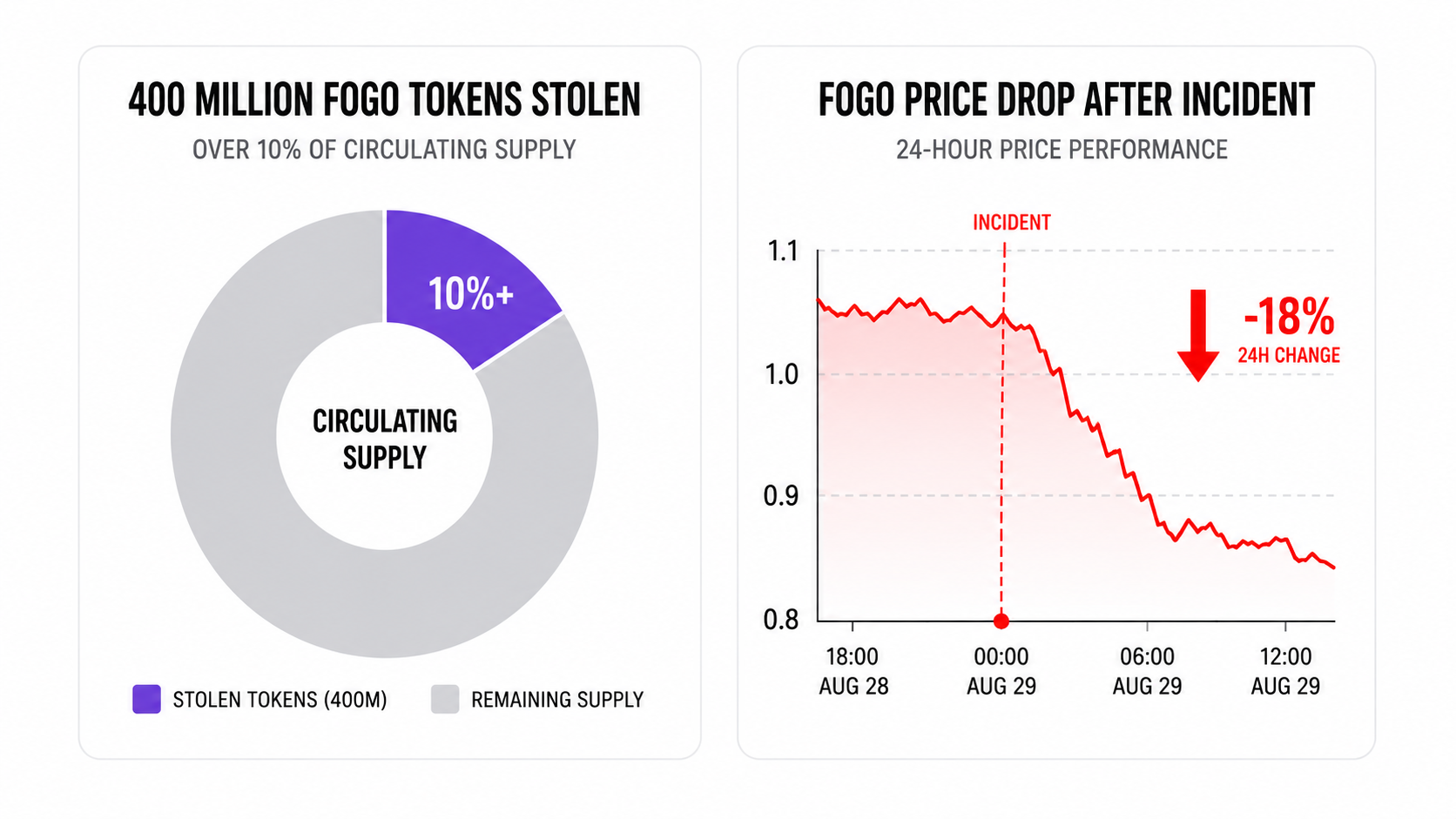
- What we know: 400 million tokens stolen, over 10% of circulating supply, worth approximately $3 million. The token price dropped 18-20% following the disclosure.
- What we don't know: the precise attack vector, which systems were compromised, and when the network will return to full operation.
- The real question: if a network can be halted and specific addresses can be frozen, how decentralized is it?
The Decentralization Question: A Blockchain That Can Be Stopped
This is where the story gets genuinely interesting, well beyond the immediate theft. The response to the attack, specifically the capacity to halt the entire network and potentially prevent certain addresses from moving tokens, opens a deeper debate about what blockchain technology actually promises.


The core promise of most blockchains is twofold: decentralization (no single authority controls the network) and immutability (once recorded, transactions cannot be reversed or blocked). But if the founding team, or a small group of validators, holds the power to halt the entire chain and freeze specific wallets, even for a legitimate reason like containing a theft, then the network is not fully decentralized. The paradox is well known to anyone watching this space closely: the very “emergency powers” that enable a response to an attack are also proof that a central control point exists. That's not inherently wrong, and it can genuinely protect users, but it contradicts the narrative of absolute decentralization that many projects market themselves on. This tension is increasingly visible in new high-performance networks built for trading, as seen in the ongoing debate around the US regulatory path for platforms like Hyperliquid.
In the last hour the Fogo Mainnet has been temporarily halted as a precautionary measure following the detection of unauthorized activity.
, Fogo (@fogo) August 29, 2026
The halt is being initiated to prevent further movement of the affected assets. During the halt, the network will be upgraded to restrict…
A Structural Problem for High-Performance Chains
The Fogo incident fits into a broader pattern affecting many next-generation blockchains. Networks like Fogo are optimized for speed and throughput, qualities that are genuinely essential for high-frequency trading. But achieving those performance levels often requires trade-offs on decentralization: the network's operation is entrusted to a relatively small number of operators, which makes the system faster and more efficient.
It also makes the network more susceptible to a single point of control, and as this case shows, to a single point of organizational failure. The incident echoes another major security theme from recent months: the fragility of shared architectures, as demonstrated by the exploit that affected six blockchains in the Cosmos ecosystem. Speed and decentralization are not natural allies, and the Fogo case is a concrete reminder that neither can be assumed. Knowing where your assets actually sit, and who has the power to move or freeze them, matters. Our guide on crypto custody and self-custody covers the practical side of that question.


The Bigger Picture
Whatever the final outcome of the Fogo incident, it offers a lesson that extends well past this single event. When evaluating a blockchain, it's not enough to look at transaction speed or TPS benchmarks. The sharper questions are: who actually controls this network? What happens when an emergency arises? How real is decentralization when it's genuinely tested under pressure?
Two takeaways stand out from this episode. First, the weakest link in crypto security is almost always human and organizational: key management, internal system hygiene, access controls. Not the blockchain code itself. Second, and more subtly, the response to this attack reveals something about the real architecture of many new networks. The ability to deploy “emergency powers” is reassuring in the short term, but it raises legitimate questions about what these networks actually are. Every time a founding team demonstrates it can stop its own chain, the decentralization debate restarts. For anyone serious about understanding crypto, the answer to that question matters far more than the dollar value of the tokens taken.