


In the mountains of Puebla, Mexico, federal authorities dismantled a clandestine cryptocurrency mining operation on September 6, 2026, seizing approximately 300 graphics cards along with substantial electrical and satellite infrastructure. This hidden crypto farm in Mexico is the fourth such facility discovered in the same area since early 2025, and investigators are now examining whether the operation ran on stolen electricity and whether it was connected to organized crime networks. The case reveals a specific economic model worth understanding closely.
Before diving in, one framing error is worth avoiding: this is not a story about “cartels using crypto” in some generic sense. It is a more precise story about a specific economic mechanism in which a stolen physical resource, electricity, is converted into a liquid digital asset that can be moved and sold globally. That distinction matters for anyone assessing the real relationship between crypto and organized crime.
What Authorities Found at the Site
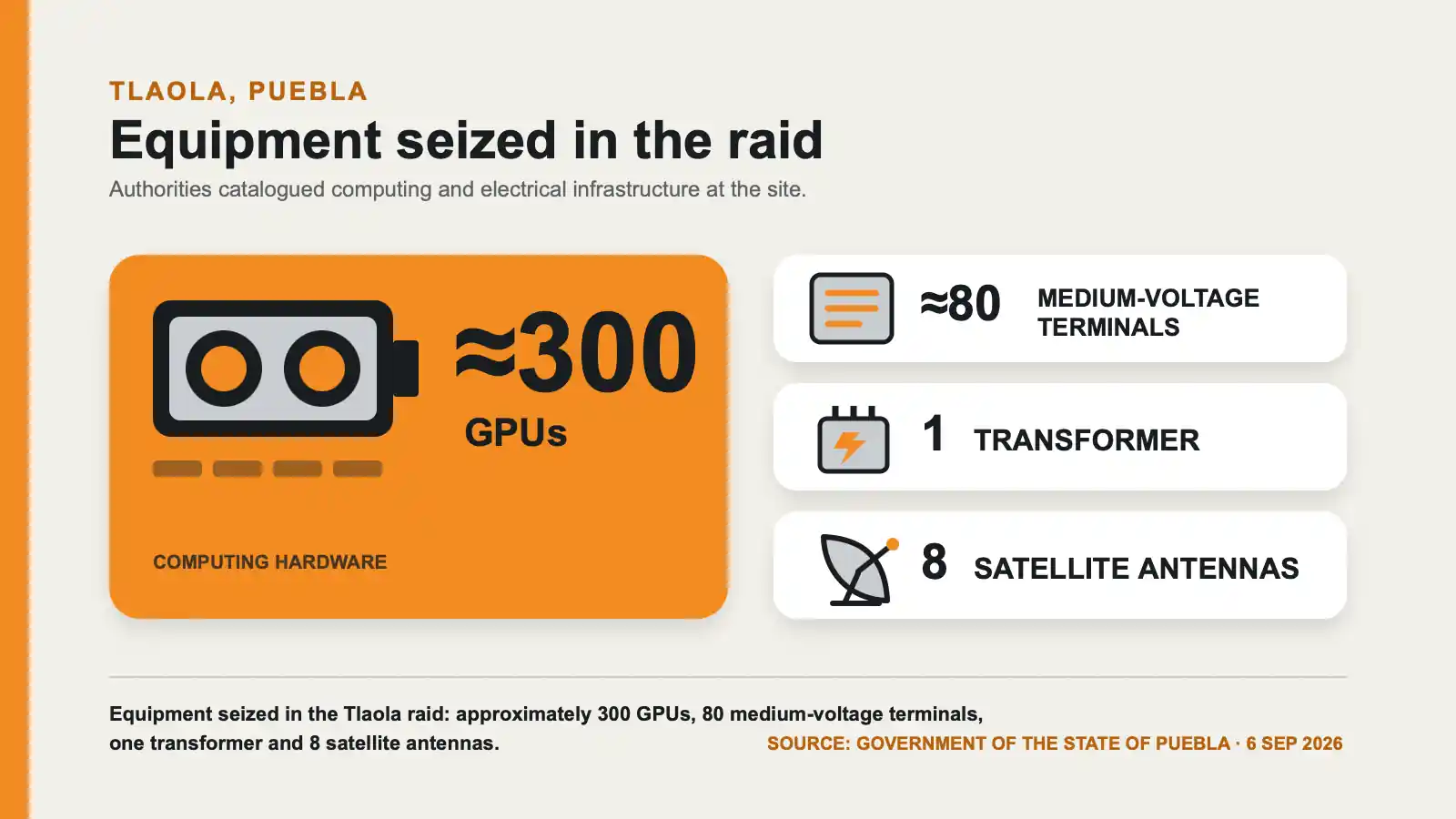
The joint operation was carried out by Mexico's federal attorney general's office, the Mexican Navy, and the Puebla state public security agency. According to the official Puebla state government press release of September 6, 2026, the seizure included roughly 300 graphics processing units, one electrical transformer, approximately 80 medium-voltage terminals, and eight satellite internet antennas. The facility sat in an isolated mountain zone about two kilometers from the nearest inhabited area, close to a local hydroelectric dam.
Witness accounts collected by investigators noted that the mechanical hum of the computers was audible from roughly one kilometer away, well before the structure itself was visible. No arrests have been made at the time of writing, and no specific criminal organization has been formally named as responsible. Mexican authorities declined to comment further, citing the ongoing nature of the investigation. Investigators are pursuing two separate but related questions: whether the operators were stealing electricity from the grid, and whether the operation was also being used to launder proceeds from other criminal activities.

The Economic Model: Stolen Energy as Raw Material
This is where the Puebla case gets genuinely interesting from an analytical standpoint. In legitimate crypto mining, electricity is typically the single largest operating cost. According to the Cambridge Blockchain Network Sustainability Index (CBECI), maintained by the Cambridge Centre for Alternative Finance, producing a single Bitcoin under normal market conditions requires energy worth roughly $45,000 at current rates, a figure that still leaves a meaningful profit margin given prevailing Bitcoin prices. But that margin changes entirely when the electricity input costs nothing because it has been stolen.


A researcher specializing in electricity theft, quoted in connection with the case, put it plainly: if the operation was genuinely stealing power, its principal operating cost was effectively zero. That transforms the math entirely. A stolen physical commodity, grid electricity, gets converted through computing hardware into a liquid digital asset that can be transferred anywhere in the world and sold on any exchange. The profit margin approaches nearly 100% on the energy side. That is the real core of this model, and it flips the usual narrative around mining economics.
The Tlaola Case: What We Know
Confirmed facts and open questions. Source: Reuters, Mexican authorities, 2026
- The seizure: 300 GPUs, one transformer, 80 terminals, 8 satellite antennas.
- Still unknown: no arrests made, no organization formally named.
- The model: stolen energy eliminates mining's main cost, pushing margins toward 100%.
A Pattern, Not an Isolated Incident
Four facilities in the same region since early 2025: that frequency shifts this story from an isolated police matter into something that looks more like a structural phenomenon. Local authorities are reportedly coordinating with neighboring Mexican states to check for similar operations across the wider region. According to an analysis by a cybersecurity firm active in Mexico, the use of crypto mining as a money-laundering instrument grew significantly in the country over the past year, per reporting by Reuters on the Puebla case.
 Chainalysis Team
This is not a Mexico-specific problem. Similar cases tied to electricity theft for mining operations have recently surfaced in Malaysia and Thailand, according to regional law enforcement reports, suggesting the dynamic is rooted in the economics of mining itself rather than any particular local context. Where criminal organizations can seize or steal energy with limited immediate consequences, the temptation to run zero-cost mining operations is obvious.
The contrast with legitimate compute investment is striking. The same processing capacity that investigators suspect of feeding an illicit circuit is the exact same resource that, when sourced legally, is driving some of the largest industrial transformations underway, from former Bitcoin miners converting into AI data center operators to large technology companies committing billions to secure decades of power supply through legal channels. Energy converted into computation can travel radically opposite paths depending entirely on how it is obtained.
The Broader Picture: Crypto Crime and Context
Beyond its still-unresolved judicial outcome, this case offers a clear window into how criminal organizations adapt relatively recent technologies to very old ambitions. In the scenario investigators are working from, crypto mining is simply the latest variation on an ancient theme: taking illicit proceeds or a stolen asset and converting it into something clean, liquid, and spendable. What changes, compared to traditional methods, is the speed and scale at which the process can happen through digital infrastructure.
Chainalysis, in its 2026 Crypto Crime Report, documented the accelerating professionalization of crypto-related crime, including the growth of what it described as “laundering-as-a-service” networks that facilitate both on-chain and off-chain criminal activity. The Puebla operation, if confirmed as a laundering vehicle, would fit squarely within that broader trend.
Two lessons emerge from this case. Organized crime predictably pursues the most profitable opportunities available at any given moment, and zero-cost crypto mining in territories where criminal control makes electricity theft consequence-free is a compelling opportunity by that logic. At the same time, context matters: the overwhelming majority of global mining activity is entirely legal and transparent. Cases like Puebla, significant as they are, represent a specific and bounded slice of a much larger sector. Conflating the two does a disservice both to accurate analysis and to the many legitimate operators in the industry. Readers who want a solid foundation on how these technologies actually work can start with a primer on what cryptocurrencies are and how mining fits into the broader ecosystem.
The next milestone to watch is whether Mexican federal prosecutors formally name any organization in connection with the four Puebla facilities. If charges are filed linking the sites to a single network, that would shift this from a pattern of opportunistic theft into evidence of coordinated criminal infrastructure. Watch the Puebla state attorney's office for updates through the remainder of 2026.