


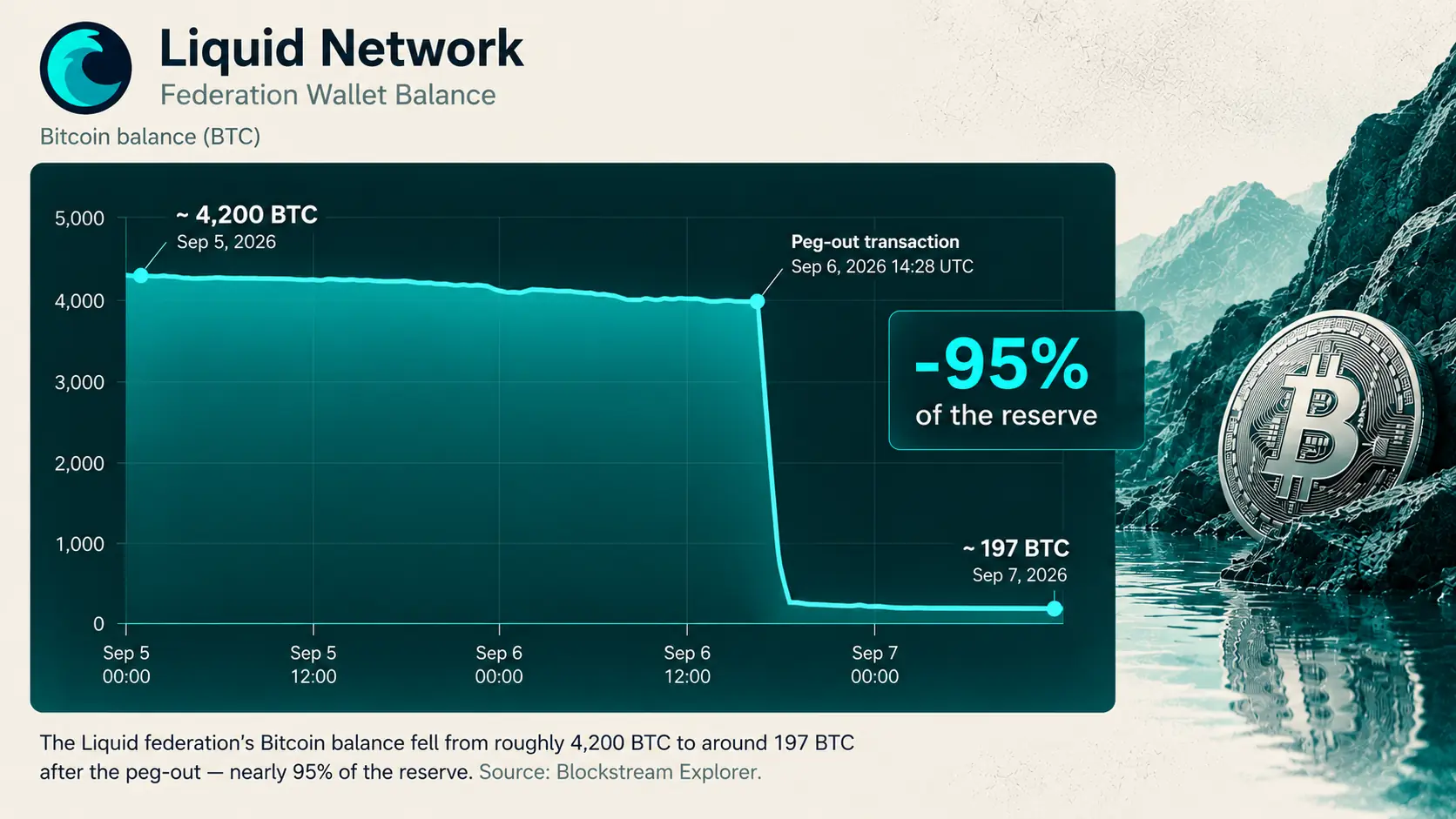
Liquid Network, one of the most significant infrastructure layers built on Bitcoin, entered emergency mode on September 6, 2026. Nearly 4,000 Bitcoin, worth approximately $320 million according to market data at the time, exited the reserves of Blockstream's Bitcoin sidechain, forcing operations to halt. That figure represents roughly 95% of all Bitcoin held by the network. But the number, staggering as it is, tells only part of the story.

The real story is how the funds left. No private keys were stolen. The federation that governs Liquid Network authorized the withdrawal with perfectly legitimate signatures. A software bug in the underlying protocol made it possible, and that distinction matters enormously. One more point deserves immediate clarification: Bitcoin's mainnet was not touched, compromised, or affected in any way.
What Actually Happened on September 6
Liquid Network is a “sidechain”: a separate blockchain linked to Bitcoin, designed to enable faster and more private transactions for exchanges and institutional investors. The mechanics work in two directions. Users lock real Bitcoin to receive an equivalent on the sidechain called L-BTC, and when they want their original Bitcoin back, they burn those L-BTC in a process called a peg-out. A federation of fifteen operators secures the real Bitcoin reserves, and any movement of funds requires approval from at least eleven of them.
On September 6, an unidentified party initiated a peg-out for nearly 4,000 Bitcoin. The federation, using its normal signing process, authorized and executed the transfer. The transaction was technically valid: the signatures were legitimate. No security key was stolen or compromised by force. So how did 95% of the reserves walk out the door? According to initial statements from those involved, the answer is a flaw in the software itself.
We are aware of a security incident on @Liquid_BTC. Purported white-hat hackers have withdrawn ~4,000 BTC (~$320 million) from the Liquid Federation wallet. The @Blockstream team is working on contacting them on-chain with a signed message.
— Liquid Network 🌊 (@Liquid_BTC) September 6, 2026
What we know so far is that the funds…
The Core Issue: A Bug, Not a Stolen Key
Here is the technically decisive point. SideSwap, the peg-out service through which the operation was routed, stated that the L-BTC used to withdraw the Bitcoin were created by exploiting a bug in Elements, the open-source software on which Liquid Network is built. Blockstream confirmed this reading. The attacker did not steal keys to force an exit. Instead, they reportedly exploited a flaw in the code to create apparently legitimate L-BTC from thin air, then converted those tokens into real Bitcoin through the standard peg-out process.
That distinction is everything. A stolen key is a contained incident: revoke the key, secure the funds, problem solved. A logical flaw in how the system authorizes withdrawals is a far deeper design-level problem, one that requires a correction to the protocol itself. Think of it as the difference between a thief stealing a key and a flaw in the lock's design that lets anyone who knows the trick open it without a key at all. The federation's defenses, built to protect against stolen keys, were simply irrelevant against an attack that never needed to steal anything. The same category of structural vulnerability appeared in the bug that hit six Cosmos ecosystem blockchains: not the cryptography, but the code logic.
“White Hat” or Attack? The Evidence That Matters
There is another layer that keeps this story open. The parties behind the withdrawal left an on-chain message claiming to be “white hat” hackers, ethical actors who exposed the vulnerability intending to return the funds. Blockstream confirmed it is attempting to contact them via a signed on-chain message. Healthy skepticism is warranted here.
https://docs.liquid.net/docs/technical-overview
The security community has been cautious. As a senior technical officer at a prominent blockchain security firm noted in public commentary, the “white hat” label is confirmed by actions, not declarations. The only real test is whether the funds are actually returned. In past comparable incidents, the ethical hacker classification was applied only after Bitcoin was genuinely restituted. Until that happens, the distinction between a benevolent disclosure and an outright theft remains unresolved. As of this writing, the funds have not been returned and the identity of those involved remains unknown. The episode is a sharp reminder of why self-custody matters: holding assets on platforms where you do not control the keys carries risks that no federation design can fully eliminate, a topic we've covered in depth in our guide on how to safely custody crypto assets.
The Critical Distinction: Bitcoin Is Not Liquid
Whatever the outcome, this incident illustrates a distinction that gets ignored far too often: the difference between the security of Bitcoin itself and the security of the infrastructure built on top of it. Bitcoin's mainnet, running on a decentralized consensus mechanism across thousands of nodes, was not touched by this incident. What failed was a sidechain: a separate system, built by a company, operating under a security model that is significantly more centralized.
Sidechains and additional layers built on Bitcoin promise real advantages, such as greater speed and privacy. But those advantages come with trade-offs and new points of fragility that Bitcoin's base layer simply does not have. In this case, trust was placed in a federation of operators and in the software governing their process. That is precisely where the vulnerability opened. The pattern echoes what happened during the Fogo blockchain halt following an attack. Bitcoin's soundness does not automatically extend to everything built around it. That is not a criticism of Bitcoin; it's a structural fact about layered systems.
The Wider Lesson for Crypto Investors
The Liquid Network incident, regardless of how it ultimately resolves, delivers a lesson that applies across the entire crypto ecosystem. Security is not a single monolithic property. It is a chain, and the strength of the strongest link (Bitcoin's base layer) does not guarantee the strength of the weaker links (the infrastructure built on top). Every additional technology layer, however useful, introduces new attack surface and new trust assumptions that must be evaluated on their own terms.
Two takeaways stand out. First, the security claims of Bitcoin-adjacent infrastructure deserve scrutiny independent of Bitcoin's reputation. Liquid Network is not Bitcoin. Its risks are its own, defined by its design choices, its federation model, and the software it runs. Second, and more broadly, this case confirms a pattern that experienced security researchers recognize well: in crypto, the most frequent points of failure are not in the underlying cryptography, which tends to be extremely robust, but in the software implementations and trust models built by humans on top of it. That is where bugs nest. That is where vulnerabilities find their entry points. For anyone building or investing in this space, understanding where Bitcoin ends and where its layers begin is not optional knowledge. For those starting from the foundations, our guide on what Bitcoin and cryptocurrencies are remains a practical starting point.