

MiniMax M3.1 Flash, released on October 19, 2026, is priced at $0.15 per million input tokens and $0.60 per million output tokens. The model is available now through MiniMax-hosted services, with open weights announced for October 23. For developers building agents and automated pipelines, the lower unit price is only one part of the cost equation: total spend per task also depends on how much the model reasons, which tools it calls, and how many correction loops it requires.
Pricing Cuts Two Rates, Not Every Invoice
The official pricing page makes direct comparison straightforward. In the standard tier, covering up to 512,000 input tokens, MiniMax M3 costs $0.30 per million input tokens and $1.20 per million output tokens. Flash halves both rates. Cache reads drop from $0.06 to $0.015 per million tokens. These are distinct billing items: the cache rate applies only to tokens the system actually recognizes as reusable, not to all material sent in the request.
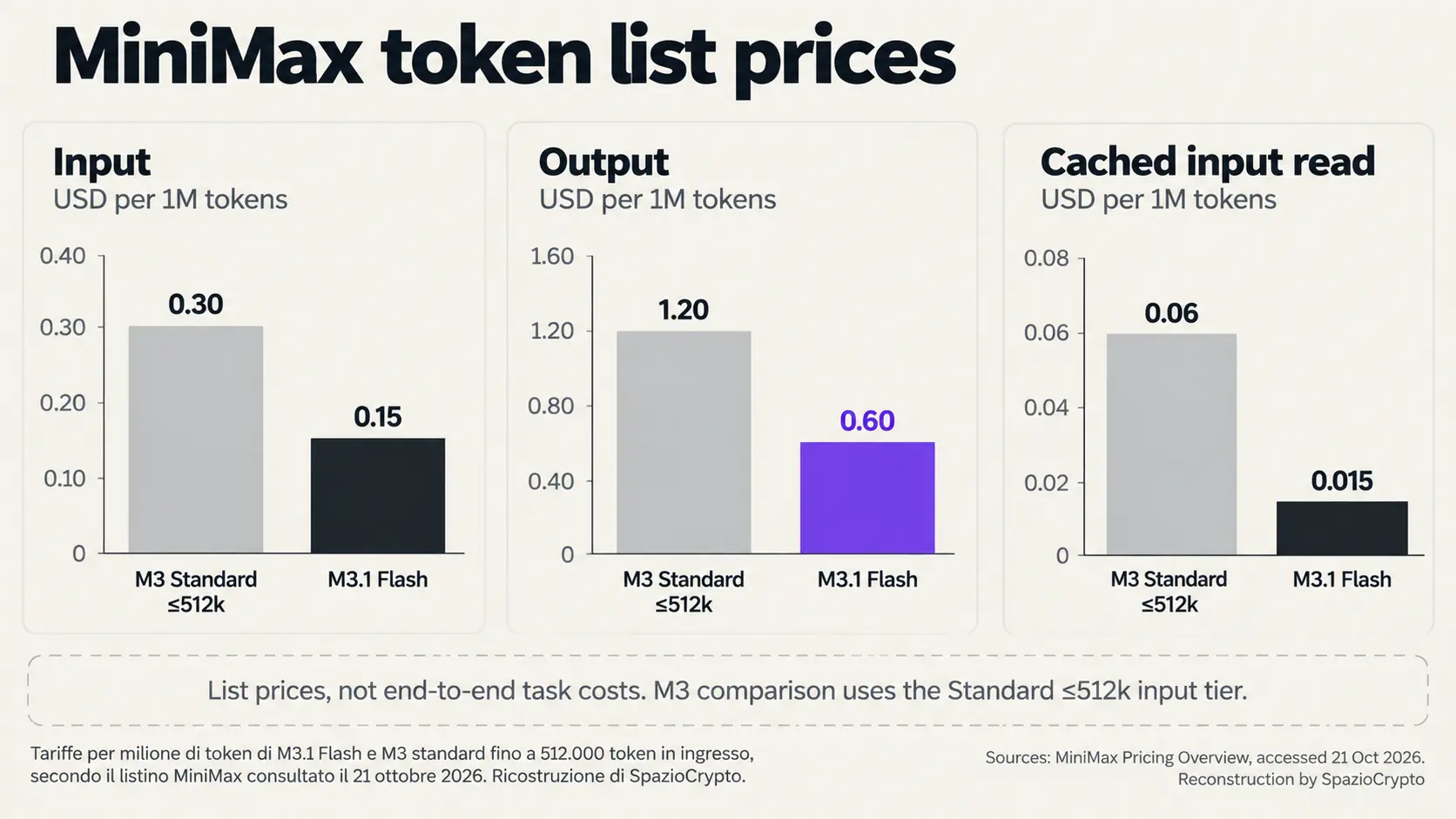
MiniMax's announcement claims that overall agentic task costs are 70% lower than the predecessor. That figure doesn't follow directly from halving the two main rates. It may reflect differences in token consumption patterns and task-completion behavior, but it can't be promised as a universal saving for every workload. For teams evaluating automated systems, the distinction separates a verifiable price list from an operational outcome that still needs measuring against their own traffic.
A worked example clarifies the gap. One million input tokens distributed across requests within the indicated tier, plus 100,000 output tokens with no cache, would cost roughly $0.21 with Flash versus $0.42 with M3. That's an indicative calculation based on identical hypothetical consumption. It excludes additional tool calls, external API requests, or human review. When an agent re-runs a step or generates more reasoning tokens, the billed quantity changes even if the unit price stays fixed.
Reasoning Has a Dial, Not an Off Switch
The Anthropic-compatible interface documentation describes five reasoning levels, from low to max. For MiniMax M3.1 Flash, max is the default when the parameter is omitted. Adaptive reasoning cannot be disabled using the values listed for turning it off: the documentation returns an error for that request. Any integration that reuses configuration from a previous model should verify which behavior the new model actually supports.
According to the same documentation, raising the reasoning level can produce more reasoning tokens and higher latency. Unit price and total response time describe two different aspects of cost. Useful benchmarking should hold the objective, tools, and acceptance criteria constant while recording the reasoning level chosen. Without that discipline, a fast shallow response and a slower deep one get compared without making the trade-off explicit.
MiniMax M3.1 Flash: Space Performance + Bunny Speed 🚀🐰 Yes, Space Bunny - which has topped global leaderboards with 200T+ tokens - was an earlier version of M3.1 Flash. 💰Redefining the performance economics of agentic AI. M3.1 Flash achieves frontier-level intelligence across key tasks such as Cowork (Automation-Bench: 62%; ALE: 30%), Coding (DeepSWE: 74%) and Visual Reasoning (BabyVision: 91%), at 1/3 the cost of M3 and 3x the speed. API pricing (flat rate): $0.15 / $0.60 per 1M input/output tokens, with cache reads at $0.015 / 1M tokens. Model weights will arrive on Oct 23. API: https://t.co/fHRdSV73Hr M Plan: https://t.co/XfJWSyauda MiniMax Code for desktop: https://t.co/SGmLTI2HQm
— MiniMax (official) (@MiniMax_AI) October 19, 2026
The official model card lists a one-million-token context window and multimodal capabilities. A large declared context doesn't guarantee that every long document is handled correctly. For developers integrating via an API interface, the practical point is preserving the right information across steps. A very large prompt can contain redundant or conflicting instructions: accepting it doesn't demonstrate that the model will reliably select the relevant material.
Benchmarks Are Scoped Tests, Not General Guarantees
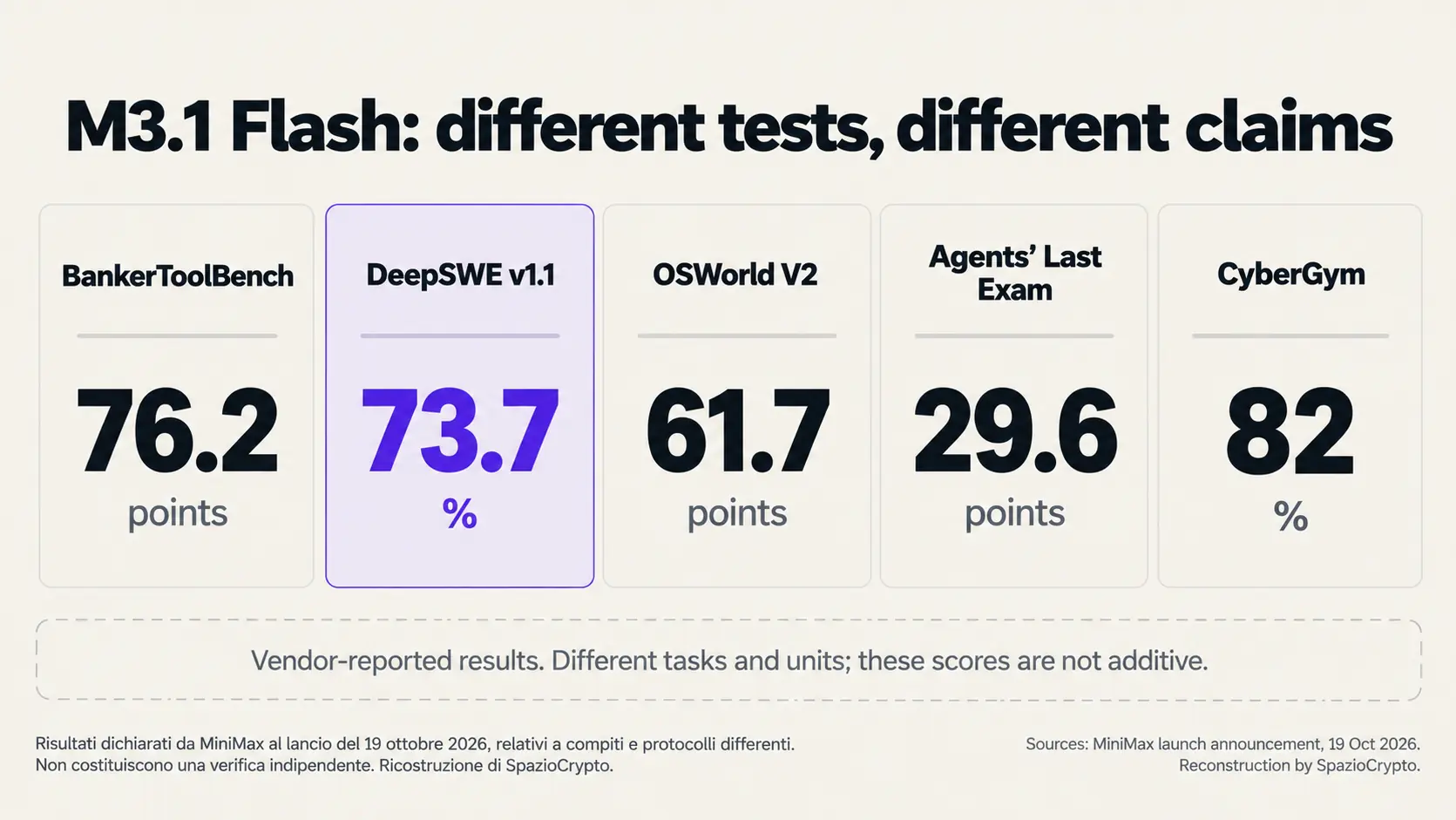
MiniMax publishes results across coding, computer use, and security tasks. Per the company's announcement, those include 73.7% on DeepSWE v1.1, 61.7 points on OSWorld V2, and 82% on CyberGym. The announcement also reports 76.2 points on BankerToolBench and 29.6 on Agents' Last Exam. These are producer-reported figures. Each test observes a different task and they can't be summed into a single reliability percentage. A strong coding score doesn't by itself demonstrate that an agent handles financial documents or permission workflows without error.
Speed figures need the same qualification. MiniMax reports over 200 tokens per second under certain conditions and a median above 170. Those are figures from MiniMax's own infrastructure, not a guaranteed completion time for any given workflow. Tokens generated per second doesn't automatically account for latency between calls, responses from external services, or human review of outputs.
That distinction matters in cross-model benchmark comparisons too. Any number needs to be accompanied by the test version, the tools permitted, and the reasoning configuration used. For Flash specifically, comparisons need an identical objective and a declared token budget. Presenting a vulnerability-detection score as evidence of general model reliability would conflate one specific task with the full range of work the model might be asked to do.
Artificial Analysis provides an external data point on a separate suite: in its October 19 post on X, the firm assigns Flash 42 points on the Intelligence Index with reasoning at maximum, reporting approximately $0.22 per index task versus approximately $0.51 for M3. That's an assessment published by a party independent of MiniMax. The cost figure reflects Artificial Analysis's specific tasks and methodology, not a universal price for any workload you might assign to the model.
Hosted Service and Weight Access Are Separate Phases
The October 19 release identifies three access channels: the MiniMax API, M Plan, and MiniMax Code. The main announcement deferred weights to a later date without specifying one; a post on MiniMax's official LinkedIn page points to October 23. That's an announced deadline, not a completed release. The hosted service you can use today and the downloadable artifact remain two distinct phases. MiniMax's identification of Space Bunny as an earlier version of the model is a company statement; the anonymous name doesn't constitute independent verification.
MiniMax-M3.1-Flash scores 42 on the Artificial Analysis Intelligence Index, 13 points higher than MiniMax-M3 and less than half the cost per task. It scores level with GLM-5.3-Flash but behind DeepSeek V4.1 Flash 1017
, Artificial Analysis (@ArtificialAnlys) October 19, 2026
MiniMax-M3.1-Flash is @MiniMax_AI's new Flash reasoning… pic.twitter.com/bEelNegMKP
The two access modes enable different kinds of verification. A hosted service lets you test the interface and response behavior immediately. Weight publication would open the possibility of archiving the artifact, studying alternative configurations, and deploying on controlled hardware, subject to whatever license accompanies it. The announcement doesn't detail that license or the hardware requirements. Until weights ship, treating Flash as already fully autonomously deployable would get ahead of a step that's still only promised.
The Useful Count Is Tasks Completed, Not Tokens Billed
In the shift from assisted coding to agentic coding, cost distributes across multiple attempts. An agent might read a repository, propose a change, run tests, and return to the code when a check fails. That's an operational example, not a measured result on Flash. Any honest economic comparison should count the full sequence through to accepted output, including runs that don't produce a usable solution.
The value of independent evaluation also depends on how observable and reproducible those sequences are. A practical framework is to record outcome, token consumption, repetitions, and corrections while holding the acceptance criterion constant. Lowering the reasoning level might cut a single wait time while increasing subsequent revision cycles. That's a hypothesis to test against your own workload, not a behavior to attribute to the model without measurement.
MiniMax M3.1 Flash: Summary
- Confirmed: October 19 release, public pricing, and hosted access documentation.
- Not yet verified: actual weight release announced via LinkedIn for October 23, and claimed 70% task-cost reduction across all workloads.
- To watch: token consumption at equivalent task scope, correction loops required, and delivery of the promised artifacts.
The Broader Picture
Competition in applied AI is shifting from price per response toward cost per acceptable outcome. Flash's pricing lowers one measurable component; it doesn't remove the need to verify results. A cheaper model becomes genuinely useful only when it also reduces the steps that require correction, measured at identical output quality and execution conditions.
The concrete signals to watch next are whether MiniMax meets the October 23 weight deadline, whether independent teams can reproduce benchmark results with explicit configurations, and how the model behaves when it fails. Does it signal the limit, stop work, or keep spending tokens? Those differences don't show up in a per-million-token rate card, but they determine the real cost of running a reliable agent.