

Chimiver and Skyline have built Kimi, a virtual assistant that lets customers and resellers query product information for flooring solutions directly through WhatsApp. As reported by the local press on November 27, 2026, Kimi addresses a challenge common to industrial companies: making accumulated technical knowledge accessible without forcing clients to dig through manuals or call a support line every time. When questions need deeper expertise, the system routes users to human technicians.
For this article, we reviewed the project profile published by Skyline, the joint brochure issued by both companies, and the Montagne & Paesi article dated November 27. The first two are materials produced by the parties involved, not independent assessments. We have not tested the assistant ourselves.
An Industrial Knowledge Base Inside a Chat
Chimiver, based in Pontida, manufactures adhesive, treatment, and maintenance solutions for floor coverings. Skyline, a Seriate-based company specializing in business digitization, collaborated on building the assistant. The project organizes product data sheets, manuals, and specialized terminology into an information base used by generative AI. According to Skyline, responses are grounded in the company’s own documentation.
That design choice matters in a sector where technical knowledge is rarely simple. The right answer often depends on the substrate material, the application conditions, or the finish being treated. A seemingly straightforward question can require several data points before a useful recommendation emerges. The potential value of a conversational interface lies in making that path easier to navigate, not in guaranteeing that every model-generated response is correct.
Kimi is a narrow, well-scoped AI application, quite different from a system designed to autonomously execute entire workflows. In our analysis of AI agents for freelancers and SMEs, we examined why identifying bounded tasks is a prerequisite before broadening automation. Kimi offers a concrete case for observing that principle in an industrial context, without attributing capabilities to the assistant that the available documentation does not describe.
Why WhatsApp Came First
The project documentation lists WhatsApp as the activated channel. Integrations with the Chimiver website and a dedicated application are planned, though no release date is provided. The assistant is described as available around the clock and able to respond in the language the user writes in. The brochure notes a commercial presence across 65 countries, which is not a measure of markets where the service is currently in use.
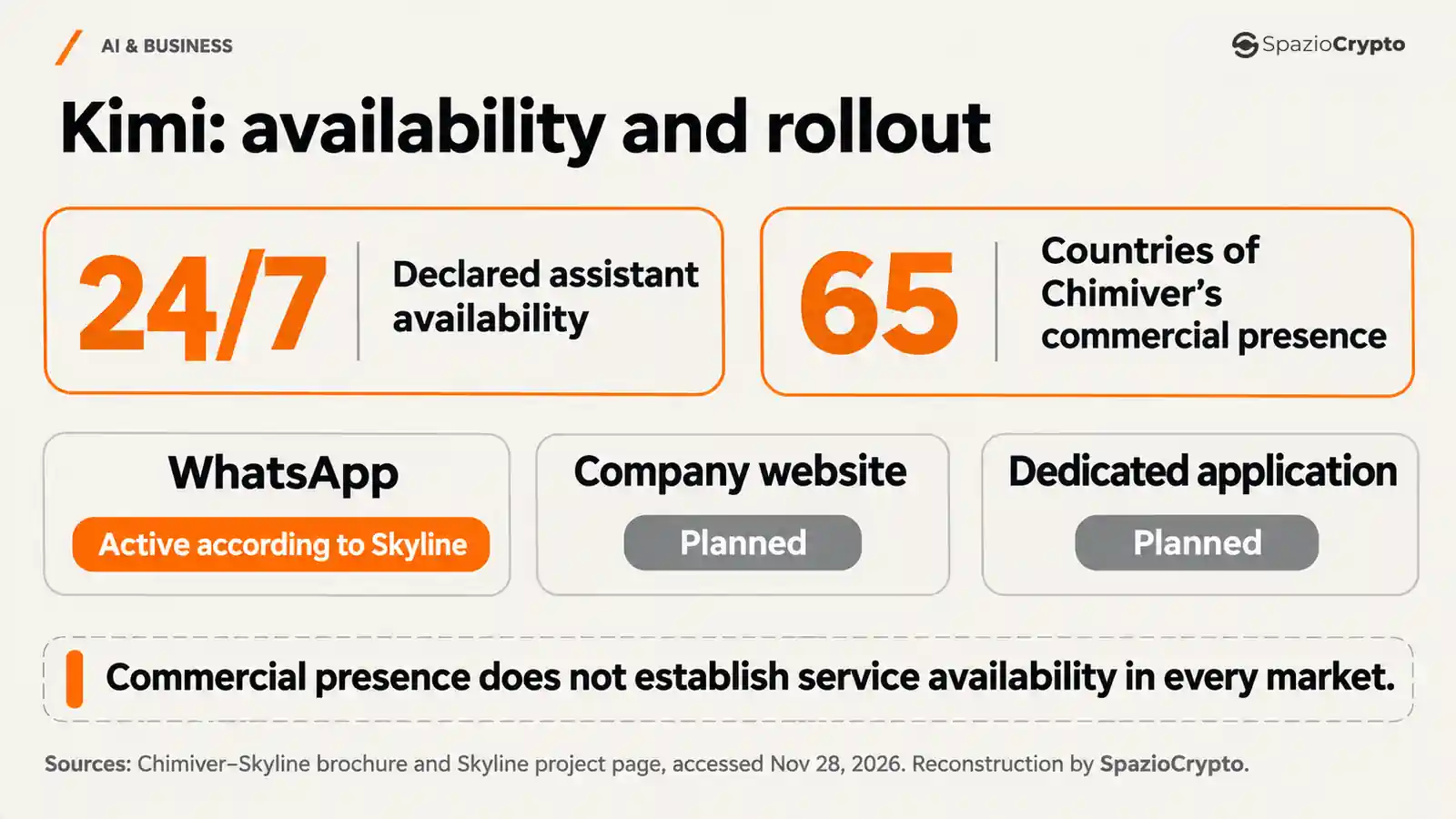
From an adoption standpoint, the choice of channel matters almost as much as the technology itself. A chat interface can cut down on the number of steps needed to frame a question, especially when a professional is away from a desk. The real value of that choice would need to be measured by comparing the time it takes to get a useful answer against the time required through traditional channels. Round-the-clock availability alone says nothing about how quickly a complex case gets resolved, nor does it imply a human expert is always reachable.
Professionals and Consumers Get Different Access
The company describes differentiated pathways: professional-grade information is accessible through a dedicated entry point reserved for the trade network and qualified operators, while consumers receive guidance on surface care and maintenance. For questions requiring deeper investigation, the system routes the request to technical support.
That distinction carries real weight, because an answer appropriate for a professional installer is not necessarily safe or relevant for someone asking about home maintenance. What remains unclear is how the system identifies which category a user belongs to, which information is subject to access restrictions, and how requests that push against those limits are handled. The integration between Workday and Claude illustrates, in a different industry, why switching to chat should not override access rules already established by an organization.
Product knowledge also changes over time. A document may be superseded, a specification updated, or a product discontinued. It would be useful to know whether Kimi allows users to trace back to the version of the source consulted, and whether it distinguishes current from outdated information. The project sources do not describe these mechanisms in any detail, nor do they specify which underlying model is used or the retrieval architecture deployed.
What Does the 95% Actually Measure?
Montagne & Paesi attributed to the pilot a 95% rate of producing relevant and comprehensive answers without human intervention. Skyline’s own project profile states that nearly all test requests were handled autonomously, without citing a specific figure. No evaluation protocol has been published. The trial involved internal technicians and a selection of the commercial network, according to the company.
The gap between those formulations is not trivial. A system can close a conversation without operator involvement and still deliver an incomplete answer. It can also correctly escalate a difficult question to a specialist, which is genuinely useful behavior even if the case was not resolved autonomously. Autonomy, accuracy, and the ability to recognize when to escalate are distinct properties. Our analysis of AI evaluation metric limitations addresses a similar distinction between benchmark results and real-world product behavior.
To interpret that figure properly, you would need the number of requests examined, the selection criteria, the definition of success, and how evaluators classified errors. It would also help to separate results by language, by user category, and by question complexity, distinguishing simple queries from those with meaningful technical consequences. Without that information, the reported result describes the experimental phase, not a guarantee of accuracy for future interactions.
Knowledge Grows, but With Human Review
Another feature described in the brochure is the expansion of the knowledge base through conversations validated by technicians. This does not mean the model is retrained automatically: the documentation explains that approved exchanges can become reference material, without detailing the technical process involved.
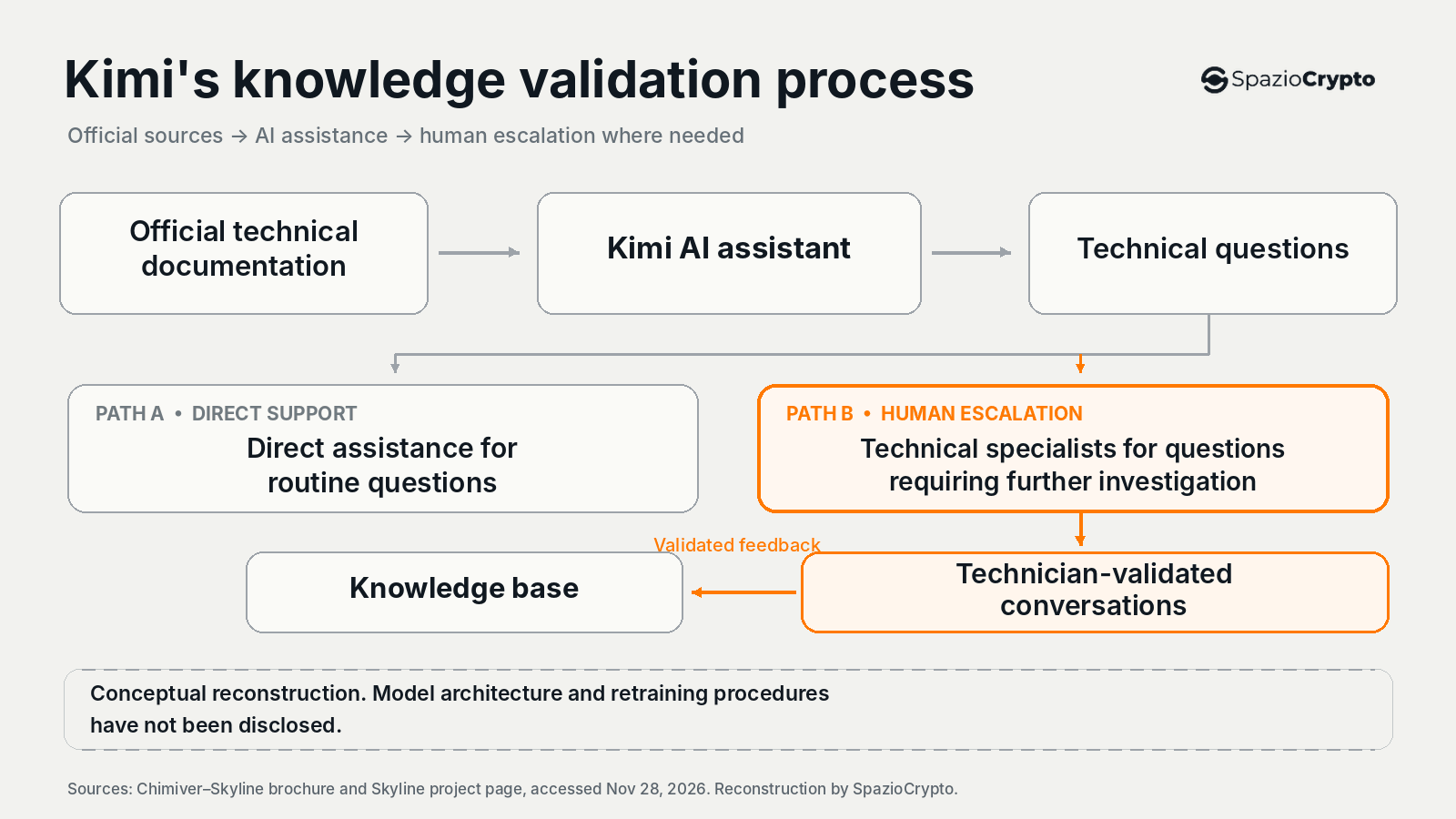
Our read is that the validation loop may be the most substantive part of the project. A recurring question signals an information gap; a specialist-approved response can become a resource for future queries. Knowledge accumulates value beyond the original conversation. The open questions are: who approves new entries, how are errors already in the archive corrected, and when should a response not be reused.
The same governance challenge appears in higher-stakes contexts. In our coverage of Chargebee’s financial AI agents, for instance, we examined the role of human approval. Oversight needs to be proportionate to the task: an informational response and a financial transaction carry very different risk profiles, but both require identifiable accountability.
What Industrial Companies Can Take From This
Unlike the AgID-backed AI agent tests for public services, the knowledge base here belongs to a single private company. The Bergamo case suggests a concrete starting point for businesses considering AI adoption: identify a reliable body of documentation and a sufficiently narrow support problem. Before investing in automation, a company can categorize recurring requests, identify missing documents, and decide which answers should remain gated to specialists. These are design principles the editorial team proposes, not activities we attribute to Chimiver beyond what the sources state.
Any evaluation should also cover the data transmitted through the chat, the conditions under which conversations are stored, and who is authorized to access them. Deploying an official tool does not automatically eliminate the risks associated with business data handling, as we noted in our piece on Shadow AI in the workplace. The specific data processing conditions and the pricing of the Kimi service are not detailed in the sources we reviewed.
Kimi at a Glance
What is confirmed, what is not
- Confirmed: WhatsApp activation documented by both companies, and an escalation path to human technicians for complex queries.
- Not disclosed: evaluation methodology, precise launch date, and performance metrics in production.
- To watch: planned integrations, response quality over time, and how edge cases are managed.
The Bigger Picture
For many industrial companies, the opportunity AI presents is not about building a generalist model from scratch. It is about improving access to what the organization already knows. A specialized assistant can make years of accumulated expertise more readily available to whoever needs it, at whatever hour. The competence stays in the people and the documents they produce; the technology changes how that competence reaches the person asking the question.
To judge whether this experiment delivers lasting value, we will follow production conversation outcomes, response times, escalation rates to human technicians, and any subsequent corrections. A comparison with resolution volumes before the assistant was introduced would also help put any automation rate in context. Without a baseline, a single percentage figure only tells part of the story.
Sources
Primary documentation: Skyline’s Kimi project profile and the official Chimiver and Skyline brochure, undated, accessed November 28, 2026. Press: Montagne & Paesi, article dated November 27, 2026.