

Ideogram 4.6, released on November 19, 2026, is the company’s most precise image editing model yet. It generates and modifies images up to native 4K, accepts up to five reference images, and supports an optional mask to restrict changes to a defined area. The pitch is straightforward: fewer unintended alterations outside the edited zone, more faithful colors, and an iterative workflow built for professional production.
The problem it targets is familiar to anyone who has used AI for photo retouching. Ask a model to change the color of a bag and, step by step, the face shifts too, the fabric changes, a background text disappears. By the fifth edit, the original subject is barely recognizable. Ideogram 4.6 is built specifically to resist that degradation.
What Changes with Ideogram 4.6
According to Ideogram’s official model page, the update introduces four quality tiers (very low to high) and genuine native 4K output at up to 4,096 by 4,096 pixels, not an upscale of a smaller image. The lowest-cost tier caps at 2K. Two API endpoints are available: Generate, for creating images from text or modifying them using reference inputs, and Precise Edit, for changing a specific area of an existing image while preserving the rest and keeping the original dimensions.
The workflow Ideogram promotes is deliberately iterative: one edit at a time, verify the result, submit the next request on the same image. That’s the same direction taken by tools like Canva Brush for graphics and presentations or World Labs Atlas for 3D scenes, as AI moves deeper into professional production pipelines.
Introducing Ideogram 4.6: the new frontier of precise editing, now in native 4K.
— Ideogram (@ideogram_ai) November 19, 2026
A new image model with dramatically better realism and texture detail. Significantly less pixel drift outside your edits and much better color accuracy. pic.twitter.com/otOQZcRUpQ
The Benchmark: First Place, but Barely
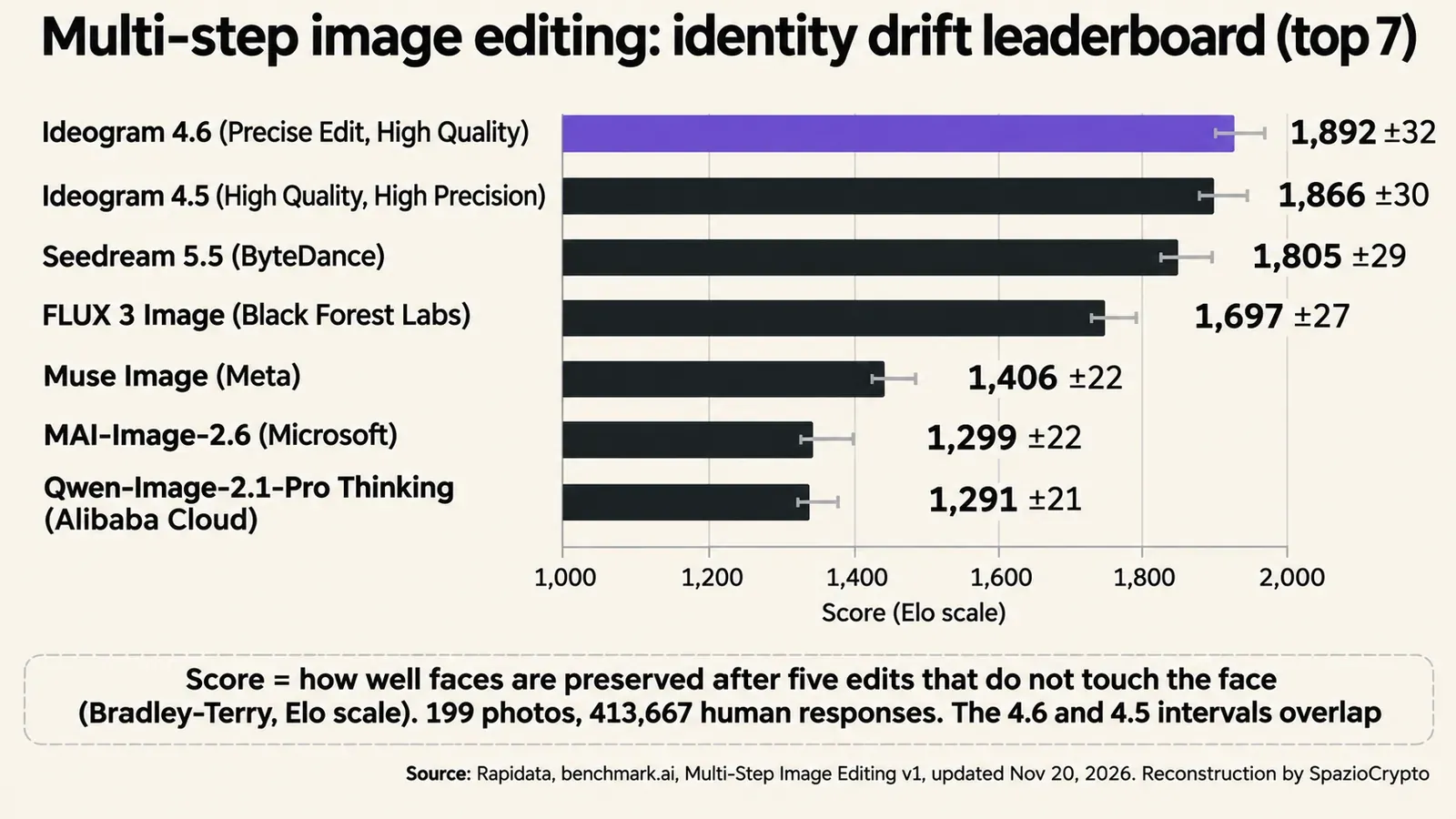
Ideogram claims the top spot on Rapidata’s multi-step image editing benchmark, scoring 1,892 points on identity drift. The leaderboard, updated November 20 on the Rapidata benchmark page, confirms the ranking: Ideogram 4.6 leads, followed by Ideogram 4.5 at 1,866 points, ByteDance’s Seedream 5.5 at 1,805, and Black Forest Labs’ FLUX 3 Image at 1,697. Models from OpenAI and Google appear further down the table.
The gap between 4.6 and 4.5 deserves scrutiny. It amounts to 26 points, against uncertainty margins of 32 and 30 points respectively, meaning the confidence intervals overlap. The two versions were also tested in different configurations: Precise Edit at high quality for 4.6, high quality and high precision for 4.5. The lead over competing models from other companies is considerably wider and statistically cleaner.
What the Benchmark Actually Measures
The benchmark has a specific, narrow focus: identity drift. Rapidata starts with 199 photographs of real people and applies a chain of five sequential edits to each, targeting clothing, objects, or text. None of the edits touch the face. After the fifth pass, human evaluators perform pairwise comparisons between the faces produced by different models and the original, selecting whichever looks more similar. The 413,667 responses collected across 76,714 comparisons are aggregated into a single score. Higher is better, meaning the face changed less.
It’s a meaningful signal. People notice a subtly altered face even when they can’t articulate what shifted. But identity drift is not the full picture. A model can preserve a face perfectly and still get a color wrong or corrupt a text overlay. First place on this benchmark means first place on this specific test, not a general verdict on the best image editor available.
The Numbers Ideogram Publishes
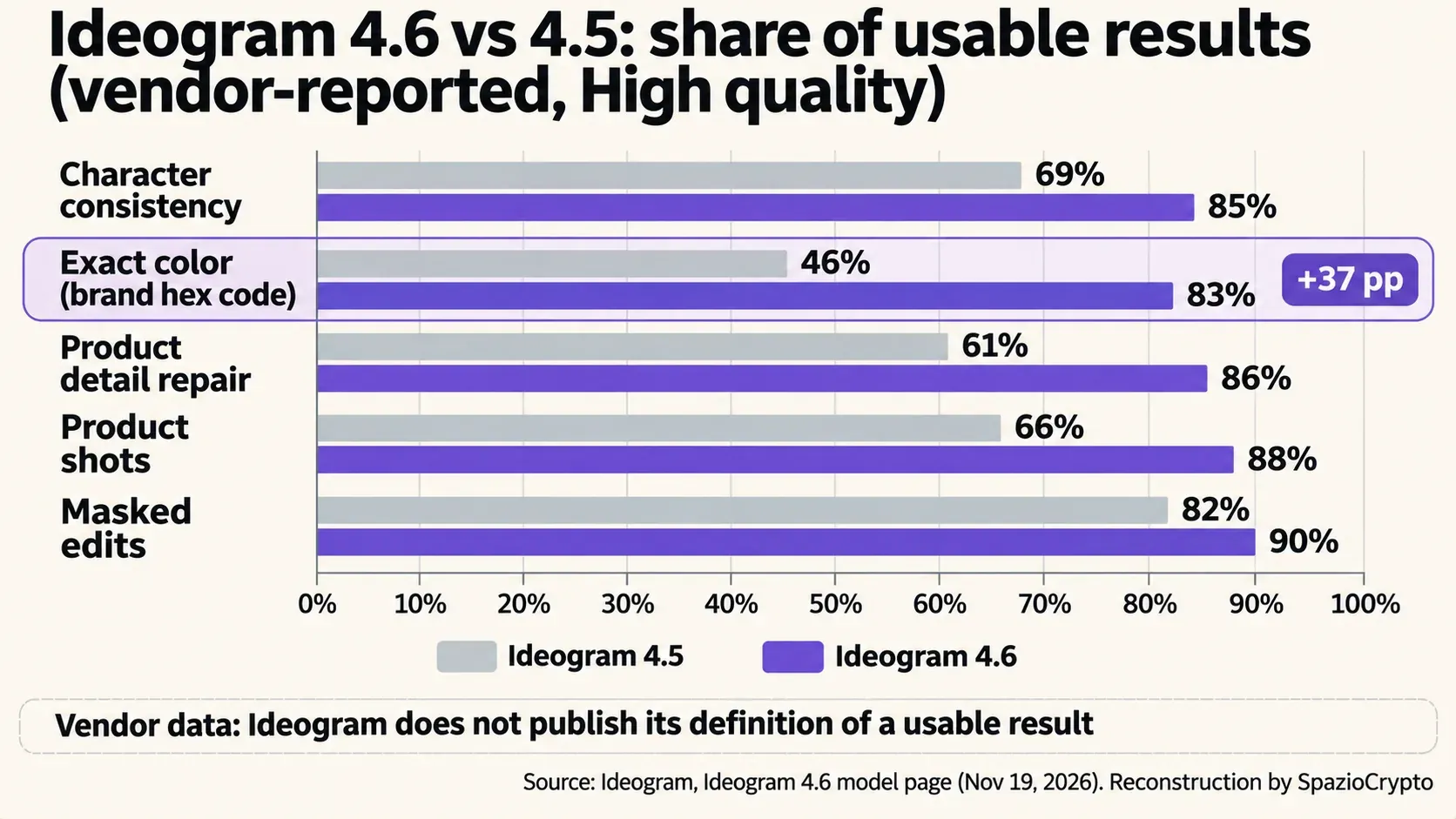
Alongside the leaderboard, Ideogram publishes its own internal percentages of “usable” results at high quality, comparing 4.5 and 4.6 side by side. According to the company, character consistency rises from 69% to 85%, exact color matching (recoloring an object using a brand’s hex code) from 46% to 83%, small defect correction in product photography from 61% to 86%, product shots from 66% to 88%, and masked edits from 82% to 90%. These are self-reported figures. The model page does not define what counts as a “usable” result, so they should be read as directional indicators rather than independently verified metrics.
Pricing: Same Up to 2K, 4K Costs More
Up to 2K resolution, Ideogram 4.6 is priced identically to 4.5. According to Ideogram’s API pricing page, the range runs from $0.008 per image at the lowest quality tier to $0.10 per image for a high-quality generation, while a high-quality edit costs $0.22. At 4K, prices increase: $0.20 for a high-quality generation and $0.60 for a high-quality edit. Five sequential 4K edits at high quality therefore add up to roughly $3.00 per image (a back-of-envelope estimate to illustrate the cost of a full iterative workflow).
There’s a strategic detail worth noting in Ideogram’s API offering. The same interface surfaces models from other providers alongside Ideogram’s own, including OpenAI’s GPT Image and Google’s Nano Banana. The company is positioning itself as a platform, not just a model vendor.
The EU Transparency Angle
For agencies, e-commerce teams, and design studios working in the EU, the practical promise is real: correct a product detail or recolor a brand element without regenerating the entire scene. But as edits become more faithful and harder to detect, transparency obligations become harder to ignore. Since August 2, Article 50 of the EU AI Act requires machine-readable labeling of synthetic content and explicit disclosure of deepfakes. Those obligations remained unchanged after the Digital Omnibus agreement. Ideogram itself advises users to retain originals and prompts, to work only with images they have the rights to, and to disclose AI modifications when context demands it. The ability to change a single detail while leaving a face intact is genuinely useful in production. It’s also, in the wrong hands, a tool for increasingly convincing synthetic fraud.
Ideogram 4.6: What’s Confirmed and What Isn’t
What we know and what to watch
- Confirmed: released November 19, 2026; image generation and editing up to native 4K; four quality tiers; up to five reference images; optional mask; Generate and Precise Edit API endpoints; first place with 1,892 points on the Rapidata identity drift benchmark.
- Read with caution: the gap over 4.5 falls within statistical uncertainty margins; usable result percentages are internal figures with no public definition; open-weight release is not mentioned on the official page.
- To watch: Ideogram 4.6’s ranking on independent generation and editing leaderboards beyond identity drift; competitor responses from OpenAI, Google, and ByteDance; and the real-world cost of iterative 4K workflows at e-commerce volumes.
The Bigger Picture
The competition among image generators is shifting from the first output to the tenth edit. Demos reward the most spectacular single result; professional work demands revision cycles, color consistency, and detail preservation across multiple passes. Ideogram is trying to differentiate precisely where most models still degrade the source material, and it’s doing so with a benchmark that measures degradation rather than visual appeal.
Four concrete signals are worth watching. First, independent leaderboard results that go beyond face preservation, to test whether the advantage holds on color and text accuracy. Second, 4K pricing at scale, which will determine whether iterative editing is commercially viable for e-commerce operations. Third, responses from OpenAI, Google, and ByteDance, all competing on the same terrain. Fourth, content traceability tools: under the EU AI Act, watermarking and disclosure are product requirements, not optional features. The watermarking discussion already extends to text, as the case of Claude’s invisible text watermark shows.
Sources
Official documents: Ideogram, model 4.6 page; Ideogram, API model documentation; Ideogram, API pricing. Benchmark: Rapidata, Multi-Step Image Editing (Identity Drift), updated November 20, 2026. Social: Ideogram on X, November 19, 2026.