

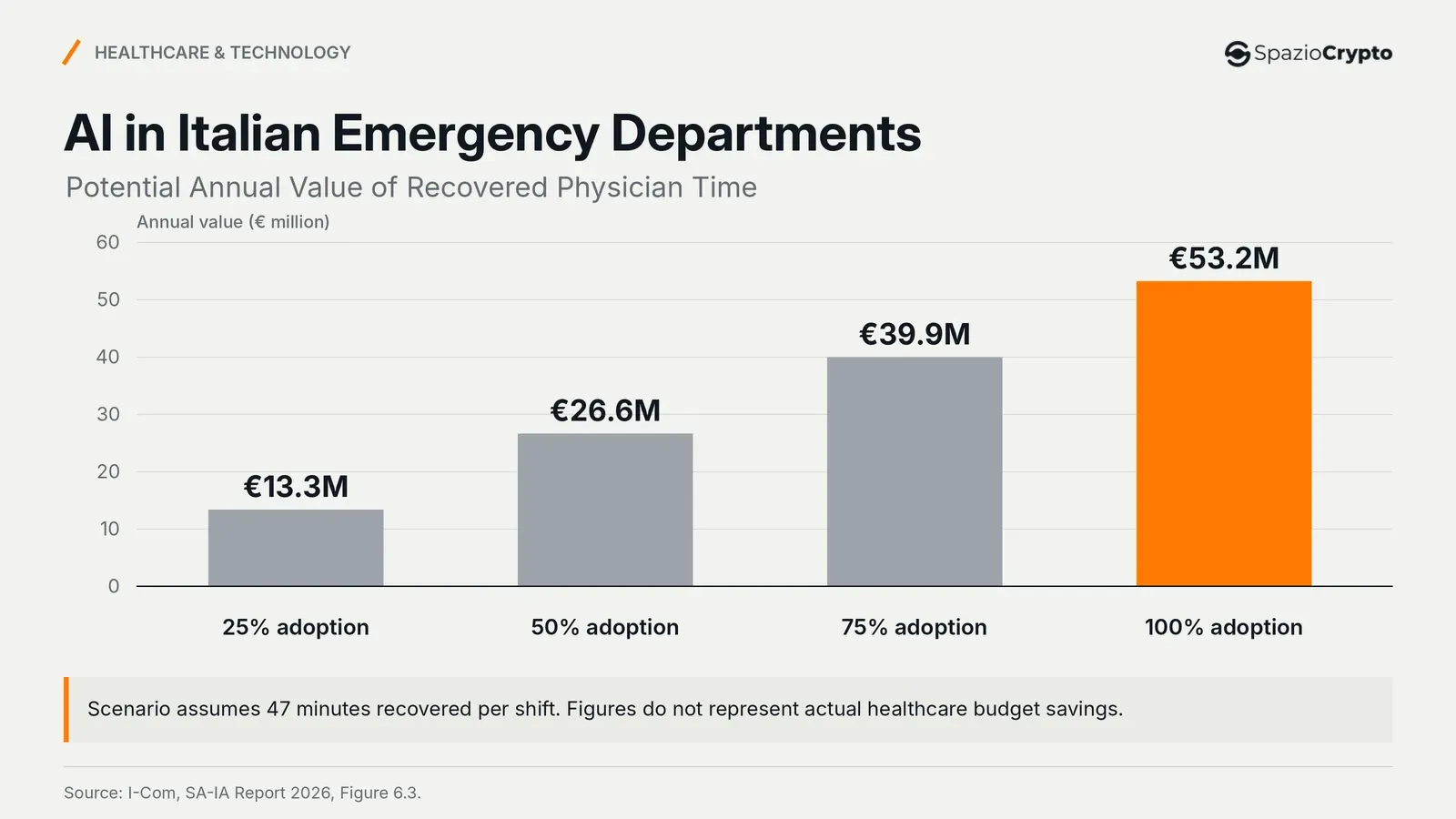
Artificial intelligence could give emergency room doctors something genuinely scarce: time with their patients. According to the SA-IA 2026 Report published by the Institute for Competitiveness (I-Com) and presented on November 25, 2026, at Italy's Ministry of Health in Rome, ambient scribing technology could unlock up to 53.2 million euros per year in recovered physician time across Italian emergency departments. That figure captures potential, not a guaranteed budget saving.
What Is Ambient Scribing and How Does It Work in Emergency Rooms?
Ambient scribing combines voice recognition, natural language processing, and generative AI to automate part of clinical documentation. During a consultation, the system listens to the conversation between doctor and patient, extracts the clinically relevant information, and drafts the medical record automatically.
The physician keeps full control. Before anything is validated, the clinician reviews and approves the output. The goal isn't to hand clinical decision-making to an algorithm. It's to cut the repetitive administrative tasks that pull doctors away from the bedside.
In emergency departments, where staff must simultaneously manage acute cases, paperwork, and coordination with other wards, even a modest reduction in bureaucratic load can have meaningful organisational ripple effects. Time recovered per shift adds up fast across a system the size of Italy's National Health Service (SSN).
Where the 53.2 Million Euro Figure Comes From
The economic model in the I-Com SA-IA 2026 Report is built on four parameters, as stated in the report itself:
- 4,748 emergency medicine specialists active in Italian hospitals;
- 220 working shifts per physician per year;
- an estimated hourly cost of 65 euros;
- between 20 and 47 minutes of recoverable time per shift.
The 47-minute upper bound comes from a prior UK pilot experience, whose results I-Com adapted to build a simulation for the Italian context. At full adoption and 47 minutes recovered per shift, the model projects approximately 818,000 physician hours freed annually, valued at 53.2 million euros, according to the SA-IA 2026 Report.
Twelve Scenarios: How Adoption Rate and Time Savings Interact
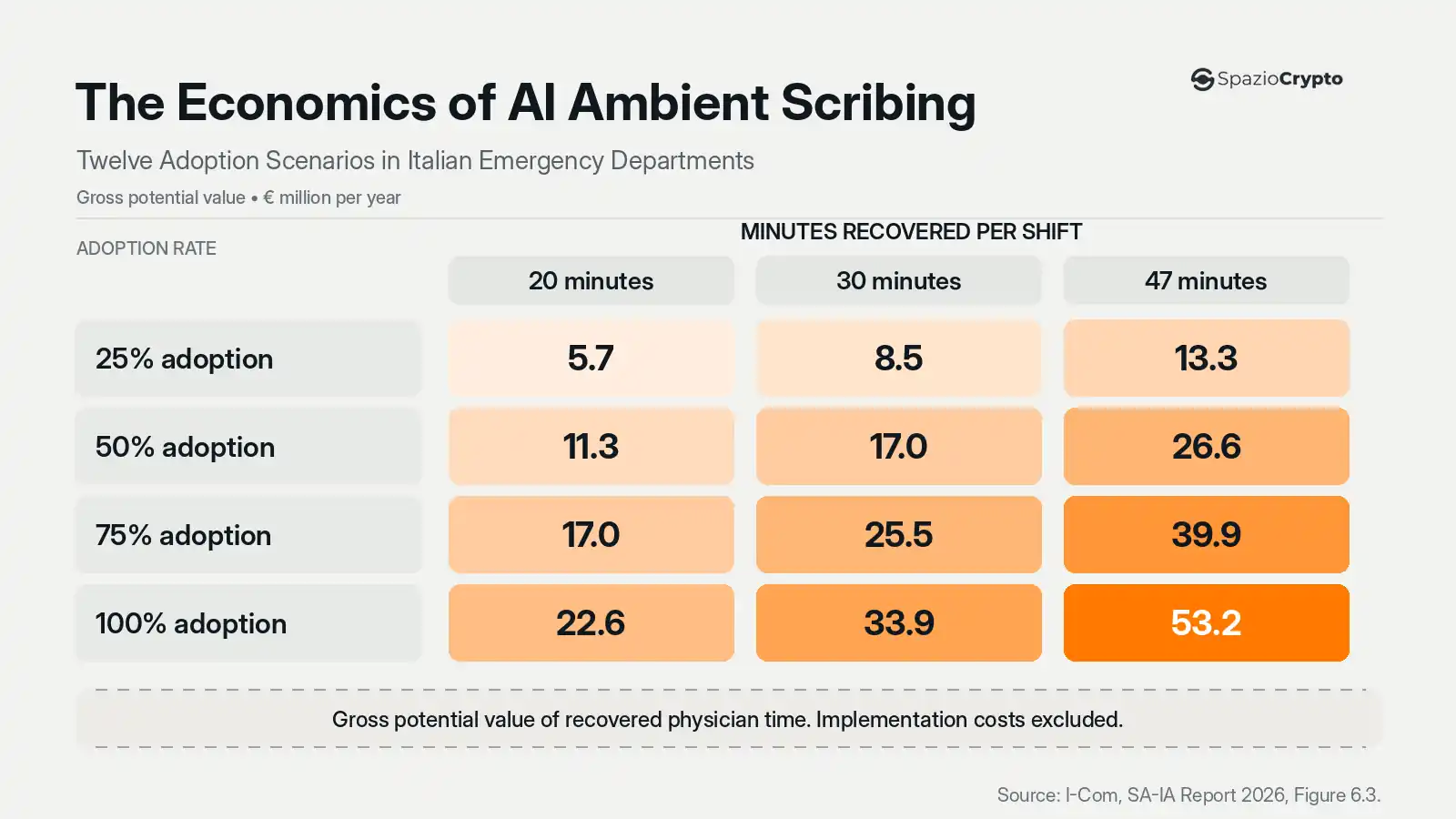
The projected value varies considerably depending on how widely the technology is deployed and how many minutes per shift it actually saves. The I-Com model maps twelve combinations across four adoption rates and three time-saving assumptions:
| Adoption Rate | 20 minutes | 30 minutes | 47 minutes |
|---|---|---|---|
| 25% | €5.7M | €8.5M | €13.3M |
| 50% | €11.3M | €17.0M | €26.6M |
| 75% | €17.0M | €25.5M | €39.9M |
| 100% | €22.6M | €33.9M | €53.2M |
Source: I-Com SA-IA 2026 Report. Figures represent the gross potential annual economic value of recovered physician time, before implementation costs.
The linear scaling in the model is a function of its mathematical assumptions. Real-world rollout across hospitals with different IT infrastructure and organisational cultures is likely to produce uneven results, particularly in smaller or under-resourced facilities.
Why 53 Million Euros Is Not a Net Saving for the NHS
The distinction between productivity gain and financial saving matters here. A doctor spending less time on paperwork still earns the same salary. The economic benefit lies in what those recovered hours enable: more patient throughput, a better distribution of workload, or a reduction in overtime.
The simulation also excludes several cost categories that any real deployment would require, as noted in the I-Com report:
- Software licensing fees;
- Integration with existing hospital IT systems;
- Technology infrastructure and ongoing maintenance;
- Staff training programmes;
- Documentation supervision and validation workflows;
- Data protection and cybersecurity compliance.
A complete economic assessment will need to measure the ratio of value generated to total cost of deployment. The 53.2 million euro figure is a gross potential benefit, not a net saving already achieved by Italy's National Health Service.
The 53.2 million euro figure represents a gross potential economic benefit, not a net saving already secured by the National Health Service.
From Proposal to Pilot: What a Multicenter Trial Would Need
At the official SA-IA Report presentation, I-Com proposed a multicenter pilot of ambient scribing across several Italian healthcare facilities, with shared evaluation criteria built in from the start. For a pilot to demonstrate genuine return on investment, the report identifies at least six indicators to measure:
- Time recovered: minutes actually freed per shift, net of review and correction time.
- Accuracy: completeness and correctness of AI-generated documentation.
- Reliability: frequency of errors and manual corrections required.
- Economic sustainability: total technology cost per facility.
- Care capacity: any measurable impact on patient volumes or waiting times.
- Security: protection of patient data and incident management.
A well-designed pilot should also compare AI-using facilities against control sites running traditional processes. Without that comparison, it's impossible to separate the technology's effect from the effect of organisational changes that happen in parallel.
Privacy, Liability, and the Limits of Automation
Automated processing of clinical conversations introduces risks that go beyond model accuracy. A system might misinterpret a symptom description, omit a clinically relevant detail, or introduce information not present in the original exchange. These aren't hypothetical edge cases in an emergency context. They're foreseeable failure modes.
Particular scrutiny will be needed around patient data protection, recording storage policies, authorised access controls, and how external technology vendors handle sensitive health information. The EU's General Data Protection Regulation (GDPR) sets the baseline, but the clinical data environment requires layers of governance that go well beyond standard data compliance.
Human oversight remains non-negotiable, especially in emergency medicine where the cost of a documentation error can compound rapidly. Interoperability is another constraint worth naming: new AI tools shouldn't deepen fragmentation in hospital IT systems. The goal is to ease documentation within existing infrastructure, not to add yet another disconnected platform.
AI as a Healthcare Productivity Investment
I-Com's proposal sits inside a broader shift in health economics: artificial intelligence as a tool to raise throughput without cutting headcount. For technology companies, the opportunity spans clinical software, specialised language models, cloud infrastructure, cybersecurity, and systems integration services. The addressable market is real and growing.
For the public health system, the challenge is different. The SSN needs to identify solutions that produce verifiable benefits without creating new inefficiencies or long-term technological dependencies on a handful of vendors. That's a governance question as much as a procurement one.
Healthcare shows clearly that the economic value of AI depends not only on what a model can do, but on how well it integrates into actual working processes. A sophisticated ambient scribing tool deployed in a hospital with fragmented IT and no structured training programme will underperform a simpler tool in a well-prepared environment.
What Happens Next for Italy?
As of November 26, 2026, the multicenter pilot remains a proposal. Available sources do not yet document approval of an operational programme, allocated funding, or formal sign-on from regional health authorities. Those steps, including agreement on a common protocol, selection of participating facilities, and independent outcome measurement, will determine whether the investment holds up under scrutiny.
The real test for AI in Italian emergency rooms won't be counted in software licences installed. It will be measured in the minutes returned to doctors and their patients each shift, verified through controlled pilots with transparent data, and weighed against the full cost of making it work at scale.
Sources
- I-Com, SA-IA 2026 Report, November 25, 2026.
- I-Com, Official Press Release.
- I-Com, SA-IA Report Presentation at the Ministry of Health.
- Italpress, La Nuova Sardegna, November 25, 2026.