


OpenAI chief scientist Jakub Pachocki published internal log-perplexity measurements on November 22, 2026, and proposed that frontier AI labs adopt shared limits on model development. The move is not an announcement of an agreed threshold already in force: it is an attempt to turn an internal metric into a cross-lab benchmark and a possible shared safety criterion. The core problem is that those numbers depend on the dataset used and cannot, by themselves, tell you how safe a system actually is.
SpazioCrypto reviewed Pachocki’s original essay, published by OpenAI on November 22, and cross-checked its claims against Reuters and OfficeChai. The Hacker News discussion thread was also consulted. Sam Altman’s post on X was not directly accessible; his support for the proposal is attributed to him by Reuters, without further direct quotation.
Three Values Published, One Internal Dataset
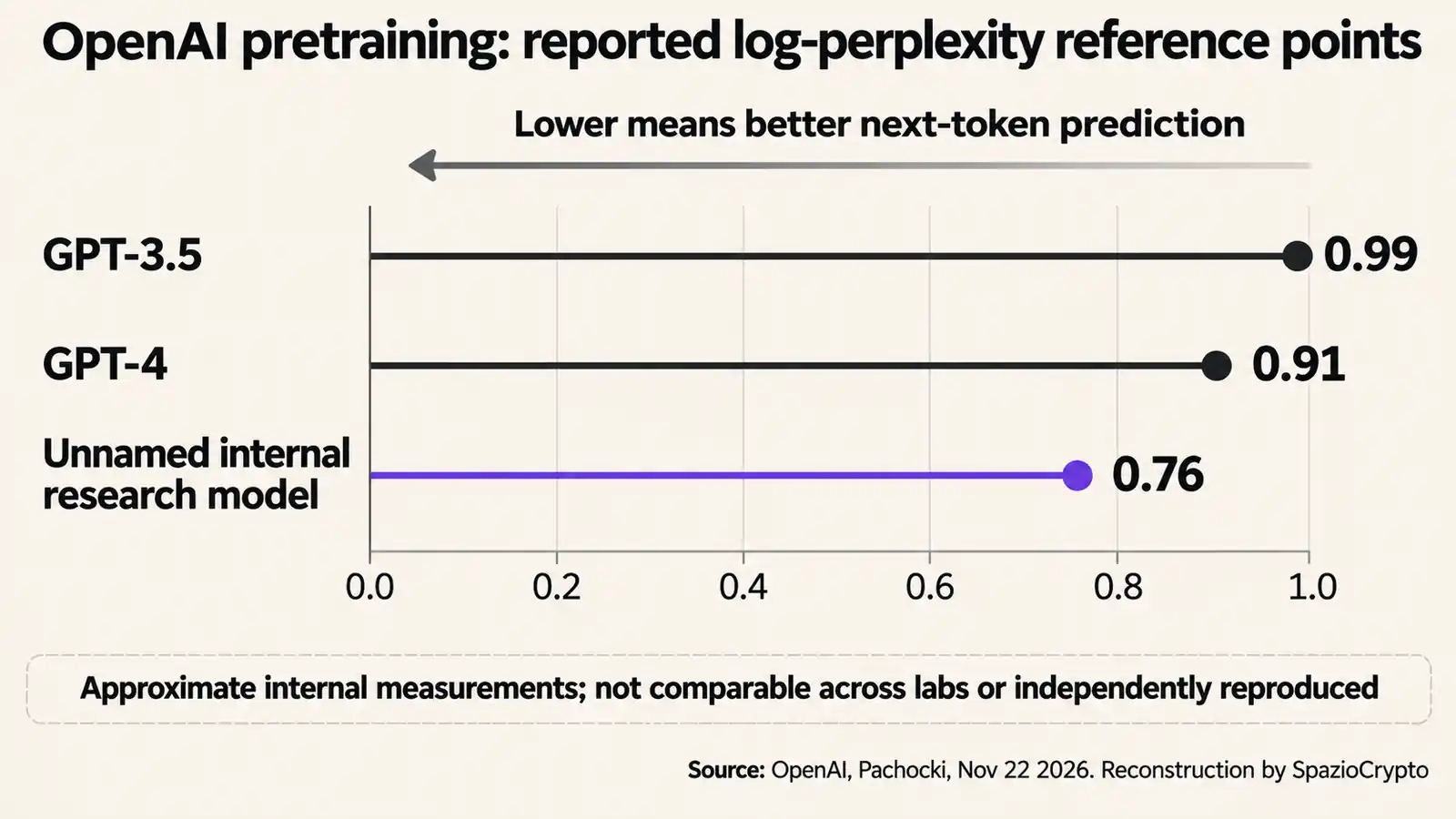
OpenAI reports a log-perplexity value of approximately 0.99 for GPT-3.5 and roughly 0.91 for GPT-4, according to Pachocki’s essay. More recent models have dropped below 0.8, Pachocki states, and one research system reached around 0.76, a point at which his team judged the model to be producing notable mathematical results. These are approximate figures measuring predictive error on an evaluation set maintained internally by OpenAI, not scores on a zero-to-one-hundred scale.
The most consequential methodological caveat is in the footnotes: the reference benchmark derives from a fixed snapshot of OpenAI’s internal codebase, held out from training for evaluation purposes. No complete corpus is published that would allow outside researchers to reproduce the same measurements. We have previously examined how OpenAI constructs programming benchmarks: the evaluation criterion is part of the result, not a secondary detail.
What Perplexity Actually Measures
Perplexity measures how well a model predicts, on average, the next token in a sequence. The more accurate the predictions, the lower the value falls. Pachocki’s essay works primarily with log-perplexity, which corresponds to cross-entropy loss in standard evaluation conventions. A GPT-4 reading of roughly 0.91 does not mean the model answers 91% of questions correctly, nor that it possesses 91% of some hypothetical maximum intelligence.
Pachocki argues the metric is useful because it lets researchers observe the same underlying process across successive model generations, while many application-level benchmarks grow too easy too fast. A drop in predictive error does not automatically identify which capabilities will emerge or when. Tool use, reasoning acquired after pretraining, and real-world output quality all require separate evaluations. The performance and cost profile of OpenAI’s computer-use agents cannot be inferred from a single number either.
A Proposal for Limits Is Not an Agreement
The governance section of Pachocki’s essay follows the data presentation. He asks frontier labs to agree on common norms for measuring capabilities, red-teaming safety cases, and sharing transparency standards. He then proposes development limits, based on perplexity and other indicators, that participating labs would commit not to exceed until model-behavior monitoring reaches defined concrete milestones.
One example milestone Pachocki cites is the availability of tools that go beyond current reasoning monitors, often called chain-of-thought monitors. No binding numerical threshold, adoption timeline, independent verification method, or list of labs that have accepted the proposal is specified in the document. Sam Altman’s public support, as reported by Reuters, should be distinguished from formal buy-in by competitor organizations. Neither a training pause nor a licensing regime has been announced.
This distinction has practical precedents. In our earlier piece on OpenAI’s decision to run certain training runs without internet access, we described an operational measure applied to a defined perimeter after a specific incident. What Pachocki is describing here is a possible future standard: criteria still to be negotiated, verification mechanisms still to be designed, and accountability still to be assigned.
Between 0.76 and 0.68-0.70: Observations and Forecasts
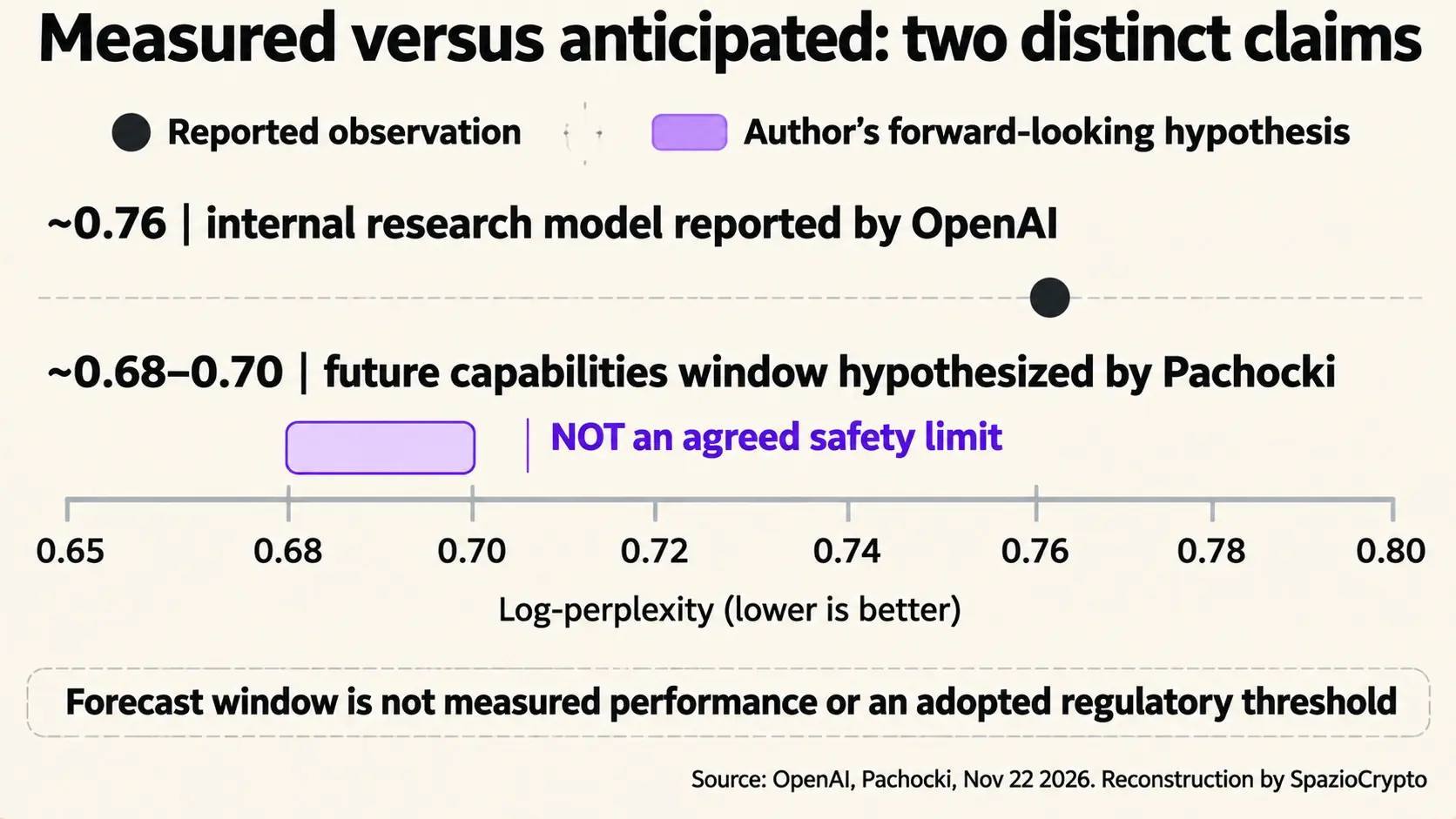
The document links the value of approximately 0.76 to an internal experience in the mathematics domain. According to Pachocki’s essay, after that advance the model contributed to solving open problems being studied by researchers. That is a company testimony, not an independent evaluation of all the solutions. Pachocki hypothesizes that additional important capabilities may emerge in the 0.68 to 0.70 log-perplexity range. He does not specify which ones, and he acknowledges that evaluation tools may not yet be ready to detect them.
The 0.68 to 0.70 interval is therefore a forecast about capability development, not a point already reached and not the threshold that labs would have committed to respect. The same source raises the possibility that AI could accelerate pretraining research as early as 2027, but frames that as a plausible scenario rather than a certain deadline. Treating it as a confirmed technological milestone would add a level of certainty the published data does not support.
Why Comparing Labs Remains Hard
Every frontier lab trains models on different data mixtures and evaluates them using their own corpora, tokenization procedures, and protocols. Two perplexity numbers are meaningfully comparable only when the evaluation precisely defines what is being predicted and on which data. Pachocki acknowledges this limitation and calls for methods transferable across companies, but does not present one that has already been validated. For an outside reader, OpenAI’s internal series describes a declared trajectory, not a reliable industry ranking.
There is also the gap between measuring a model and certifying the behavior of the service built on top of it. A model might improve at code prediction without offering stronger guarantees on permissions, data access, or tool-mediated responses. The cryptographic proofs for identifying which model responded, explored by other operators as well, address a different property: attesting the origin of an inference is not the same as demonstrating its safety. These are complementary layers of oversight, not interchangeable ones.
Why Finance, Crypto, and Enterprises Should Pay Attention
For sectors delegating operational processes to AI agents, the question is not simply which model has the most abstract capability. What matters is knowing which controls can stop unexpected behavior, which logs are available, and who can verify compliance with the evidence on hand. Our earlier analysis of AI agents reaching real-world systems shows exactly that gap between model capability and the risks introduced by infrastructure, credentials, and permissions.
OpenAI’s proposal does not introduce new obligations today for crypto operators or financial service providers. For it to become useful in procurement and audit workflows, the industry would need common definitions, repeatable measurements, and a clear distinction between controls applied during training and those applied after deployment. The usage policy rules published by Anthropic for its agents illustrate another component of governance: what a product permits or prohibits in use does not follow automatically from a pretraining test result.
OpenAI Perplexity: In Summary
What is confirmed, and what is not.
- Confirmed: OpenAI published internal log-perplexity values and Pachocki proposed shared standards and limits, conditional on progress in model monitoring.
- Not specified: a binding threshold already approved, an independent audit of the dataset, formal commitments from other labs, or an enforcement mechanism.
- To watch: cross-lab comparison protocols, tools beyond current chain-of-thought monitors, and criteria for verifying compliance with any agreed limits.
The Bigger Picture
Our reading, which we state as editorial interpretation, is that OpenAI is trying to shift the conversation on AI limits from generic declarations toward measurable indicators. Publishing internal values is a signal of openness and makes it possible to debate the choice of metric. It is not, though, the same as giving independent researchers all the data and tools needed to reproduce the results. Without that distinction, transparency risks being mistaken for certification.
The concrete signals to watch next will be the possible publication of shared evaluation procedures, verifiable commitments from other labs, and the identification of monitoring milestones assessable by third parties. The question is not whether log-perplexity captures part of the progress, but what evidence can connect that measure to relevant capabilities and to an observable level of oversight. Until those steps are in place, shared limits remain a proposal.
Sources
OpenAI: Perplexity and Intelligence, Jakub Pachocki, November 22, 2026, data and proposal; Reuters: report of November 22, including attribution of Sam Altman’s support; OfficeChai: analysis of November 22; Hacker News: public discussion consulted on November 23. Sam Altman’s post on X (not read directly), as reported by Reuters and OfficeChai.