


ChatGPT Wallet, unveiled by OpenAI on November 13, 2026, lets ChatGPT agents complete purchases using a user’s existing credit card, but every single transaction requires explicit biometric approval from the user before it goes through. The feature launched exclusively for Pro subscribers in the United States, and OpenAI has confirmed no plans for wider rollout yet.
TL;DR: OpenAI launched ChatGPT Wallet on November 13, 2026 for U.S. Pro users: agents prepare purchases and users approve each one with Face ID or fingerprint. OpenAI holds no funds, issues no credit, and bears no liability for purchases.
At a glance:
- On November 13, OpenAI introduced ChatGPT Wallet, allowing ChatGPT agents to complete purchases with cards the user already owns.
- At launch, the feature is restricted to adult Pro subscribers in the United States, using U.S.-issued American Express, Chase, Mastercard, or Visa credit cards.
- Every purchase requires a biometric confirmation; the merchant receives a tokenized card number, not the user’s real card data.
- Per OpenAI’s terms, Wallet does not create an account, hold a balance, or extend credit.
What Does ChatGPT Wallet Actually Do?
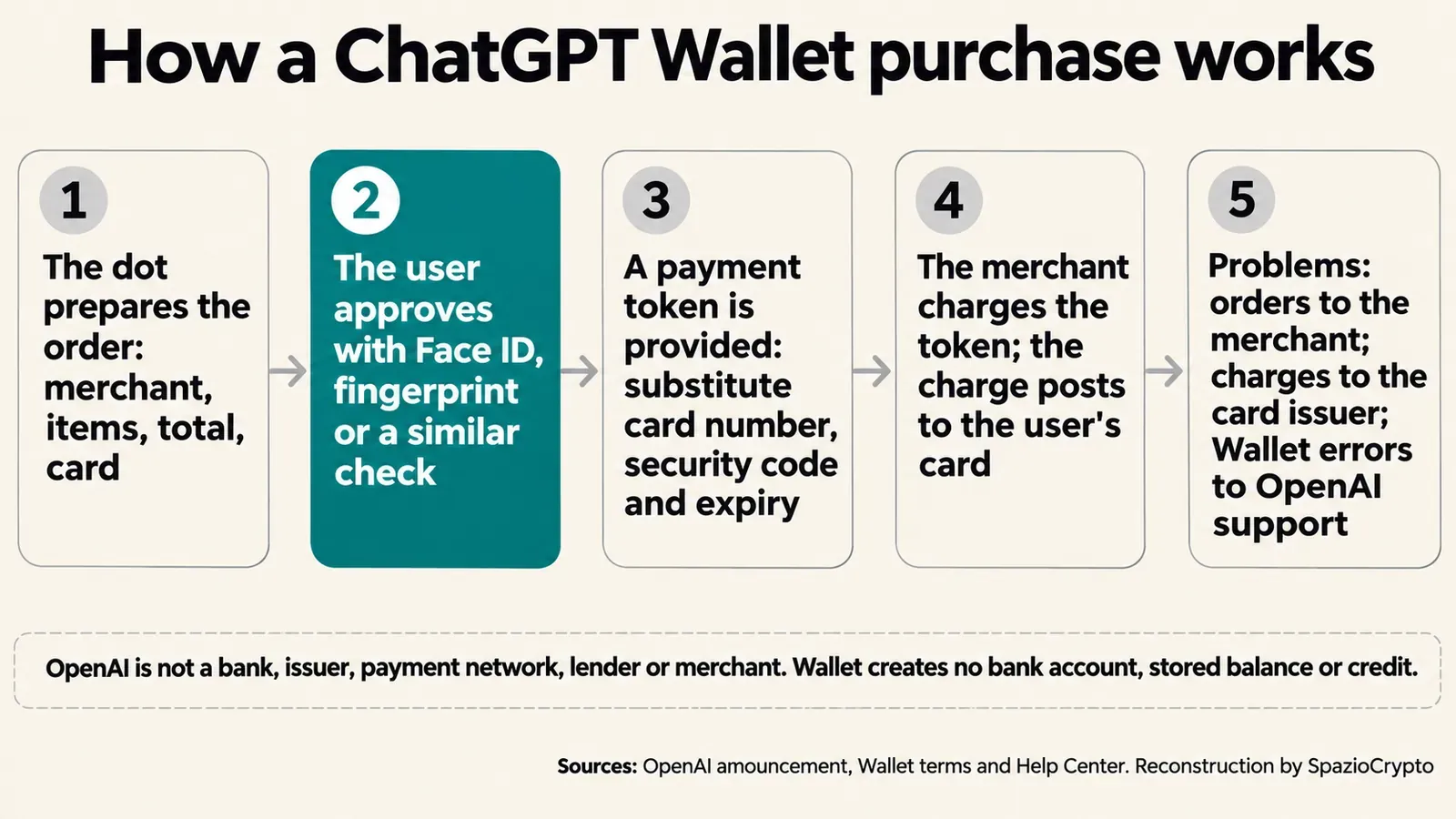
Wallet operates inside “dots,” the personal AI agents built into ChatGPT. A user adds a card once, asks their agent to make a purchase, and before any charge goes through, they see a confirmation screen showing the merchant, items, total, and selected card. They then approve with Face ID, fingerprint, or an equivalent biometric check. According to OpenAI’s official announcement, each approval generates a logged record of the authorized purchase.
Once approved, the payment network issues a token: a substitute card number, security code, and expiry date. Neither the merchant nor the agent ever sees the user’s real card details. The charge appears on the selected card, with the rewards and dispute protections that card already offers. OpenAI describes it as “the first wallet that lets agents pay without accessing real card data.”
The technical stack is substantial. OpenAI built Wallet in partnership with American Express, Mastercard, and Visa on the network side; Forter, Riskified, Sardine, and Signifyd on fraud prevention; and Adyen, Checkout.com, and Stripe as payment processors. The launch fits into a broader industry race to give AI agents their own payment capabilities.
Who Can Use It, and Where?
The rollout is deliberate and narrow. The conditions listed in OpenAI’s Help Center as of the launch announcement are as follows:
| Requirement | At Launch |
|---|---|
| Subscription | ChatGPT Pro, with a dot already configured |
| User | Adult, U.S. resident, with a U.S. billing address |
| Accepted cards | U.S.-issued American Express, Chase, Mastercard, and Visa credit cards |
| Excluded cards | Debit cards and virtual cards |
| Where it works | Only inside dot conversations, not in Chat, ChatGPT Work, or Codex |
OpenAI’s Help Center also notes that Wallet may not complete payment at every retailer, because some checkout flows are built to block automated agents. According to FinTech Futures, OpenAI is currently not charging transaction fees.
Who Is Liable When Something Goes Wrong?
The Wallet Terms, effective November 12, are unambiguous on this point. OpenAI is not a bank, card issuer, payment network, lender, or merchant: the seller is always the retailer. Wallet creates no account, holds no balance, extends no credit, and transfers no funds. The terms explicitly disclaim OpenAI’s liability for purchases, payments, and orders, written in uppercase for legal emphasis.
For disputes, the Help Center identifies three separate contacts:
- The merchant, for order status, cancellations, returns, and refunds.
- The card issuer, for declined, disputed, or unrecognized charges.
- OpenAI support, for Wallet errors, suspicious access, or purchases that differ from what was approved.
Approving a purchase completes only the user’s side of the transaction. It does not confirm the merchant has accepted the order. This is the same tension that emerged during benchmarking of AI agent reliability under real-world task conditions.
The Agent Pays, But Doesn’t Decide
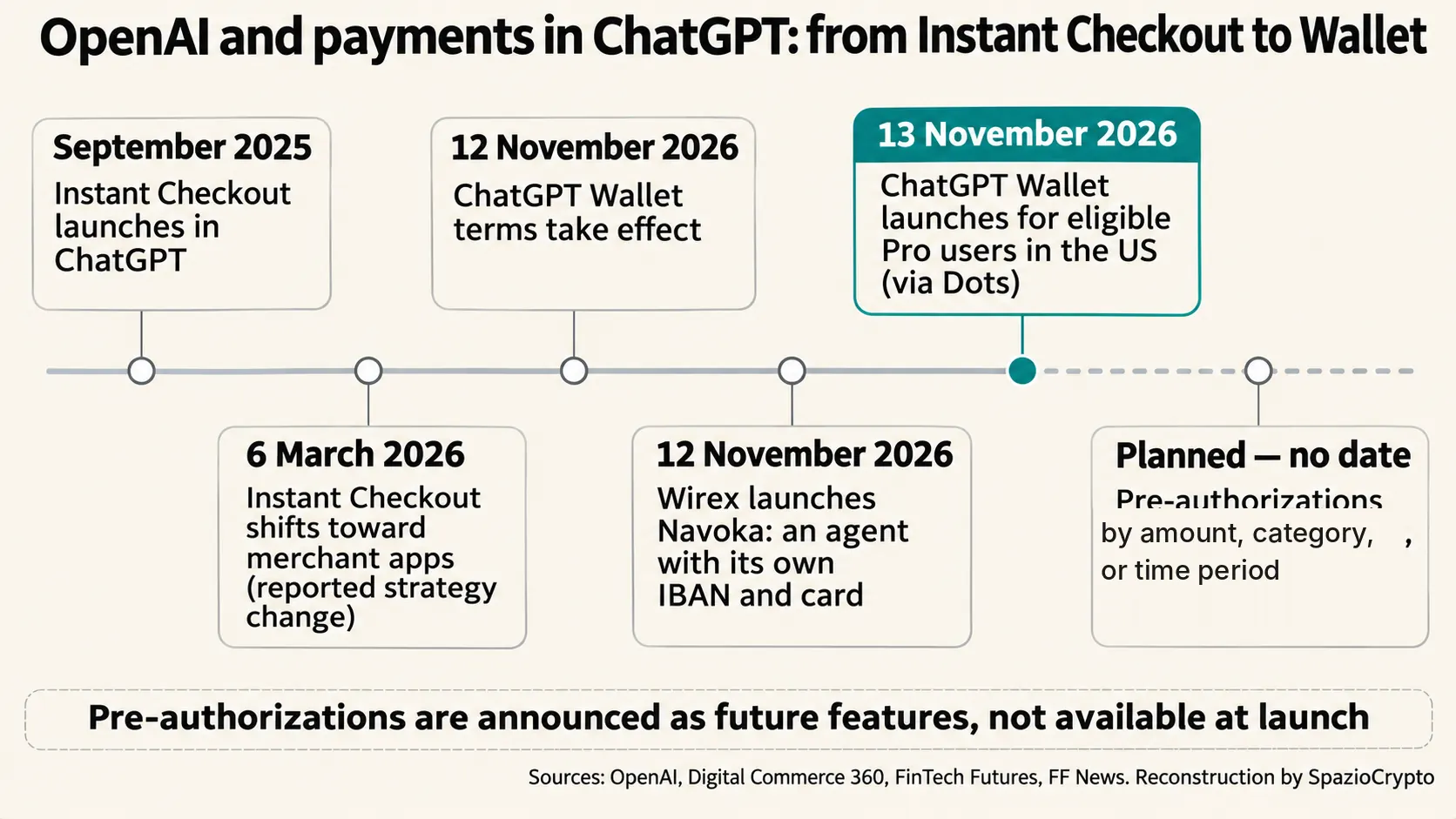
There’s a tension at the core of the product’s name. The agent’s wallet gives the agent nothing to spend autonomously: it converts the user’s card into a one-time credential, valid for a single already-approved purchase. OpenAI describes standing authorizations by amount, category, or time period as a future development, with biometric controls and authorization logs. None of that is available today.
The cautious approach has a direct predecessor. Instant Checkout, ChatGPT’s direct-purchase feature launched in September 2025, was pulled back into merchant apps by March 2026. “We’re changing how we approach commerce in ChatGPT,” an OpenAI spokesperson told Digital Commerce 360 in March 2026. ChatGPT Wallet restarts from that position, with human consent at the center of every transaction.
The contrast with Wirex Navoka, launched on November 12, illustrates two distinct design philosophies. According to FF News, Navoka gives an agent its own IBAN, a dedicated card, and wallets in USDC and EURC (two stablecoins), all governed by user-set rules and spending caps. OpenAI instead tethers the agent to an existing card and requires approval for each individual purchase. The difference maps closely onto the broader debate around AI agent permission frameworks in enterprise contexts.
What About Europe and the UK?
Not yet. OpenAI has announced no availability in the European Union or the United Kingdom, and the current requirements exclude anyone without a U.S. billing address. European readers should note, though, that the core design principle of Wallet (biometric approval for every payment) already describes existing legal reality on this side of the Atlantic. Under Article 97 of the PSD2 directive, as monitored by the EBA, payment service providers are required to apply Strong Customer Authentication whenever a payer initiates an electronic transaction. Per-purchase approval is the rule here, not a novelty.
The more complex challenge for a European launch will come when OpenAI introduces the promised standing-delegation features, where an agent is pre-authorized to spend within set limits without per-transaction approval. Those delegations would need to be reconciled with PSD2’s SCA requirements, and potentially with incoming PSD3 rules. The FCA in the UK and the ECB’s payments oversight teams are likely to scrutinize that model carefully.
ChatGPT Wallet: Confirmed and Unconfirmed
What’s settled, and what’s not:
- Confirmed: launch on November 13 for U.S. Pro users; biometric approval required for every purchase; card tokenization instead of real card data; no account, balance, or credit; OpenAI is not a bank, issuer, network, or merchant.
- Not disclosed: user numbers, participating merchant count, and transaction volume; fraud rates, error rates, and incomplete purchase rates; timeline for standing delegations and international expansion.
- To watch: the debut of amount- and category-based authorizations; expansion to other countries and to debit cards; how many retailers will block versus accept agent-initiated checkouts.
The Bigger Picture
Our read, stated as editorial opinion: the real product OpenAI shipped on November 13 is not the wallet, it’s the boundary. The agent reaches the final click, but the payment method belongs to the user, the risk stays with issuers and merchants, and the decision remains human. It’s a deliberately cautious model, built after a public retreat, that positions the agent inside the payment flow without granting it autonomous control.
That boundary will shift when standing delegations arrive, and that’s where accountability gets genuinely interesting: who answers when the agent buys the wrong thing within the authorized limits? Three signals are worth watching closely: the debut of amount and category authorizations, retailer behavior toward agent-driven checkouts, and the first real-world error and dispute data. The lessons from earlier work on AI agents with access to live systems remain directly relevant here.
Sources
- OpenAI: Introducing ChatGPT Wallet (November 13, 2026), ChatGPT Wallet Terms (effective November 12, 2026), and Help Center: Making purchases with ChatGPT Wallet.
- Context: FinTech Futures (November 2026) and Digital Commerce 360 (March 6, 2026).
- Comparison: FF News on Wirex Navoka (November 12, 2026).
- European rules: EBA, Article 97 of the PSD2 Directive on Strong Customer Authentication.