

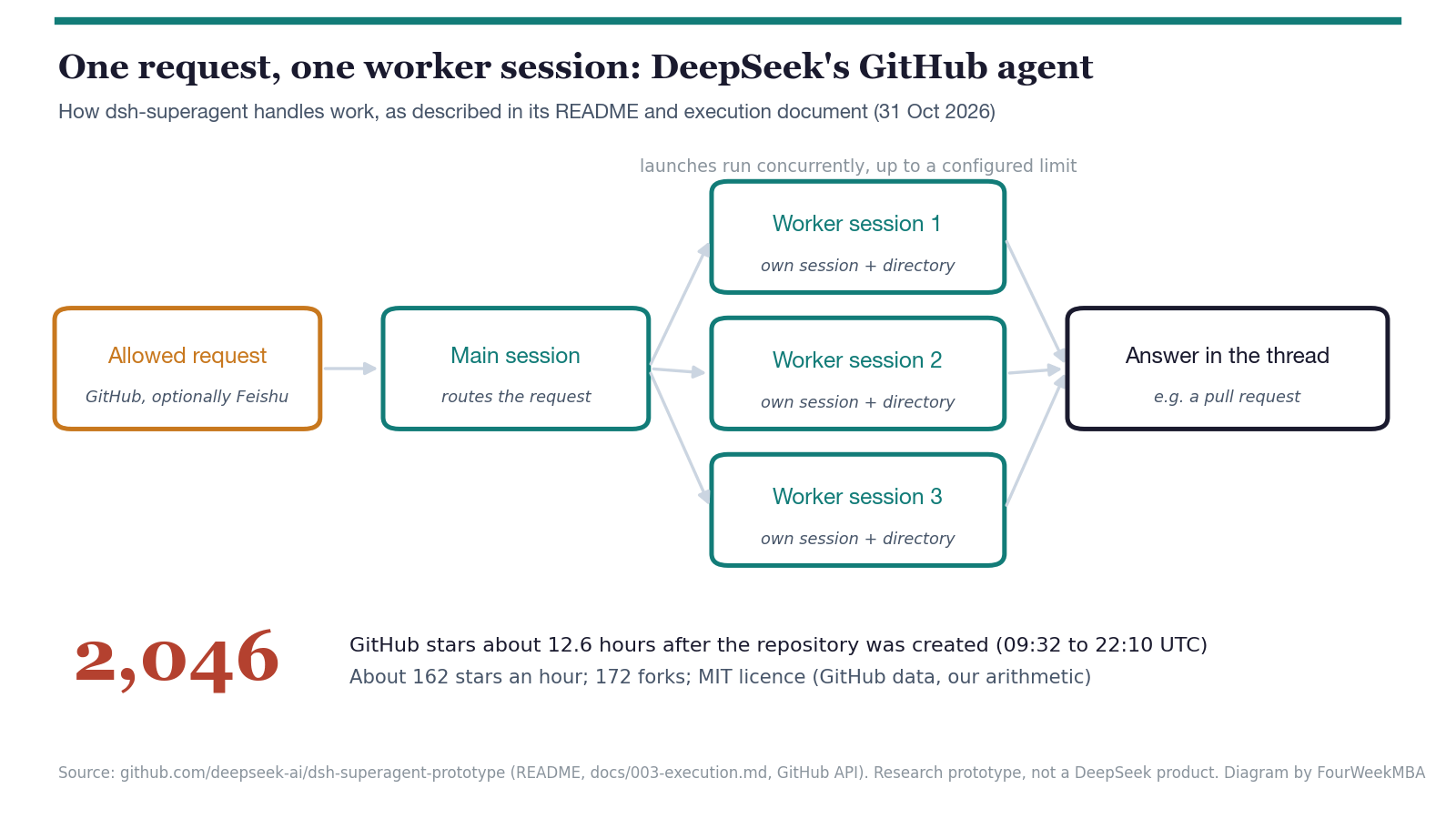
DeepSeek Super-agent is an experimental, MIT-licensed prototype that accepts task assignments from a GitHub repository and optionally from Feishu, then handles each task in its own isolated session. DeepSeek Harness published the code on October 31, 2026. The team is explicit: this is research code, not an official DeepSeek product and not ready for production use.

The project is available on GitHub under an MIT license. It does not introduce a new AI model. Instead, it functions as a component for DeepSeek Harness, the framework that manages agent sessions and tools. The practical ambition is to turn task requests already embedded in a team’s existing workflows into actions an agent can handle autonomously.
From Message to Repository Work
The prototype monitors a single GitHub repository and, when configured, Feishu conversations. When an authorized team member assigns a task, the system opens a ticket and creates a dedicated session and working directory. On completion, it can report results back into the originating conversation, including as a code-change proposal. A web page surfaces items that require human review.
The stated design goal is to reduce coordination overhead without adding noise to team communication channels. The software is meant to act only in response to an authorized request or a team-defined rule, and to signal when a human decision is needed or when a usable result is ready. This is a design choice described by DeepSeek, not a capability validated by independent testing.
The working model resembles other developer tools that link agents, code, and applications, including Vercel agent-desktop. The distinction here is focus: DeepSeek Super-agent organizes tasks and responses around a repository and group conversations, rather than controlling a desktop interface.
Not a New DeepSeek Model
The repository frames the software as a bundle for DeepSeek Harness and notes clearly that the published code does not necessarily match the internal version used by the team. It also clarifies that some architectural ideas from the Super-agent technical paper represent future directions and are not yet implemented in the available prototype.
Another DeepSeek drop: dsh-superagent
— Leandro von Werra (@lvwerra) October 31, 2026
An agent framework that works through a repo's GitHub issues and PRs with many agents in parallel, designed to take as little human attention as possible while delivering as much value as possible.https://t.co/3H2v9z6Wn6 pic.twitter.com/E1B75oOkEJ
That distinction matters. The release does not demonstrate that the agent can already manage a full product development cycle autonomously. The code provides an experimental foundation for integrating requests, separate sessions, and change proposals. As of the sources reviewed, there are no independent results on patch correctness, complex repository handling, or operational costs.
Any comparison with established coding-agent tools should therefore be made carefully. Benchmarks published by other companies, such as those covering COBOL code migration, address specific tasks under defined criteria. DeepSeek’s repository, by contrast, describes a work-orchestration prototype without offering a comparable benchmark.
Human Review Remains Essential
Setup requires a repository, credentials, and communication channels. The setup guide instructs users to collect operator responses before running configuration and to present the full plan before proceeding. Documentation also describes a web page for flagging decisions that belong to a human.
A proposed code change is not the same as approved or deployed code. The team can review the output, request revisions, or reject it entirely, exactly as they would with a standard pull request. Agent permissions, rules governing which tasks it can initiate, and repository controls all remain critical design decisions.
 Gennaro Cuofano
The broader supervisory question is shared across the current generation of agent tools. In Claude Duet, the agent works in the background and surfaces when a choice is needed. The Gemini agent from Google is positioned as an enterprise assistant with its own tools and sub-agents. These are different products and configurations. In every case delegation requires clear upfront decisions about which actions the system may take without fresh authorization.
Prototype, Not Production-Ready
DeepSeek warns explicitly that the code may contain bugs, that engineering practices may be inconsistent, and that anyone adopting it must review and adapt it first. The repository also showed a single commit at the time of the October 31 initial release, a signal of the project’s early stage rather than an independent measure of its quality.
Open-sourcing the code lets developers study the architecture and experiment in controlled environments. That alone doesn’t prove the system is reliable on real-world repositories or suitable for enterprise workflows. The value of the publication lies in the structure it proposes: an agent connected to team conversations, handling one isolated task at a time and returning a change for human evaluation.
DeepSeek Super-agent at a Glance
- Confirmed: public repository under MIT license; support for one GitHub repository and optional Feishu integration.
- Not established: independent benchmarks, success rates on real repositories, and operational costs.
- Worth watching: the permissions model, implementation of architectural ideas not yet present in the prototype, and the quality of proposed code changes.
The Bigger Picture
The real novelty here isn’t a new model. It’s an attempt to embed an agent inside a team’s daily workflow: requests arriving through an existing channel, tasks handled in isolation, and results returned to the original conversation thread. The practical challenge, in our reading, is reducing coordination friction without turning every agent output into yet another review item on an already busy backlog.
The elements worth tracking next are reproducible tests on real repositories, granular permission controls, and how the system handles ambiguous requests or incomplete outputs. Until those evaluations exist, DeepSeek Super-agent remains a prototype worth exploring, not a validated development tool ready for team deployment.