
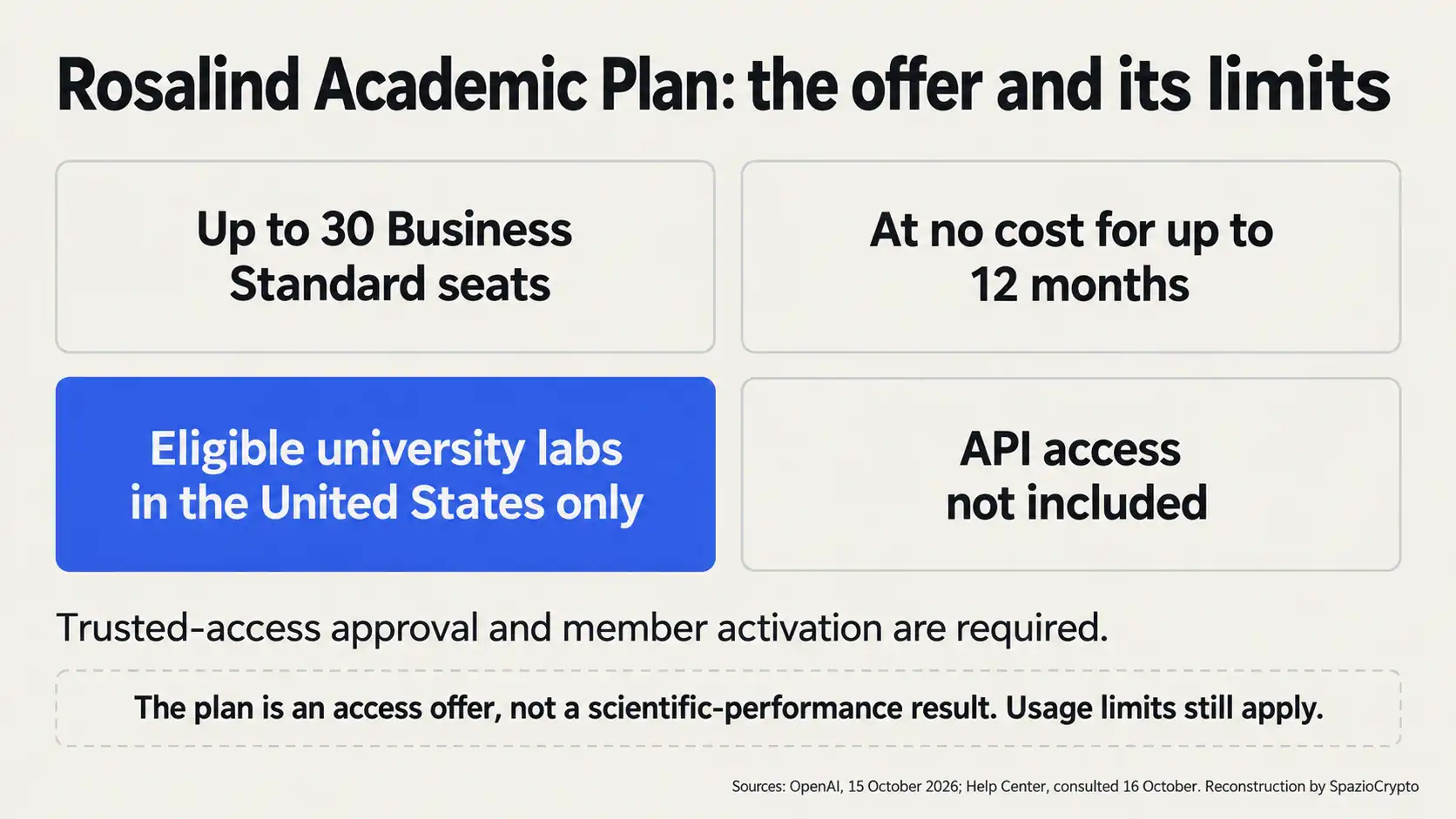
OpenAI announced the Rosalind Academic Plan on October 15, 2026, offering approved U.S. university laboratories up to 30 Business Standard seats at no cost for a maximum of 12 months. Access to GPT-Rosalind, the life-sciences-focused model, remains subject to verification and activation. The new offering is a structured academic program, not an open door for any researcher with a university email address.
We reviewed the OpenAI announcement, the program’s operational guide, and the model’s public page. These sources describe the offer, its requirements, and the provider’s oversight controls. They do not constitute an independent scientific evaluation of the model’s effectiveness. We did not submit an application, use the model in a lab setting, or verify the results cited in promotional examples.
The Free Offer Has Clear Boundaries
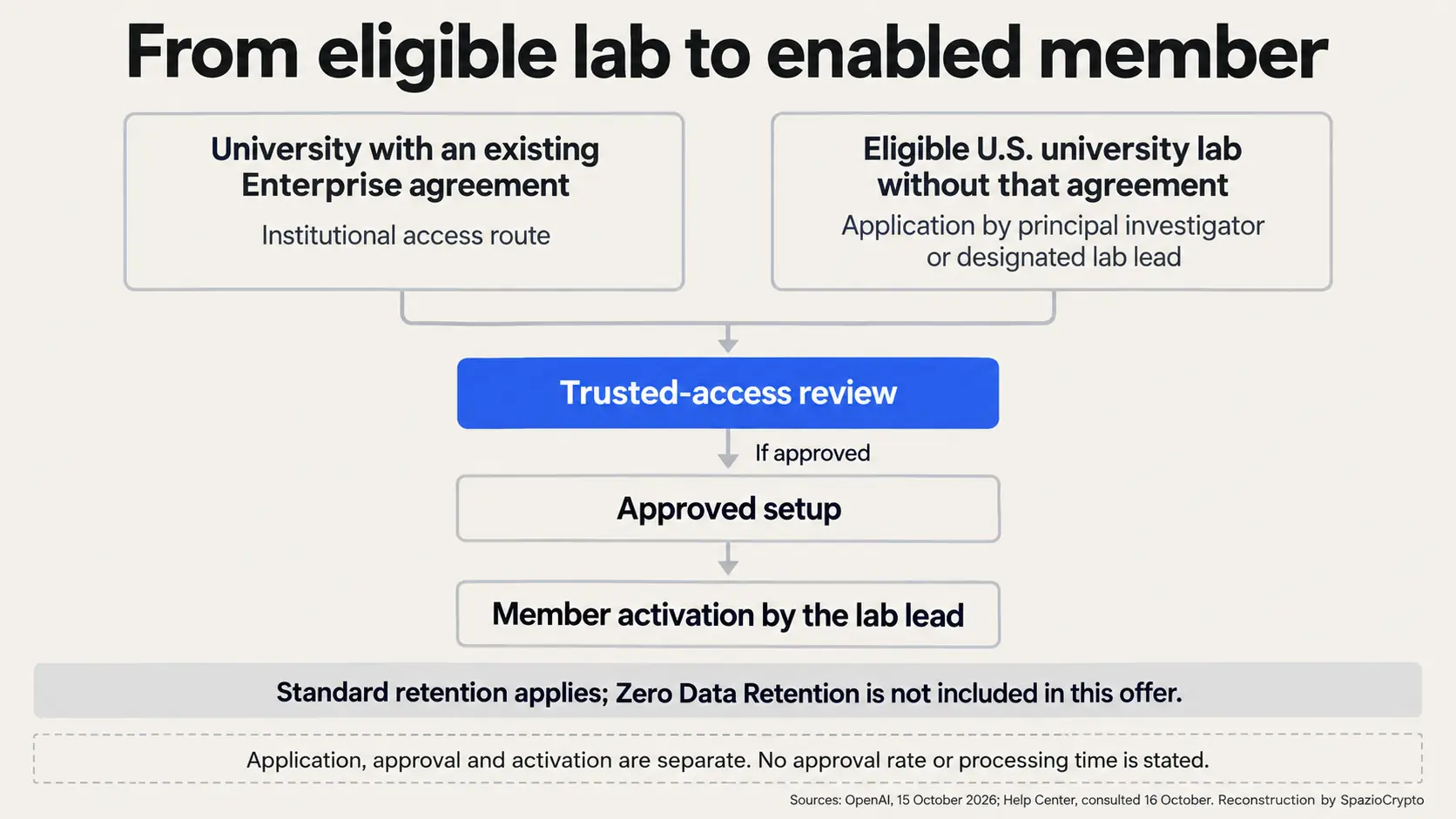
The program targets academic laboratories affiliated with universities in the United States. The operational guide draws a firm line between eligibility for the offer and approval for model access: holding a university email address or an existing subscription does not guarantee entry. After the review, the applicant must still complete workspace configuration and member activation. Submitting an application, in other words, is not the same as being able to use GPT-Rosalind immediately.
The 30 seats include ChatGPT and Codex access with their respective usage limits. The plan does not include API access. The 30-user cap applies to a single workspace, and labs cannot multiply the benefit by spinning up additional environments. We won’t calculate a dollar-savings figure by stacking different subscription prices: OpenAI defines this as a promotion with its own specific terms, and the public listing is not a quote for institutions that fall outside the eligibility criteria.
We’re tracking this program in our AI coverage archive as a shift in how specialized AI tools reach research environments, not as a scientific discovery in its own right. OpenAI cites laboratories that are already exploring uses for the model. Those testimonials help clarify the product’s intended purpose, but they don’t measure accuracy, reproducibility, or comparative advantage over unassisted research. A statement of use is not a demonstration of efficacy.
The Lab Director Controls Member Access
The application must be submitted by the principal investigator or a designated lab representative. Where a university already holds an Enterprise agreement with OpenAI, the process routes through that existing institutional arrangement. In all other cases, the guide describes a lab-level application process. That distinction exists to prevent an individual researcher’s initiative from being confused with institutional authorization to create a separate environment.
The verified contact manages member permissions and model access, and must review those permissions when affiliations or usage needs change. The guide also requires a knowledgeable institutional contact for biosafety. The program is not described as blanket authorization for any line of research: access remains bounded by declared use, approvals, and ongoing monitoring. We’re not embedding experimental instructions or protocols in describing these conditions.
The question of operational identity here echoes the Workday and Claude case, where permissions were tied to the HR management system. That parallel is our editorial reading, not a commercial relationship between the two products. In both contexts, the useful distinction is between who formulates a request and who carries institutional responsibility for authorizing a tool’s use. In the academic plan, that responsibility stays tied to identifiable people and institutions.
A Research Assistant Does Not Validate a Discovery
OpenAI presents GPT-Rosalind as a support system for scientific reasoning and for orchestrating specialized tools. According to the program guide, it can be useful in a lab context for reading literature, working with data, and developing analysis code. The plan does not produce a new experimental result to evaluate. We’re not reporting success-rate percentages or time-savings figures that our editorial team has not independently verified.
The boundary between generated content and observed data remains central to responsible use. The scientific video disqualified by Nikon for AI use turned on competition rules specific to that contest, not on this model. We cite it to mark an editorial distinction: a plausible representation does not replace the provenance of material or the verification a given context requires. Our read is that eased access should come with clear criteria for auditing outputs.
The documented incidents in Claude testing belong to a different provider and a different environment. We don’t use them to attribute the same behaviors to GPT-Rosalind. They serve as a reminder that a model and the tools it connects to need to be evaluated together. This article does not include a comparative test of the two systems: the verified fact is a new academic access pathway with stated constraints.
Not Training on Data Is Different from Not Retaining It
OpenAI’s announcement states that research data shared under the plan is not used to train models by default. The operational guide clarifies that standard workspace data retention applies and that the offering does not include Zero Data Retention. Those two statements answer different questions. Opting out of training use is not a promise that every piece of content gets deleted immediately after a request.
Data control, a point raised by Tim Berners-Lee in broader debates about the web, remains part of the institutional decision each lab must make. Our read is that a lab should evaluate uploaded information, enabled personnel, and environment conditions together. A subsidized price does not automatically make it appropriate to transfer any data into the system. We’re not attributing a specific regulatory approval or a universal guarantee on sensitive data handling to this plan.
What About Labs Outside the U.S.?
As of the consultation date, the program accepts applications from laboratories affiliated with U.S. universities. This is not an announcement of free access for institutions in Europe or elsewhere. The geographic requirement reported in the source materials applies to the lab and its institution; we don’t infer different conditions from the nationality of an individual researcher. For labs based outside the United States, the pages reviewed do not describe an equivalent plan that can be called available.
The usage policies of other AI providers don’t carry over to OpenAI: each program requires its own documentation. Access through an existing university enterprise agreement is also distinct from this new free-seat offer. These are useful constraints for reading the headline without overstating it: the number of admitted users and the maximum duration define the benefit, while affiliation and approval determine who can receive it.
Rosalind Academic Plan at a Glance
What’s confirmed, what isn’t
- Confirmed: Plan announced for approved U.S. university labs, up to 30 seats for 12 months.
- Not indicated: Extension to non-U.S. institutions or editorially verified scientific benefits.
- To watch: Approvals issued, member activation rates, and results from independent evaluations.
The Bigger Picture
Our read is that the distribution of specialized AI models is increasingly organized around the selection of specific, controlled environments. Lowering the cost of access can broaden experimentation, but accountability and oversight remain baked into the product design. The interesting detail here isn’t just the zero-cost entry: it’s that the offer is structured around an identified lab and a named contact who manages authorized personnel.
The signals to watch next are actual lab activations, any geographic expansion of the program, and scientific outcomes that can be assessed through independent methods. For now, we can verify the published requirements and conditions. We can’t say the plan has already accelerated a discovery, replaced an experimental result, or made GPT-Rosalind available without oversight.