

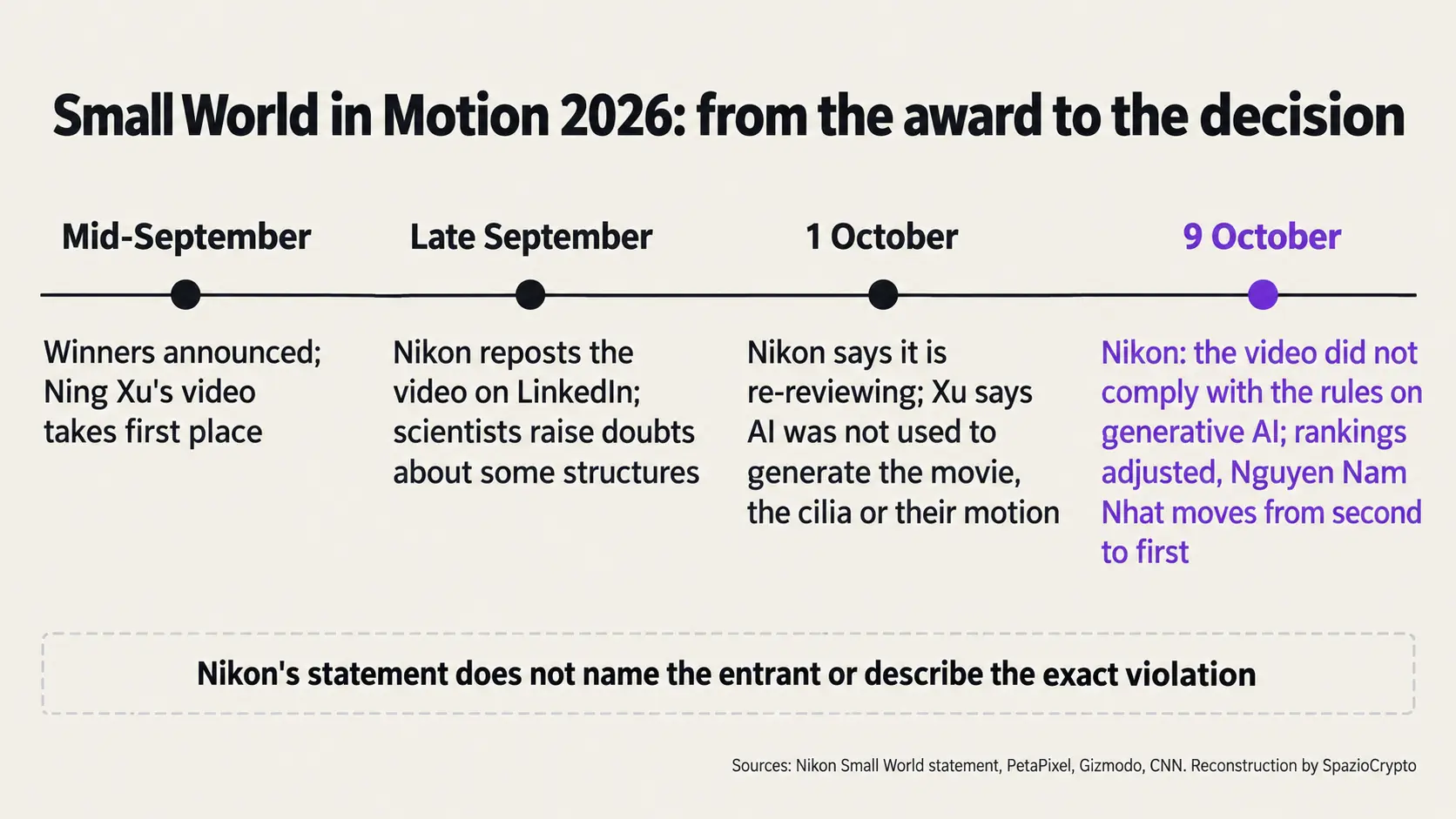
Nikon disqualified the winning video from its Small World in Motion 2026 competition on October 9, removing researcher Ning Xu from first place after concluding that his microscopy footage violated the contest's rules on generative AI. The top prize now goes to Vietnamese researcher Nguyen Nam Nhat, whose video captures a tiny roundworm alongside a single-celled organism. The case has drawn attention far beyond the photography world, touching a question that creators, scientists, and image-makers are all wrestling with: where exactly does processing an image end and generating its content begin?
🥇 Congratulations to Dr. Ning Xu for winning this year's Nikon Small World in Motion competition!
— Nikon Small World (@NikonSmallWorld) September 17, 2026
Read more about Dr. Ning Xu and his winning video in his Masters of Microscopy article: https://t.co/5fAIQZg8bY pic.twitter.com/JuU4sZs2fa
The decision is confirmed by the official Nikon Small World statement and by reporting from Gizmodo, PetaPixel, CNN, TechRadar, and Amateur Photographer. One key technical question remains open: none of those sources fully explains what role AI played in the footage, so it would be wrong to assume the entire video was AI-generated. The Ars Technica coverage was inaccessible to our tools at the time of writing.


What Is Confirmed: The October 9 Decision
In its October 9 statement, Nikon Small World said it had re-evaluated the video and supporting materials and consulted with jury members, concluding that the entry “did not comply with the competition rules on generative AI.” The rankings were updated accordingly. Notably, the official statement does not use the word “disqualification” (that language comes from PetaPixel, Gizmodo, and Amateur Photographer), does not name Ning Xu directly, and does not specify which rule was broken or how.
Nikon was careful to add that the decision is based solely on the video's eligibility under contest rules and should not be read as a judgment on the competitor's professional reputation, scientific contributions, or intentions. The company also acknowledged that advances in imaging and AI are creating new challenges, and that both Small World and Small World in Motion will need to revise their rules and evaluation procedures for future editions. The updated top five now lists Nguyen Nam Nhat (Vietnam), Benedikt Pleyer (Germany), Andrew Moore (United States), Patrick Hickey (United Kingdom), and Igor Adameyko (Austria). According to PetaPixel, Nguyen had originally placed second.
The rule cited in the press deserves a brief note. PetaPixel reports that the competition rules state “AI-generated videos are not permitted.” The version of the rules page we were able to read did not include that exact phrase: it requires videos to be captured by the entrant using an optical microscope, excludes graphics, and voids entries generated by scripts or automated means. The discrepancy may reflect a different version of the rules document, so this citation remains attributed to press reporting rather than primary source.
The Video and the Researchers' Doubts
The disqualified footage showed the abnormal ciliary beat of respiratory cells from a child with primary ciliary dyskinesia, a rare genetic condition. Nikon announced the winner in mid-September and later reposted the video on LinkedIn, where critical comments began to surface. Edward Phelps, an associate professor at the University of Florida, wrote that the video had “many serious problems” and that violet structures “appear and disappear” in ways that don't match known biology. According to Gizmodo, Phelps explained that the violet structures resemble mitochondria, but extracellular mitochondria as large as cell nuclei simply don't exist; the blue nodules look like nuclei without behaving as such; and he could not identify the red structures at all.
🥈 Second place in the 2026 #SmallWorldInMotion competition has been awarded to Nam Nhat Nguyen for his video of a tiny roundworm and a single-celled Dileptus exploring their microscopic world. Congratulations!
, Nikon Small World (@NikonSmallWorld) September 18, 2026
View the full gallery online: https://t.co/9wEIy8KQ0D pic.twitter.com/WwudpdxerB
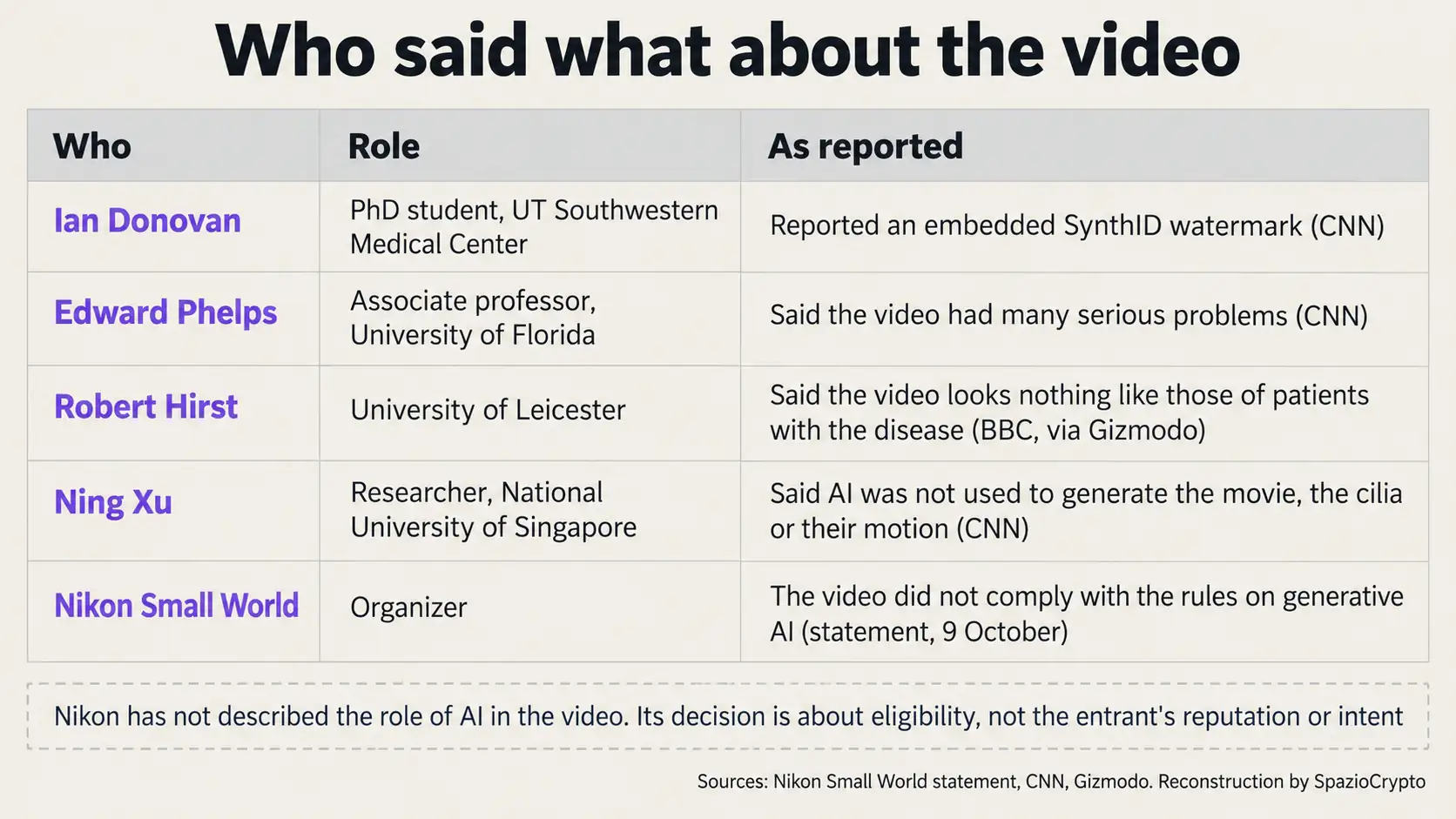
Ian Donovan, a doctoral researcher at UT Southwestern Medical Center, flagged a SynthID watermark in the video. SynthID is the system developed by Google DeepMind to mark content produced with AI tools. According to PetaPixel, Donovan detected it by running the video through Gemini, suggesting that at least some portion of the content was AI-generated. CNN and Gizmodo both reported the finding, and none of the sources we read included a response from Nikon on this point. The principle is the same as the invisible watermark that Anthropic applies to Claude's text outputs: a hidden signal indicating that an AI tool was involved, without specifying how much.
Robert Hirst, a researcher at the University of Leicester who has spent twenty years diagnosing primary ciliary dyskinesia by observing cilia, told the BBC that the video “looks nothing like” footage from patients with the condition, as reported by Gizmodo. Hirst stated that the episode had caused harm to patients, clinicians, and support networks around the world.
Xu's Defense and What Remains Unclear
Xu, currently a researcher at the National University of Singapore and, according to CNN, affiliated with Tsinghua University at the time of submission, stated that “AI was not used to generate the experimental footage, the cilia, or their motion.” He acknowledged applying AI after the fact, to grayscale reconstructed data, to distinguish and colorize structures with similar morphology, without making anatomical claims about what those structures represent, as reported by Gizmodo. Also per Gizmodo, Nikon had updated its own post to note the use of an unsupervised neural network method in post-production and visualization, aimed at producing a “more vivid and engaging” video. At the time Nikon issued its decision, Xu had not responded to Gizmodo's request for comment.
Three questions remain open. No source explains which specific AI tools were used or at which stages of production, and Nikon has not publicly described the AI's role in the video. According to PetaPixel, several scientists argue the matter could be settled by releasing the raw grayscale footage, which has not been shared publicly. CNN reports that Xu is preparing a full description and quantitative analysis for publication.
Where Processing Ends and Generation Begins
The real question isn't whether AI is banned from microscopy, but what it actually does at each stage. Gizmodo argues that generative AI represents “a difference in kind, not degree,” because it produces new pixels rather than correcting recorded ones. The outlet also cites a 2010 scientific guideline, predating generative AI, requiring disclosure from anyone who colorizes images. Our read is this: a filter that enhances what the camera captured works on the data; a model that decides how to colorize or fill gaps can introduce something the original data never contained. As we explored in our piece on ChatGPT as a trading assistant, AI holds up as a support tool only as long as decision-making and accountability stay human.
 Nikon Small World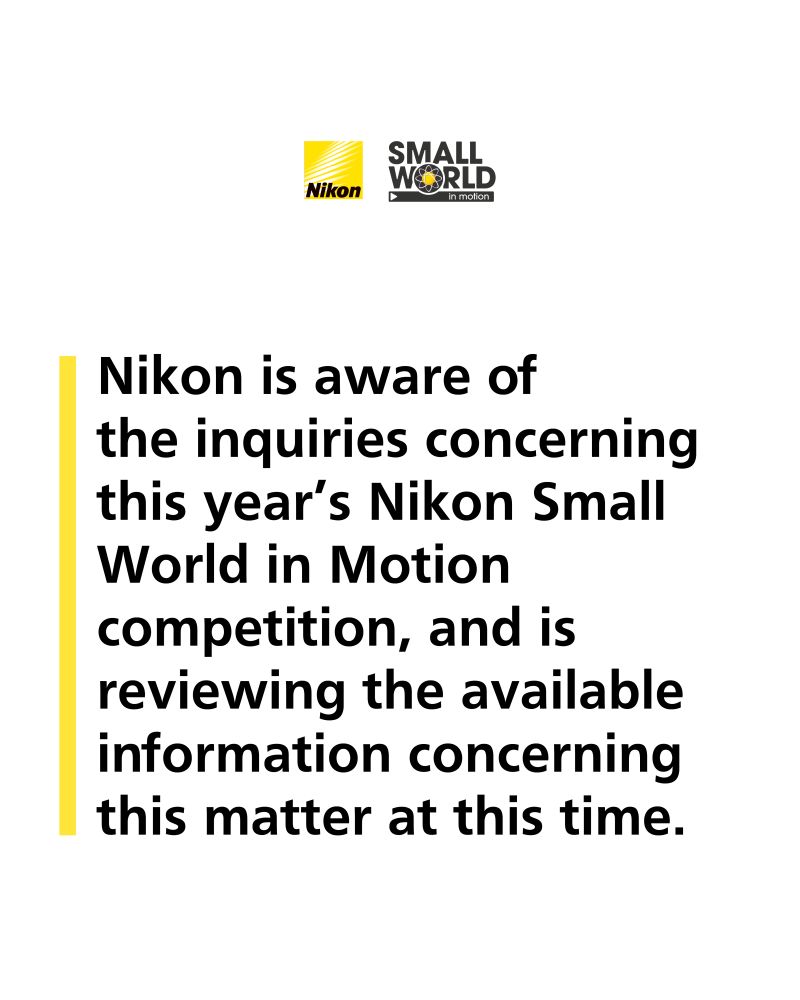
Melanie White, a developmental biologist at the University of Queensland, told Nature (as cited by Gizmodo) that scientists need to trust that what they see is grounded in actual measurement. Among the contestants, Patrick Hickey, described by Gizmodo as the fifth-place finisher, stated that the rules were clear: generative AI could not produce content, and images had to be captured under a microscope. Andrew Moore, a former competition judge, said the rendering reminded him of old photographs restored with AI, per Gizmodo's reporting.
The rules governing this space operate on three distinct levels. There is the law: from August 2, 2026, Article 50 of the EU AI Act requires disclosure of any content generated or manipulated by AI, including deepfakes. There is the platform: Anthropic's updated Usage Policy addresses deceptive campaigns, for instance. And there are the organizers, who write their own contest rules. Our assessment is that the Nikon case illustrates how much a rule declared before the award ceremony matters, rather than one reconstructed after the fact.
This isn't the first competition to grapple with AI. Amateur Photographer notes that in 2023, the winner of the Creative Open category at the Sony World Photography Awards turned out to be an AI-generated image, and that in 2026 a finalist at the Hasselblad Masters was disqualified after AI use came to light. These are precedents cited by the source and not independently verified.
The Nikon Case at a Glance
What is confirmed, what is not. Sources: Nikon statement, Gizmodo, PetaPixel, CNN
- Confirmed: on October 9, Nikon concluded that the winning video violated the rules on generative AI and updated the rankings; first place goes to Nguyen Nam Nhat; Xu acknowledges using AI in post-production and denies using it to generate the footage, the eyelashes, or their movement; Nikon clarifies that the decision is not a judgment on reputation or intent.
- Not disclosed: which AI tools were used and at which stages; the precise role of AI according to Nikon; the AI clause in the version of the rules we reviewed; any public verification of the SynthID watermark; Xu's response to the decision.
- To watch: the technical description and quantitative analysis Xu is preparing; the new evaluation procedures announced by Nikon; whether the raw grayscale video will be made public.
What Changes for Creators and Photographers
The case points to three practical conclusions for anyone producing content, and this reading is our own. Competition rules should be read as constraints on process, not just on the final output, because Nikon assessed eligibility rather than intent. Keeping original files and documenting every editing step is the only way to demonstrate what was done, as the scientists' request for the raw footage makes plain. Disclosing AI use in post-production before submitting an entry costs far less than explaining it after the ceremony.
The authenticity question extends well beyond competitions. The AI voice-cloning fraud targeting Fideuram and the fake government request that deceived Revolut both show that verifying the origin of what you see or hear has become an operational problem, not merely a reputational one.
The Broader Picture
The Nikon case doesn't suggest that AI has no place in research or photography. It does indicate that any processing step that changes what is visible must be disclosed to those judging the work, especially when an image carries scientific weight and depicts a real disease. That is our interpretation; Nikon, for its part, has stated that it values the integrity of every selected image and video and intends to uphold those standards.
The concrete signals worth tracking: whether Xu publishes the full technical description and quantitative analysis, whether the raw video is shared publicly, how Nikon rewrites its rules and procedures for future editions, and whether other competitions follow suit. Until those questions are answered, the story remains a ruling on eligibility and a debate about the boundary between processing and generation, not proof that the video was entirely artificial.