


A network configuration change triggered a service disruption that knocked out Outlook, Teams, Copilot, and other Microsoft 365 functions for users across multiple regions for more than a day. Microsoft confirmed the problem emerged after a network modification and reported progress in restoring services, but as of November 14 the status page still listed Microsoft 365 as degraded. The company stated, in its own public communications, that no cyberattack was involved and that artificial intelligence systems were not the cause. A full post-incident report is still pending.
This article draws on the Microsoft public status page, Associated Press reporting from November 13, and Sky News coverage from the same date. According to the Associated Press, Downdetector reports reached well above average levels across 74 countries. Those figures reflect user-submitted reports, not an official count of affected accounts.
What Went Down: Mail, Collaboration, and Copilot
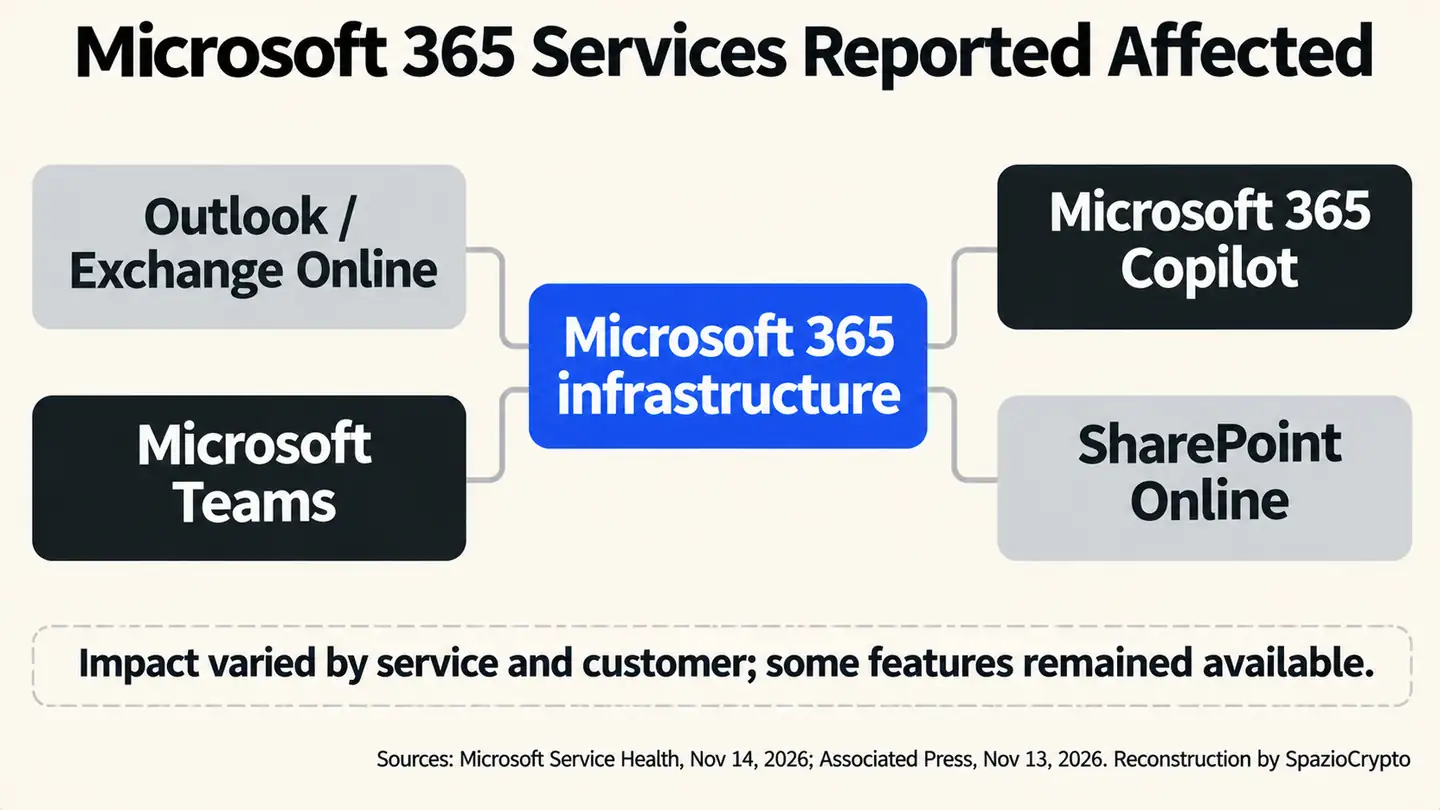
The incident began on November 12 and hit multiple components of Microsoft 365 at once. Services listed in Microsoft’s own status updates included Exchange Online, Outlook, Teams, Copilot, SharePoint, and certain admin and productivity features. The impact was not uniform: Microsoft noted that features dependent on mail and Exchange services were degraded, while some capabilities unconnected to those backend systems remained available.
Users reported difficulty accessing inboxes, email delivery delays, and disruptions to collaboration and AI-assisted features. As of November 14, Microsoft’s status page indicated that some customers could still experience intermittent access issues or delayed messages even as recovery work continued.
The propagation across multiple products is the most telling aspect of this incident. A cloud service is not a collection of independent applications. Authentication, networking, mail routing, storage, and backend services often underpin several tools simultaneously. When a shared layer degrades or fails to respond correctly, the effect can surface in products that users treat as entirely separate.
That said, this was not a blanket Azure outage. The documented disruption affected specific Microsoft 365 functions, with impacts varying by region and product. SpazioCrypto’s coverage of data center infrastructure tracks the physical and network layers that underpin cloud and AI services.
Microsoft Traces the Fault to a Network Change
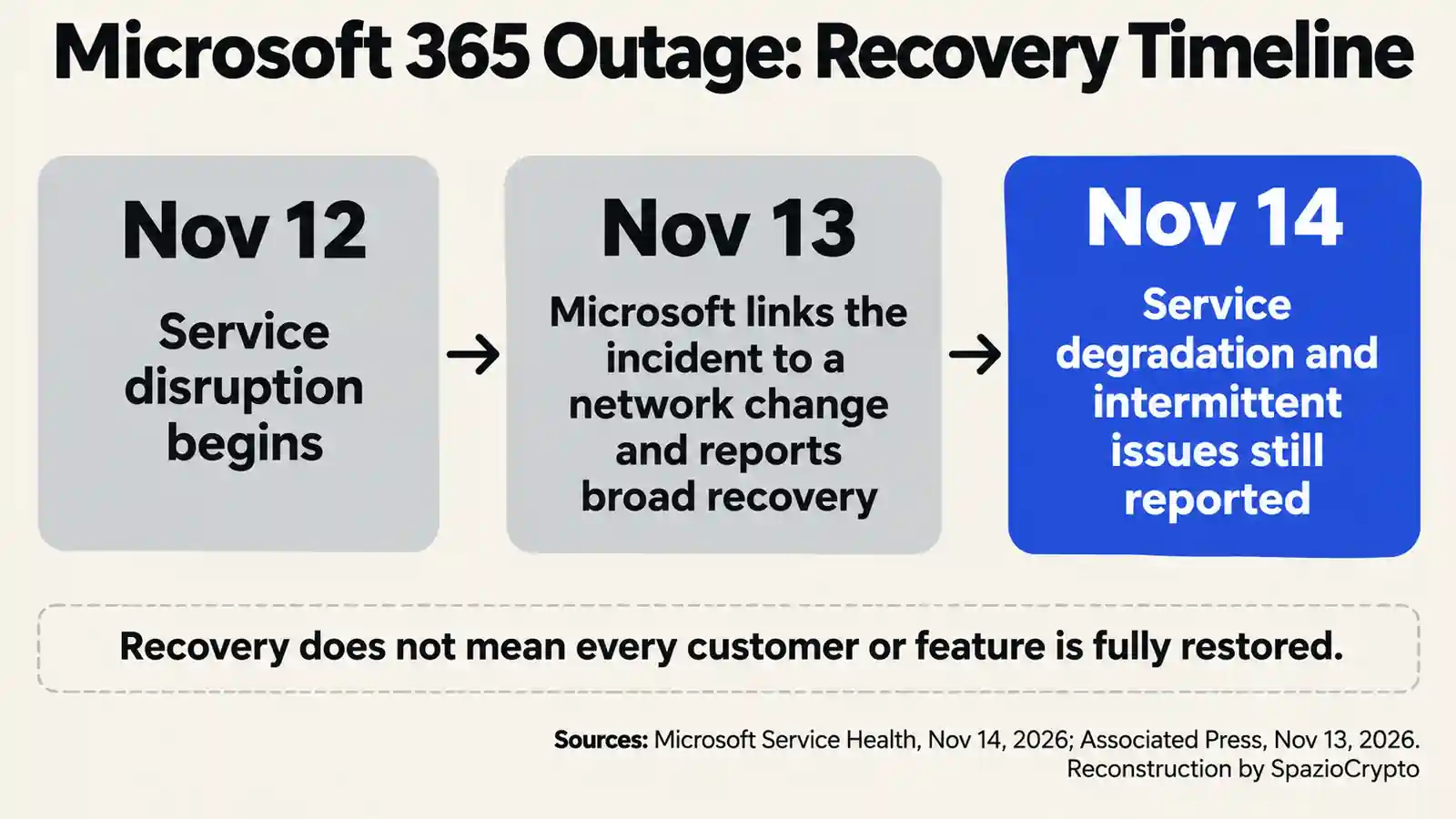
In its November 13 update, Microsoft described the incident as a technical problem unrelated to a cyberattack, to AI systems, or to any AI agent behavior. The company said a problem introduced during a prior network capacity upgrade surfaced after a subsequent configuration change. Engineers worked to restore capacity, recover affected systems, and gradually return services to stable levels.
That public statement clarifies the category of event, but it does not constitute a full technical post-mortem. Microsoft said it will publish a post-incident review after mitigation is complete, covering the root cause and planned prevention measures. Until then, specific details about configurations, affected components, and the precise failure sequence should not be treated as confirmed.
The ruling-out of a cyberattack also comes from Microsoft itself. The company stated it found no evidence of malicious activity associated with the problem. That is a useful data point, but it does not replace a final report or independent verification. Early speculation that circulated online about the outage’s origin does not constitute evidence.
The distinction between a technical failure and a security incident matters for organizations assessing their exposure. A technical failure primarily carries availability risk. A security incident may add unauthorized access or data exposure to the equation. Based on Microsoft’s public communications so far, this appears to be an availability and capacity problem, not a data compromise.
Recovery Is Broad, But the Incident Is Not Closed
According to the Associated Press, by November 13 Microsoft was observing extended recovery and greater stability across North America, Europe, and Asia-Pacific. Email queues were trending back toward normal levels, though some customers could still experience intermittent access and delays. The public status page continued to show Microsoft 365 degradation on November 14, so recovery should not be confused with formal incident closure.
Operational consequences extended beyond individual inconvenience. The Associated Press collected reports of disruptions at businesses and public bodies in multiple countries, including organizations that depend on email for internal processes and official communications. The severity varied: not every function was down, and not every organization cited experienced a critical outage.
Microsoft 365 serves more than 450 million paid commercial subscribers, according to the Associated Press. That figure illustrates the potential scale of a platform disruption, but it does not indicate how many users were actually affected in this specific event. Microsoft has not published a verified count of impacted accounts.
The incident returns a familiar question to the foreground: how much operational risk comes with concentrating productivity tools in a single vendor ecosystem? European regulators have already flagged concentration risk around digital and AI services provided by non-EU operators, a concern explored in depth in SpazioCrypto’s analysis of European finance’s dependence on foreign digital infrastructure. This outage alone does not prove systemic risk, but it makes a practical case for testing business continuity plans before the next disruption arrives.
Resilience Depends on Plans That Actually Work
No organization can prevent every failure at a third-party provider, but most can reduce the operational impact of one. Measures worth reviewing include alternative communication procedures for urgent matters, locally accessible copies of essential contacts, independent data export and retention, clearly assigned emergency roles, and documented steps for resuming work once a platform comes back online. A written plan is not enough: it needs to be tested without relying on the very services that may be unavailable.
The question also touches the physical structure of the digital economy. The expansion of data centers used by Microsoft and other hyperscalers is usually discussed in terms of energy and compute capacity. Reliability, redundancy, and interconnection are an equally important part of the same infrastructure picture. As more services rest on shared platforms, understanding which dependencies overlap and which alternatives are genuinely independent becomes a practical business concern, not just an IT abstraction.
Cloud growth also makes it strategically important to distribute workloads and data across multiple infrastructures. SpazioCrypto’s coverage of IREN’s expansion into AI data centers and the global race for AI infrastructure shows how capacity, energy, and geography are becoming core dimensions of digital service delivery. Redundancy is not just about buying more servers: system separation and the practical ability to switch providers matter as much.
Multi-cloud agreements deserve scrutiny here. A second cloud vendor does not guarantee continuity if identity management, email, backups, or core processes remain tied to the same single point of failure. Access to models and services from different clouds, as in the case of OpenAI models previewed on Google Cloud, does not automatically translate into a disaster recovery strategy. That requires specific architecture decisions and regular testing.
Microsoft 365: What Is Confirmed and What Is Not
A Summary of Known Facts
What we know and what we don’t:
- Confirmed: Microsoft reported a multi-service Microsoft 365 incident beginning November 12, attributed to a network configuration change, and communicated progress in recovery.
- Not confirmed: the verified number of affected users and the complete root cause, which Microsoft has committed to publishing after mitigation closes.
- To watch: formal incident closure, the post-incident report, and stable restoration of mail and related functions.
The Bigger Picture
As an editorial observation: this incident makes the operational cost of concentration visible. A single network change can affect multiple tools when they share components and infrastructure. That is not evidence that cloud services are inherently unreliable, nor does it prove Microsoft’s redundancy was insufficient. Assessing the causes and corrective measures will require the full technical report.
The signals to watch next are the official incident closure, the detailed technical sequence Microsoft commits to publishing, and the specific prevention actions announced. For organizations, the most useful test is straightforward: check whether emergency procedures actually function when mail, collaboration, and file access all depend on the same ecosystem at the same time.
Sources
Service status and recovery updates: Microsoft Service Health, accessed November 14, 2026. International scope, recovery progress, and service dependencies: Associated Press, November 13, 2026. Microsoft statements on technical cause and recovery: Sky News, November 13, 2026.