

MFL Arena, the free-to-play mode of the MFL football management game, opens to everyone on Tuesday, October 27, 2026, at 13:00 UTC. The MFL team announced the launch on October 26, after two weeks of private invite-only beta: creating a club now requires no codes and no waitlist. The move matters for blockchain gaming because MFL is trying to broaden its player base while keeping newcomers’ progression separate from the tradeable asset economy. That separation, though, has a gate that opens in only one direction.
This piece is based on the October 26 announcement, the beta rules published on October 5, the official MFL guide page for $MFL, and the article Flow published in March presenting MFL on its blockchain. The $MFL whitepaper page did not load during research, and the game app was not accessible to our tools. At the time of writing, the opening is scheduled but has not yet occurred.
Arena and Pro Manager: Two Modes, One Balance
MFL has existed since 2021, founded in Paris without external funding, according to Flow. The original game, covering clubs, leagues, contracts and seasons of roughly six weeks each, is now called Pro Manager. Arena is the second entry point: real-time 90-minute matches where the coach adjusts formation, pressing and substitutions while the game is live, with its own ranking and clubs kept separate from Pro Manager. Players start by choosing three young players and a captain.
The ladder runs through eight tiers: Amateur, Prospect, Semi-Pro, Pro, Elite, Champion, World-Class and Master, each with three levels, plus Legend at the top with twenty spots. The weekly cycle closes every Monday at 23:00 and rewards are distributed from there. The closest reference point for football fans is fantasy football with digital cards, similar to Sorare’s NFT model, with one key difference: matches are played and adjusted minute by minute in real time.
 MFL Team

What Changes From the Beta
According to the October 26 announcement, the public launch brings larger packs, with players ranging from 30+ up to 80+ overall rating (OVR), plus temporary boosts: each boost adds one point to all attributes for 15 Arena matches, with a maximum of three boosts active simultaneously. Matchmaking becomes more balanced, as the first 30 matches of each season factor in starting lineup strength, with a maximum gap of 5 OVR points between opponents at Amateur level and 10 at Prospect. The wait time between matches drops from five minutes to one.
Season 1, called First Night, also launches with a free Season Pass and a Premium one. Beta clubs, Arena players and rankings are all reset. Cosmetics, earned $MFL and purchased pro players carry over. This rule was stated clearly on October 5: those who played the beta restart from scratch on the pitch, but keep everything that holds value outside Arena.
Gems: How You Earn Them and Where They Go
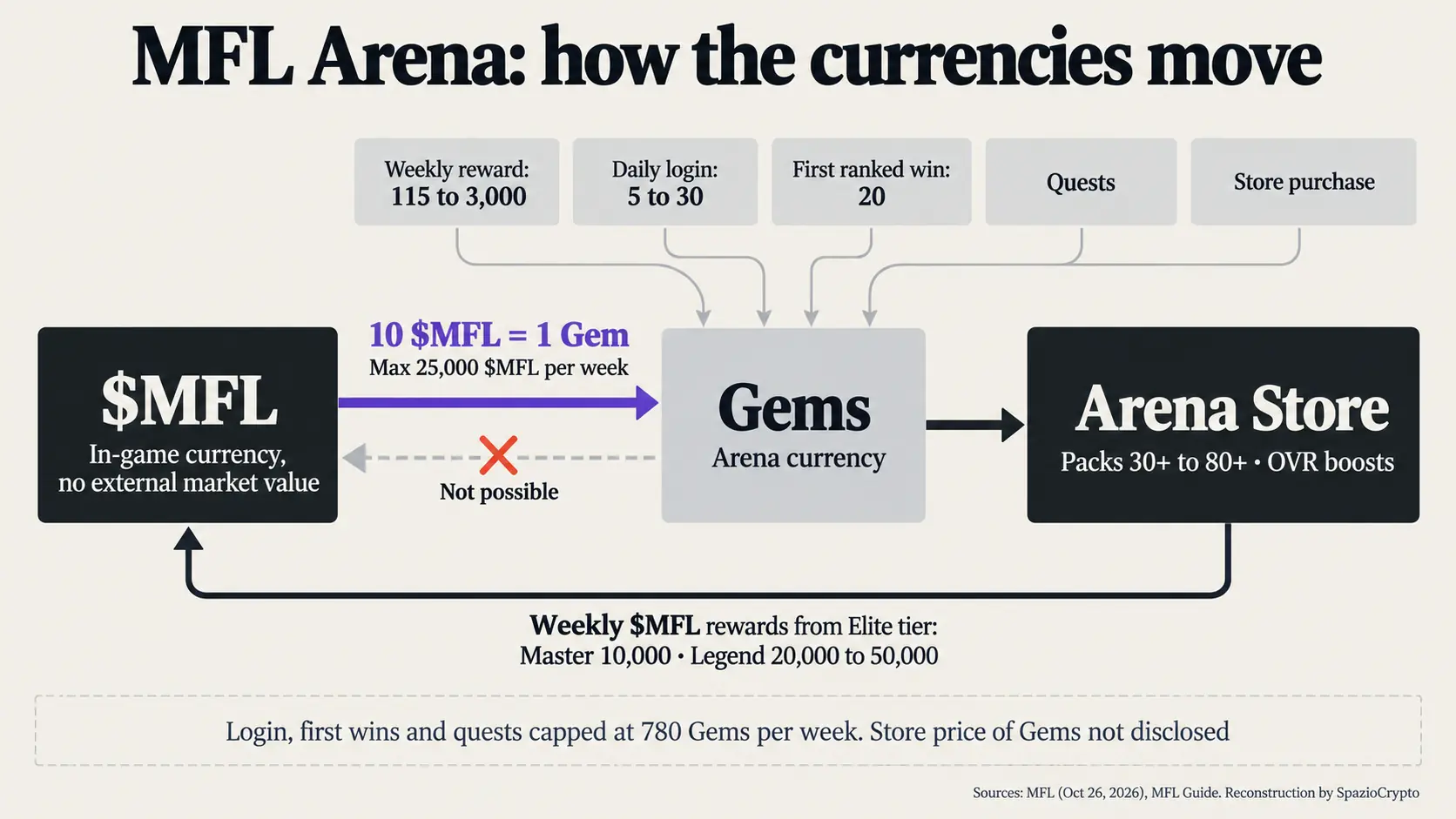
The central new feature is Gems, Arena’s internal currency. They are spent in the Store on packs and boosts. Players earn Gems through the weekly reward (from 115 Gems at Amateur III up to 3,000 at Legend), a one-time bonus the first time a new level is reached in a season, a daily login streak (from 5 Gems on day one up to 30 from day seven, with the streak resetting if a day is missed), 20 Gems for the first ranked win of each day, and daily and weekly missions. Login rewards, first wins and missions are capped at 780 Gems per week.
Two additional channels were not prominently flagged in the original beta brief. Gems can be purchased directly in the Store, according to the announcement, though no prices or payment methods are listed. And they can be obtained by converting $MFL at a rate of 10 $MFL per Gem, up to 25,000 $MFL per week. The conversion is one-directional: as MFL states, Gems cannot be converted back into $MFL. This is a deliberate design choice that keeps inside Arena what enters Arena.
$MFL Is Not an Exchange Token
A distinction worth drawing for crypto readers: according to the official MFL guide, $MFL is an in-game currency. It carries no external market value, cannot be sent to other managers. Does not trade outside the game. Supply is unlimited because it originates from competition rewards. Inside the Store, the reference rate is 800 $MFL per dollar, used to anchor prices.
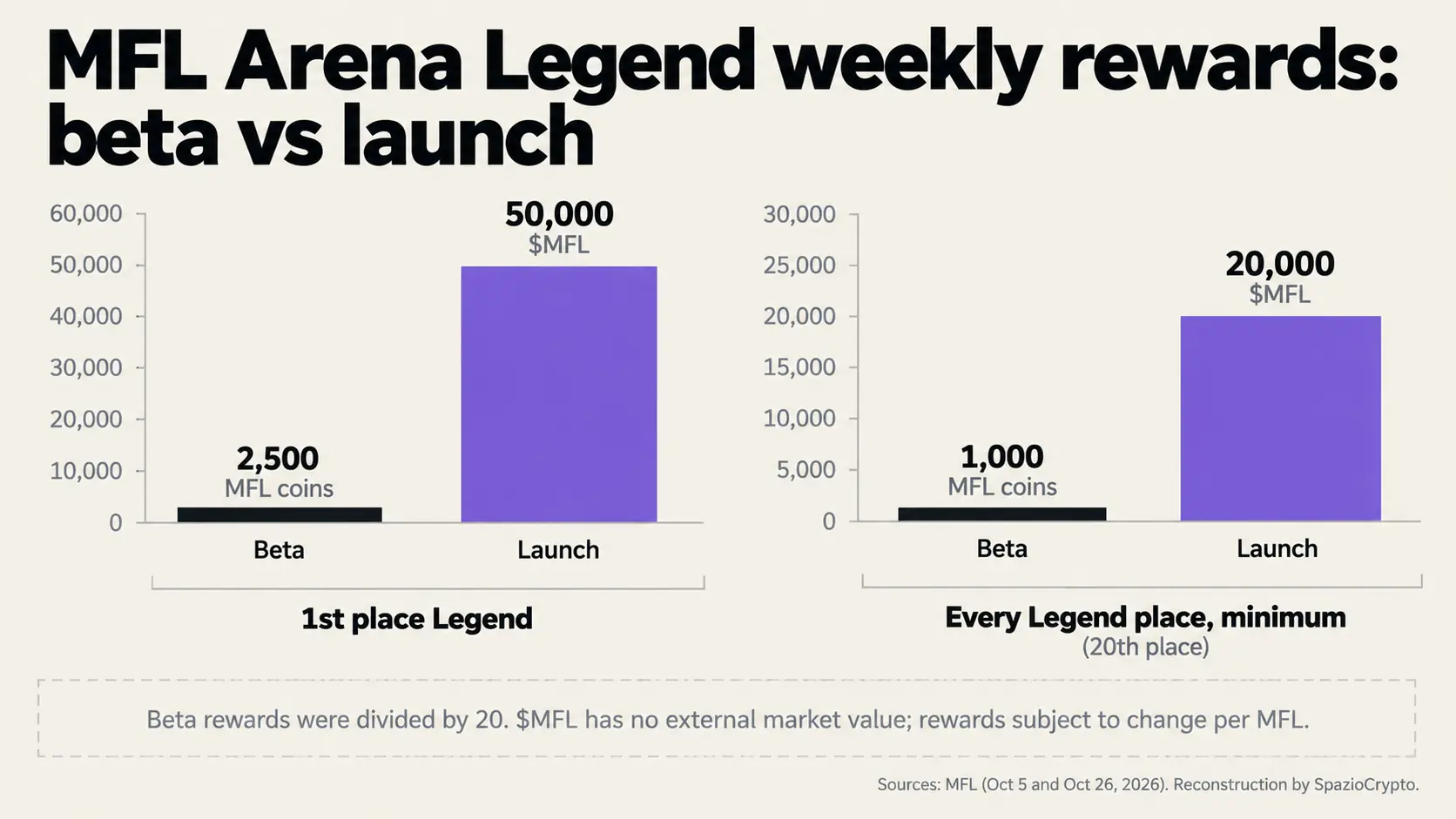
Applying that rate, one Gem is worth roughly 1.25 cents of a dollar, and the weekly conversion ceiling of 25,000 $MFL works out to about $31. That is an indicative calculation based on MFL’s Store reference rate, not a market price. Arena also pays out $MFL, not just Gems. From Elite level onward, the weekly reward includes $MFL: 10,000 at Master, and from 20,000 for Legend’s twentieth-place finisher up to 50,000 for first. A minimum of 10 matches per week is required, and from Pro level upward, 5 wins as well. These figures are consistent with the beta structure, where first-place Legend was worth 2,500 $MFL and MFL had disclosed that launch rewards would be 20 times the beta amounts.
Where the Blockchain Fits: Pro Players on Flow
The on-chain layer does not sit in Gems or $MFL. It sits in the assets. According to the article published by Flow in March, transfers, contracts and match outcomes are processed through smart contracts written in Cadence, Flow’s native language, and every in-game asset resides in the owner’s account: it can be transferred, not copied. Players do not need to install a wallet or pay network fees (what other platforms call gas fees): identity is managed through account abstraction. For a broader context on the underlying technology, our guide to NFTs remains useful, though the Flow article itself does not use that term.

Arena’s rules draw a clear line between two categories of players. Pro players, purchased with $MFL on the marketplace, are fully owned and tradeable. They can now progress in Arena too, but each pro can play in only one mode per season, determined by the first match played, and only if not under contract in Pro Manager. Arena pack players, by contrast, are bound to the mode and cannot be traded. According to the MFL guide, it is the $MFL-purchased assets that carry external market value. Flow reports, citing figures supplied by MFL, over 5,000 active managers and more than $3 million in cumulative secondary market volume.
Risks and Open Questions
Pricing is the first unresolved issue. MFL's announcement confirms that Gems can be purchased in the Store, but specifies neither the accepted currency nor the cost per unit, and packs operate as loot draws with a guaranteed minimum valuation. The second concern is rule stability: beta rewards were described by MFL as “subject to change,” and any game that controls its own currency supply can quietly shift the relative value of whatever players have accumulated. Third comes the broader sector context, which offers little comfort. As we reported at SpazioCrypto, 93% of GameFi projects are now inactive per the Caladan report, and Yield Guild Games shut down YGG Play, effectively walking away from the play-to-earn model.
 Flow
MFL promises no yields, and its in-game currency doesn't trade outside the ecosystem. Players who buy pro footballers, though, hold assets whose value depends entirely on internal demand and on how long the game survives. The same ownership-linked reward logic appears elsewhere in blockchain gaming: Splinterlands is preparing Collector Achievements tied to cards held in the binder.
MFL Arena in Brief
What is confirmed and what isn't
- Confirmed: public launch announced for October 27, 2026 at 14:00, no invite codes required; Gems as the Arena currency, obtainable by converting $MFL at a 10-to-1 rate (up to 25,000 per week) but not convertible back; $MFL rewards from Elite tier upward; pro players are tradeable, Arena pack players are not.
- Not specified: Gems price and payment method in the Store, Premium Season Pass price, pack drop probabilities. The announcement does not mention Flow.
- To watch: the actual activation after 14:00, how the new matchmaking system performs in practice, the effect of pro players in Arena on marketplace volumes, and the first Legend leaderboards paying out at full reward value.
The Bigger Picture
Our own read, stated plainly as such: MFL is applying a lesson the blockchain gaming sector learned at considerable cost. A new player doesn't need to touch a wallet or a tradeable asset to get started. Whatever currency they earn in the first weeks can't leave Arena. Existing $MFL holders can bring tokens in, but not take them back out. That valve shields the asset economy from inflation driven by a free-to-play mode. Simultaneously creating $MFL demand routed through the pro player marketplace.
Three signals are worth tracking. The Gems price in the Store will reveal how much Arena relies on direct spending. Marketplace volumes over the coming weeks will show whether pro player demand actually shifts now that pros can compete in Arena. And the conversion rate of Arena clubs upgrading to Pro Manager status, meaning full ownership economics, will be the real test: that figure, more than registration counts, will indicate whether the wider entry point is actually working.