

Tokenized deposits can now move between Singapore and the United States around the clock. On November 16, 2026, DBS and Kinexys by J.P. Morgan activated 24/7 dollar-denominated transfers between blockchain accounts in both countries, with Ant International as the first institutional client and Partior coordinating settlement. These are not stablecoins: they are bank deposits registered on a permissioned blockchain, and there is still one technical constraint worth knowing about.
TL;DR: DBS Token Services and Kinexys by J.P. Morgan went live on November 16, 2026 with round-the-clock dollar tokenized deposit transfers between Singapore and the US. Ant International is the first client, but a three-hour Saturday maintenance window still interrupts fully seamless 24/7 coverage.
How the Cross-Border Link Works
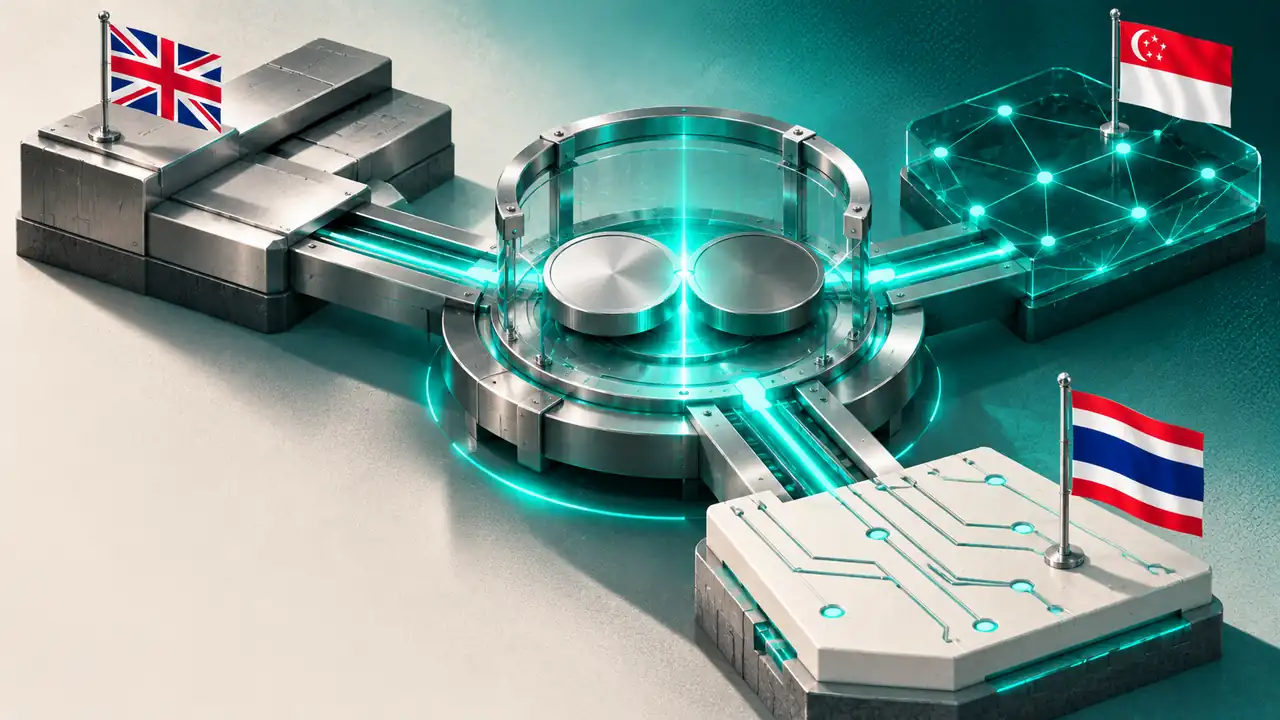
Each bank operates its own permissioned network. DBS uses DBS Token Services; Kinexys, JPMorgan's blockchain division, runs the Blockchain Deposit Account network. Neither is open to the general public. The new service bridges them: a client can move dollars in tokenized deposit form from a DBS account in Singapore to a Kinexys account in the United States, or in the reverse direction, with near-instant settlement.
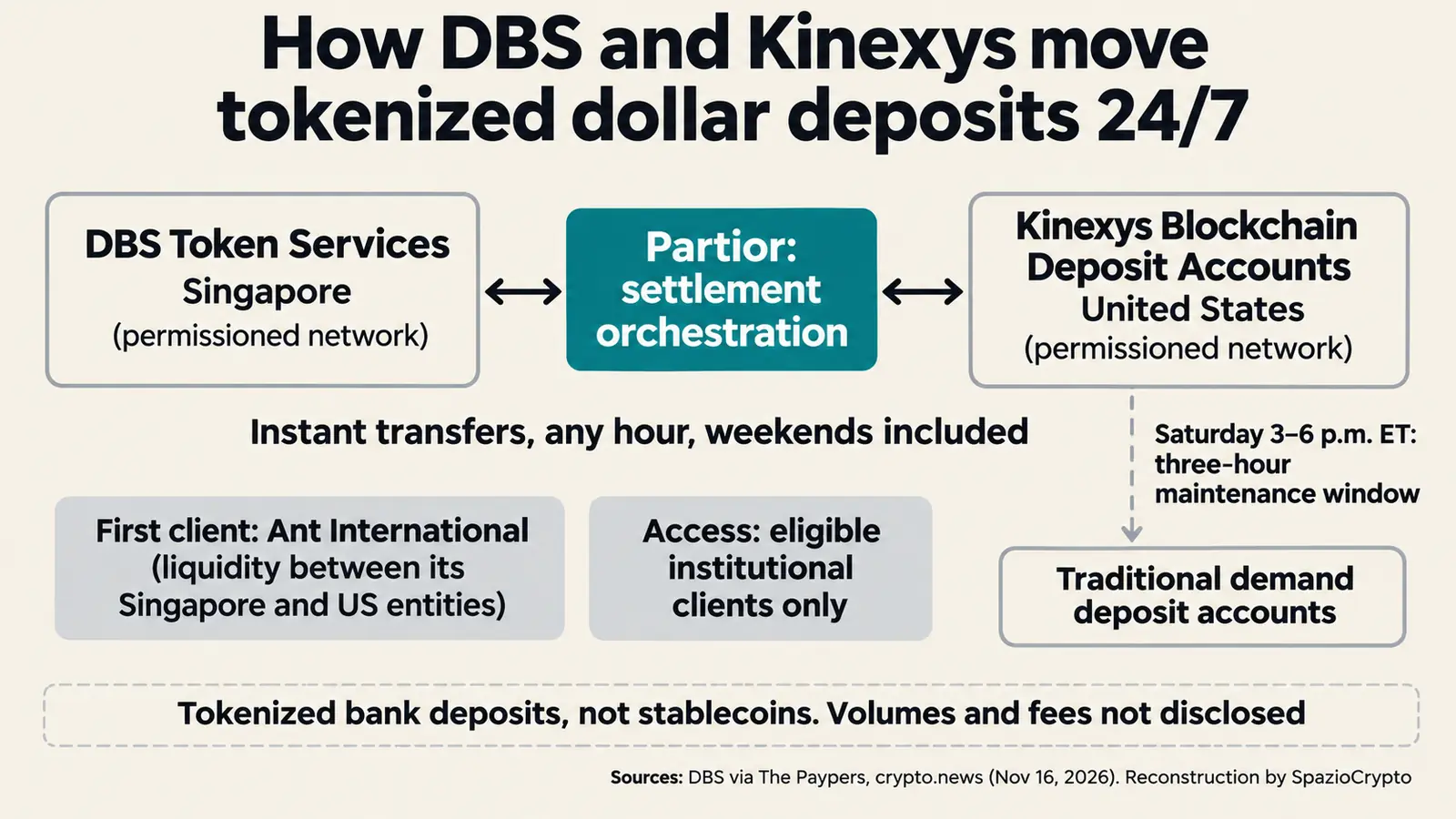
Sitting between the two networks is Partior, a settlement platform co-founded by DBS and JPMorgan. Partior handles the orchestration: it coordinates the transfer so that funds leave one network and enter the other simultaneously. As reported by crypto.news, the service is restricted to eligible institutions and is not available to retail clients.
Tokenized Deposits, Not Stablecoins
The distinction matters more than it might seem. A stablecoin is issued by a private company such as Circle or Tether and can circulate freely between any wallet holder. A tokenized deposit is a standard bank deposit recorded on blockchain: it remains a liability of the bank to the customer, governed by the same banking regulations and supervisory oversight as a conventional deposit, and moves only between authorized accounts.
This is the path that major US banks are pursuing domestically as well, with a shared tokenized deposit network targeted for 2027. For a corporate treasurer the operational advantage is straightforward. Cross-border wires stop on weekends and public holidays, and the time-zone gap between Singapore and New York runs to twelve or thirteen hours. Kelvin Li, Ant International's General Manager for Platform Technology, stated in the announcement that the group operates across fast-moving global markets and needs treasury tools available at every hour of the day.
The Saturday Maintenance Window
The “24/7” claim carries a footnote. According to crypto.news, transfers within the Kinexys network itself run every day without interruption, but the bridge between Kinexys blockchain accounts and traditional deposit accounts has a three-hour maintenance window every Saturday, from 3:00 p.m. to 6:00 p.m. US Eastern Time. JPMorgan is developing a fix to eliminate it, though no target date has been given. Seven of the ten publications surveyed by Newscord did not report this detail.
Specific usage data is also absent. No source has disclosed volumes, fees, or additional clients beyond Ant International. Rachel Chew, Head of Operations and Co-Head of Digital Assets in DBS's Global Transaction Services division, stated in the announcement that tokenized money is moving rapidly from experimentation to concrete client value. Measuring that claim will require data that is not yet public.
From a 2025 Announcement to Live Service
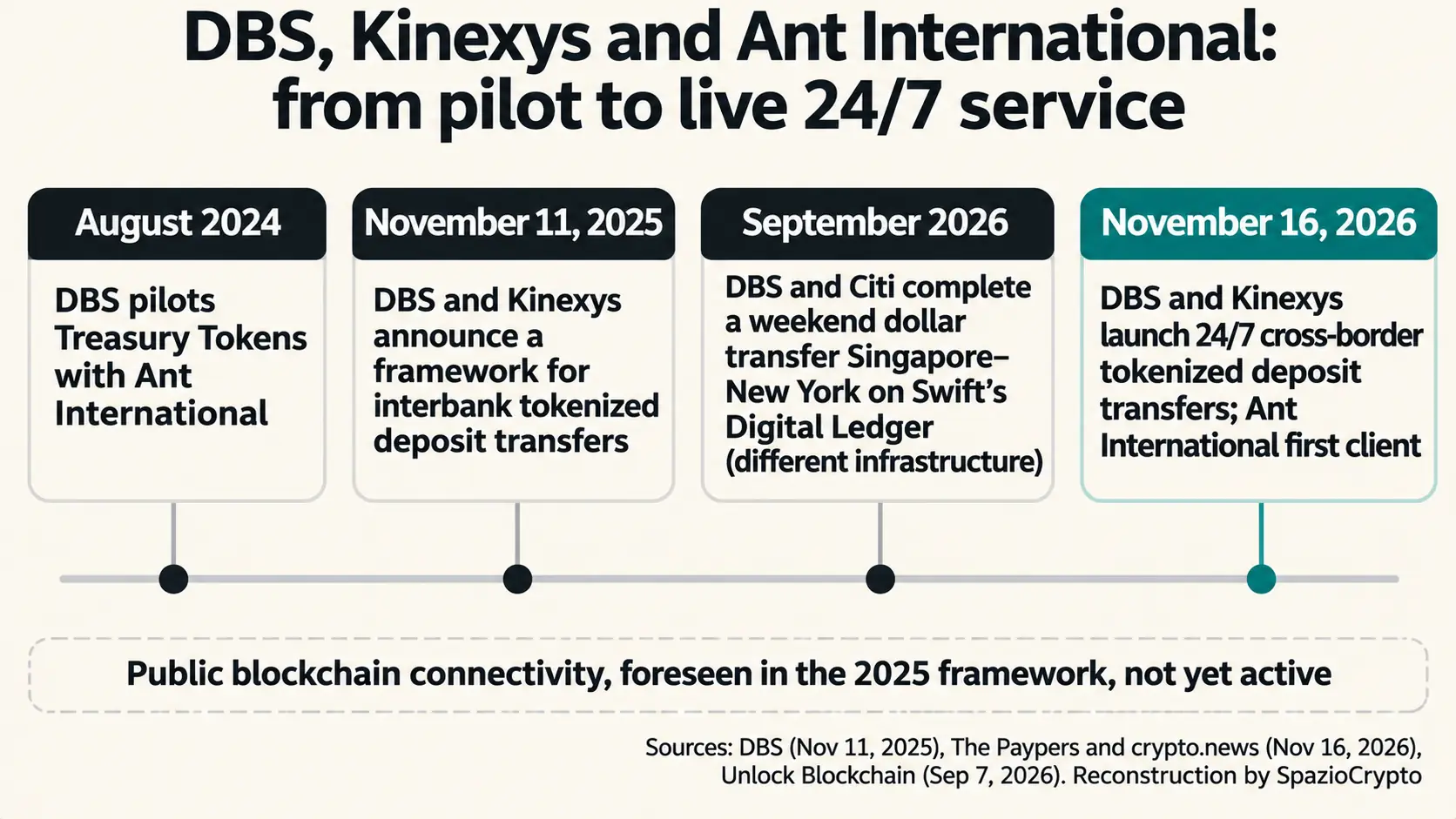
The launch puts into practice the interoperability framework both banks announced on November 11, 2025, when DBS and Kinexys described their intent to exchange tokenized deposits between public and permissioned networks. Ant International is not an incidental first client. In August 2024, it piloted Treasury Tokens, the tokenized treasury deposit product, with DBS, and was among the first Asian corporates to connect to Kinexys's deposit network. Kinexys is the same platform where BlackRock brought its tokenized money market funds in Europe.
In September, DBS had already executed a Saturday dollar transfer between Singapore and New York alongside Citi, but on a different infrastructure: Swift's experimental digital ledger. DBS is therefore pursuing multiple rails in parallel, a sign that no single standard has yet won out.
Singapore as a Regulatory Sandbox
The service falls under Project BLOOM, the Monetary Authority of Singapore's tokenized money initiative, in which DBS and Kinexys jointly lead the token interoperability working group. Singapore is simultaneously testing foreign-exchange settlement across traditional systems and distributed ledgers, as covered in our piece on Project Meridian FX in Asia.
The scale of what is at stake becomes clearer with one data point: according to DBS, cross-border payments leaving Asia are projected to grow from $13.5 trillion in 2025 to $24 trillion in 2033. In a DBS survey, 88% of companies reported already using or experimenting with tokenized money. Those are the figures driving the urgency.
The United Kingdom is moving in the same direction. In September, Lloyds, NatWest, Barclays, and HSBC completed the first interbank transactions using tokenized deposits. The difference is that the DBS-JPMorgan link crosses a border and two separate legal jurisdictions, raising a layer of complexity the UK pilot did not face.
What This Means for US and UK Businesses
For companies operating across the Pacific, the gap this service closes is real. International dollar wires between US and Singapore entities currently stop at weekends and bank holidays; the twelve-to-thirteen-hour time-zone difference means a Monday morning in Singapore can easily become a Tuesday resolution in New York. Tokenized deposits on a permissioned shared rail remove that friction without the counterparty and regulatory uncertainties associated with stablecoins.
The Federal Reserve and the OCC have both signaled openness to bank-issued digital money, and Kinexys already operates as one of the more mature institutional blockchain networks in the US market. For US corporates with Asian treasury operations, this corridor is worth watching closely.
What Is Confirmed, What Is Not
Cosa è confermato, cosa no
- Confirmed: from November 16, eligible institutional clients can transfer dollar-denominated tokenized deposits at any hour between DBS Token Services accounts in Singapore and Kinexys accounts in the United States; Partior coordinates settlement and Ant International is the first client.
- Not disclosed: volumes, fees, additional clients, and a date for eliminating the three-hour Saturday maintenance window between Kinexys and traditional accounts.
- To watch: the arrival of additional clients and currencies, the connection to public networks outlined in the 2025 framework, and the competitive choice between this infrastructure and Swift's digital ledger.
The Bigger Picture
Banks have worked out that the real advantage stablecoins offer is not the blockchain technology itself: it's availability. A digital dollar that moves on a Sunday between two continents is what businesses actually need, and DBS and JPMorgan have shown it can be delivered without leaving the regulated banking system. The contest now is not between banks and crypto. It is between competing infrastructure models: bilateral links between individual bank networks, as in this case, or a shared ledger of the kind Swift is experimenting with.
Four concrete signals are worth tracking. First, initial usage data, if the banks choose to publish it. Second, the elimination of the Saturday maintenance window, which would make the 24/7 promise unconditional. Third, other banks joining the same corridor. And fourth, the opening to public blockchain networks, which was part of the 2025 framework but has not yet been activated.