

Google DeepMind unveiled Genie 4 on October 27, a world model that generates explorable environments in real time, complete with sounds, music, and dialogue produced alongside the visuals. Users navigate with keyboard and mouse and can rewrite the scene mid-session using plain-language prompts. Right now, only a small group of hand-picked testers has access. Google AI Ultra subscribers inside Project Genie and API partners are listed as “coming soon,” with no dates attached. And DeepMind itself puts in writing that object permanence, scene coherence, and physics can still break down.
This analysis draws on the DeepMind announcement authored by Raia Hadsell, Diego Rivas, and Hang Qi, the Google blog post, and the model page. The X post could not be accessed directly, nor could the YouTube demo be reproduced independently: the post text is verified through the embed published by AI Lately. Genie 3 specifications come from The Decoder’s coverage in August 2025.
This is Genie 4, our most realistic and interactive world model yet. 🌐
— Google DeepMind (@GoogleDeepMind) October 27, 2026
Explore dynamic environments in real time to see how the scene responds, sounds, and how the people in it move, react, and speak. pic.twitter.com/6mmSUm9BBO
What Genie 4 Actually Does
Genie 4 is a world model, not a video generator. It does not produce a clip to watch passively; it produces an environment that responds to commands frame by frame. A session starts from a text prompt or a reference image used as the opening frame. From there, the user explores with keyboard controls for movement and camera angle. During a session, weather can change, the framing can shift. New people or objects can be added on the fly. According to DeepMind, a Gemini model interprets each request against the current scene and keeps the world running between commands.
The model draws on the Gemini family. Gemini Omni grounds scenes in real-world appearance and behavior, while other Gemini models handle the reasoning that keeps the simulation coherent. It is the same family Google is pushing into enterprise workflows with the Gemini agent for businesses, also currently in restricted preview.
The Declared Leap: Native Audio
DeepMind positions Genie 4 as the first real-time world model capable of generating audio natively. Every environment carries its own ambient sounds and music. Characters speak, and dialogue adapts to commands and in-world events.
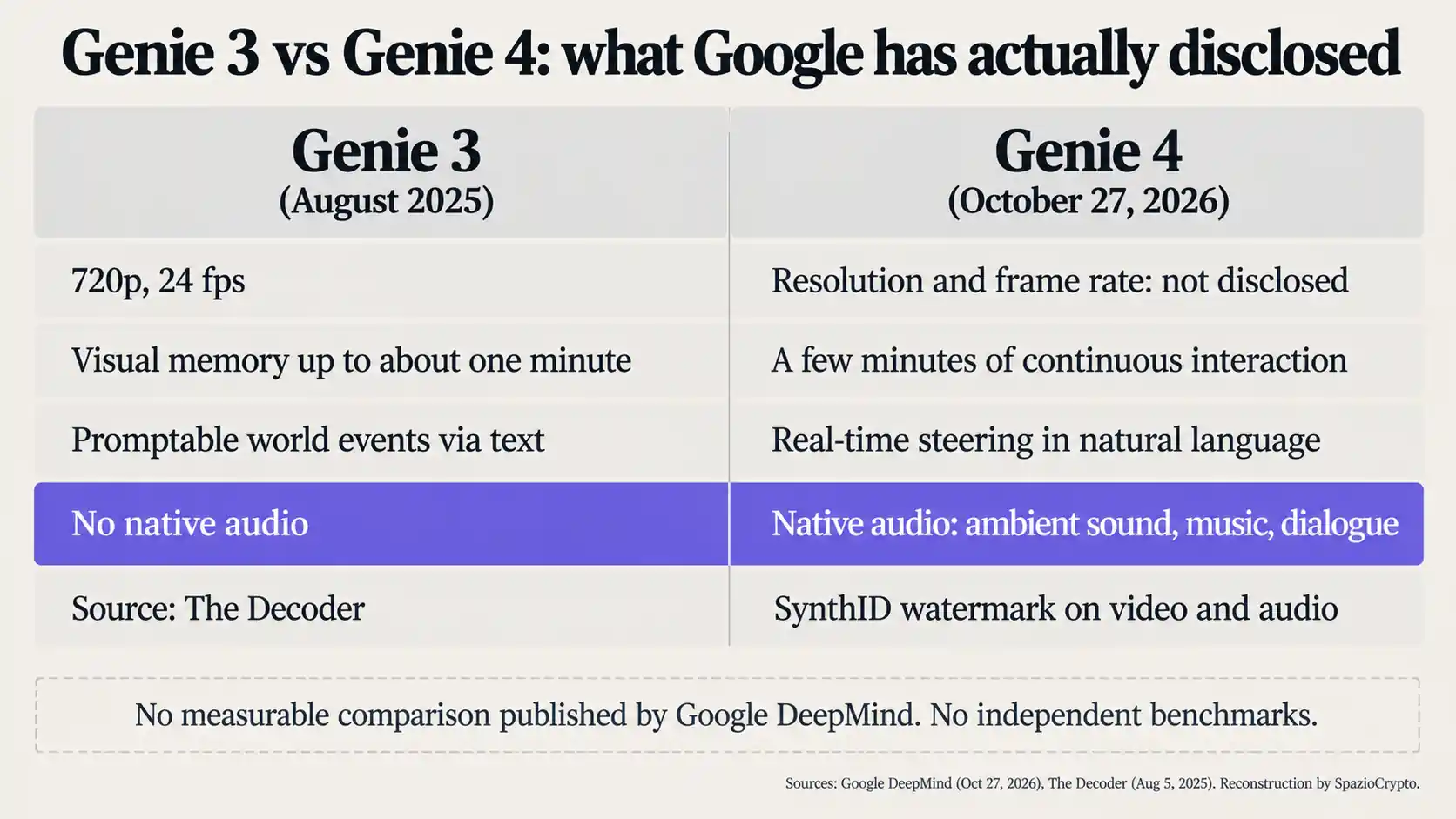
That is the meaningful break from Genie 3, announced in August 2025. According to The Decoder, that model generated worlds at 720p and 24 frames per second, with a visual memory of up to one minute and text-driven scene changes called promptable world events. Audio was absent. For Genie 4, DeepMind publishes neither resolution nor frame rate nor a session-length figure in minutes, and offers no measurable comparison with the previous version. The model page refers only to “a few minutes of continuous interaction.”
An Interactive Prototype, Not a Video
The distinction matters for understanding where Genie 4 fits. A video generator produces a finished clip. Genie 4 produces a scene that reacts to whoever is steering it. DeepMind lists concrete use cases: directors shooting multiple takes inside a live simulation, photojournalists turning a single archive photo into a navigable environment, developers testing visual styles and game mechanics from a text prompt, and enterprise partners evaluating rapid scenario generation. These workflows sit alongside tools that Adobe and NVIDIA are accelerating for the creator economy.
The most strategically significant territory is simulation for agents and robots. In the announcement, Gemini 3.8 Flash observes frames, breaks a goal into steps, checks each one, and revises the plan when the world changes or the user intervenes. A separate demo shows Gemini 4 Argon working alongside Genie 4 on a robotic task involving Apptronik’s Apollo robot and a checkers match. Training agents in generated worlds is the same bet underlying NVIDIA and LG’s physical AI push. The gap between a polished demo and a production line, though, is exactly what humanoid robots on factory floors have made clear.
The Limits DeepMind Wrote Itself
The announcement does not hide the weak points. Visual detail and object permanence can degrade, particularly in long sessions, after multiple text edits, or during navigation. Complex physical interactions, real-time audio accuracy, readable in-world text, spatial precision, and long-term coherence remain active research problems, per DeepMind’s own disclosure.
The model page adds three further limitations. First: multi-agent and multi-user interaction within the same environment is unsupported. Second: real-world locations cannot be reproduced accurately. Third: sessions last only a few minutes, not extended periods. A note clarifies that the recordings shown are real sessions but edited for length, with results presented for illustrative purposes. There is no benchmark and no independent evaluation: what is visible is a corporate demonstration.
Who Can Try It, and When
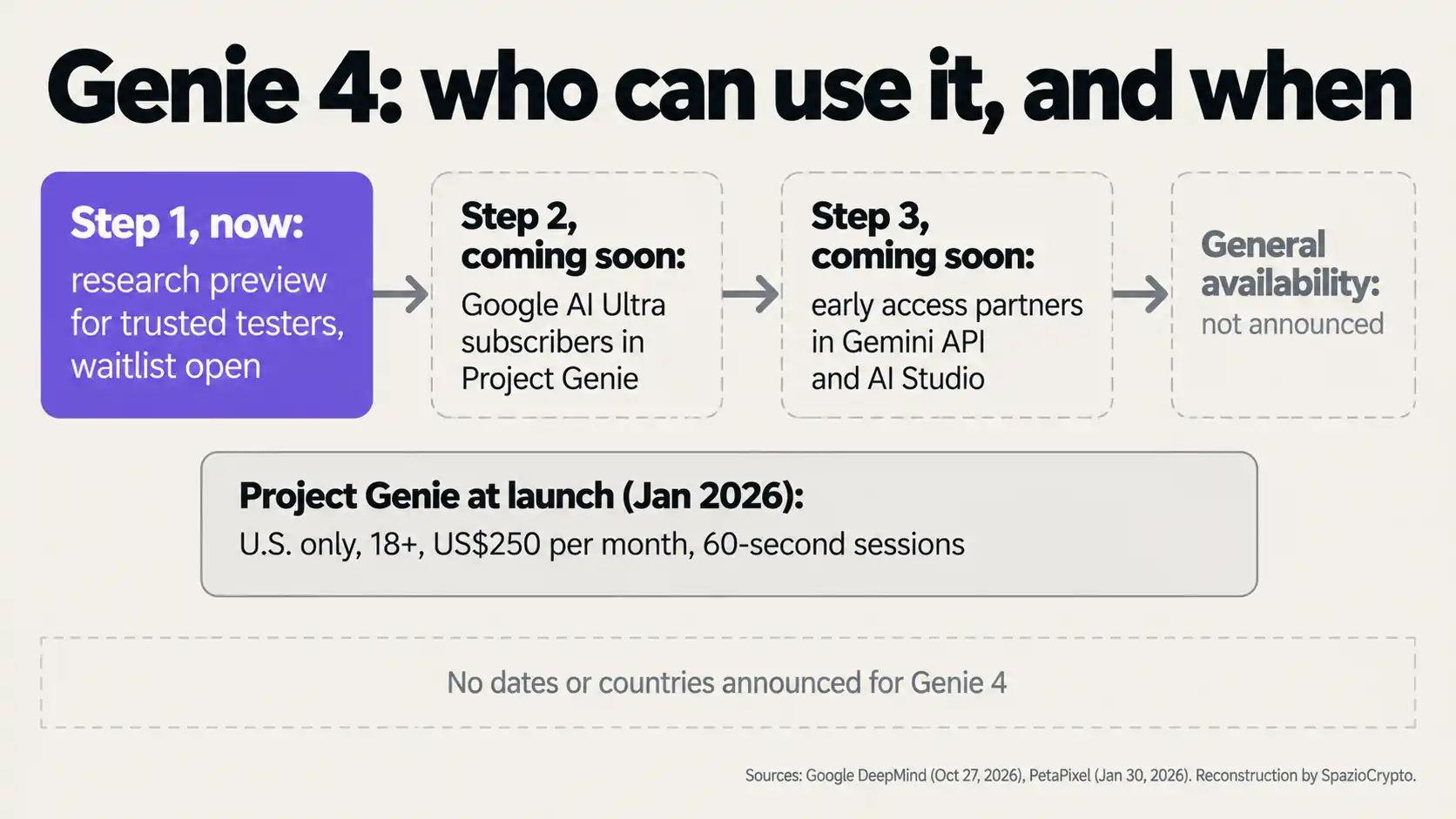
Short answer: almost nobody, for now. The model is in a research preview for trusted testers, with an open waitlist. Next in line are Google AI Ultra subscribers inside Project Genie, and partners with early access to the Gemini API and AI Studio. No dates, no countries named.
Prior history helps set expectations. Project Genie launched on January 29, 2026 with Genie 3 and, according to PetaPixel, was at launch restricted to Ultra subscribers in the United States, adults only, at $250 per month, with generations capped at 60 seconds. Whether those boundaries have since expanded is not publicly confirmed. There is no confirmed access path for users outside the US at this time. On the transparency front, DeepMind states that all video and audio generated by Genie 4 will carry a SynthID watermark, a question that carries real weight after cases like the video that was awarded and then disqualified by Nikon for AI generation.
Genie 4: What Is and Isn’t Confirmed
A clear-eyed summary of what DeepMind has and has not disclosed:
- Confirmed: real-time world model with native audio, text-editable scenes mid-session, research preview for selected testers, SynthID watermarking on video and audio, self-declared limits on object permanence, physics, audio accuracy, and session duration.
- Not disclosed: resolution, frame rate, session length in minutes, countries and availability dates, API pricing, benchmarks, or independent evaluations.
- To watch: the opening of access to Ultra subscribers in Project Genie and to API partners, and the first independent tests of coherence and physics.
The Bigger Picture
Our read, stated plainly, is that Genie 4 shifts the generative AI race from the clip to the world. Video is something you watch; an environment is something you use: you test a game level, you shoot a scene, you train an agent. That is precisely why the self-declared limits carry more weight here than they would for a video generator. An object that vanishes in a clip is an aesthetic flaw. In a simulator for robots or AI agents, it is a data error. The value today sits in rapid prototyping, not yet in reliable simulation.
Three signals are worth tracking. First: when and where access expands beyond the current tester cohort, and with what session-length ceiling. Second: whether independent evaluations of object permanence, coherence, and physics appear, all of which are currently absent. Third: how far the use of Genie 4 alongside agents, including those that operate computers on behalf of users, moves from curated demos into real workflows.