

Brent crude dropped to $91.66 per barrel on November 17, 2026, even as fresh attacks targeted tankers in the Strait of Hormuz, the narrow waterway between Iran and Oman through which a significant share of the world's oil flows. At 04:30 GMT, WTI was trading at $84.99, according to Reuters. Traders looked past the Gulf incidents and focused on a looming supply surplus that the International Energy Agency flagged just days earlier.
This report draws on UKMTO alert 207-26, Reuters dispatches republished by Business Recorder, the IMO maritime incident log, and analysis from Riviera Maritime Media. Iranian government claims made on November 16 about naval mines have not been independently verified as of publication time.
Why Oil Prices Fall When Tankers Get Hit
Think of the Strait of Hormuz as a single-lane road through a hostile neighborhood. If enough trucks keep getting through, store shelves stay full and prices drift lower, even if the occasional truck takes a hit. That is the trade-off markets priced in on November 17: supply has caught up with demand, so the geopolitical risk premium no longer dominates.
Tim Waterer, chief analyst at KCM Trade, told Reuters that supply “has finally caught up with demand and may now be set to exceed it.” Waterer added that the geopolitical risk premium tied to the US-Iran conflict “is clearly on the back burner for now.” At 01:02 GMT, before European desks opened, Brent had already slipped 0.5% to $92, with WTI at $85.28.
What the IEA Report Actually Said
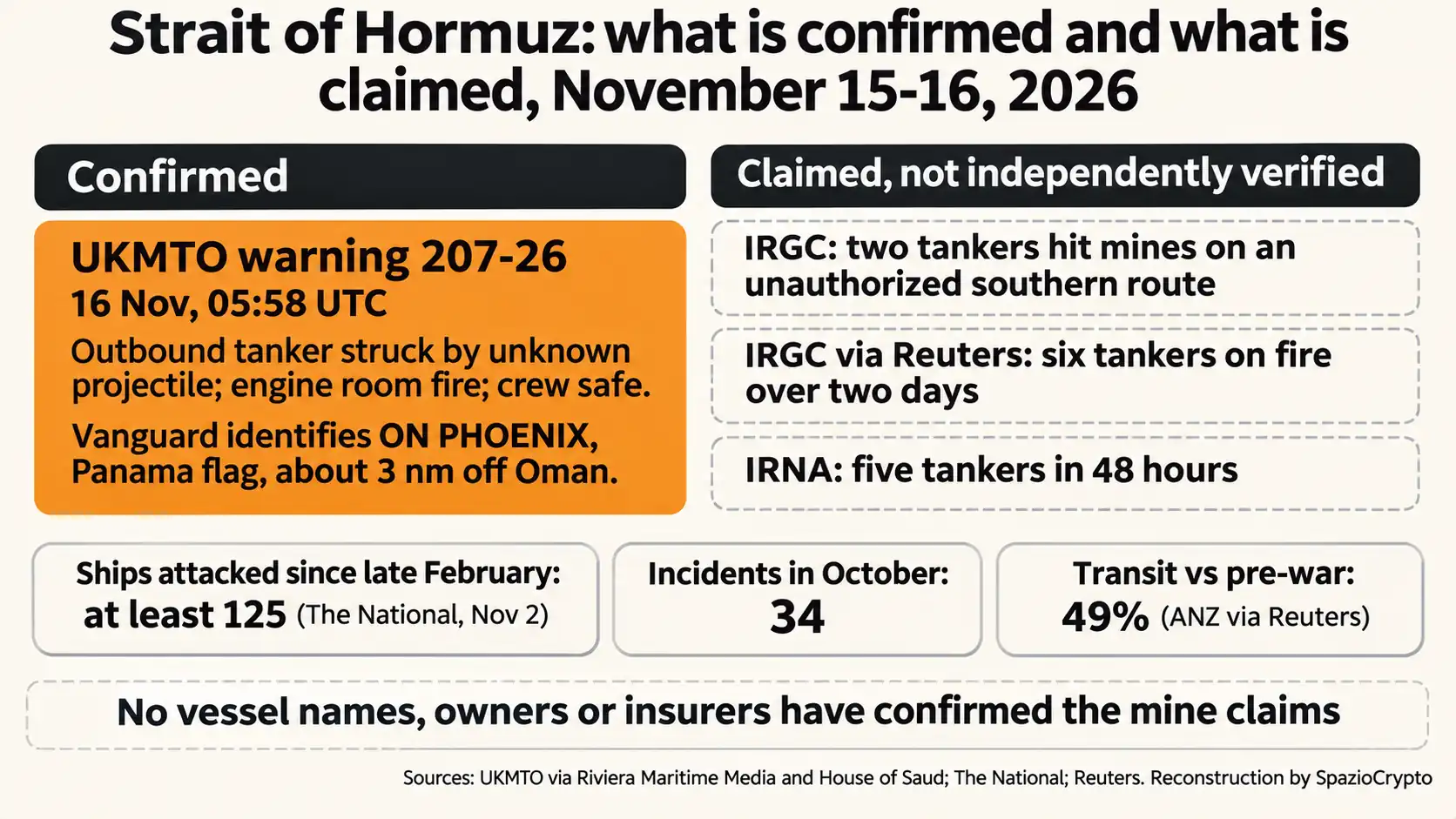
The heaviest weight on prices came from the IEA monthly oil market report published Friday, November 13. According to a summary by gCaptain, the IEA projects global supply in Q4 2026 at 105 million barrels per day, some 1.7 million barrels above estimated demand. One month earlier the agency had still been forecasting a deficit. “The oil market is showing early signs of rebalancing,” the IEA wrote in that report.
For 2026, the IEA estimates demand at 102.3 million barrels per day, a drop of 2.7 million barrels partly attributed to elevated prices suppressing consumption. The agency sees a surplus of around 3.8 million barrels per day by 2027. OPEC production data cited by gCaptain showed the OPEC+ group pumped 41.23 million barrels per day in October, equivalent to 97% of pre-war February volumes.
What Actually Happened in the Strait
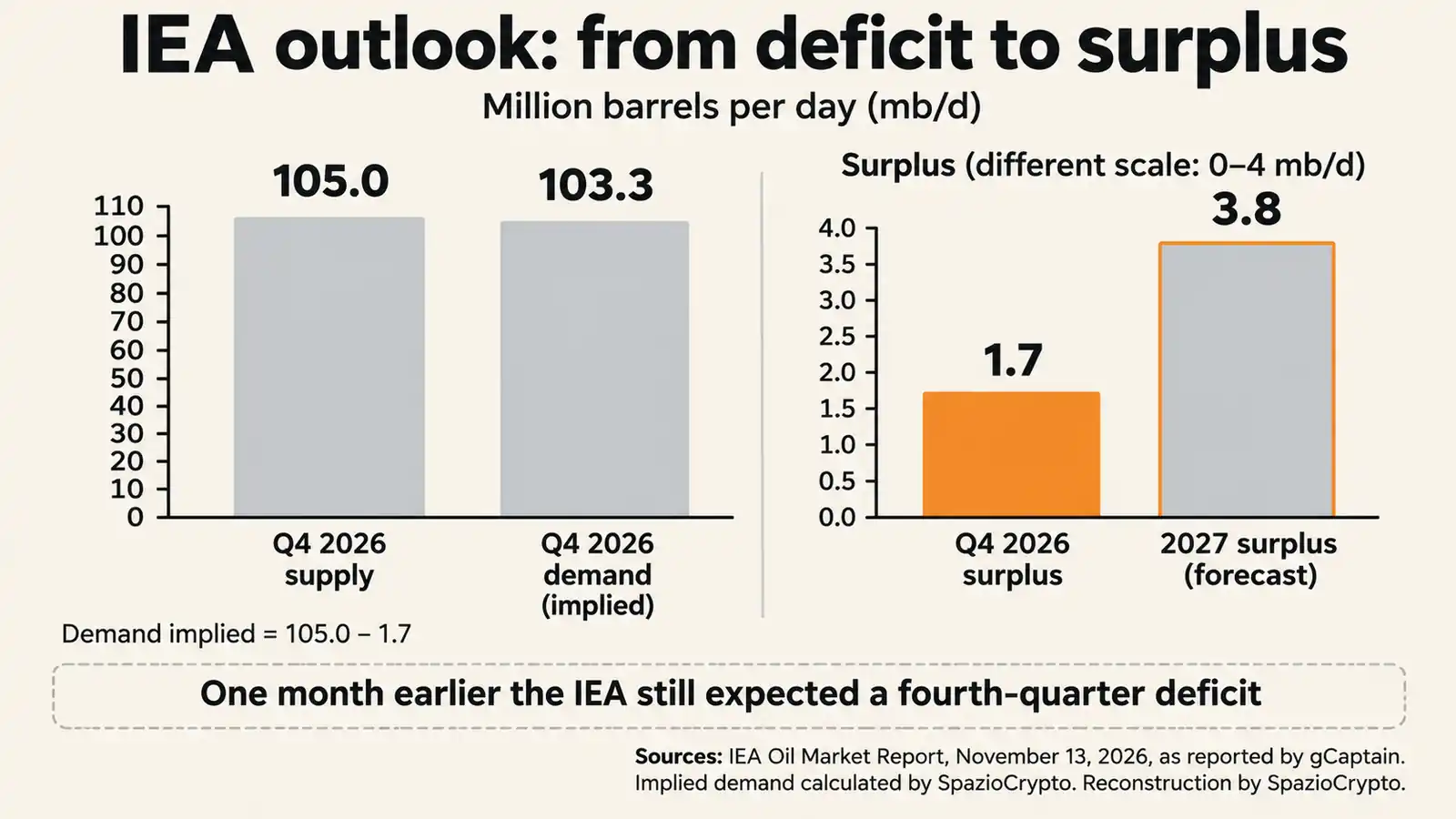
The incidents split into two categories: confirmed facts and unverified claims. On the confirmed side, UKMTO issued advisory 207-26 at 05:58 UTC on Monday, November 16, reporting a tanker exiting the Strait that had been struck by an “unknown projectile,” causing an engine-room fire with no crew casualties. Maritime monitor Vanguard identified the vessel as the On Phoenix, flying a Panamanian flag, approximately three nautical miles off the Omani coast.
The unverified side is more dramatic. Iran's Islamic Revolutionary Guard Corps (IRGC) stated that two tankers had struck naval mines on an “unauthorized” southern route, and Reuters reported IRGC claims of six tankers on fire between Sunday and Monday. Iran's state agency IRNA counted five incidents in 48 hours. No vessel names were provided, and according to House of Saud, no shipowner, flag state, or insurer confirmed any of the additional cases. UKMTO made no reference to mines.
Why Mines Matter Even When No One Can See Them
A naval mine works like an invisible warning sign: even when it doesn't detonate, it changes how everyone behaves. On October 28, US Central Command (CENTCOM) stated that primary routes had been cleared. Then on November 2, IMO Secretary-General Arsenio Dominguez told The National: “There is no confirmation that there are no mines in the region, so I cannot guarantee it is safe.”
In the same interview, The National reported at least 125 ships attacked since the US-Iran war began in late February, with 34 incidents in October alone, making it the worst month on record. Around 12 vessels a day were still transiting the Strait, while between 350 and 400 remained stranded in the Gulf. The IMO's official incident log, last updated October 9, lists 24 seafarers killed. The same page notes that over 20,000 mariners in the region are affected by the crisis.
How Solid Is the Supply Surplus?
Not everyone is convinced the cushion holds. ANZ analysts estimate, per Reuters, that Strait transit volumes are running at just 49% of pre-war levels and that current flows “are not sustainable in the long term.” Part of what keeps the numbers up are so-called dark crossings, tankers that switch off their AIS transponders to avoid detection. That workaround holds only as long as the risk stays manageable.
Strategic reserves add another layer of fragility. US Strategic Petroleum Reserve stocks have fallen to 276.4 million barrels, the lowest level since August 1982, as part of a planned release of 172 million barrels, according to Reuters. On Monday, OPEC reviewed member production capacity, the baseline that will feed into 2027 quota decisions when OPEC+ meets on November 29.
What This Means for Crypto Investors
Oil feeds into the price of almost everything, and broader prices guide central bank policy. A more expensive barrel keeps inflation elevated and gives the Federal Reserve reason to hold rates higher for longer, the scenario we examined when Bitcoin faced the Fed with Treasuries at 5%. A cheaper barrel eases that pressure somewhat, though it doesn't eliminate it.
Risk assets arrive at this juncture already stressed after the Nasdaq's November 5 selloff. Bitcoin ETF flows remain one of the clearest sentiment gauges to watch. The energy angle also carries direct weight for Asia, which absorbs a large share of Gulf crude: Japan felt this through the record yen intervention in July and the Bank of Japan rate debate, while China continues to expand its gold reserves.
The View from Europe
European buyers of Gulf crude feel this directly. A lower Brent benefits manufacturers and households across the continent in theory, but the pass-through at the pump is uneven: refined product prices, the euro-dollar exchange rate, and energy taxes all sit between the barrel price and the forecourt. The UK, which uses UKMTO as its maritime security arm in the region, has a specific stake in Strait transit safety that most European governments rarely acknowledge publicly.
For investors watching from London or Frankfurt, the useful number is not the overnight price move but the gap between the IEA's projected surplus and actual Strait transit volumes. While ships keep moving, markets focus on abundant supply. A single confirmed, named incident with documented damage could shift that calculus within hours.
Hormuz and Oil: The Scorecard
What is confirmed, what is not
- Confirmed: Brent at $91.66 (-0.8%) at 04:30 GMT on November 17; IEA projects a 1.7 million barrel-per-day surplus for Q4 2026; tanker On Phoenix struck by an unknown projectile on November 16 per UKMTO advisory 207-26, crew unharmed.
- Unconfirmed: IRGC claims of tankers hitting naval mines, with no vessel names or independent verification; the IMO cannot confirm primary routes are mine-free.
- To watch: shipowner and insurer confirmations of any additional incidents; IMO and UKMTO updates; the OPEC+ meeting on November 29 and its 2027 quota decisions.
The Bigger Picture
Oil markets appear to be adjusting to persistent Gulf conflict much as residents near a railway line eventually stop hearing the trains. The IEA surplus forecast and the partial recovery in export volumes outweigh any single attack in the market's current calculus, and unverified claims move prices only briefly. That equilibrium holds as long as ships keep transiting, and no longer.
Three signals are worth tracking closely. First, incident verification: a named vessel, a confirmed shipowner, an insurer on record. Second, actual Strait transit volumes, running at around half of pre-war levels according to ANZ. Third, the OPEC+ decision on November 29, which will reveal how much additional supply producers are willing to put on the market in 2027 and whether the IEA's surplus projection holds.