


The U.S. Senate votes today on one of the most consequential bills in crypto history: the CLARITY Act, designed to establish which federal regulator has jurisdiction over which digital assets. Before the anticipation builds too high, one distinction matters enormously and gets routinely lost in headlines. Today's vote is not a final passage vote on the CLARITY Act. It is a procedural cloture vote, asking a simple question: are at least sixty senators willing to formally open floor debate on the bill?
The difference is everything. If the threshold passes, debate begins and further amendments follow, with a separate final vote down the road. If it fails, the bill is functionally dead for all of 2026 and, given midterm election dynamics, probably until 2029. Here's what the revised text contains, why sixty votes is so difficult to reach, and what the realistic probability picture actually looks like.
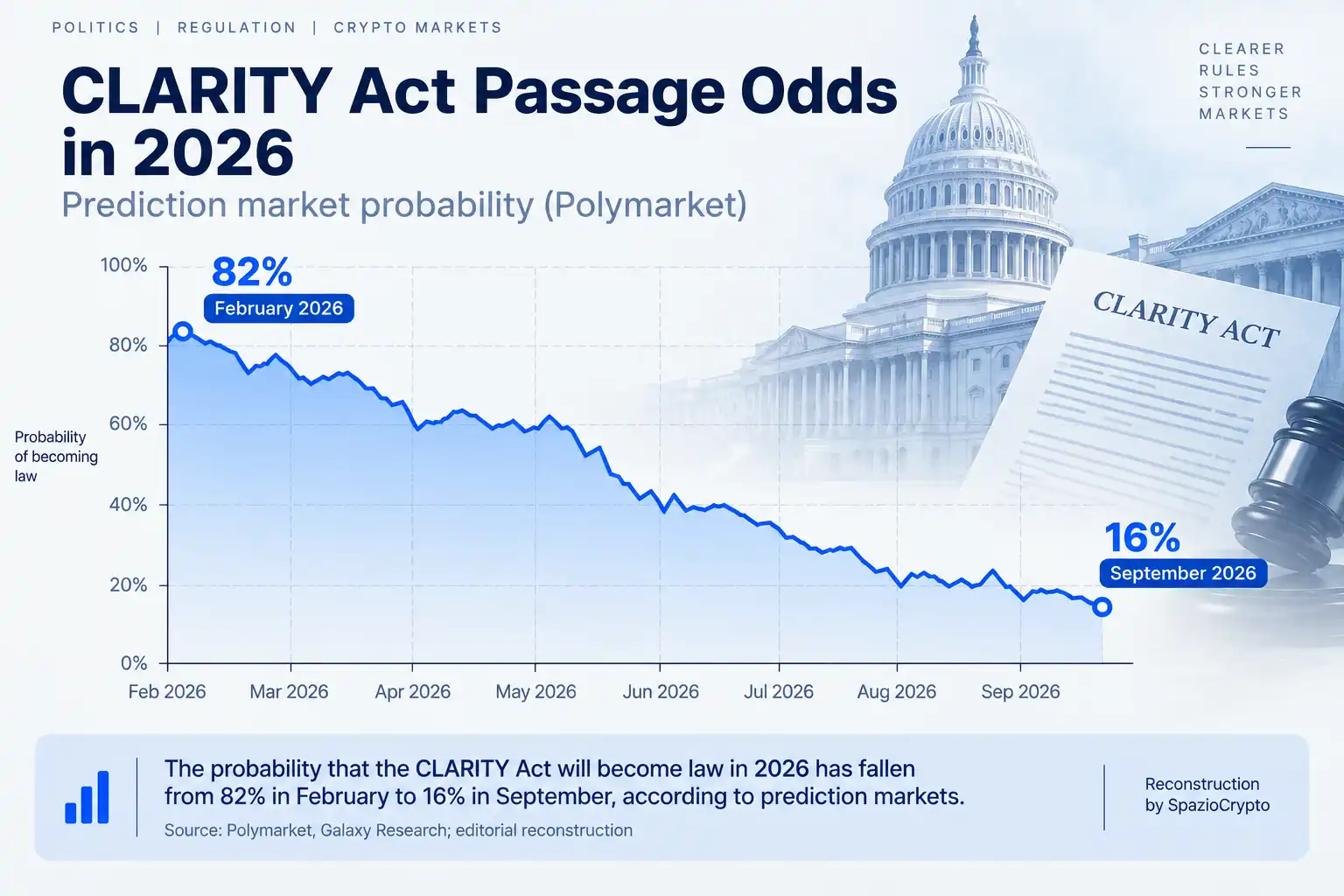
TL;DR: The Senate votes today on a procedural threshold for the CLARITY Act, not final passage. According to prediction markets, the odds of the bill becoming law in 2026 have collapsed from 82% in February to roughly 16% in September.
The New Text and 126 Amendments
Senate Republicans published a revised version of the bill on Tuesday, incorporating 126 amendments, the majority requested by Democrats in a bid to build the bipartisan supermajority the vote requires. These are not cosmetic edits. The new text substantially strengthens restrictions on crypto-related profits for public officials, a politically charged subject given the roughly $1.4 billion in crypto-linked income attributed to President Trump, and expands enforcement powers for state attorneys general.
One major fault line remains unresolved: stablecoin yield. Large banks continue to oppose this section vigorously, fearing that interest-bearing crypto products could pull deposits away from the traditional banking system and reduce lending capacity. The stakes are concrete. According to some estimates, the stablecoin yield provision alone could put more than $1 billion in annual revenue at risk for a major crypto exchange that currently earns that figure from rewards programs tied to one of the leading stablecoins in circulation.
Why Sixty Votes Is So Hard to Reach
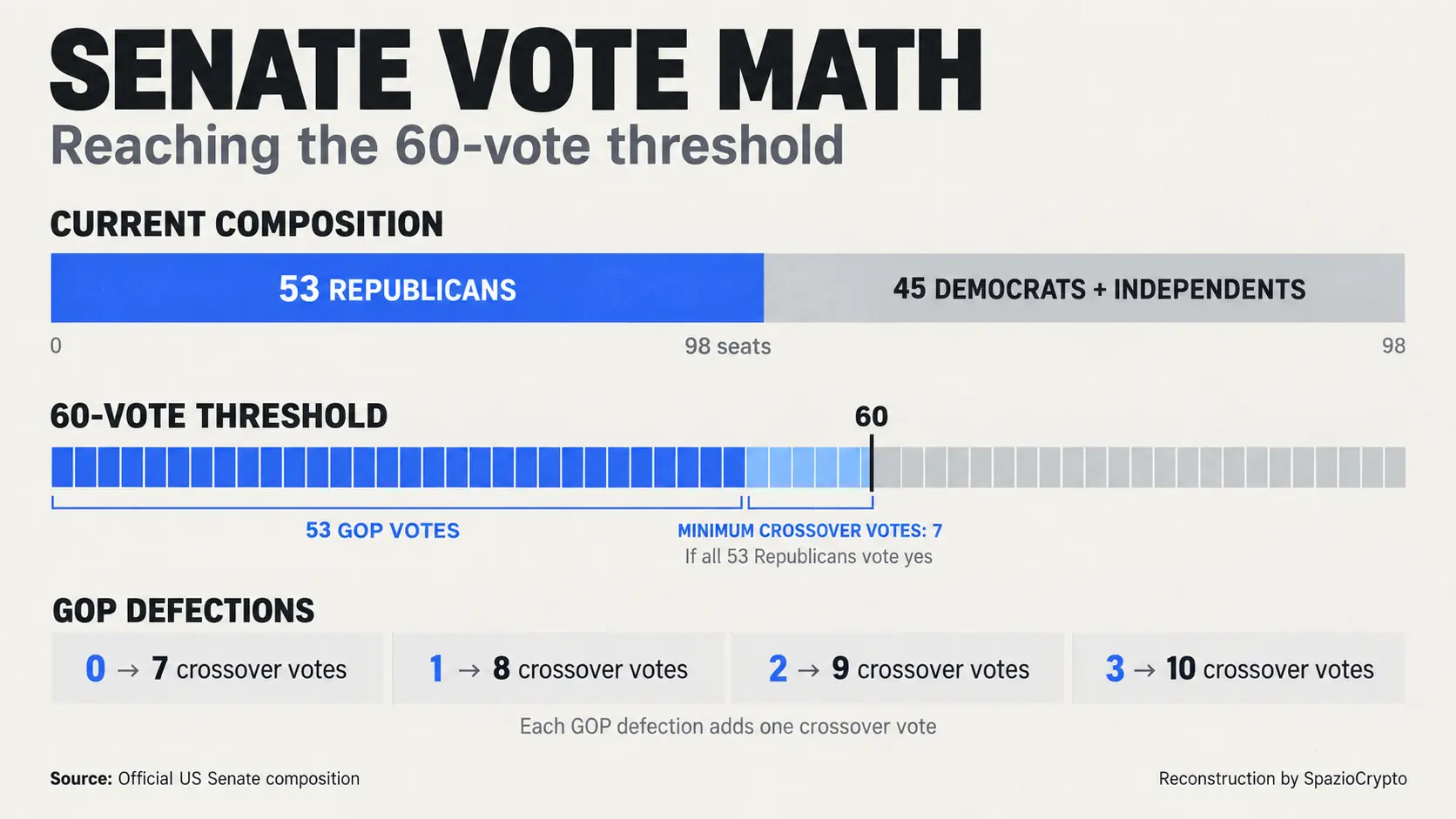
The Senate's current composition explains the difficulty plainly. Republicans hold 53 seats. Democrats, together with two independents who caucus with them, hold 45. Even with perfect Republican unity, the bill needs at least seven Democratic crossover votes. The math gets harder if any Republicans defect, which would push the required crossovers to ten or more. For context: only two Democratic senators voted in favor of the bill during the committee stage.
The push to assemble this coalition has been led by the Senate Banking Committee chair and a senator with a long record on digital asset policy, who worked together to merge the primary text with the version produced by the Agriculture Committee, which holds jurisdiction over digital commodity markets. The bill has also drawn public support from a major blockchain industry association, more than 160 former national security officials, and one of the world's largest investment banks, which has endorsed its general framework.
Today’s Vote at a Glance
What happens and what doesn’t. Source: Reuters, 2026
- What it is NOT: not a final vote on the law; it’s the threshold to open formal debate.
- The threshold: 60 votes needed; Republicans hold 53; at least 7 must come from Democrats.
- The odds: collapsed from 82% in February to 16% in September, per prediction markets.
A Probability Picture Far Less Certain Than the Headlines Suggest
Prediction markets, which aggregate bets from thousands of participants on future events, tell a sobering story. The probability that the CLARITY Act becomes law before the end of 2026 has fallen sharply across the year: from an optimistic 82% in February down to roughly 16% at the start of September, according to publicly available prediction market data. Analysts at a research firm specializing in the crypto sector place the odds even lower, closer to 10%.
That steep decline reflects the political difficulty described above, compounded by the fact that the Senate allowed the entire August recess to pass without a vote, squeezing the legislative calendar ahead of midterm elections. The takeaway is a real one: whatever the outcome of today's procedural vote, the path to final enactment remains long, uncertain, and far from guaranteed.
Bitcoin Watches Congress and the Federal Reserve Simultaneously
The timing of this vote is not coincidental. Crypto markets are navigating a compressed window of macro and regulatory news simultaneously. Bitcoin, which has been recovering from lows touched in late August (as tracked in our analysis of ETF inflow data from recent weeks), faces a week that also brings inflation data and a Federal Reserve interest rate decision. Some analysts describe the combination as a concentrated volatility corridor.
A positive cloture outcome, even without resolving the underlying legislative battle, would likely be read by markets as a signal of progress toward regulatory clarity. That clarity matters especially for the CFTC, the agency the CLARITY Act would designate as the primary regulator over spot digital commodity markets, and the same body that featured prominently in the Kalshi prediction market insider trading case.
The Bigger Picture
Today's vote, whatever it produces, offers a clear-eyed view of where U.S. crypto regulation actually stands. After months of negotiation, 126 amendments, and a bicameral mediation exercise spanning both the Banking and Agriculture Committees, the industry is still one procedural hurdle away from merely starting the formal floor debate. Not finishing it. Starting it.
Two things stand out. First, the sheer volume of negotiated changes, 126 amendments agreed upon, signals that serious legislative work has been done and that the traditional financial industry (including at least one major Wall Street bank) now treats clear digital asset rules as a question of when, not if. Second, the collapse in prediction market odds from 82% to 16% between February and September 2026 is a pointed reminder that legislative timelines on complex financial law rarely follow optimistic early projections, particularly when midterm elections compress the calendar. Watch the cloture vote count closely today. If the threshold clears, the next benchmark is whether a final vote can be scheduled before Congress turns its full attention to November campaigns. If it fails, the CLARITY Act moves into a legislative holding pattern that almost certainly extends into the next Congress. For broader context on the underlying technology at stake, our guide on what cryptocurrencies are remains a useful starting point.