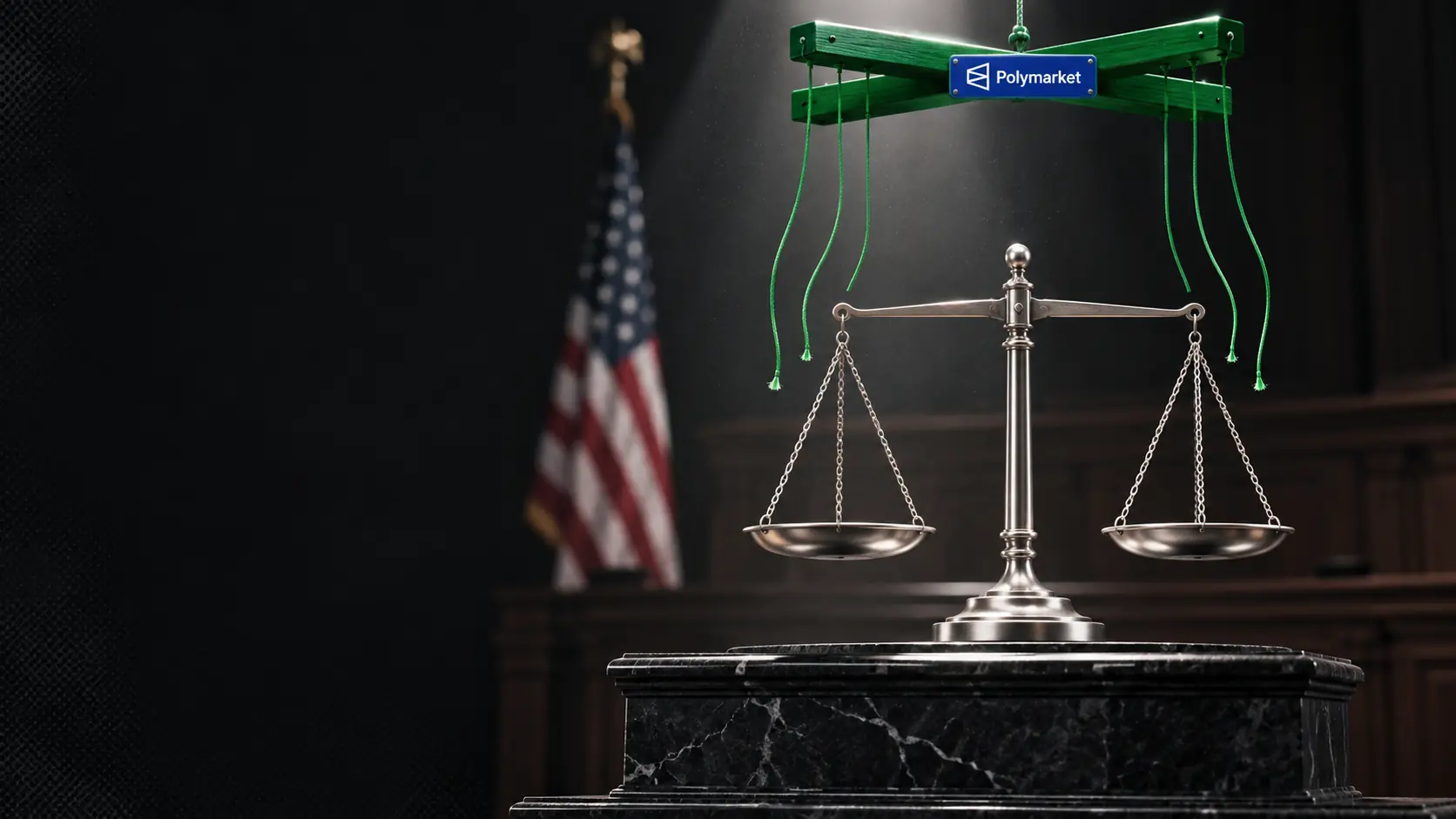
The Commodity Futures Trading Commission (CFTC) published on October 5 an Advanced Notice of Proposed Rulemaking (ANPRM) to build a federal regulatory framework for crypto transactions offered to retail customers with margin, leverage, or financing. The most significant element is a proposal to codify a new subcategory of regulated exchange, the Crypto Asset Market (CAM). These CFTC federal rules for crypto exchanges must be read carefully: no rules have been approved. This is a preliminary notice soliciting public comment, the step that precedes any formal rulemaking proposal.
CFTC Chair Michael Selig outlined the details in a speech delivered October 5 at the Fordham Law Blockchain Regulatory Symposium and in an op-ed published in the Wall Street Journal, linking the initiative to the CLARITY Act's failure to advance in the Senate. Selig noted at the outset of his remarks that his words reflect his personal views as Chair, not necessarily those of the full Commission.
What the CFTC Published
The document covers Regulation Crypto Asset Transactions (Regulation CTX) and Regulation Crypto Asset Markets (Regulation CAM), addressing the “retail commodity transactions” defined under section 2(c)(2)(D) of the Commodity Exchange Act. The CFTC calls these CTXs: in Selig's framing, transactions where a retail customer trades crypto with margin, leverage, or financing. The ANPRM solicits comment on three fronts: how to prevent abusive practices under a uniform national regime; how to give market participants crypto-specific guidance on the compliance practices the CFTC, drawing on its supervisory experience since 2014, considers sound; and how to codify the CAM as a designated contract market subcategory designed specifically for CTXs.
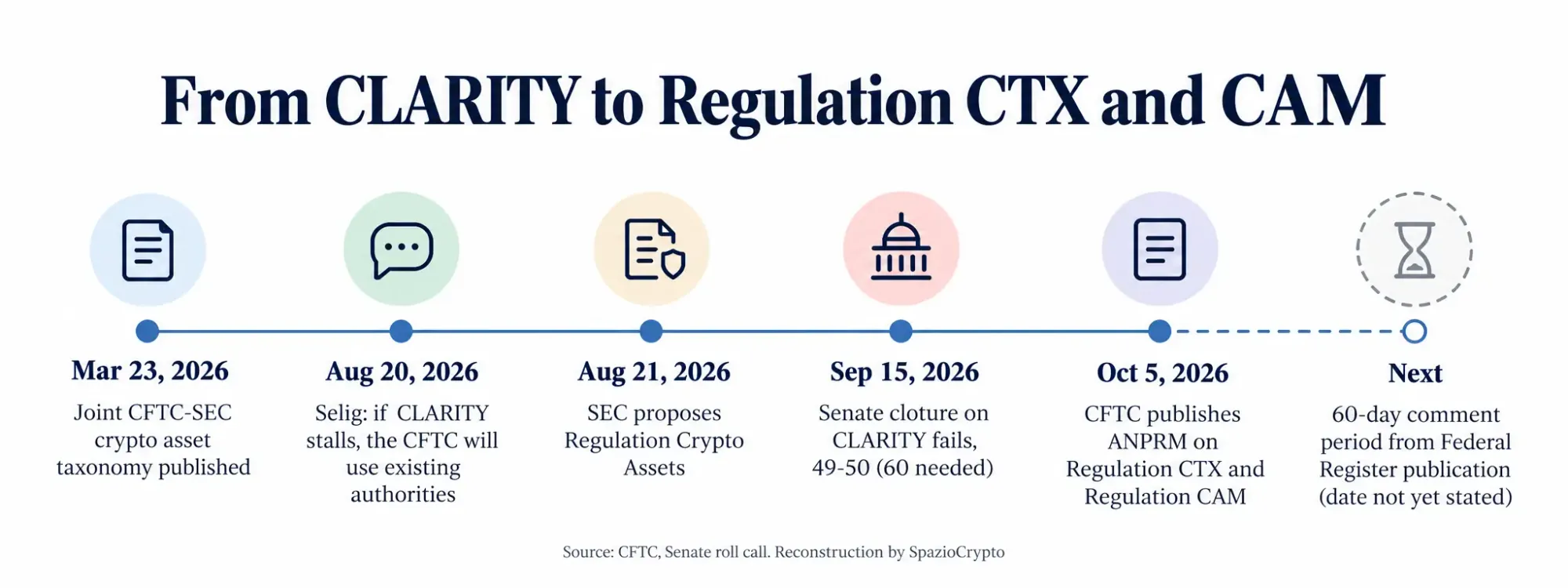
Written comments must be submitted within 60 days of the ANPRM's publication in the Federal Register and will be publicly visible on Regulations.gov. The press release does not specify the Federal Register publication date, so the exact deadline is not yet determinable. The Commission states it will use the comments to inform possible future action, such as a formal rulemaking proposal. Selig said the goal is to prevent fraudulent schemes of the kind seen with FTX, not merely pursue them after the fact.
The Three-Step Ladder and the CAM
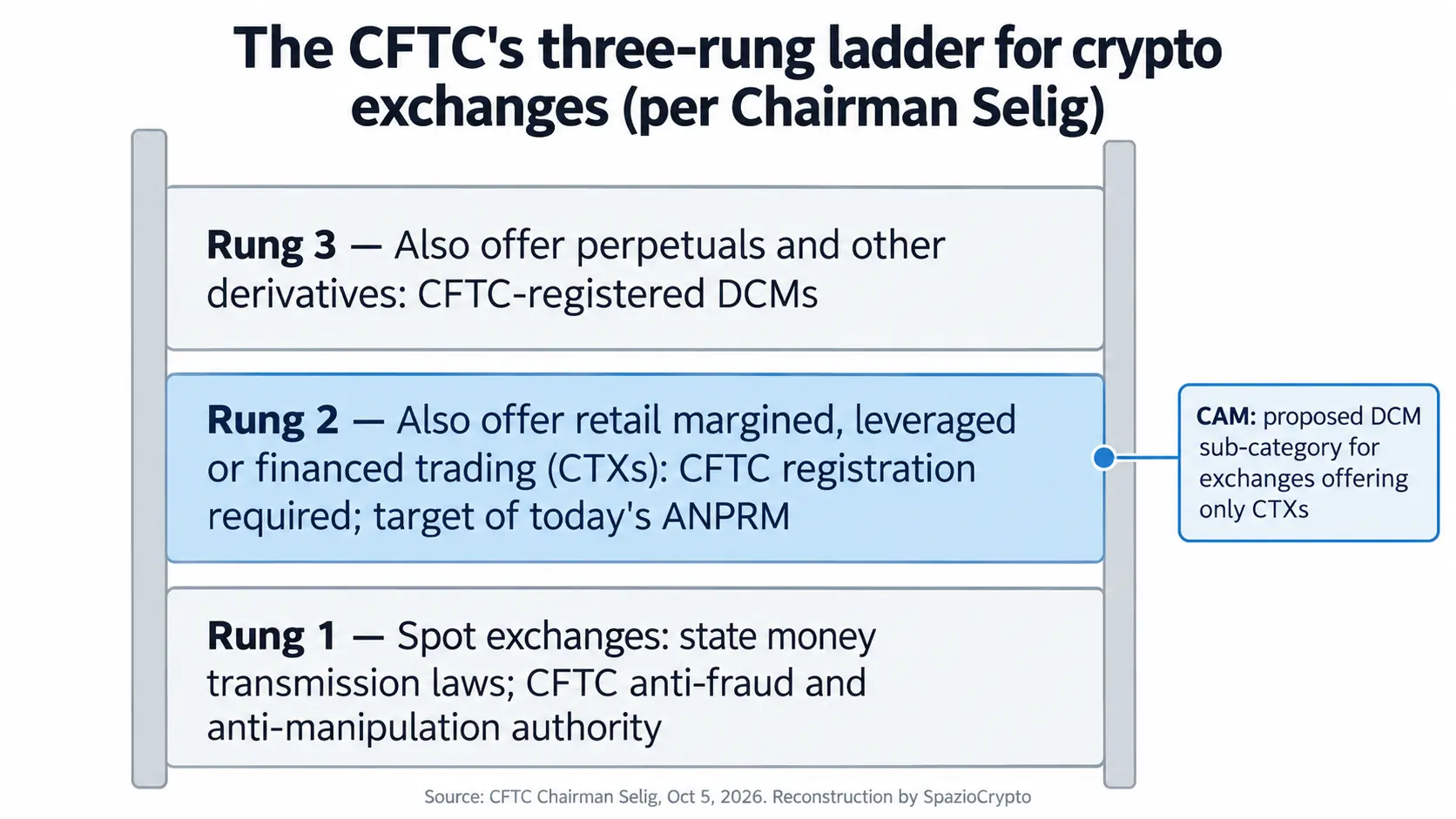
Selig describes the market as a three-step ladder. On the first step sit ordinary spot exchanges, subject to CFTC anti-fraud and anti-manipulation authority but otherwise governed broadly by state money-transmission laws. The second step holds exchanges that also offer retail customers margin, leverage, or financing: by law they must register with the CFTC and fall under its exclusive jurisdiction. The third step covers venues that also allow perpetuals and other derivatives, also registered with the CFTC. Today's proposals target the second step.
Exchanges already registered as designated contract markets (DCMs) could offer CTXs under fit-for-purpose rules. Platforms wanting to offer only CTXs could register either as a standard DCM or as a CAM. A CAM would need to satisfy the core principles the law requires of DCMs, with regulations tailored for CTXs, while venues offering futures, options, or swaps would remain in the existing DCM regime. Selig stressed this is a federal option: just as in banking, where a firm chooses between a federal or state charter, crypto firms could choose between state licenses and federal registration depending on their product mix. Only Congress, he said, can make CFTC registration mandatory for all crypto exchanges.
The ANPRM at a Glance
What it is and what it is not. Source: CFTC, press release 9307-26 and Selig speech, October 5, 2026
- What it is: a preliminary notice seeking written comments for 60 days from publication in the Federal Register.
- Who it targets: exchanges offering retail customers crypto trading with margin, leverage, or financing; a federal option, not a universal mandate.
- What it is not: not an approved rule or a formal proposal; making registration mandatory for all exchanges would require an act of Congress.
Measures on the Table
Among the protections the framework would contemplate, according to Selig's remarks at the Fordham symposium, are manipulation-risk assessments at the point of listing, tied to an asset's distribution and concentration, lock-up periods, vesting schedules, and programmatic issuance or buyback arrangements. The ANPRM also raises a proof-of-reserves requirement for exchanges holding customer assets in omnibus accounts, and mandatory intermediation by a futures commission merchant (FCM), bringing with it protections on disclosures, capital, and fund segregation, alongside Bank Secrecy Act anti-money-laundering and know-your-customer obligations. The CFTC says it wants comment on how to adapt FCM requirements for the specifics of crypto activity.
For those aligned with the cypherpunk tradition, the agency proposes codifying an interpretation of “actual delivery”: transferring a crypto asset to a user's external, non-custodial wallet within 28 days would generally satisfy the exception to the requirement of trading on a registered exchange. Outside the current proposal's scope, though under active study, is a durable policy for developers who publish software without soliciting orders, controlling execution, or holding client assets. Under such a framework, writing code alone would not trigger registration as an introducing broker.
Why Now: The CLARITY Act
The political backdrop is explicit. On September 15, the Senate rejected the cloture motion on the CLARITY Act by 49 votes in favor and 50 against, falling short of the 60 required, as covered in our article on the failed vote. Selig stated publicly that he was disappointed: the bill would have drawn a statutory line between securities and non-securities, required centralized crypto exchanges and brokers to register with the CFTC, and introduced tailored core principles. In his editorial, he wrote that agency action cannot indefinitely substitute for a legislative framework passed by Congress. The move had, in any case, been signaled conditionally on August 20, when Selig declared that if the CLARITY Act stalled, the CFTC would deploy its existing authority to launch a crypto markets regime.
The CFTC is relying on a joint interpretation published with the SEC in March 2026 that classifies crypto assets into five categories, placing Bitcoin and Ether among digital commodities, meaning assets that are not securities. On the SEC side, Selig also referenced the agency's proposed Regulation Crypto Assets, released on August 21.
The Bigger Picture
In just over ten days, the Federal Reserve published its rules for bank-issued stablecoins, the SEC introduced its crypto custody proposal, and now the CFTC is opening the exchange front. Three regulators assembling a patchwork while Congress remains gridlocked.
The picture carries a dual lesson. On one hand, nothing changes for platforms at this stage: after an advance notice, the process still requires a formal proposal, a public comment period, and a final rule, and the federal pathway leaves two routes open, state and federal, without a general mandate that only legislation could create. On the other hand, comparing this to Europe clarifies the difference in approach. Selig himself cites MiCA, alongside the UK and Singapore, as organic frameworks adopted in the wake of FTX's collapse, while the United States proceeds through parallel, voluntary tracks. That European framework is already being stress-tested, as seen in the Binance case. We'll continue tracking the Federal Register publication and the opening of the comment period.