
Cryptosmart announced on October 6 the launch of Cryptosmart Easy, the first product rolled out by the Perugia-based exchange after receiving authorization as a crypto-asset service provider (CASP) under MiCA, the EU regulatory framework. Easy adds over 30 new cryptocurrencies to the platform and integrates a managed tax regime: at every sale, the exchange calculates, withholds, and remits the capital gains tax on the user’s behalf. The token count is the least interesting part of the story. For anyone buying crypto in the EU, the more relevant question is what Easy signals about how exchanges are repositioning after MiCA, and what the tax regime actually covers.
What Is Cryptosmart Easy?
According to a press release reported by Milano Finanza and InvestireOggi, Easy is designed as a guided, step-by-step buy-and-sell journey aimed at first-time crypto buyers. Users pick a cryptocurrency, enter an amount in euros, and see a guaranteed price with all fees already included, plus the exact net quantity they will receive, before confirming. Holdings and performance are visible on a single screen. There is no personal wallet or private key to manage, which means funds remain in custody with the platform, one of the regulated services for which Cryptosmart holds authorization.
The 30+ new cryptocurrencies were selected, according to the press release, based on market capitalization, liquidity, and regulatory compliance. The release does not list them individually and does not disclose commission amounts. The Cryptosmart website describes Easy as charging a fixed fee that does not vary with order size and sets a maximum transaction value of 10,000 euros, while the Pro version allows larger orders. CEO and founder Alessandro Frizzoni framed the product in a post statement:
Easy is here to make operations and taxes equally simple, within an authorized and supervised perimeter.
 Absolute Dev
The Managed Tax Regime: Existing Feature, New Home
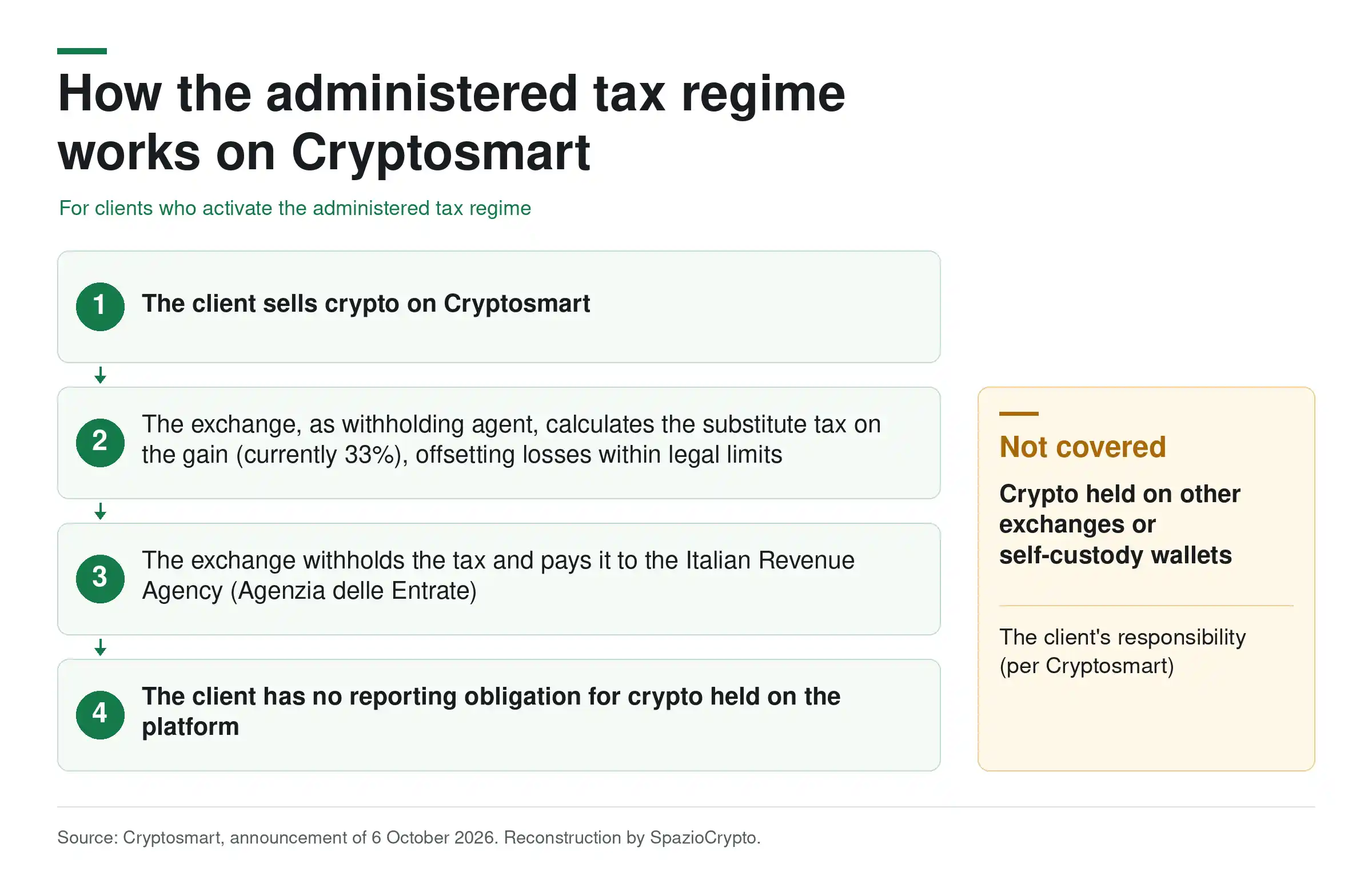
The press release explains the mechanism: at each sale, the exchange acts as a withholding agent, calculating the substitute tax on capital gains, currently set at 33%, retaining it, and remitting it to the Italian tax authority (Agenzia delle Entrate), while offsetting any realized losses within statutory limits. For crypto held on the exchange, the customer has no self-reporting obligations. This contrasts with the declaratory regime, where the taxpayer must calculate and report everything independently on an annual tax return.
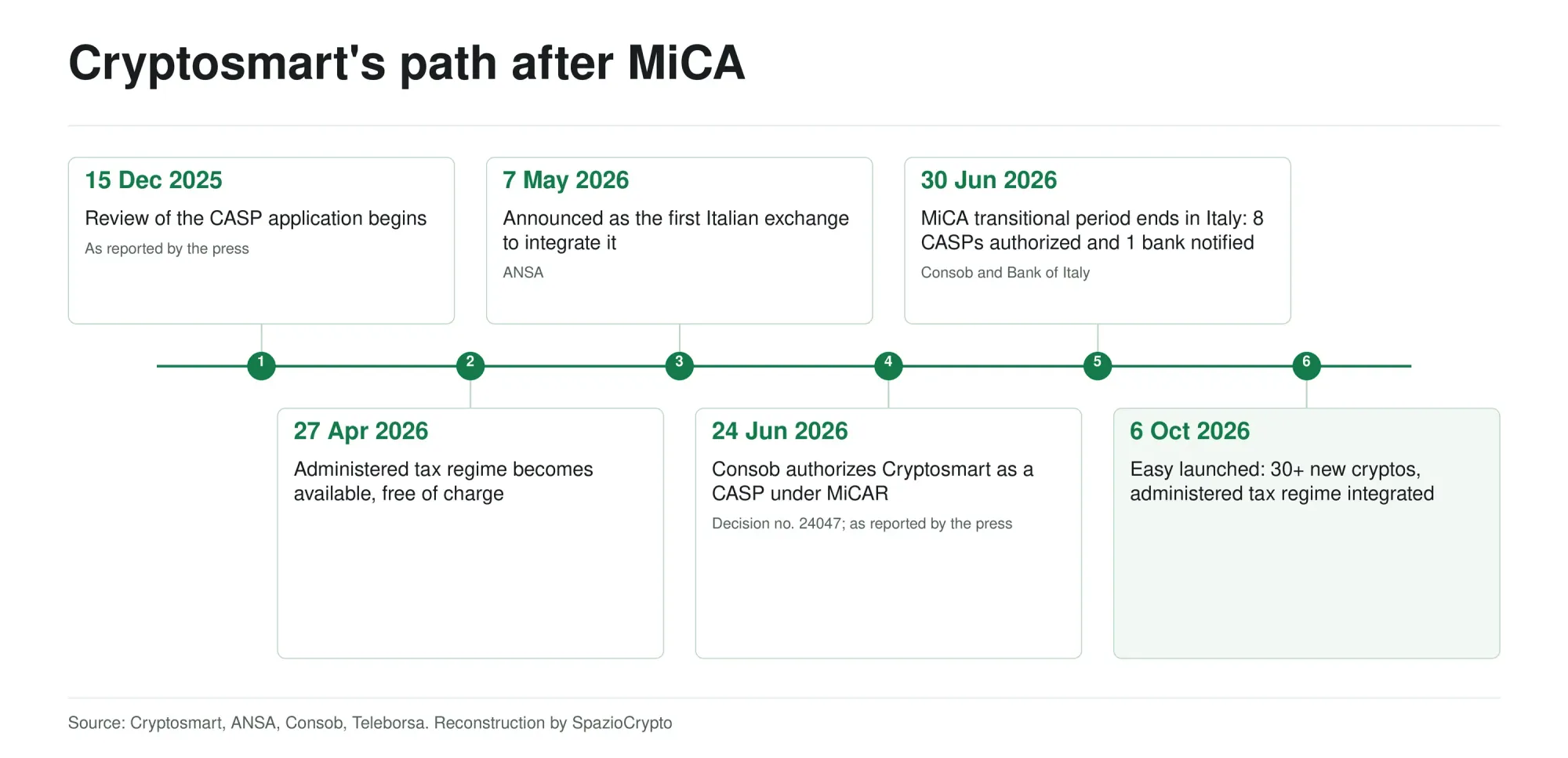
The managed tax feature did not originate with Easy. Cryptosmart made it available on April 27, 2026, free of charge, and presented it in May as the first Italian exchange to integrate it, as reported by ANSA. Easy brings it into the guided purchase flow. The scope remains as declared by the company: the regime covers only operations conducted on the platform. Crypto held on other exchanges or in self-custodial wallets remains the user’s responsibility, and the website encourages users to transfer those assets to Cryptosmart to bring them under the service. The website describes enrollment as optional; the Easy press release does not clarify whether activation is automatic for new Easy users.
The rate itself may still shift. The 33% figure has applied since 2026, and a technical draft presented to Italy’s Chamber of Deputies proposes reverting to 26% from 2027 onward. That draft is not yet law or a finalized bill. The broader tensions remain: capital losses under Italian rules are managed rigidly and are time-limited, and the reporting burden remains heavy even for small amounts. The managed regime reduces that burden for on-platform holdings, but only for those.
For European readers outside Italy, the comparison is instructive. Under MiCA, CASP authorization is now required across the EU, but tax handling remains a purely national matter. Countries like Germany (with its 12-month Jahresfrist exemption under EStG §23) and France (with the 30% PFU flat tax) have very different retail crypto tax environments. An exchange-managed withholding system like Cryptosmart’s has no direct equivalent in most EU markets, making it a distinctly Italian product feature.
From License to Product: The MiCA Timeline
Easy is the first commercial step after a sequence that can be traced by date. According to press reports, Cryptosmart’s authorization review began on December 15, 2025, and Consob issued the authorization on June 24, 2026, via resolution n. 24047. On June 30, at the close of the MiCA transitional period, a joint statement from Consob and Banca d’Italia listed eight authorized CASPs in Italy: CryptoSmart S.p.A., CheckSig, Conio, Hercle, Hodlie, Olliv Italia, Riv Digital, and Young Platform, plus one notified banking intermediary, Banca Sella. Operators without authorization were required to cease activity and wind down client relationships. Cryptosmart is partly owned by Banca Popolare di Cortona.
Authorization doesn’t close the compliance workload. Banca d’Italia has reiterated mandatory controls on transfers with no minimum threshold, and SpazioCrypto’s own research across 19 KYC and AML solution providers for European CASPs shows that operational compliance transparency remains thin across the sector. On the enforcement side, as of August 31, 165 of the 167 records on the ESMA non-compliant operators register originated from Consob, as detailed in our MiCA blacklist analysis.
Cryptosmart Easy at a Glance
What is confirmed, what is not. Sources: Cryptosmart press release of October 6, 2026; Cryptosmart website; Consob
- From the press release: first product after MiCAR authorization; 30+ new cryptocurrencies selected by market cap, liquidity, and compliance; guaranteed price with fees included; managed tax regime integrated (current rate: 33%).
- Not confirmed: commission amounts, full token list, user count and volumes, whether the tax regime activates automatically within Easy.
- Scope: the managed regime covers only on-platform operations and has been active since April 27, 2026. Crypto on other exchanges or self-custodial wallets remains the user’s own tax responsibility.
The Bigger Picture After MiCA
After MiCA, a license is a floor, not a differentiator. Italy now has nine authorized entities, and competition shifts to product and service quality. The managed tax regime is Cryptosmart’s most locally resonant feature, because it addresses a real friction point for Italian retail investors: the burden of calculating and filing crypto taxes. There’s an implicit trade-off, though. The regime works only for assets held on the platform, and within Easy those assets stay in exchange custody. Whether that suits a given user depends on where they currently hold crypto and how comfortable they are with custodial arrangements.
The product sequence is straightforward: MiCAR authorization, CASP status, expanded asset offering, managed taxation, retail-facing product. The press release is a corporate document. The new cryptocurrencies could not be independently verified, and fee structures remain undisclosed. Anyone evaluating a crypto platform in the EU will find the criteria we consider essential in our guide to the best crypto trading platforms, covering everything from MiCA authorization to fees, services, and tax handling. The next signal to watch is whether Cryptosmart discloses the full token list and fee schedule, and whether other Italian CASPs move to match the managed tax integration before year-end 2026.