On October 6, UniCredit announced it had structured its first tokenized Schuldschein: a three-year loan maturing in September 2029 for German real estate company OSMAB Holding. The blockchain is used to manage, securely store, and certify the transaction's documentation. No official source states that the loan itself was converted into a tradeable token on-chain, and that distinction matters when reading the headlines.
What UniCredit and OSMAB Actually Announced
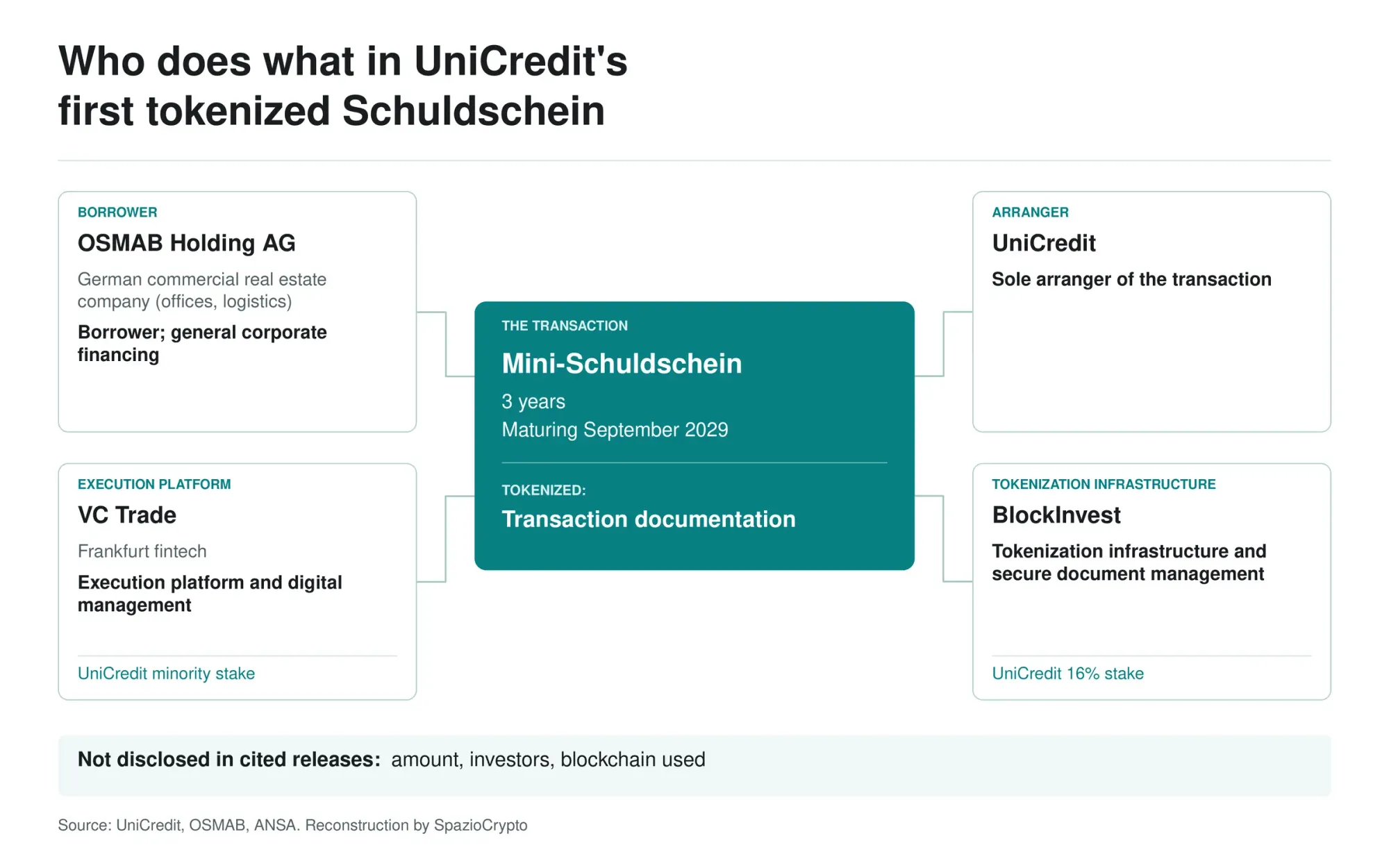
According to UniCredit's official statement, the bank acted as sole arranger for the deal. The financing, described in sources as a “mini-Schuldschein”, covers OSMAB Holding's general funding needs. OSMAB is a German company that invests, develops. Manages commercial real estate, with a focus on office and logistics assets. This is the second Schuldschein OSMAB has completed with UniCredit. The deal amount has not been made public. Neither the investors nor the specific blockchain used have been named.
The news had already broken before the bank's release. OSMAB published the announcement on its own website on October 2, four days ahead of UniCredit's press note. OSMAB's text describes a tokenized three-year mini-Schuldschein and explains that the digital and tokenized representation of the documentation makes processes more efficient, transparent, and secure across the entire loan lifecycle.


What a Schuldschein Actually Is
The Schuldschein, formally Schuldscheindarlehen, is a German-law loan documented by a debt acknowledgment note. It is not a listed security and does not trade on any exchange. UniCredit describes it as one of the most widely used financing instruments among German corporates. In practice, it sits between a bilateral bank loan and a public capital markets issuance: an arranger can distribute the financing to multiple lenders, offering borrowers an alternative to a single-bank relationship.
What Is Tokenized, and What Is Not
The official sources are consistent. UniCredit uses blockchain and tokenization to manage, securely store, and certify transaction documentation. OSMAB speaks of a digital and tokenized representation of the deal's documentation. Both companies point to the same claimed benefits: greater transparency, security, and efficiency, verifiable auditability, and fewer manual processes. German trade publication IT-Finanzmagazin references tokenization of the documentation and the mini-Schuldschein itself, but neither UniCredit nor OSMAB state that the underlying credit claim became a tradeable on-chain token.
That leaves the questions crypto readers care about most still unanswered: on which network are the documents recorded, who can access them, do investors receive a token, and can that token circulate? Until further details emerge, “tokenized Schuldschein” is the label the sources use, not a description of a loan that lives on-chain.
Who Is Behind the Deal: VC Trade and BlockInvest
The transaction relies on two companies in which UniCredit has taken stakes. VC Trade, a Frankfurt-based fintech founded in 2016, provided the platform for digital execution and management. UniCredit acquired a minority stake in VC Trade on September 8, 2026, and describes it as the leading marketplace in the German Schuldschein market by volume and number of transactions. BlockInvest, an Italian tokenization firm, supplied the infrastructure for tokenization and secure document management. UniCredit acquired a 16% stake in BlockInvest for 4 million euros, as reported in April 2026, as part of a broader strategy that also included Italy's first tokenized bond settled in central bank money.
A Path That Started in December 2025
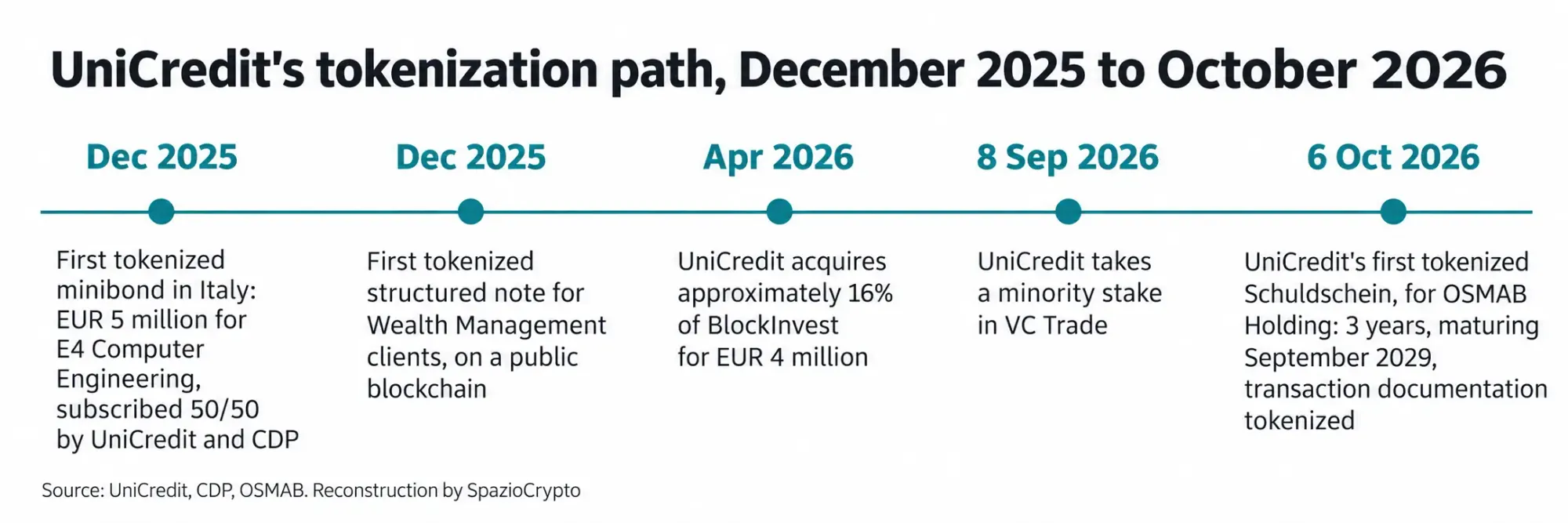
UniCredit's press release places this deal within a broader sequence of tokenized instrument moves. That sequence began with Italy's first tokenized minibond: a 5 million euro issuance by E4 Computer Engineering, subscribed at par by UniCredit and CDP (Cassa Depositi e Prestiti), announced on December 11, 2025. Also in December, UniCredit issued a tokenized structured note on a public blockchain for wealth-management clients. Then came the two equity stakes: first BlockInvest, then VC Trade. Within ten months, the bank had acquired positions across two distinct layers of the tokenization stack: the firm that tokenizes assets and the platform that runs German Schuldschein deals.
Tokenized Schuldschein: What is Confirmed
What is verified and what is not. Sources: UniCredit (press release, October 6, 2026), OSMAB (October 2, 2026)
- Confirmed: UniCredit's first blockchain-based Schuldschein; UniCredit as sole arranger; borrower is OSMAB Holding; maturity September 2029; transaction documentation tokenized.
- Not disclosed: deal amount, identities of investors, and the specific blockchain used.
- Not the case: the underlying loan has not been converted into a tradeable on-chain token, per official sources.
The Bigger Picture
This announcement is less a technology breakthrough than a signal about method. UniCredit is not launching a new crypto-market asset. The bank is placing a digital layer beneath a traditional and widely used instrument, starting from the least visible part: the documents. Sam Kendall, UniCredit's Head of Client Solutions Germany and Head of Advisory and Financing Solutions, stated that through the digitization and tokenization of Schuldschein deals the bank aims to broaden access for Mittelstand companies and SMEs to the advantages of syndicated financing, as an alternative to bilateral lending. That's an ambition without attached volumes or delivery dates.
The direction fits what the rest of the European market is doing. The European Central Bank activated Pontes on September 21, the infrastructure for settling tokenized securities in central bank money. UniCredit is part of the bank consortium behind Qivalis, a euro stablecoin on Ethereum, and reports suggest the bank is seeking a technology partner for digital asset custody and trading. In Italy, non-performing loans have already seen their first blockchain-native securitization, via doValue and Weltix, and real-world tokenized assets grew over the past year while traditional DeFi lost deposits. The pattern that emerges is consistent: infrastructure and process digitization first, then, perhaps, assets that investors can actually trade.
Three things worth watching: whether UniCredit discloses the deal size and investor identities; whether future Schuldschein deals follow the same structure and with which partners; and whether tokenization moves down from the document layer to the credit claim itself, something no official source has announced yet. The press materials reviewed contain no reference to any extension of this approach to UniCredit's Italian retail or corporate clients.