


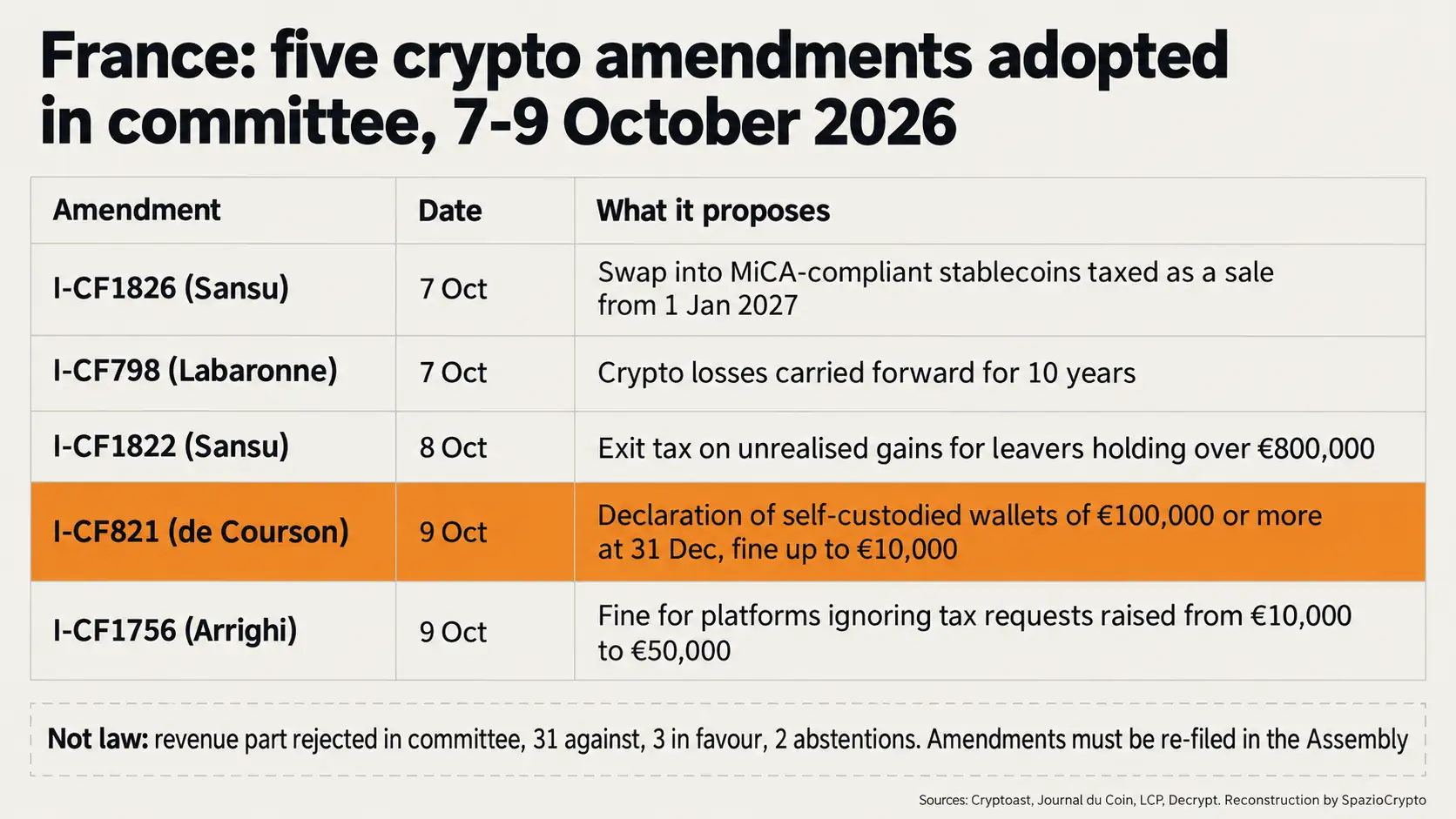
France's Finance Committee passed a mandatory declaration requirement for self-custody crypto wallets worth €100,000 or more on October 9, when the Assemblée nationale's Finance Commission adopted amendment I-CF821 to the 2027 draft budget. Under the proposal, French residents would have to report self-custodied crypto-asset portfolios valued at or above €100,000 on December 31 each year, with fines of up to €10,000 for non-compliance. That same evening, the committee rejected the entire revenue section of the budget, meaning the measure is not yet law and must be reintroduced and voted on in the full chamber, then in the Senate.
The amendment was drafted by Charles de Courson of the LIOT group and filed on October 3. Reporting from Cryptoast, Journal du Coin, bitcoin.fr, and law firm Kohen Avocats forms the basis of what follows. The exact vote count on the amendment itself, the precise scope of the obligation, and its effective date have not been publicly specified, and the original amendment text was not accessible on the Assemblée nationale website at the time of writing.
Exchanges vs. Self-Custody: Why the Tax Authority Only Sees Part of the Picture
The core distinction is about who holds the keys. On an exchange, the platform controls the private keys, knows the customer's identity, and must report transactions to regulators: the DAC8 directive, in force from January 1, 2026, requires crypto service providers to collect client data, with a first transmission to tax authorities expected in 2027. With self-custody, the user controls the keys, no intermediary can see the balance, and no one reports it. According to crypto.news, withdrawals to self-custodied wallets can only fall within reporting obligations when routed through a regulated provider subject to DAC8.
France's current framework leaves a clear gap. Residents are already required to declare digital asset accounts opened, held, or closed abroad using form 3916-bis, but the tax authority's guidance does not specify whether a wallet not held by an intermediary falls under that obligation. According to law firm Kohen Avocats, holding bitcoin in a self-custodied wallet without selling and without a foreign account does not currently trigger either a tax or a specific reporting requirement. Amendment I-CF821 is designed to close that gap, shifting regulatory focus from where money moves to where assets sit.
The Case for the Amendment, and the Practical Objections
The amendment's explanatory note cites a parliamentary inquiry into the taxation of large fortunes. In 2021, realized crypto capital gains were reported at €3.5 billion, against only €400 million in assets declared to the DGFiP, France's tax administration. The two figures measure different things (gains versus declared wealth), so they should be read as an indicator of opacity rather than a precise shortfall. In committee, rapporteur general Philippe Juvin called the initiative “full of wisdom,” and Nicolas Sansu of the GDR group announced his support while describing the threshold as “high,” adding that the process has to start somewhere.
This is not a first attempt. A version with a €5,000 threshold was approved in committee in December 2025, according to The Big Whale, only to be dropped at the joint committee stage in April, according to Journal du Coin. At the time, industry association Adan argued the rule was unworkable because no administration can verify the existence or value of a self-custody wallet. That practical problem remains: the reference date is December 31, but sources do not explain how a portfolio that no third party certifies is to be declared and valued.
The Security Risk: A Registry That Becomes a Target
The most sensitive issue is not fiscal. Cryptoast notes that MPs did not address the physical security of crypto holders, in a climate marked by nearly a hundred violent attacks against them. A 2025 case in Bobigny saw a tax official convicted of consulting fiscal software on behalf of a client who was targeting investors, according to Le Parisien. Bitcoin.fr has also raised “serious security concerns” about a state registry of self-custody holders, pointing out that concentrating sensitive data was never debated in committee. Bull Bitcoin and Paymium have separately asked the Conseil d'État to suspend France's DAC8 implementation decree on similar grounds: on September 17, the emergency suspension request was rejected because the court deemed the risk to holder data very unlikely, while the full merits case remains pending.
The Broader Package: Stablecoins, Exit Tax, and Loss Carryovers
Amendment I-CF821 is one of five crypto-related measures adopted by the Finance Committee between October 7 and 9. On October 7, amendment I-CF1826 by Nicolas Sansu passed: it would treat the conversion of crypto into MiCA-compliant stablecoins as a taxable disposal from January 1, 2027, with capital gains calculated on the original cost basis and subject to France's flat tax, which rose to 31.4%, according to Decrypt. On October 8, amendment I-CF1822, also by Sansu, introduced an exit tax on unrealized gains for holders of more than €800,000 in crypto who have been French tax residents for at least six of the last ten years and are leaving France, with a requirement to declare crypto held abroad or in self-custody, according to Decrypt.
October 7 also saw the passage of a ten-year crypto loss carryover provision under amendment I-CF798 by Daniel Labaronne, and on October 9, amendment I-CF1756 by Christine Arrighi raised the penalty for platforms that fail to respond to tax authority requests from €10,000 to €50,000 per request. Two amendments by Paul Midy were rejected, including an exemption for crypto payments below €1,000 per year. The overall direction is striking: tax the move toward regulated assets, penalize departure, and make visible what currently sits off-platform.
France Crypto Wallet Rules: Key Facts
What is confirmed, what is not. Sources: Cryptoast, Journal du Coin, LCP, Decrypt
- Confirmed: Amendment I-CF821 by Charles de Courson adopted in committee on October 9; €100,000 threshold as of December 31, fine of up to €10,000; revenue section rejected with 31 votes against, 3 in favor, and 2 abstentions.
- Not specified: vote count on the amendment itself, exact scope (who must declare, which wallets qualify), effective date, valuation methodology, and original text not reviewed.
- Watch next: full chamber debate from October 13, revenue vote on October 20, full budget vote on November 17, then Senate and joint committee; DAC8 merits case at the Conseil d’État still pending.
Why This Is Not Yet Law
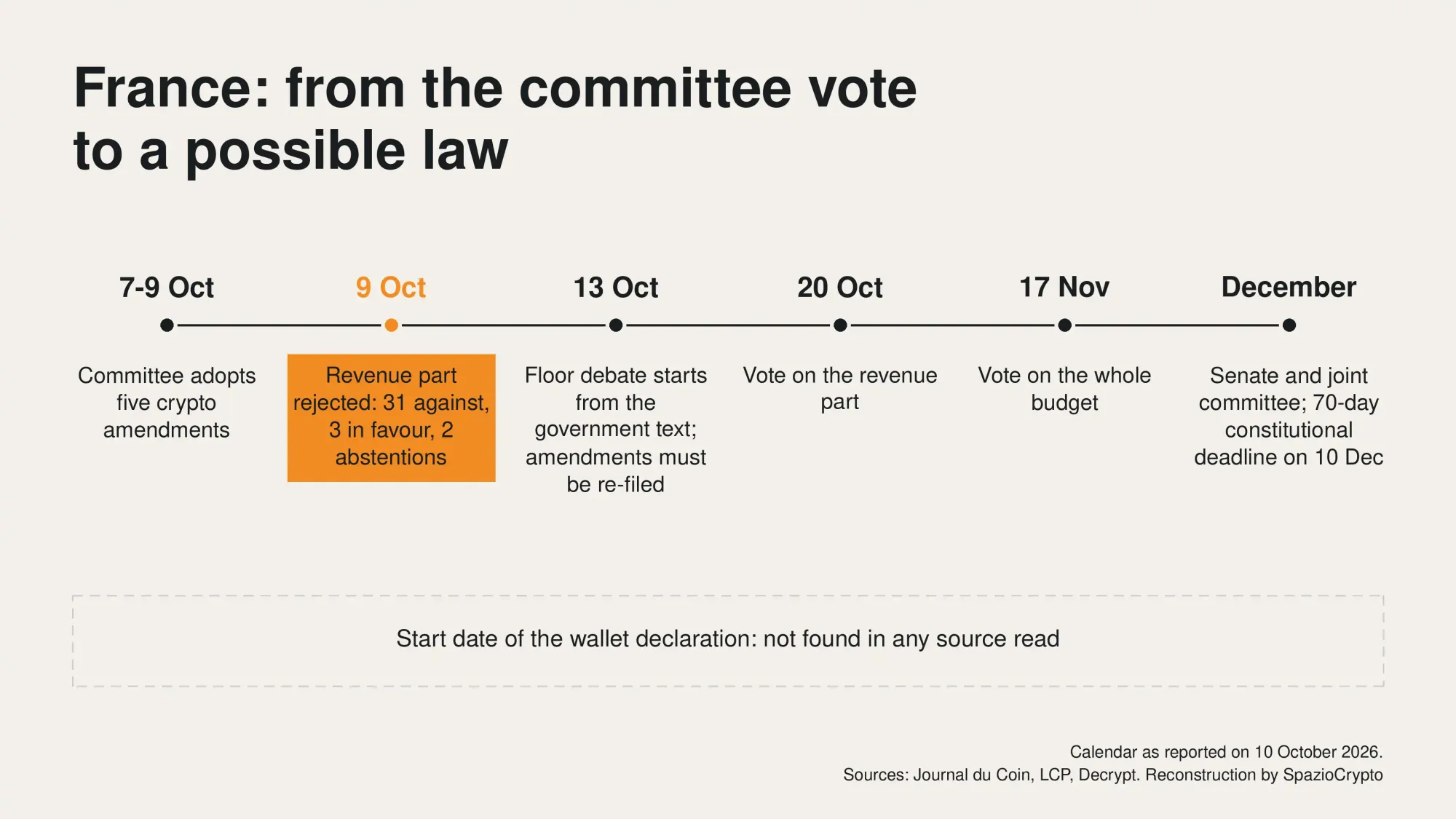
A committee vote is not legislation. On the evening of October 9, shortly before 11 p.m., the Finance Committee rejected the entire revenue section of the 2027 draft budget by 31 votes to 3, with 2 abstentions. Only deputies from the Ensemble pour la République group voted in favor, according to LCP. When the full chamber convenes from Tuesday, October 13, members start from the government's original text, meaning every crypto amendment must be resubmitted and revoted. In 2025, when the chamber rejected the revenue section, the text went to the Senate in its original form and the committee amendments disappeared entirely.
The timeline outlined by Journal du Coin runs as follows: floor debate through October 19, a solemn revenue vote on October 20, a full budget vote on November 17, then Senate deliberation and a joint parity committee in December. The constitutional 70-day deadline falls on December 10, after which the government could apply the budget by ordinance. Bitcoin.fr notes that even if adopted, the measure still requires formal promulgation and a potential review by the Conseil constitutionnel. According to both sources, stablecoins and the exit tax would take effect from January 1, 2027; no date has been confirmed for the wallet declaration requirement.
What About Italy?
French rules do not apply to investors residing in Italy. This is a tax proposal from another sovereign state, and its relevance for Italian residents lies in the approach it signals. Italy already has its own disclosure obligation: the RW section of the annual tax return, which per guidance issued by the Agenzia delle Entrate in 2021 and reported by informazionefiscale.it covers crypto assets held in self-custodied wallets with a private key. That guidance predates subsequent regulatory changes, so it should be verified before drawing any practical conclusions. On the tax-rate side, the administered tax regime adopted by Cryptosmart illustrates the opposite logic to France's proposal: the exchange calculates and remits the tax, but only on assets it holds in custody, while crypto on other exchanges or self-custodied wallets remains the user's own responsibility. In the same coverage, Italy's capital gains rate stands at 33% for 2026, with a parliamentary draft proposing a reduction to 26% from 2027.
The Bigger Picture
French tax authorities are pursuing the last unreported link in the chain. Having already requested data from platforms, which remain the central pillar under the European DAC8 framework, regulators are now turning their attention to wallets that no intermediary can see. The pattern appears elsewhere. In Brazil, Binance announced it will ask users to state the purpose of every cross-border crypto transfer to comply with central bank rules, and the KYC and AML providers serving European CASPs illustrate how fast identification infrastructure is solidifying. Europe built its system around licensed intermediaries: the MiCA deadline of July 1, 2026 defined who can legally operate, and a self-custodied wallet sits, by definition, outside that perimeter. That is precisely why the French proposal deserves attention even in its current fragile state: the 100,000-euro threshold and the security concerns of holders are the real sticking points, and the measure's fate depends on the budget process more than on any crypto-specific debate, given that the committee rejected the revenue section in its entirety.
The concrete signals worth tracking: whether amendment I-CF821 is resubmitted from October 13 onward and at what threshold, the revenue vote scheduled for October 20, the original bill text specifying scope and effective date, the merits challenge to DAC8 pending before the Conseil d'État, and any official response on the security question. Until those emerge, what exists is a committee vote on a text that may yet disappear, not an obligation that French holders are already required to meet.