


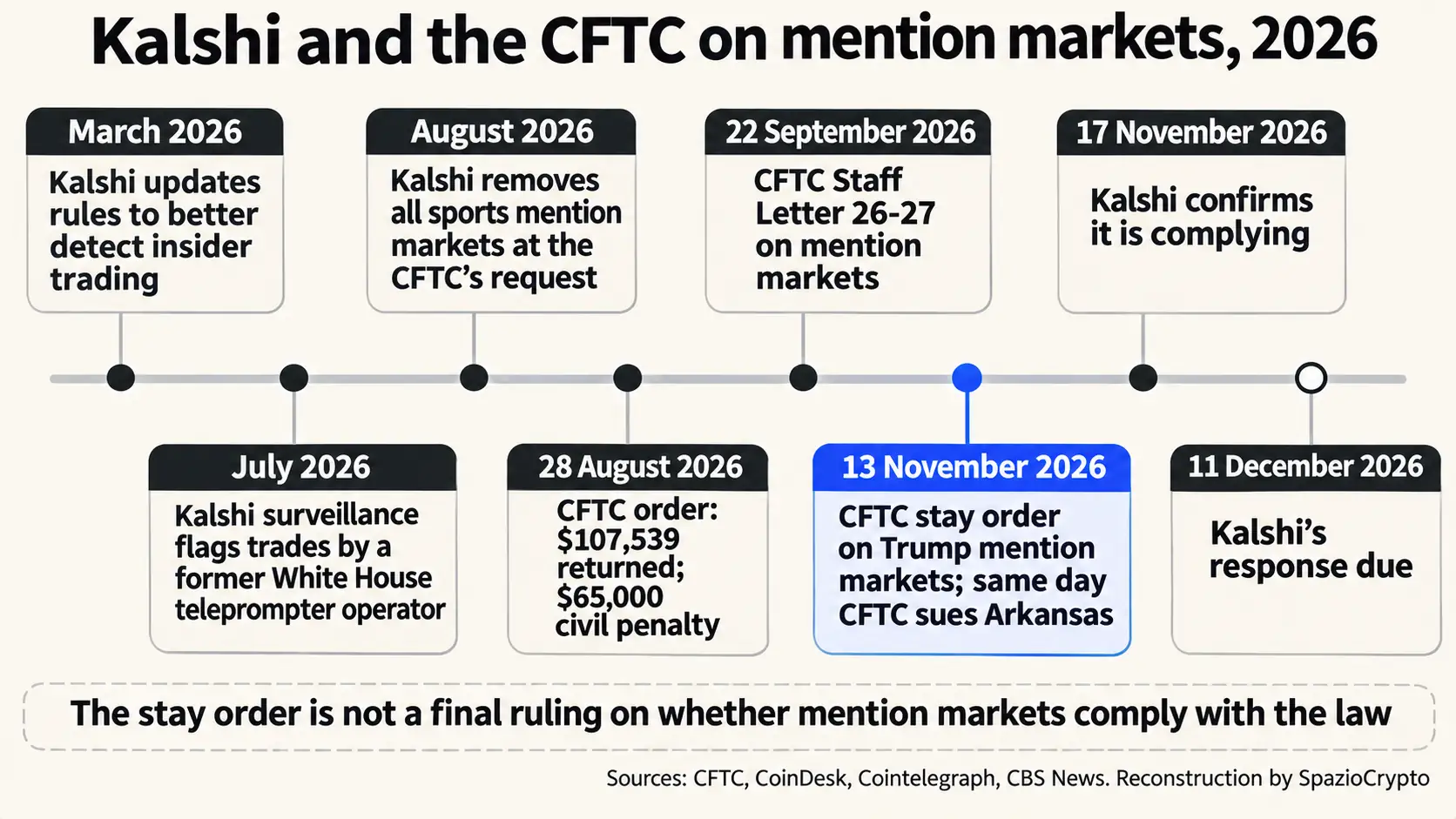
Kalshi has until December 11, 2026 to prove its Trump-linked prediction contracts resist manipulation, after the Commodity Futures Trading Commission suspended several mention markets on November 13 and opened a certification proceeding. Kalshi confirmed it had withdrawn the affected contracts on November 17. This is not an outright ban: the CFTC has not declared the markets illegal. The agency is asking Kalshi to demonstrate the compliance it originally certified.
SpazioCrypto reviewed the CFTC’s September 22 advisory, the November 13 CFTC press release on the Arkansas lawsuit, and reporting from CoinDesk, Cointelegraph, and CBS News. The CFTC order page was not directly accessible through our tools; we cite it via CoinDesk and Cointelegraph. Reuters, Axios, and the Wall Street Journal were also not accessible.
What the Order Actually Says
According to Cointelegraph, the November 13 order targets the market asking which nicknames Trump will use before 2027, along with the TRUMPSAY contract series: bets on specific words or monikers the president uses publicly. The CFTC stated it had decided to “initiate a proceeding for a false certification filing,” as reported by CoinDesk.
The scope is narrow. The order, per CoinDesk, “does not reflect any final determination” on whether a contract tied to presidential speech is lawful. It asks Kalshi to demonstrate the compliance it certified, in light of staff guidance issued in the interim. According to Cointelegraph, Kalshi had listed the nickname market after the September advisory without updating its certification.
The September Staff Letter
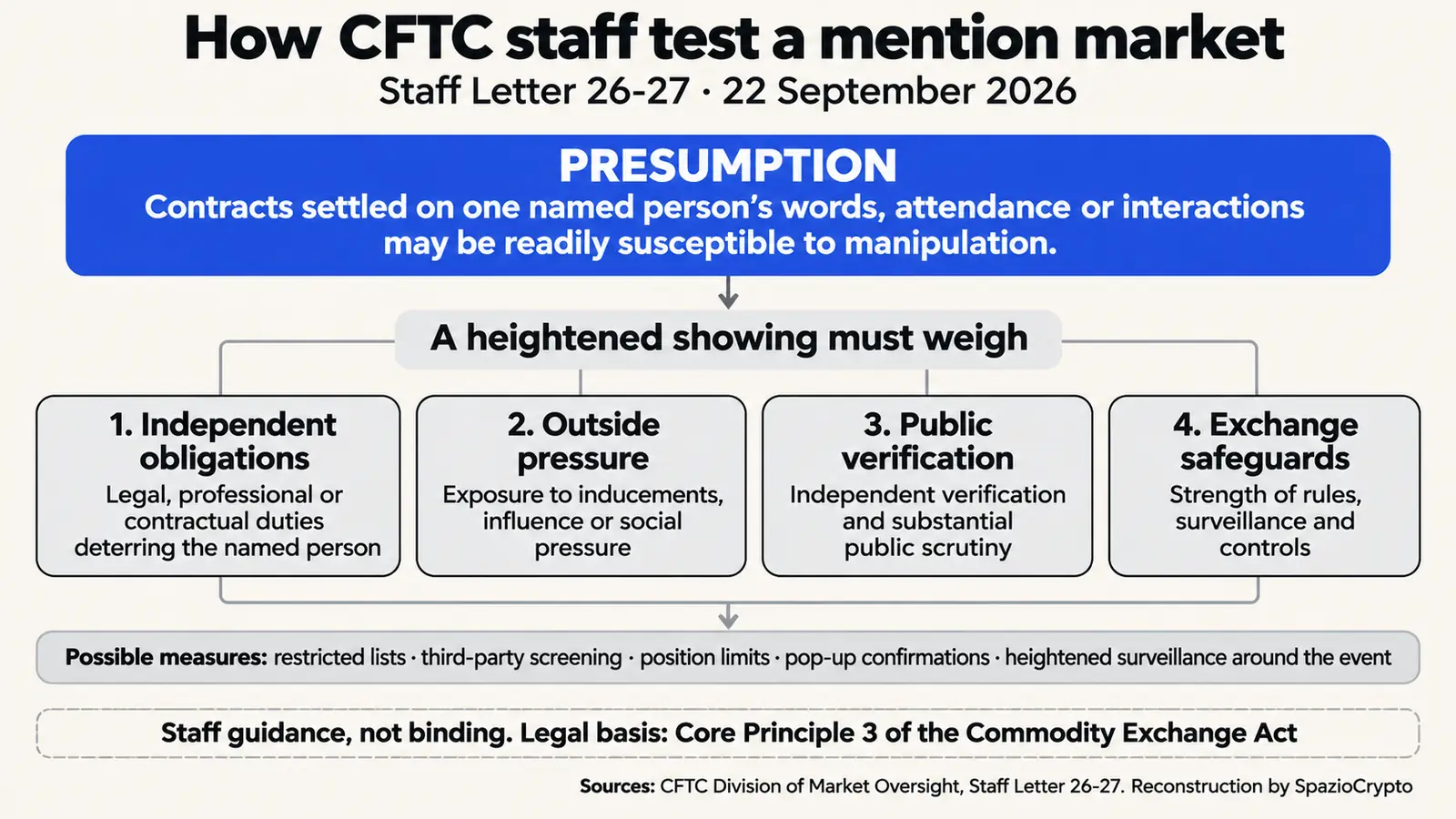
On September 22, the CFTC’s Division of Market Oversight published Staff Letter 26-27, covering three contract types: those whose outcome depends on what a specific person says, whether that person attends an event, or whether that person meets with someone else. Because the outcome depends on a single individual’s conduct, which may be neither independent nor externally verifiable, staff indicated these contracts could be “presumptively susceptible to manipulation.” Exchanges listing such contracts face a heightened demonstration burden.
The legal foundation is Core Principle 3 of the Commodity Exchange Act, which bars regulated exchanges from listing contracts easily susceptible to manipulation. The presumption can be rebutted by analyzing four factors: the obligations constraining the observed individual, external pressures on that person, the public verifiability of the outcome, and the strength of the exchange’s own oversight controls. The letter also suggests possible measures, from restricted-persons lists to position limits. Staff noted the letter is not binding but shapes how certifications are reviewed.
The Teleprompter Precedent
In July, Kalshi’s surveillance team flagged trades by a former White House teleprompter operator. According to the CFTC’s August 28 order cited by Cointelegraph, the individual typically had access to prepared remarks roughly one hour before they were delivered. The trader profited on 39 out of 43 contracts across 14 mention markets. The CFTC ordered disgorgement of $107,539 and a civil penalty of $65,000, closing the case without an admission of wrongdoing.
That case targeted one person. The November 13 order targets the product itself. According to CBS News, Kalshi had already removed all sports-related mention markets in August at the CFTC’s request; a person familiar with the matter told CBS those markets generated roughly $90 million in monthly volume. CoinDesk noted that Senator Elizabeth Warren had separately asked a White House counsel how the administration intends to prevent another similar episode.
Kalshi’s Defense
“We are complying with the order,” a Kalshi spokesperson said, as quoted by multiple outlets. CEO Tarek Mansour, according to Cointelegraph, told Axios he disagreed with the decision and argued these markets carry genuine economic value, because presidential statements move financial markets. Anyone tracking crypto knows the argument well: a single announcement can shift the market capitalization of an entire sector within hours.
Kalshi, per CBS News, had updated its internal rules in March to improve insider-trading detection. The order’s perimeter remains tight. According to CoinDesk, Kalshi was still listing a contract on what Vice President JD Vance would say at an event the following day. Many mention markets today cover corporate earnings calls rather than political figures.
Same Day, Same Agency: Two Signals at Once
On November 13, the CFTC also sued the state of Arkansas, which had filed a civil action against Kalshi in state court. Arkansas is the eleventh state the federal agency has sued to defend its exclusive jurisdiction over prediction markets. CFTC Chair Michael Selig stated that the agency will not allow state interference to destroy federally regulated markets, as reported by Cointelegraph.
The apparent contradiction resolves quickly. The CFTC is simultaneously defending the prediction market sector from state encroachment and limiting one specific product within it. Washington is drafting rules across multiple fronts at once, from stablecoins (including Tether’s two stablecoins designed around the GENIUS Act) to prediction markets. The logic is consistent: the product category survives, but must operate within a federal perimeter.
What About Europe and the UK?
The question lands differently on this side of the Atlantic. In Italy, the Agenzia delle Dogane e dei Monopoli added Polymarket and Kalshi to its list of unauthorized gambling sites in July, according to Open. The legal basis is Article 4 of Law 401 of 1989, which penalizes the collection of bets without a government license. On August 5, as reported by Il Sole 24 Ore, the TAR Lazio administrative court rejected Polymarket’s emergency suspension request.
The UK’s Financial Conduct Authority has not issued specific guidance on prediction market platforms as of this writing, leaving a regulatory gray area for British users similar to the pre-MiCA ambiguity crypto exchanges faced before 2024. For European readers, the broader principle applies: using platforms that are not authorized in your jurisdiction carries real risks, including fund custody and legal recourse. The unauthorized-site lists that regulators maintain are also used against fraudulent intermediaries, as we describe in our guide on scams that impersonate exchanges and regulators. The risks of operating outside the authorized perimeter touch self-custody and wallet security too, a topic covered in our guide on self-custody, exchanges, and wallets.
Kalshi and the CFTC: What Is Confirmed
What is confirmed and what is not
- Confirmed: CFTC order of November 13 suspending certain Kalshi mention markets tied to Trump’s words, a certification proceeding opened, Kalshi’s response due by December 11, withdrawal of the markets confirmed by Kalshi on November 17.
- Not specified: exact number of suspended contracts, any analogous orders against other platforms, final determination on the legality of mention markets.
- To watch: Kalshi’s response by December 11, the status of contracts tied to other political figures and to corporate earnings calls, and the outcome of CFTC lawsuits against individual states.
The Bigger Picture
The core tension in prediction markets operates on three levels. First, the capacity to aggregate dispersed information: this is their claimed public value. Second, surveillance over individuals with privileged access, illustrated by the teleprompter case. Third, a newer design problem: how to structure a contract whose outcome does not depend on a single person who controls the information. A market measures genuine uncertainty only when the event is not controllable by whoever holds the inside view.
The CFTC has not closed the door on mention markets. The agency has shifted the burden of proof to Kalshi, giving it until December 11 to demonstrate these contracts withstand manipulation. Four signals are worth watching: what Kalshi submits before the deadline, whether the order extends to contracts on other political figures, whether similar requests reach competing platforms, and how earnings-call contracts are ultimately treated. For US investors, the December 11 response is the next hard deadline. For European and UK readers, the American rulemaking matters regardless of local access restrictions. Digital market rules are frequently written in Washington first, as we see with European finance’s growing dependence on foreign AI infrastructure.