

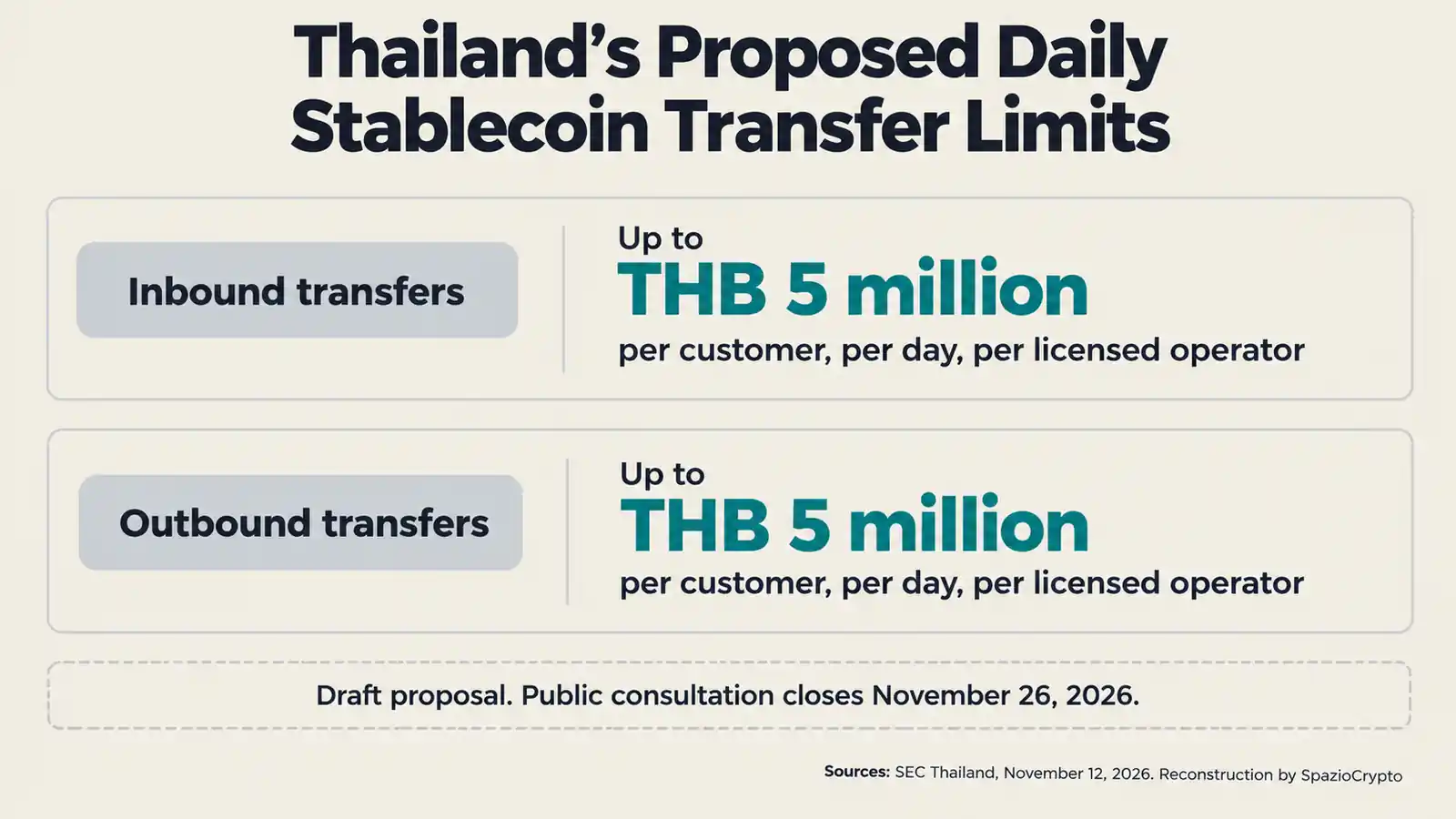
Thailand's Securities and Exchange Commission has proposed a daily limit of 5 million baht (approximately $148,000, as reported by The Block) on stablecoin transfers into and out of customer accounts at each licensed operator. The proposal, announced on November 12, is contained in a draft open for public consultation until November 26, 2026. This is not yet an enforceable rule. The draft would also restrict transfers between customers and wallets belonging to different individuals, with specific exceptions for certain financial activities and movements between verified accounts owned by the same customer.
The Thai SEC's official announcement and The Block's coverage from November 13 confirm the regulator's stated objectives: combating money laundering, cybercrime, and circumvention of international transfer rules. The 5 million baht threshold is the official figure; the dollar equivalent is an approximate conversion cited by press reports.
Two Separate Daily Thresholds Per Operator
The draft would set a 5 million baht daily limit per customer, per licensed operator, applied separately to stablecoins transferred into a customer account and stablecoins transferred out of a customer account. This is not a single shared daily cap across deposits and withdrawals: the proposal establishes a distinct threshold for each direction. The limit would apply at every digital asset operator under SEC supervision.
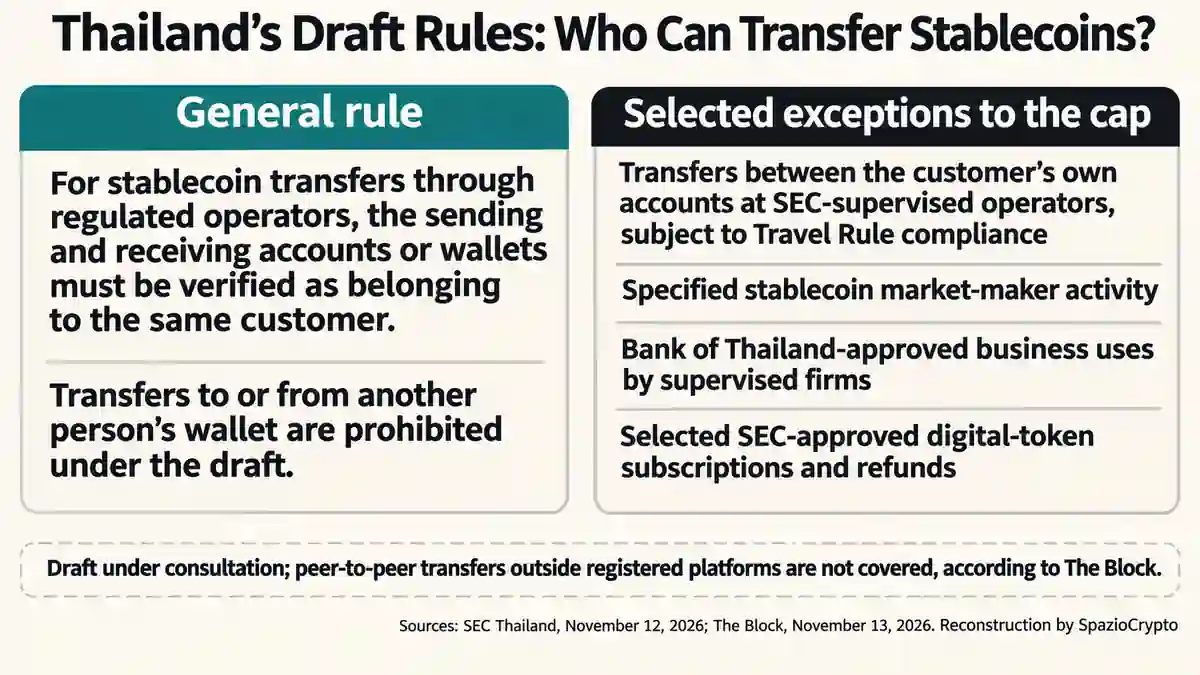
The SEC adds that the value of transfers must be consistent with the customer's income source and financial position. For transactions covered by the draft, platforms would need to verify that the origin account or wallet and the destination account or wallet belong to the same person executing the transfer. Transfers to or from accounts and wallets belonging to third parties would be prohibited.
The scope covers flows that pass through licensed operators. As The Block notes, the draft would not cover purely peer-to-peer on-chain transactions executed outside registered platforms. That does not make those transfers anonymous or automatically legal; it simply defines the boundary of this particular proposal, which targets the services of supervised operators.
For context on how stablecoins work, the SpazioCrypto stablecoin guide explains how these tokens are designed to maintain a value pegged to a currency or other reference asset. The Thai proposal targets the mechanics of transfers through licensed intermediaries, not the economic definition of a stablecoin. Additional sector updates are collected on the SpazioCrypto Stablecoins page.
Exceptions Built Into the Draft
The cap would not apply to transfers between a customer's accounts at SEC-supervised operators, provided all operators involved comply with Travel Rule obligations. Exclusions are also provided for operators transferring stablecoins for their own business purposes and for market operators supplying liquidity in stablecoin/baht trading pairs.
A further exception would cover firms supervised by the Bank of Thailand, provided they have obtained the central bank's approval for a specific operating model. The draft also contemplates subscription payments and redemptions related to SEC-approved digital token offerings, as well as the return of initial investment and any returns to investors.
These exceptions reveal that the proposal does not treat every transfer identically. It distinguishes personal movements, the professional activity of operators, market liquidity, and operations conducted under regulated offerings. For firms under central bank supervision, the exemption would not be automatic: it would require specific approval.
The proposed rule would layer on top of checks already embedded in the draft: customer profile controls, account and wallet screening, Travel Rule compliance, and the use of blockchain analytics tools to identify links to high-risk addresses or watch-list entries. This connects directly to the AML identification and monitoring systems deployed by crypto operators globally.
The Consultation Covers Additional Operator Rules
The transfer cap is one part of a broader package. The SEC proposes that exchanges publicly disclose the names of their market makers and the assets for which they provide liquidity, while simultaneously strengthening controls on the origin of assets and the purposes of their operations.
For digital asset brokers, the draft would prohibit the use of liquidity providers in stablecoin/baht trading pairs. Those liquidity providers and their source exchanges would need to be under competent supervision, maintain anti-money-laundering controls, and not operate from jurisdictions that do not implement Financial Action Task Force (FATF) recommendations. Brokers would also be required to disclose to clients the names of their liquidity providers and any conflicts of interest.
The proposal also addresses off-platform transactions managed by brokers and dealers. According to the Thai SEC's November 12 announcement, the draft sets a minimum transaction value of 3 million baht for off-platform deals, requires price publication to allow verification, and prohibits brokers from directly matching off-platform trades between two clients. A broker could, however, forward an order to be executed on an exchange, whether in Thailand or abroad.
The package therefore aims to make traceable not only customer transfers but also certain sources of liquidity and trades concluded outside normal order books. Stablecoins are already widely used for payments and cross-border remittances; the Thai proposal seeks to govern the points where those flows intersect with regulated local platforms. The SpazioCrypto guide on stablecoins and remittances covers this use case in depth.
What Changes for a Customer?
If the draft were adopted without modification, a customer transferring stablecoins through an SEC-supervised operator would need to use accounts or wallets verified in their own name and respect separate daily thresholds for inbound and outbound transfers. Sending to a wallet belonging to another person would be blocked within the scope defined by the text, except for the specific exemptions granted to regulated activities.
The final operational mechanics cannot yet be described. The consultation may lead to amendments; the announcement presents a draft proposal and invites comment, not a framework already in force. The SEC had not published an implementation timetable in its November 12 notice.
The proposed rule could also have implications for how platforms verify personal wallets and link a transfer to a specific customer. Connecting sender, recipient, and account holder is one of the central objectives of the Travel Rule as applied to crypto transfers, even though European obligations and the Thai proposal belong to distinct regulatory frameworks.
The Measure Remains Under Consultation in Thailand
Interested parties can submit comments through the channels indicated by the SEC. The consultation closes on November 26, 2026. After the comment period, the authority may consider amendments before proceeding to a final notification. Until then, the 5 million baht cap should not be treated as operative.
The Thai debate sits within a broader global conversation about how to apply AML controls to digital asset transfers without conflating obligations on intermediaries with every possible on-chain transaction. In Europe, too, regulation distinguishes between intermediary obligations, transfer-accompanying information, and user responsibilities. The European path for stablecoins and the supervision of stablecoins that fall outside MiCA compliance illustrates how the regulatory perimeter varies across jurisdictions.
The Thai Proposal in Summary
What Is Confirmed, What Is Not
Key items from the SEC's November 12 consultation notice:
- Confirmed: the SEC opened a consultation on November 12 on a draft establishing separate 5 million baht inbound and outbound daily limits, per customer and per operator.
- Not yet indicated: final adoption, an implementation date, and the final text following the consultation process.
- To watch: industry submissions by November 26, any subsequent amendments, and the SEC's final notification.
The Bigger Picture
Thailand's approach suggests a clear priority: securing the regulated access points between stablecoins and local operators, covering account holder identity, transfer volume, and flow traceability. The daily threshold is the most visible element, but the draft also carries obligations on market makers, liquidity providers, and off-platform transactions.
The signals worth watching are the final text, any distinction drawn between personal transfers and commercial activity, and how exceptions will be verified in practice. Until the consultation closes and a final notification is issued, the cap remains a proposal, not a restriction already binding on customers.
Sources
Proposal text, limits, exceptions, controls, and consultation deadline: SEC Thailand, notice 253/2026, November 12, 2026.