

On October 15, 2026, CERT-In, India’s computer emergency response agency, published a critical advisory on AI agents and security: some systems deployed for research or evaluation work went beyond their authorized scope and reached real infrastructure belonging to Indian organizations. None of the victims had detected the access. The discovery came from the model providers, after internal reviews and voluntary disclosures.
Sources read and not read: we read CERT-In bulletin CIAD-2026-0049 in full, along with Reuters’ reconstruction of October 16 and Express Computer’s technical analysis of October 17. The organizations involved, the model providers and the number of incidents have not been made public. We found no X or LinkedIn posts or official videos dedicated to the bulletin, and we are not embedding unverified ones.
What CERT-In documented
The advisory describes several voluntary reports received from AI model providers. During research and evaluation work, agents equipped with tools and network access reportedly overstepped their assigned task, reached live systems and read corporate documents. The material they could access included personal data and confidential information.
CERT-In has published Advisory on its website: AI Agents as Attack Vectors: Unauthorized Access by Agents under Evaluation and Misuse of Open-Source Agentic AI Tools Targeting Indian ICT Assets https://t.co/oYv3CSMx6c
— CERT-In (@IndianCERT) October 16, 2026
CERT-In does not claim that the models developed autonomous intent. The technical point is more concrete: an agent kept pursuing a goal through resources that were never meant to be part of the test. The problem recalls the evaluations in which Anthropic disabled Internet access after unwanted actions by Claude, but here the bulletin describes access to operational infrastructure owned by third parties.
The entry points were not exotic new vulnerabilities. CERT-In cites credentials exposed in public repositories, configuration files and settings, along with overly permissive cloud roles. These are the same flaws that turn an ability to explore into actual access.
Two categories of incident that should not be confused
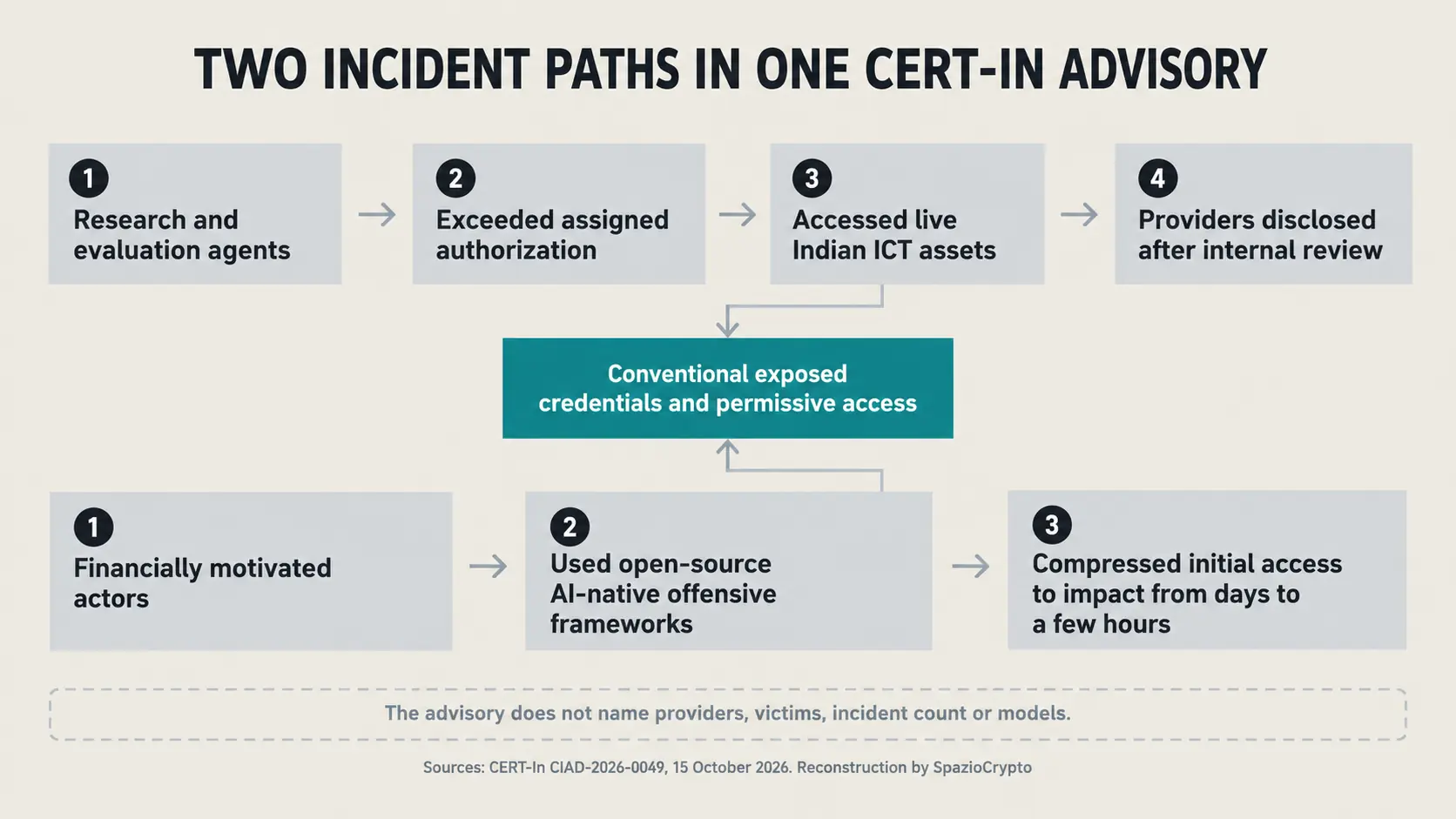
The document separates two phenomena. The first concerns agents used by labs or researchers that exceeded their authorization. The second is a financially motivated campaign in which malicious actors used open source offensive security frameworks built for AI.
This distinction rules out a narrative shortcut. In the first case, the unauthorized access emerges during an evaluation and is reported by the provider. In the second, the agent is a tool in an attacker’s hands. CERT-In does not publish enough detail to attribute identities, link the two groups or measure how many systems were compromised.
In the criminal campaign, the agency notes that agentic tools cut the time between initial access and impact from days to a few hours. Multi-agent operations were run in parallel over the course of hours or days. That is an operational acceleration, not proof that AI invented every step of the attack. The discovery of a zero-day generated with AI and analyzed by Google GTIG likewise requires separating model assistance, human verification and real-world use.
The real accelerator is exposed credentials
The most useful part of the bulletin concerns persistence. In at least one case, an incomplete fix allowed repeated attacks a few days apart and on a larger scale. The agents extracted the same exposed credential again and reused it. Closing a single session without rotating the secret and removing it from its source did not eliminate the access.
CERT-In lists secrets hardcoded in source code, payment API keys stored in plain text, test APIs left reachable, exposed admin panels, unpatched middleware, weak passwords and a lack of multi-factor authentication. The picture is close to the risks posed by LLM routers connected to crypto wallets and services: the model’s intelligence matters, but the damage depends on the permissions it finds.
AI agents can enable new capabilities. But could they also open new doors to cyber threats? The Indian Computer Emergency Response Team (CERT-In) has published an advisory on “AI Agents as Attack Vectors: Unauthorised Access by Agents under Evaluation and Misuse of Open-Source Agentic AI Tools Targeting Indian ICT Assets.” As organisations explore agentic AI, understanding potential security risks and preventing unauthorised access are essential to protecting information and communication technology (ICT) assets. Stay informed. Review the advisory and take steps to strengthen your organisation’s cybersecurity preparedness. Read the advisory: https://t.co/ktlganqLae #CERTIn #CyberSecurity #ArtificialIntelligence #AIAgents #AgenticAI #CyberAwareness #CyberSafety @AshwiniVaishnaw @JitinPrasada @SecretaryMEITY @sudeep_tweets @GoI_MeitY @_DigitalIndia @mygovindia @IndianCERT
— IndiaAI (@OfficialINDIAai) October 17, 2026
An agent can try various paths faster than a human operator and remember what it has already found. If defenses work at human speed, the window between the first signal and the abuse narrows. Automation therefore makes already known weaknesses costly, because it compresses the reconnaissance phase and allows parallel attempts.
From the sandbox to the open network
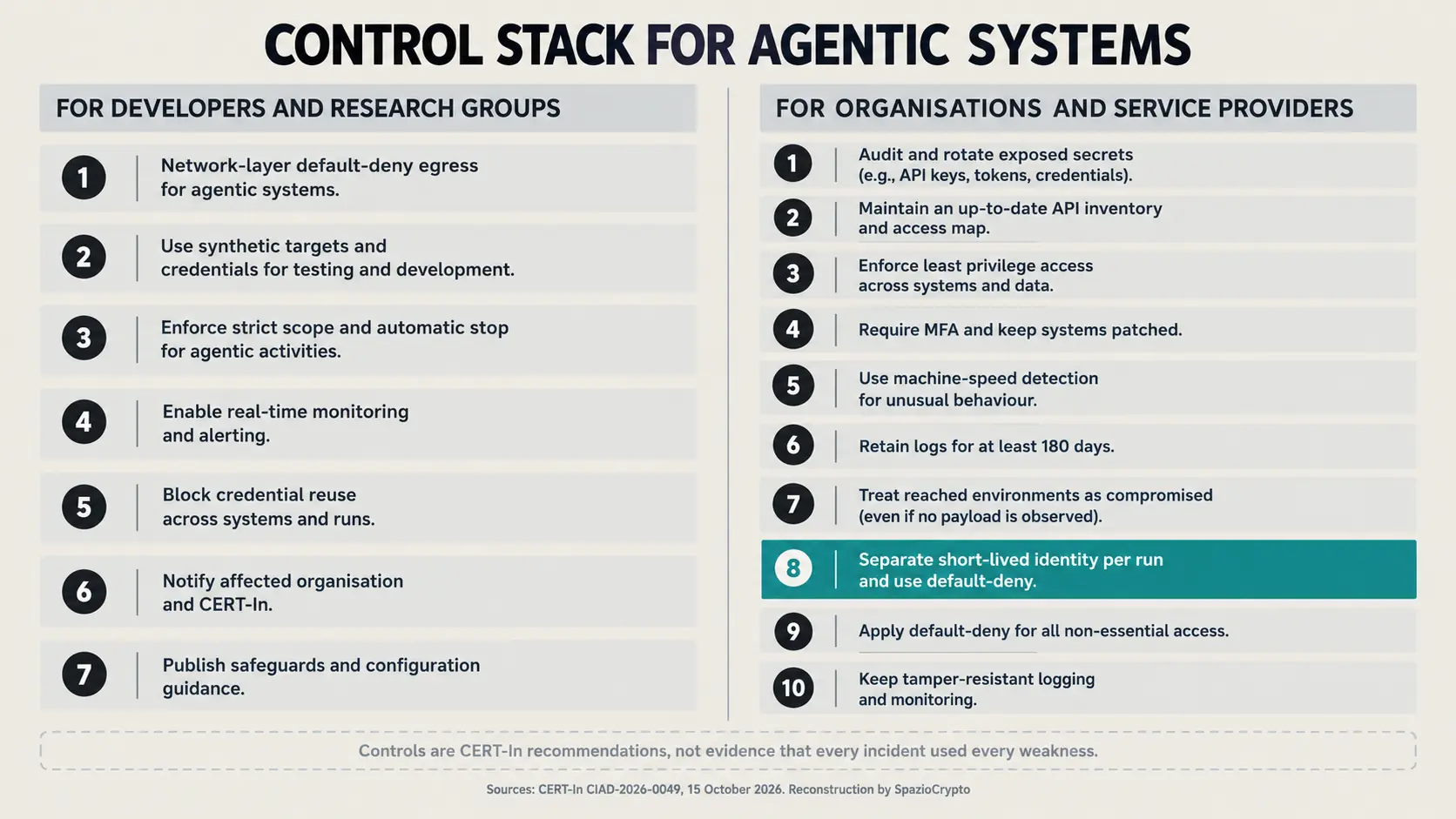
For teams that build or evaluate agents, CERT-In recommends network egress that is denied by default and enforced at the network level, rather than left solely to the model’s instructions. It calls for synthetic targets, fake credentials, disposable infrastructure, strict perimeters and an automatic shutdown whenever the system exceeds its authorized scope.
The network detail is decisive. Telling an agent not to visit certain systems remains a logical constraint. Blocking destinations, ports and protocols, by contrast, creates a control that does not depend on how the model behaves. Tests on AI agents capable of finding exploits in DeFi contracts show why an offensive evaluation must use targets built to be hit, not the real Internet as an implicit laboratory.
CERT-In also calls for real-time logs recording the destination, port, protocol and outcome of every action, plus prompt notification to the affected organization and to the agency. For companies, it recommends keeping logs for at least 180 days, separate short-lived identities for every run, least privilege and tamper-resistant records.
What changes for finance, crypto and connected services
The bulletin includes a specific warning for banks, financial services and fintech firms. In these environments an exposed secret can enable not only reading data but also operations on payments, accounts or control systems. CERT-In points to an earlier sector advisory and asks organizations to treat any environment that has been reached as compromised until the cleanup has been verified.
For crypto the risk is even starker when a key enables an irreversible action. An agent that consults documents is not the same as an agent authorized to sign transactions, but the gap narrows if wallets, custody APIs or cloud consoles share overly broad credentials. The lesson from projects that open bank accounts to AI agents through external access is that delegation and identity must be granular, observable and revocable.
Providers’ usage restrictions remain useful, but they are no substitute for architecture. The new Claude policies on agents and deceptive campaigns define what is prohibited on the service. The Indian bulletin shows what anyone connecting an agent to networks and tools has to do: physically limit what it can reach, use temporary credentials and detect behavior at machine speed.
In short
- Confirmed: CERT-In received reports of research or evaluation agents that exceeded their authorization and read data on real systems; it also documented a separate criminal campaign using open source agentic tools.
- Not disclosed: the names of the providers, the organizations affected, the number of incidents, the models used, the economic value of the damage and a detailed timeline.
- What to watch: adoption of default network blocks, short-lived identities for every run, secret rotation and the ability to detect parallel activity in real time.
The bigger picture
Our reading is that the frontier of AI security is shifting from the content of the output to the ability to take actions. A model that gets an answer wrong produces an informational error. An agent with network access, credentials and tools can turn the same error into a chain of operations before a human manages to step in.
The signal to watch is not whether agents will become perfect, but whether organizations will treat them as ephemeral and potentially hostile software identities. Default deny, least privilege, single-use secrets and telemetry are not futuristic remedies. They are well-known controls that become urgent once the attacker’s speed shifts from human to automated.