


Giga Energy has signed a ten-year, approximately $1 billion lease with an unnamed American AI cloud provider for Project Clay, a 60 MW AI data center in Hunt County, Texas, roughly 50 miles northeast of Dallas. The company announced the deal on November 17, 2026, with construction already underway since July and a spring 2027 target for going live, according to the company press release and Reuters. Giga promises a cooling system that draws no local water and a dedicated power grid that won't burden residential customers. These are the builder's own claims, not yet verified by any third party, and they arrive at a moment when data centers have become a flashpoint in Texas politics.
We reviewed Giga's press release, the Reuters report, the project page the company published for Hunt County, and the Texas Tribune's coverage of incoming Governor Gina Hinojosa's platform.
What the Contract Actually Covers
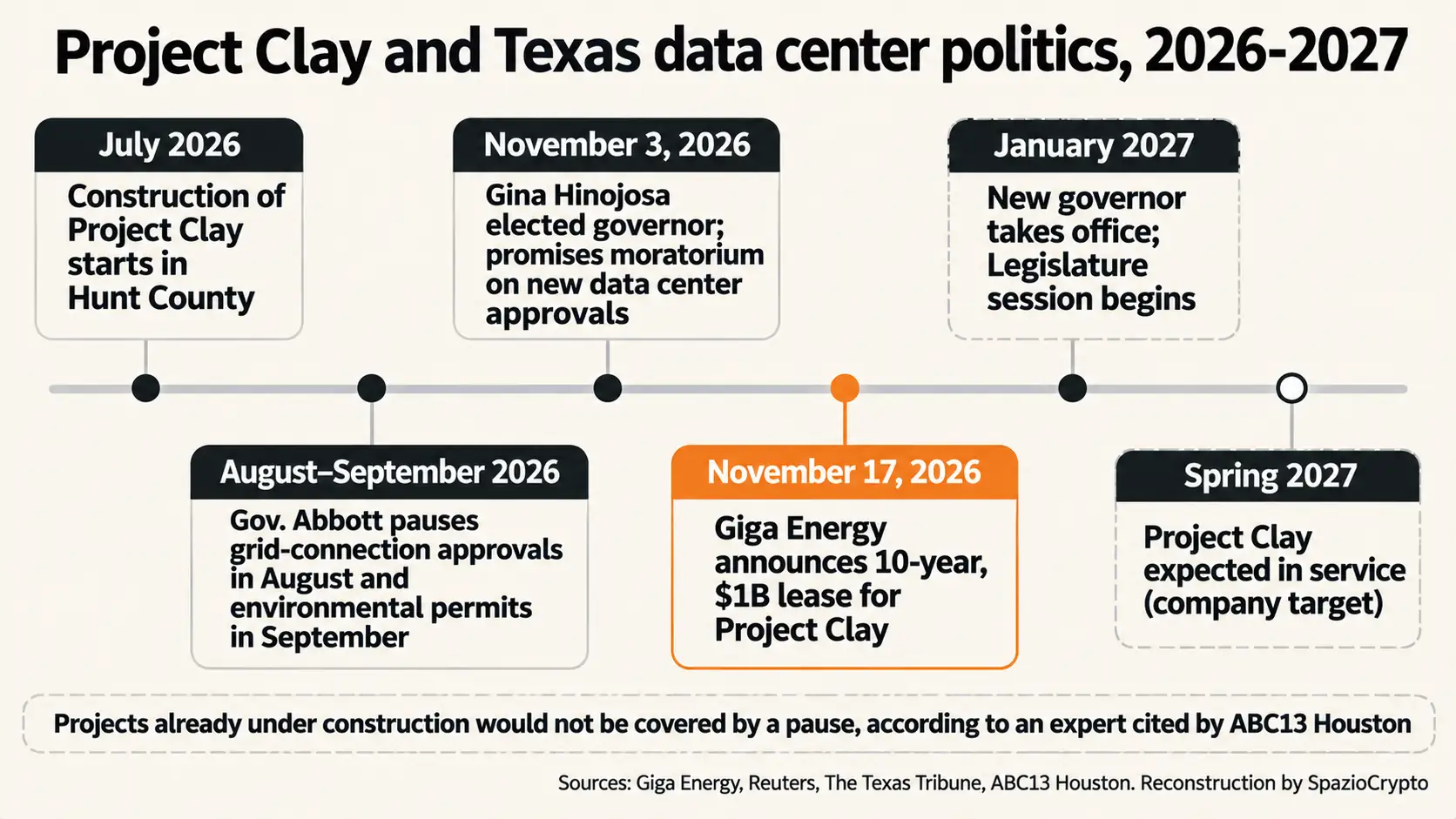
Giga will develop, own, and operate the roughly 30-acre campus. The unnamed client pays for computing capacity over ten years. Construction began in July, and the press release and Reuters both cite spring 2027 as the go-live date, though Giga's county-facing project page says mid-2027. Reuters also notes that the company's modular construction method is designed to deliver the campus in under eight months from groundbreaking.
Several details remain absent from the announcement: the client's name, the financial structure behind the $1 billion figure, the hardware that will be installed, and the actual power available to servers. The project page refers to 60 MW of access; a portion of that capacity will serve cooling and facilities infrastructure, not compute workloads.
What a Megawatt Is Worth Here
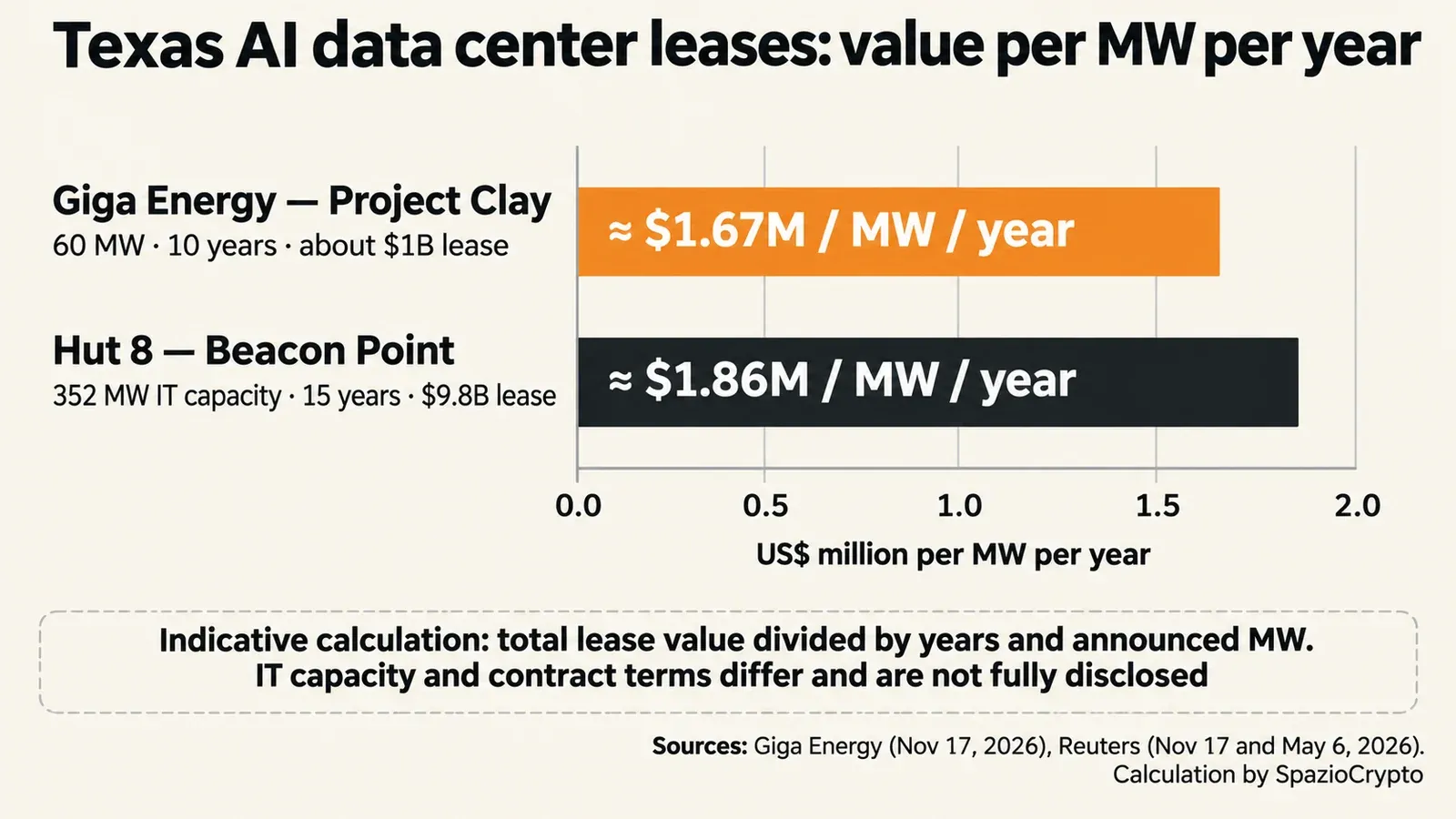
A quick comparison puts the headline number in perspective. One billion dollars over ten years works out to roughly $100 million per year, or about $1.67 million per megawatt annually. In May, according to Reuters, Hut 8 signed a 15-year, $9.8 billion deal for its 352 MW Beacon Point campus, also in Texas: approximately $1.86 million per megawatt per year. That calculation is our own and is indicative only, since the two contracts carry different terms and Giga has not disclosed how many of the 60 MW will serve actual compute.
Scale matters more than price per megawatt. Hut 8 is among the bitcoin miners that have pivoted to data center operations at hundreds of megawatts. Giga operates at smaller, standardized scales: a 60 MW campus can be designed, connected, and delivered on a schedule that a gigawatt-class facility simply cannot match.
Factory First, Site Second
That speed is Giga's core competitive advantage. Founded in 2019 by Brent Whitehead and Matt Lohstroh while both were students at Texas A&M, the company manufactures transformers and substations at its facilities in Houston and Long Beach, and still sells bitcoin mining solutions. According to the project page, roughly 90% of the work happens in the factory, with on-site assembly accounting for the remainder.
For anyone building data centers, owning transformer production is a concrete edge. Transformers are among the longest-lead components in the supply chain, as we covered in our piece on the real bottleneck in AI infrastructure. If Giga meets its timelines, the margin won't come from servers. It'll come from standardizing the electrical and thermal enclosure that hosts them.
Water and Grid: The Claims That Need Testing
The two boldest promises address the two constraints blocking other projects across the state. On water: the cooling system is a closed loop using a water-glycol mixture, with no evaporative cooling towers. The project page states the loop is filled once using water trucked in, amounting to roughly the annual consumption of two and a half households, and that ongoing water use covers only offices and services, comparable to two homes. “Zero water” applies to compute cooling specifically, not to the entire site.
On the grid: Giga says it uses previously untapped capacity on dedicated electrical infrastructure owned by local cooperative Farmers Electric, pays out of pocket for new lines and upgrades, and holds no priority over residential customers in the event of a blackout. Backup generators would run fewer than 20 hours per year, against a 100-hour permit ceiling. All of these are builder declarations. The announcement contains no independent verification of either the water balance or the electrical capacity, a gap that matters across the whole sector, as we explored in our piece on energy as a data center constraint.
Texas Is Rewriting the Rules
The political backdrop explains why the press release reads the way it does. Since August, outgoing Republican Governor Greg Abbott has suspended data center approvals at the grid operator and the environmental permitting agency, pending a review. Abbott has demanded that data centers fund their own electrical infrastructure and adopt efficient water technologies. Democrat Gina Hinojosa, elected governor on November 3, has promised a moratorium on new approvals until the state legislature passes new protections, including safeguards for community water supplies, as reported by the Texas Tribune. She takes office in January.
Giga's press release explicitly addresses incoming Governor Hinojosa's stated priorities: data centers that pay for their own energy, efficient cooling, and no costs passed onto residents. The release does not say whether Hinojosa has commented on Project Clay. An expert interviewed by ABC13 Houston noted that a pause would likely apply only to new projects, not those already operational or under construction, a category that includes Project Clay.
What This Means Beyond Texas
The same tensions are playing out in Europe. In mid-October, Pasqualino Monti, CEO of Italian grid operator Terna, stated that connection requests for data centers had exceeded 100 gigawatts across nearly 600 projects, far outpacing the actual capacity to build them. As recently as May 2025, that figure stood at 42 GW, per Terna's own disclosures. The demand pressure is global, as the projections for data center energy consumption make clear. The same community resistance that is reshaping Texas policy led Norway to freeze grid reservations for data centers entirely. The Giga model, dedicated power paid by the builder and cooling without local water draw, is precisely what communities from Texas to Northern Europe are demanding.
Project Clay: What Is Confirmed and What Is Not
Confirmed versus outstanding details
- Confirmed: a ten-year lease worth approximately $1 billion with an unnamed American AI cloud provider for a 60 MW campus in Hunt County, Texas; construction started in July; go-live targeted for spring 2027; Giga develops, owns, and operates the campus.
- Not disclosed: the client's name, actual server-available power, financial structure, hardware specifications, and no independent verification of water consumption or electrical capacity claims.
- To watch: whether the construction timeline holds, the rules the Texas legislature passes under the new governor, and whether Giga signs further contracts using the same formula.
The Bigger Picture
Our reading of this, stated as such: for AI data centers, the unit of value is no longer just the megawatt. It's the megawatt a community is willing to host. Project Clay is designed as a preemptive answer to the objections stalling other campuses: water draw, grid load, residential costs. The press release speaks to clients, but it also speaks to Hunt County and to the incoming Texas administration.
Four concrete signals are worth watching. First, delivery on time, which would confirm that the factory-build model actually works. Second, the client's name, which would allow an independent assessment of the contract's durability. Third, the rules the Texas legislature adopts in its January session. Fourth, real water and energy consumption data once the campus is live: those numbers. Only those, will confirm whether the promises hold.
Sources
Press releases and documents: Giga Energy press release, November 17, 2026; Giga Energy project page for Hunt County.