


U.S. federal prosecutors secured a civil forfeiture of approximately $84.2 million tied to Capstone, a Montana-based payments company accused of operating as an unlicensed money transmitter. The case surfaced publicly on September 24 and 25, 2026, and it deserves careful reading because it touches on Tether, the company behind the world's largest stablecoin, without Tether itself facing any charges of wrongdoing. This $84 million seizure linked to Tether requires a precise reading of the source chain, not a shortcut to easy conclusions.
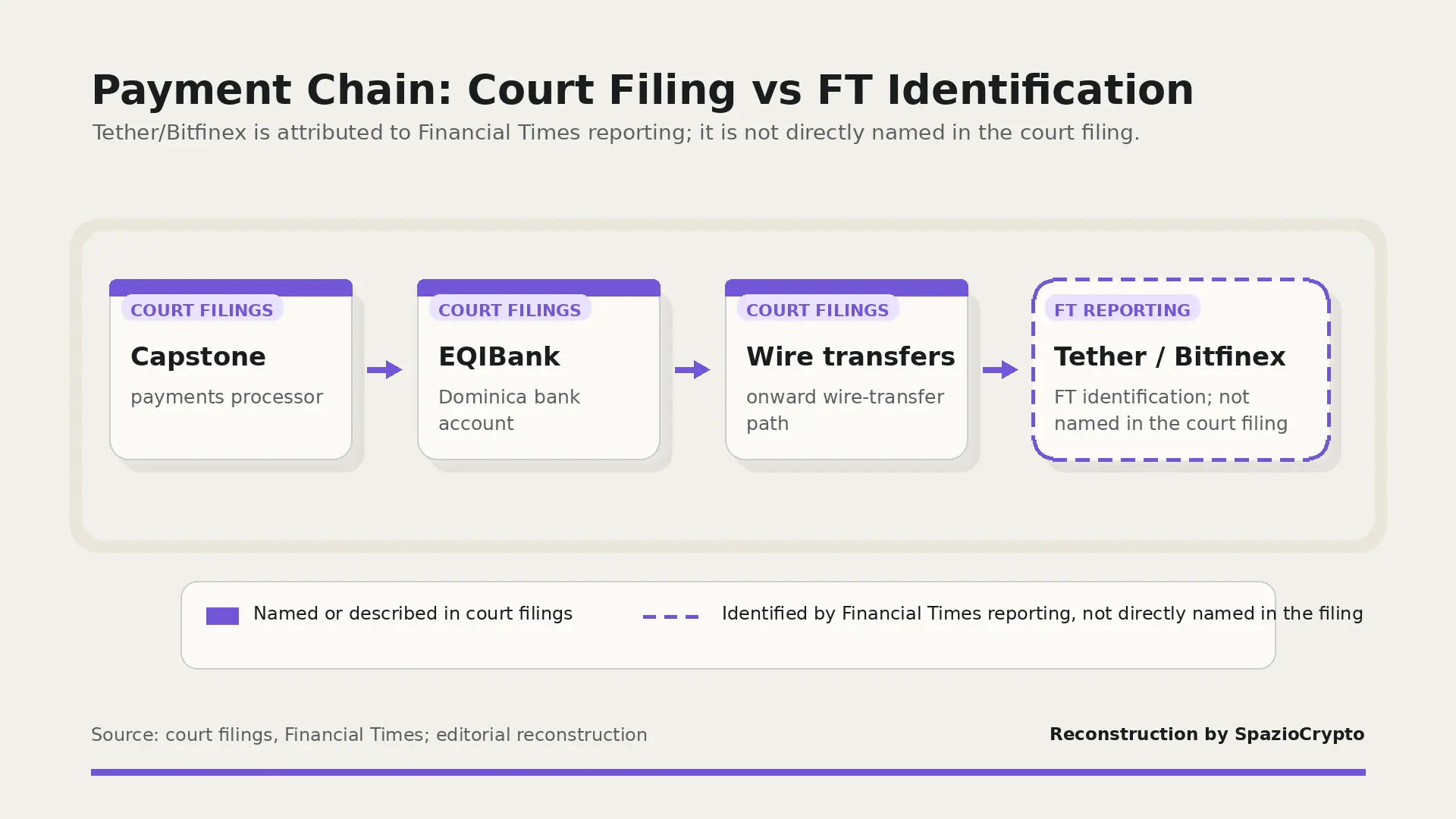
The single most important fact to establish first: the civil forfeiture complaint filed by prosecutors does not directly name Tether, its affiliated exchange Bitfinex, or the bank involved. The filing refers generically to “a cryptocurrency company,” “an affiliated exchange,” and “a bank headquartered in Dominica.” It was the Financial Times, citing unidentified sources, that connected those references to Tether, Bitfinex, and EQIBank. Tether subsequently confirmed that identification is accurate regarding its banking relationship with EQIBank, but has not accepted any allegation of wrongdoing that is the actual subject of the investigation. Here is precisely what the court documents say.
What the Forfeiture Order Covers
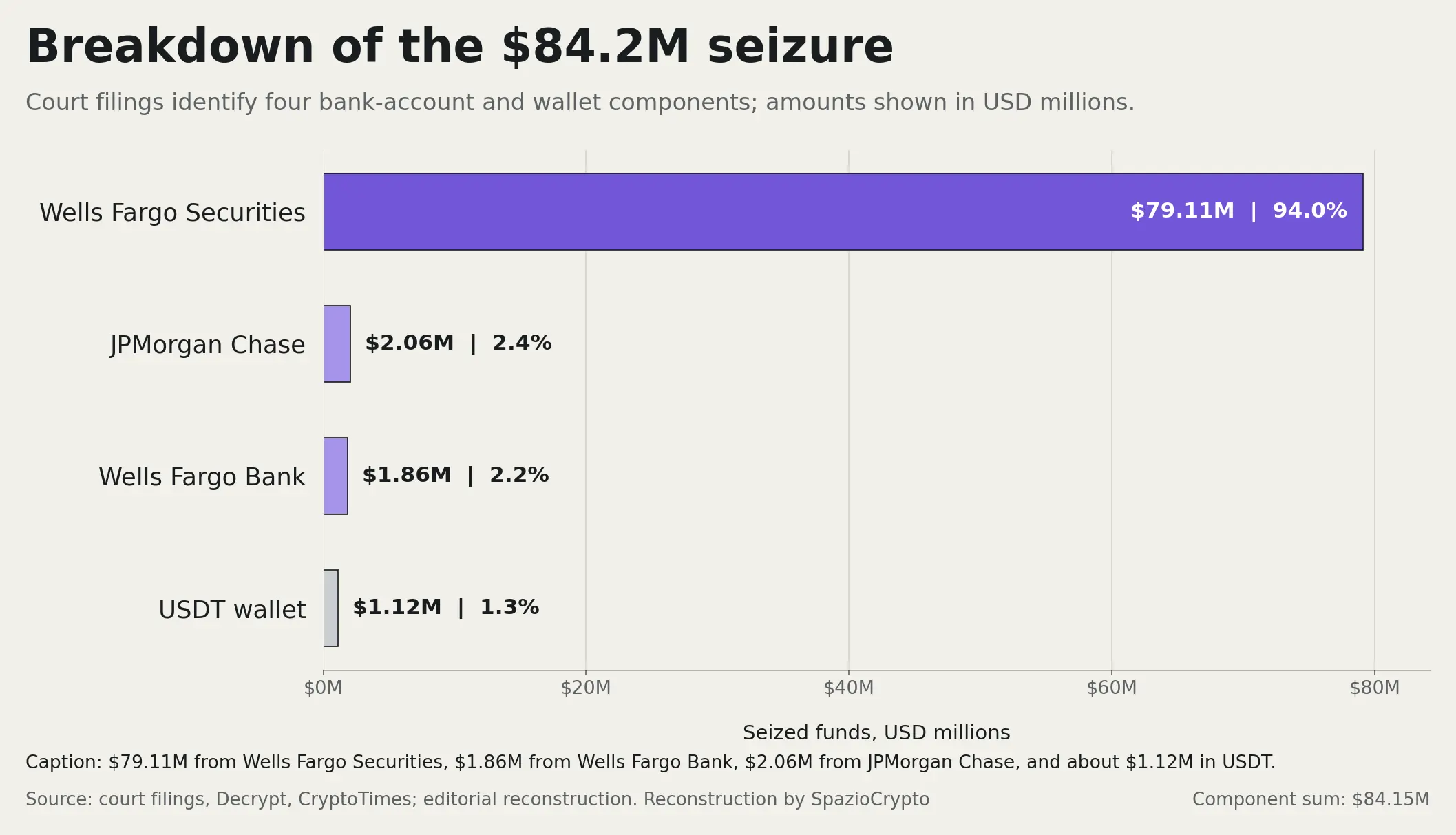
According to the civil complaint filed on July 15, 2026, in the U.S. District Court for the Eastern District of California, Capstone allegedly operated as an unlicensed money transmitter in at least six states while presenting itself to banks as an ordinary technology services company. On September 14, 2026, prosecutors executed seizures totaling approximately $84.2 million: $79.11 million from a Wells Fargo Securities account held by Capstone, $1.86 million from a second Wells Fargo account, $2.06 million at JPMorgan Chase, and just over $1 million in USDT distributed across two crypto addresses, according to the forfeiture filing.
 Riza Dagoc
Behind Capstone, according to court documents, stood EQIBank, a digitally licensed bank based in Dominica, which allegedly directed how the payments processor moved money. Capstone's owners, identified in the documents, were subjected to an FBI search of a California residence. Their attorney stated the company “denies any wrongdoing” and hopes to resolve the matter quickly. EQIBank filed an emergency motion to recover the seized funds, arguing it was deceived by Capstone and believed the firm was properly registered. A judge has already denied that request.
Tether's Actual Role, Stated Precisely
Tether publicly confirmed that EQIBank processed its wire transfers related to USDT issuance and redemption, but stated the company had no knowledge of the conduct under investigation. Tether also quantified its potential exposure at less than 0.034% of the group's total assets, a figure that, applied against its most recent quarterly attestation data, would correspond to roughly $63.8 million, according to TokenPost reporting on the forfeiture filing. The Financial Times, citing court documents, reported that Tether's relationship with EQIBank went beyond that of an ordinary customer: Tether allegedly invested in the bank itself and offered to increase its support in exchange for EQIBank opening a Tether account at a Singapore institution. That detail, worth flagging, comes from documents cited by the Financial Times and has not been directly confirmed by Tether on that specific point.
To be unambiguous about something already being muddied online: neither Tether nor Bitfinex has been charged with any wrongdoing in this proceeding. Prosecutors brought no claims against either company. Both appear in court documents only in relation to funds that moved through Capstone and EQIBank for the processing of legitimate payments.
Confirmed vs. Not Confirmed
The distinction that matters. Source: court filings, Financial Times, Tether, 2026
- Confirmed: $84.2 million seized from Capstone; Tether was an EQIBank client for its own wire transfers.
- Identified by the FT, not the filing: that the companies involved are Tether, Bitfinex, and EQIBank.
- NOT charged: neither Tether nor Bitfinex faces any allegation of wrongdoing.
The Fraud Scheme in the Background
A separate but connected element involves an alleged fraud scheme in which victims, according to court documents, were contacted by individuals impersonating FBI agents. Using psychological pressure, these imposters induced victims to make payments that were subsequently converted into stablecoins. Capstone is accused of facilitating precisely that conversion of stolen funds into crypto. This point, once again, concerns the payment infrastructure exploited by the fraudsters, not any accusation against the issuer of the stablecoin used as the final conversion tool.
The Larger Picture: Stablecoins and Banking Compliance
This case shines light on a delicate and underreported junction between stablecoins, the international correspondent banking system, and anti-money-laundering controls. Large stablecoin issuers, to operate at global scale, must rely on a web of banks and payment processors across multiple jurisdictions to handle the issuance and redemption of their tokens in fiat currency. When one link in that chain, as here an unlicensed payments processor that misrepresented itself to U.S. banks as a tech firm, fails its regulatory obligations, the reputational and operational risk can fall on parties like Tether that were simply using it as a banking service provider, regardless of their own culpability. That dynamic connects directly to the broader scrutiny of high-risk financial flows tied to stablecoins, a theme we examined in our analysis of the Bitrace report on flows toward high-risk addresses.
Two lessons emerge from this episode. First, as stablecoins push deeper into traditional financial infrastructure (a trend we tracked covering The Clearing House and Quant's on-chain initiative), every link in the banking chain supporting them must fully meet its regulatory obligations, because a single weak link can produce reputational damage disproportionate to the actual sums involved. Second, cases like this one, where a complex legal proceeding risks being compressed into misleading headlines, are a reminder of why precision matters: there is a fundamental difference between being formally charged with a crime and being named as a client or commercial counterparty of an entity under investigation. We'll track developments in this proceeding over the coming weeks, as all parties may provide further clarifications. For background on how these instruments work, our guide on what stablecoins are remains a useful starting point.