


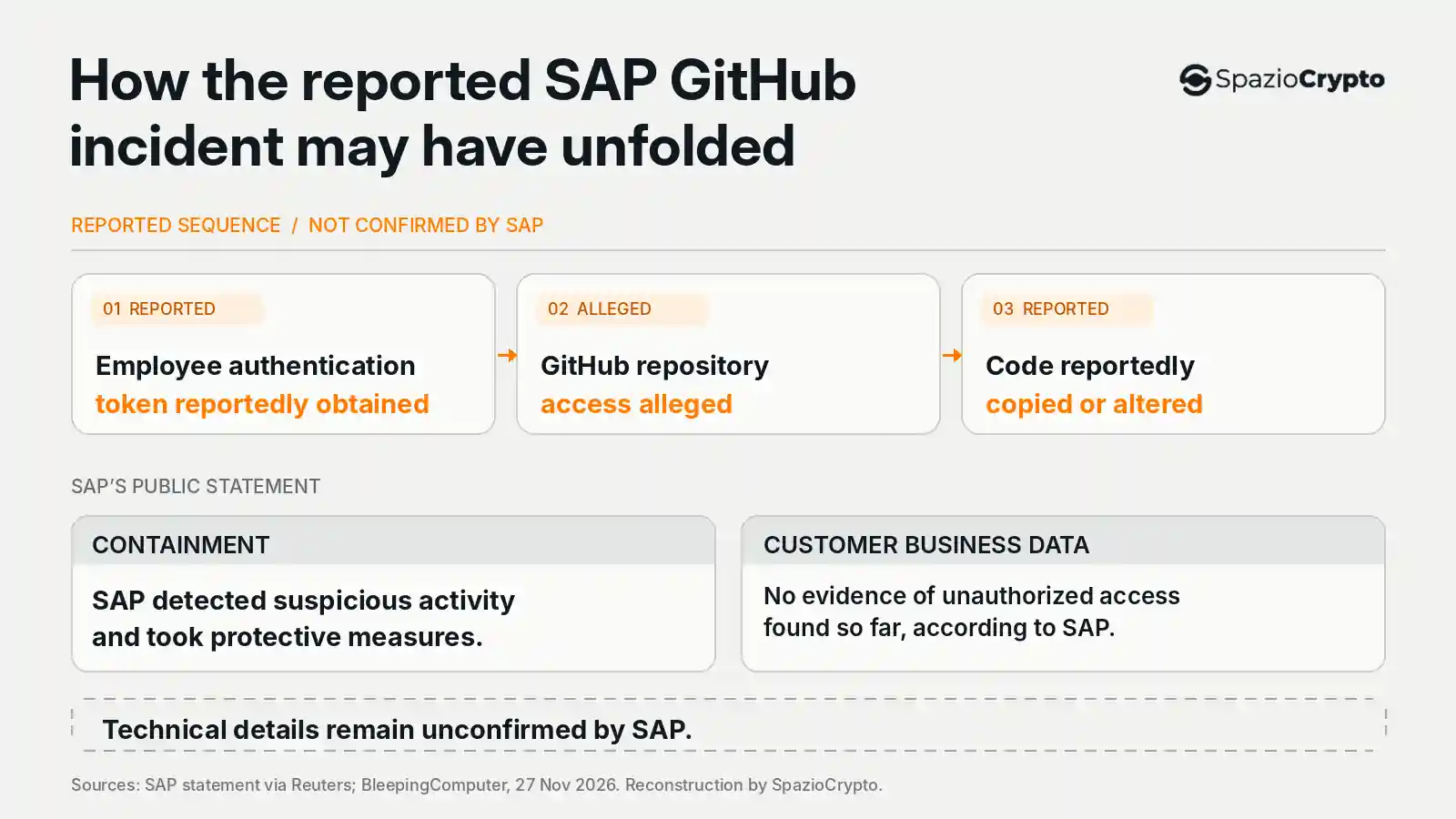
SAP confirmed it detected suspicious activity and took protective measures, but has not publicly verified the technical details reported by media outlets. According to reconstructions by Der Spiegel, Handelsblatt, and BleepingComputer, citing internal sources, attackers stole employee authentication tokens and used them to copy or modify source code on GitHub. As of November 27, SAP told Reuters it had found no evidence of unauthorized access to customer business data.
The story broke on November 26, when Der Spiegel reported an attack against SAP, citing an internal memo and company insiders. The following day, SAP confirmed to Reuters that it had identified “suspicious activities” and quickly acted to protect customers and service security. That statement also contained a carefully worded qualifier: the investigation had found no evidence, so far, of unauthorized access to customer business data.
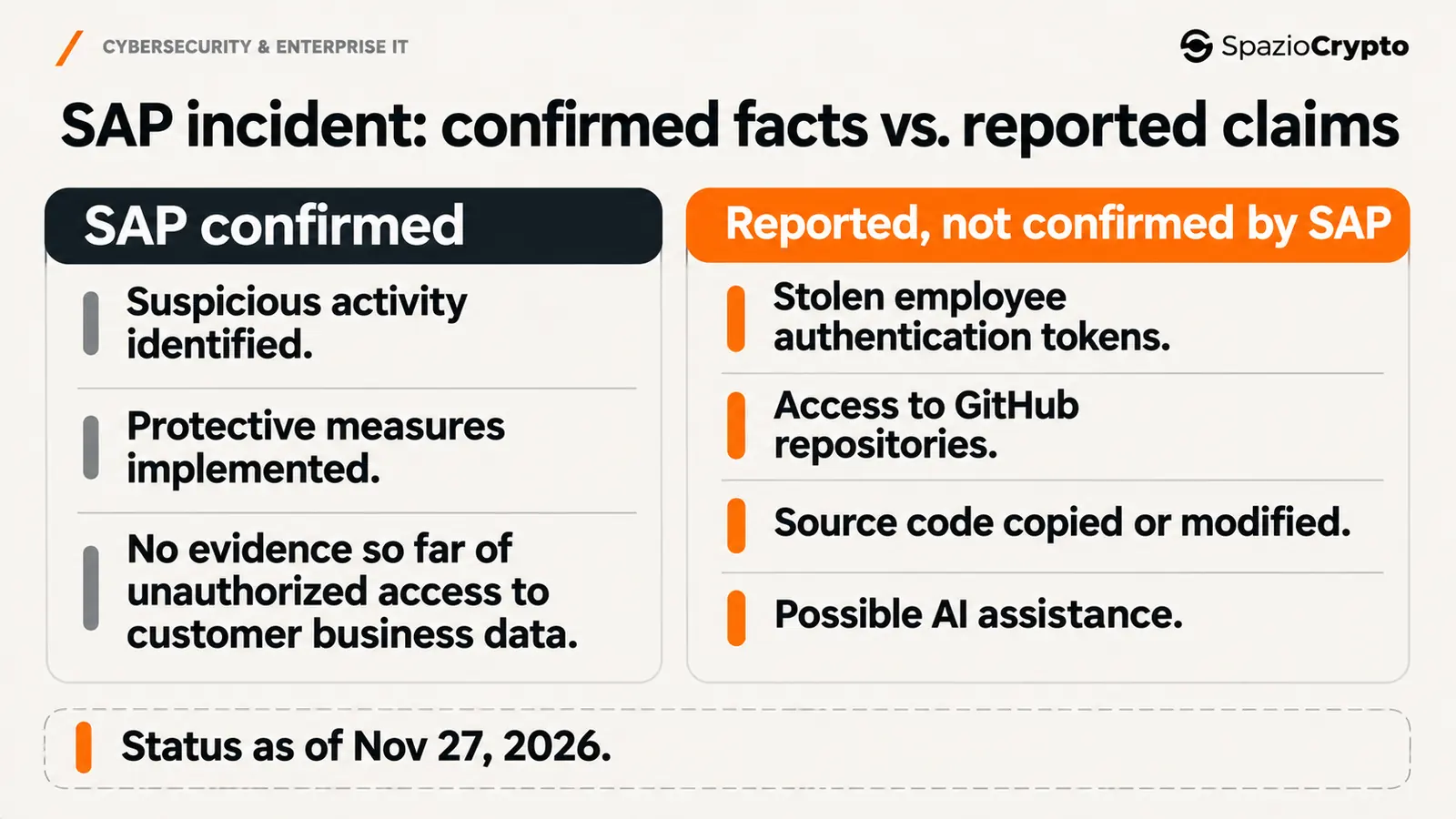
The phrasing matters. SAP acknowledged a security incident but has not released a technical account of the attack. The credential theft, code copying or modification, and the internal codename “Project Granite” are all details attributed by journalists to company insiders, not technical confirmations published by SAP itself.
The Alleged Access to SAP's GitHub Environment
According to the account assembled by Der Spiegel and subsequently reported by Handelsblatt and BleepingComputer, attackers obtained authentication tokens belonging to SAP employees. Those credentials allegedly allowed them to access development repositories on GitHub and either copy or alter source code.
GitHub is a platform developers use to store, modify, and share code. A stolen token can enable actions with the privileges of the associated account, but its misuse does not mean GitHub's own infrastructure was breached. No details have been made public about which repositories were accessed, whether they contained proprietary code, or how much data may have been copied.
Handelsblatt, citing internal sources, reported that SAP restricted access to GitHub, suspended certain automated development workflows, and replaced signing keys. These steps, if accurate, would reflect standard containment procedures following a credential compromise. SAP has not published an official list of the technical operations it performed.
Stolen Code Does Not Mean Compromised Software
No evidence has emerged that any code modifications were incorporated into products or updates distributed to customers. A software supply chain compromise requires several additional steps: altered code would need to pass review controls, be signed, and be included in a release. None of the sources consulted report that this occurred.
On the customer data side, SAP's wording remains deliberately narrow. The investigation found no evidence, as of November 27, of unauthorized access to customer business data. That is not the same as a definitive conclusion about the full scope of the incident, nor does it clarify which internal systems may have been affected.
The AI Angle Remains Unconfirmed
Der Spiegel reported that attackers may have used artificial intelligence tools to facilitate the operation. SAP has not confirmed this claim, and no technical evidence attributing a role to AI in the attack has been published. For now, it should be treated as a possibility cited by anonymous sources, not an established fact about how the intrusion was conducted.
The Questions That Still Have No Answers
SAP has not disclosed when the suspicious activity began, what the initial attack vector was, which specific accounts or repositories were affected, or who may be responsible. The company has not published technical indicators of compromise, nor has it publicly asked customers to take any specific protective action. Its public position, as stated to Reuters on November 27, is that it acted to protect customers and preserve service security.
The picture as of November 27 is therefore this: SAP has acknowledged an incident, while most of the technical detail still rests on journalistic reconstructions from internal sources. The GitHub access, the stolen tokens, and the code modification remain claims attributed to insiders. No confirmed unauthorized access to customer business data has been reported, and no evidence of altered code reaching production environments has emerged.
Sources
- Reuters, SAP statement of November 27, 2026
- Handelsblatt, measures reported by internal company sources
- BleepingComputer, incident reconstruction
- SecurityWeek, state of available information