

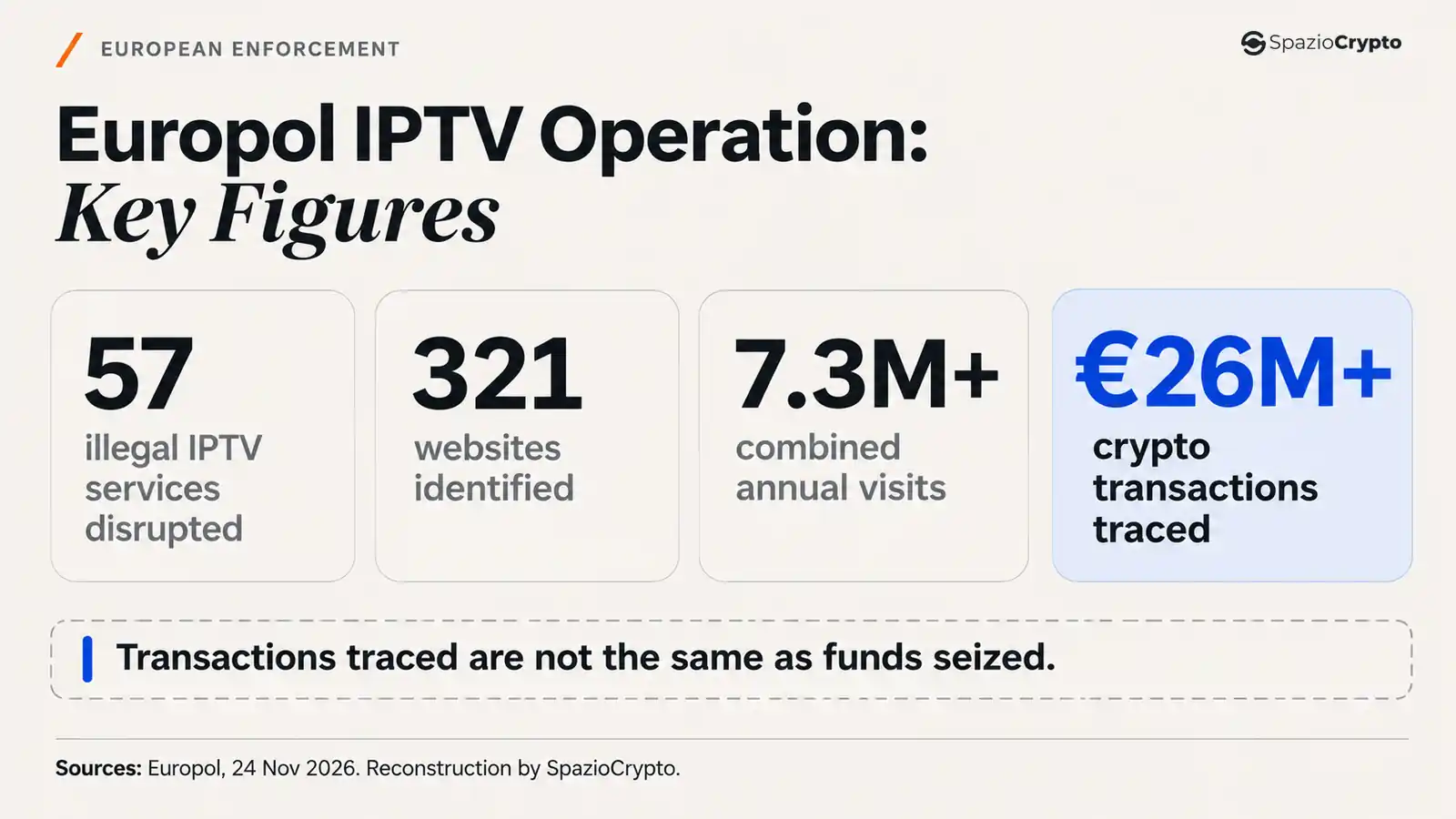
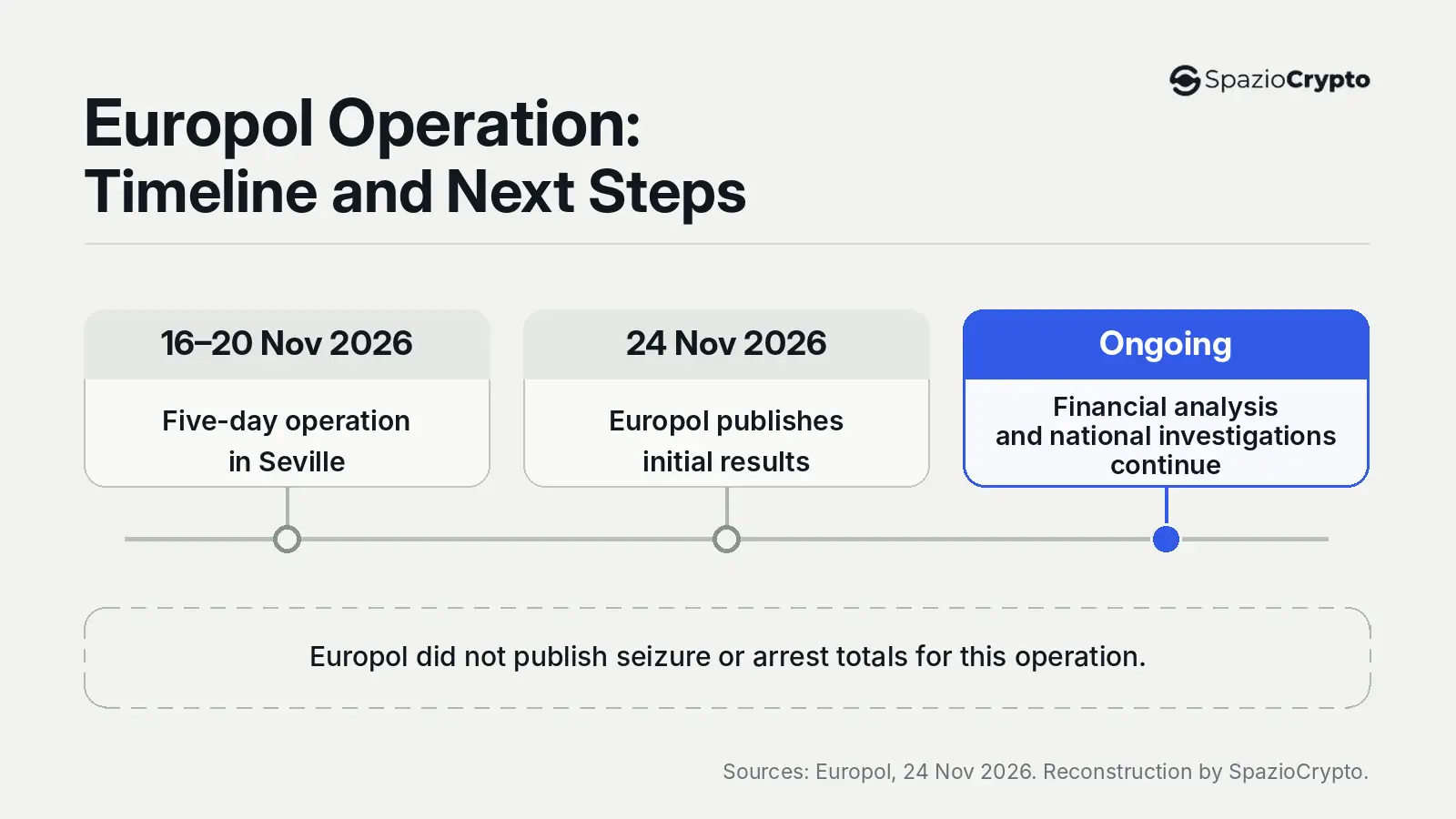
Europol traced over 26 million euros in crypto transactions linked to illegal streaming services during a five-day operation in Seville, held November 16 to 20, 2026. Investigators from eleven countries, including the United States, identified 57 illegal IPTV services and flagged 321 websites. The figure represents transactions tracked, not funds seized: that distinction matters enormously for reading what this operation actually achieved.
The primary source is Europol’s press release dated November 24, 2026. SpazioCrypto also reviewed reporting by Sky TG24 and The Block. All three sources consistently describe the 26 million euros as traced transaction volume, not a confiscation total.
TL;DR: Europol’s November 2026 Seville operation traced over 26 million euros in crypto flows tied to illegal IPTV, involving Binance, Coinbase, and Chainalysis. The 57 disrupted services and 321 identified sites reflect active investigations, not finalized seizures.
Eleven Countries Followed the Money
The operation ran out of the Spanish National Police headquarters in Seville. According to Europol, around 40 people participated, including 30 law enforcement representatives from Belgium, Bulgaria, Croatia, Greece, Ireland, Italy, the Netherlands, Portugal, Romania, Spain, and the United States. Europol coordinated the effort through its Intellectual Property Crime Coordinated Coalition, providing analytical support, real-time verification, and secure information-sharing channels.
EUIPO, Interpol, and the Audio-visual Anti-Piracy Alliance joined the investigative side. Binance, Coinbase, and Chainalysis contributed industry expertise and tools. Europol does not attribute the discovery of financial flows to any single company: the press release describes joint activity between authorities and private sector partners.
The involvement of blockchain analytics firms and exchanges fits a broader pattern. As SpazioCrypto’s guide on public versus private blockchains explains, visibility of on-chain movements does not automatically reveal the identity behind an address. Attribution requires additional investigative steps, often involving exchange data and other third-party sources.
57 IPTV Services Disrupted, 321 Sites Identified
According to Europol, the operation disrupted 57 illegal IPTV services and identified 321 websites offering copyright-protected content without authorization. The agency reports those sites collectively attracted more than 7.3 million visits per year. These are distinct indicators: the service count describes targeted infrastructure, the site count reflects the online footprint identified, and the visit figure measures declared aggregate traffic.
The press release does not specify how many of the 321 sites were permanently shut down, nor how many remained accessible at the time of publication. “Services disrupted” should not be read as “network dismantled”: Europol explicitly notes that national investigations remain ongoing to identify suspects and trace related assets.
Illegal IPTV services offer unauthorized access to television channels, live sports, and films, often through low-cost subscriptions. Cryptocurrency payment is one of the methods Europol describes. The agency also notes that proceeds can flow through payment accounts and financial intermediaries, so crypto is part of the picture, not the whole of it.
26 Million Euros: Transactions Traced, Not Seized
The figure that attracted the most coverage is over 26 million euros. Europol attributes this number to crypto transactions traced by investigators so far, with the analysis still ongoing. The agency does not state how much has been frozen, seized, or recovered, and it has not published an arrest count linked specifically to this operation.
The traced value does not necessarily equal the net revenues of the operators. A transaction flow can include transfers between wallets, intermediate hops, and movements that still require attribution and contextualisation. The financial reconstruction is therefore an evolving piece of investigative evidence, not a final accounting of criminal profits.
This distinction has come up in other cases. In the UK bitcoin seizure case, for instance, the existence of recovered assets did not by itself resolve questions of ownership over the funds. Here, too, tracing is a step in the process: further measures depend on the investigations and the relevant legal procedures in each jurisdiction.
On-Chain Analysis and the Role of Exchanges
Investigators followed suspicious transactions across blockchain networks, looking for links between IPTV services, wallets, and the individuals controlling them. On-chain analysis can reconstruct paths and relationships between addresses. To identify a specific person, however, investigators typically need to cross-reference that data with information obtained from exchanges, service providers, or other investigative sources.
Binance and Coinbase’s involvement does not mean either exchange independently decided which parties to pursue, or that every crypto transaction is automatically identifiable. Chainalysis participated as a blockchain analytics firm. The press release does not detail which specific techniques were applied to each service, nor what share of the overall outcome is attributable to any individual partner.
A useful point of comparison is the freezing of USDT following an investigation into suspicious flows. In that case, a centralised issuer had the technical ability to block tokens directly. In the Europol operation, the press release describes investigative tracing, not a broad asset freeze.
What This Means for EU and US Readers
Italy appears among the participating countries, but Europol does not attribute a specific number of services, sites, or transactions to the Italian delegation. The press release mentions no seizures, arrests, or national measures tied to this single operation. The EU-wide total cannot be recast as a measure of any single country’s impact.
The national connection is nonetheless real at the cooperation level: intelligence gathered is designed to support investigations in each participating country. Under MiCA and the EU’s Transfer of Funds Regulation (TFR), crypto-asset service providers operating in Europe already face traceability and anti-money laundering obligations that make data sharing with law enforcement more structured than it was even two years ago.
This case also differs from a formally completed asset forfeiture. In a recent US case, prosecutors actually confiscated funds linked to Capstone. SpazioCrypto’s coverage of the seized funds and Tether’s attributed role shows why the nature of the legal act and the identity of the parties must be kept precisely separate. The Europol press release, by contrast, describes traced amounts and ongoing analysis.
The Scale of Illegal Streaming Demand
Europol situates the operation within an illicit market that, according to data from the Audio-visual Anti-Piracy Alliance cited by the agency, involves roughly 60 million users across Europe. The same source estimates annual losses for legitimate providers and foregone tax revenues, but these are industry-side projections, not results measured during the five days in Seville. SpazioCrypto does not use those figures to quantify the economic damage attributable to this specific operation.
Comparing this to prior crypto investigations shows how much precision matters across categories. A hack, a suspicious transfer, a formal confiscation, and a traced payment describe entirely different evidentiary stages. In the case of the Binance attack and the funds the company declared frozen, the amount stolen and the amount blocked were separate figures attributed to different actors.
The Europol Operation in Brief
What is confirmed, what is not
- Confirmed: Europol reports 57 IPTV services disrupted, 321 sites identified, and over 26 million euros in crypto transactions traced.
- Not stated: amounts seized, arrest count, and the share of results attributable to any individual country.
- To watch: further results from the financial analysis and developments in national investigations.
The Bigger Picture
The most significant development here is not the nominal value of the flows. The shift worth watching is from enforcement focused on taking down websites to investigations that attempt to reconstruct the financial infrastructure behind illegal streaming. Shutting down a service can block access. Identifying the payment layer and who controls it can reveal whether the economic network simply migrates under a different name.
The concrete signals to monitor are the publication of national-level results, any formally confirmed seizures, and clarification on the number of identified suspects. Until those updates arrive, the 26 million euros remain, as Europol states, traced transactions. That distinction is also the right benchmark for evaluating whatever the investigation reports next.
Sources
Primary source and operation details: Europol press release, November 24, 2026. Italian-language coverage: Sky TG24, November 24, 2026. Coverage of crypto operator involvement: The Block, November 24, 2026.