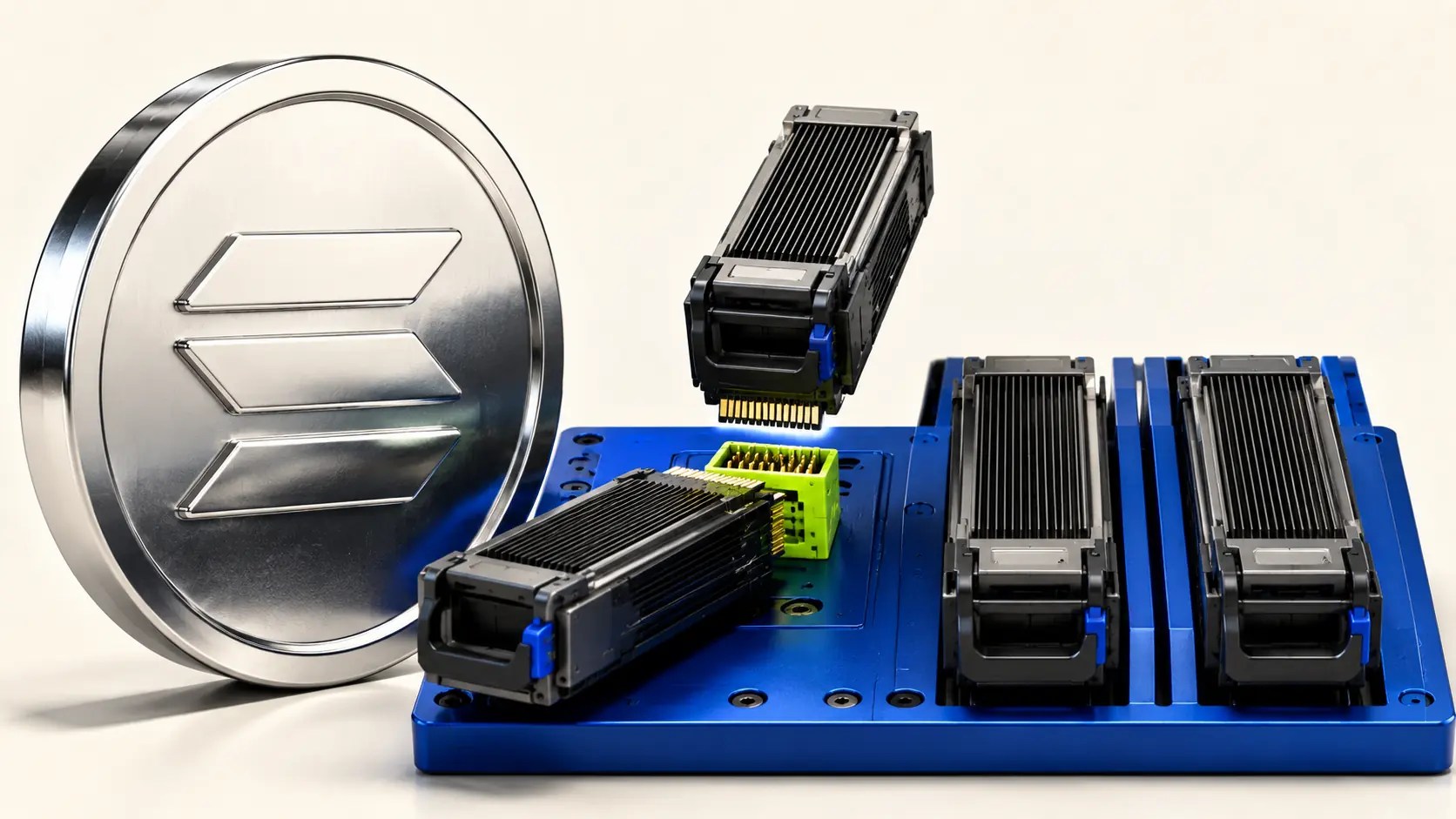


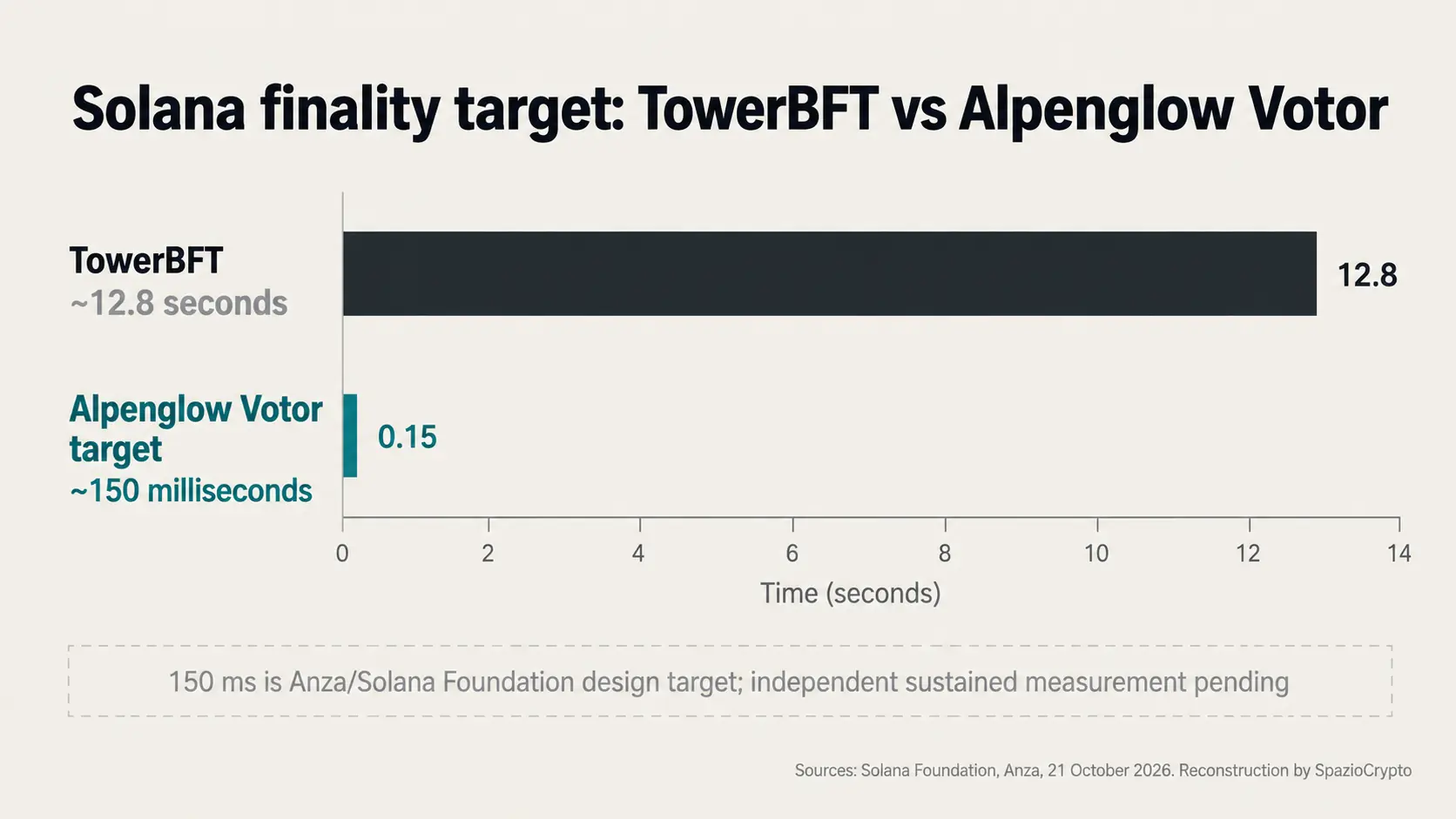
On October 21, 2026, at approximately 13:54 UTC, Solana activated Alpenglow on mainnet-beta, replacing TowerBFT with Votor and cutting the finality target from roughly 12.8 seconds to 150 milliseconds, according to Anza and the Solana Foundation. This is one of the most significant consensus-layer changes in Solana's history.
For this piece, we reviewed the official Alpenglow page published by the Solana Foundation (updated October 2026), Anza's statements from October 21, and coverage from Decrypt, The Block, and Unchained. All primary sources were accessible at time of writing.
What Actually Activated on October 21
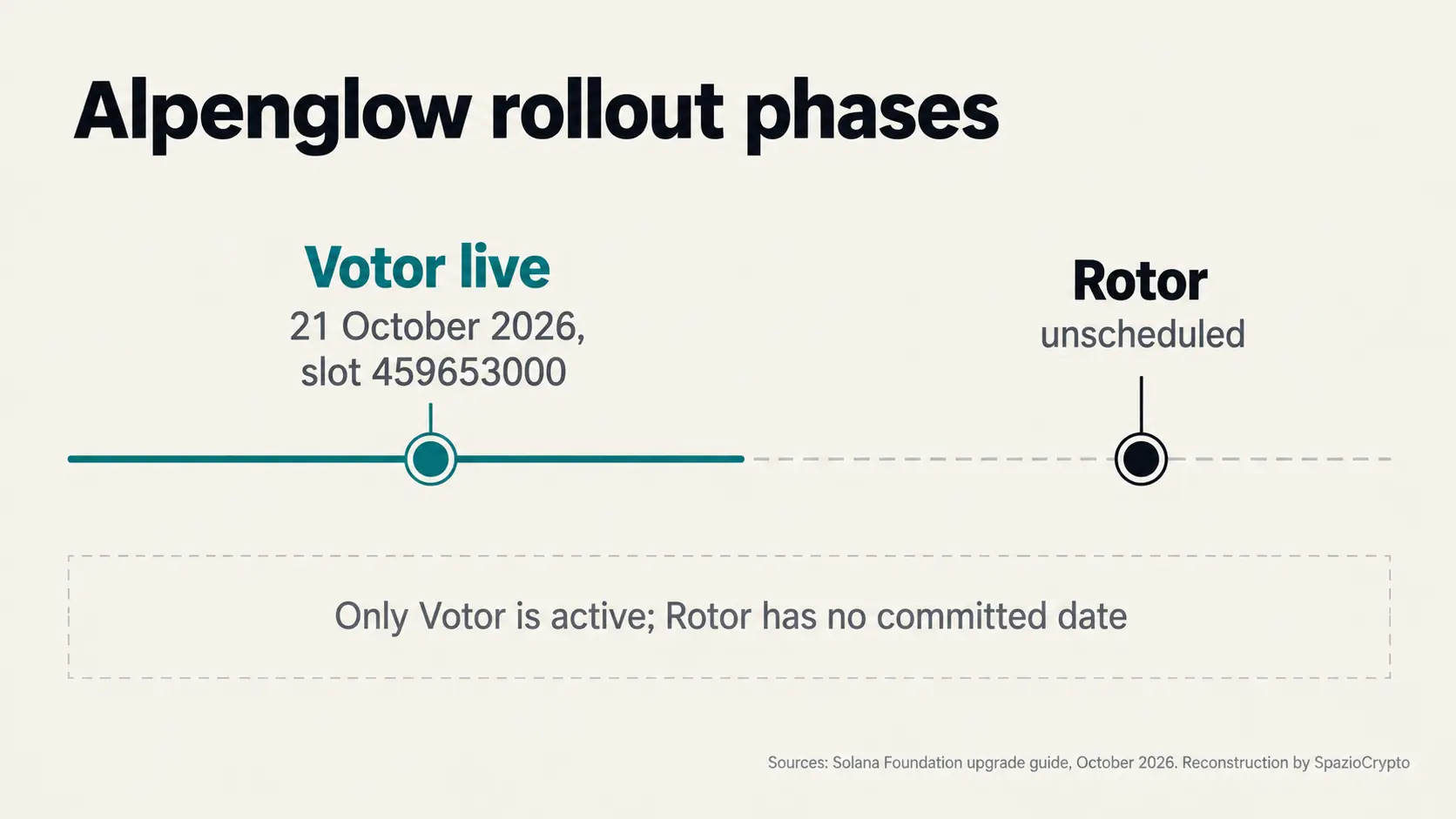
Epoch 1064 began around 13:36 UTC. After 5,000 slots, at slot 459,653,000, the network switched from TowerBFT to Votor. According to Anza, finality dropped from 12.8 seconds to approximately 150 milliseconds. The Solana Foundation confirms that Alpenglow has been live since that epoch and that Votor is the phase now in production.
Solana 已在主网激活 Alpenglow 共识升级,用 Votor 替换原有 TowerBFT,并用 Rotor 替换 Turbine 区块传播协议。
— xiyu (@ohxiyu) October 23, 2026
升级后区块最终确定时间从约 12.8 秒缩短至约 150 毫秒,直接减少交易确认等待;交易执行与 SVM 未变,改动集中在验证者投票方式、共识机制以及共识信息向下游基础设施的传递方式。
Votor changes how validators handle votes: instead of posting votes as on-chain transactions, they exchange votes directly and aggregate them into certificates. A block reaches finality after one or two voting rounds, either via a fast path at 80% of stake or a fallback at 60%. Transaction execution, the SVM, programs, and fee structures remain unchanged.
Why It Matters for Exchanges, Merchants, and Users
Under TowerBFT, a transaction could receive an early confirmation in seconds but took roughly 12.8 seconds to reach full finality, the point at which it becomes irreversible. With Votor, the design target brings that moment down to approximately 150 milliseconds. According to Anza, this cuts wait times for exchanges crediting deposits and for merchants processing payments at point of sale.
For end users, wallets and apps continue to work exactly as before. The perceptible difference, if the target holds in production, is near-instant confirmation. The Foundation is explicit that 150 ms is a design target, not a guarantee that holds independent of network conditions. Anza stated that real-world performance will depend on network state and the geographic distribution of validators.
🚨 $ETH ALERT: Ethereum delays Glamsterdam test after security devs flag risk to existing contracts
, Futures Wire (@FuturesWire) October 23, 2026
📊 Trade This Asset: https://t.co/wsbSCPlkCm
🟢 Bullish: 25%
• Developers postponed the upgrade to investigate potential smart-contract security risks before…
The switch followed approval of proposal SIMD-0326 in September 2025, which passed with roughly 98% of validator votes in favor. Anza moved the protocol from white paper, published in May 2025, to mainnet production in under 18 months. Tests on community clusters and on devnet/testnet had already demonstrated the ability to complete live migrations, though some rollbacks occurred during those trials.
What Stays the Same, and What Remains Open
Rotor, the second phase that would replace Turbine for block propagation, has no scheduled date. The Solana Foundation describes it as a “later release, unscheduled.” Proof of History no longer governs block timing in the same way it did before, but the execution details for everyday application developers remain unchanged.
Validators must run a client built on Agave 4.3.2 (Agave, Jito-Solana, or Harmonic Salsa) and maintain at least 0.8 SOL above the rent-exempt minimum in the vote account to cover the Validator Admission Ticket. Firedancer and Frankendancer were not supported for the migration.
Early dashboard readings, as reported by Altcoin Buzz and others, showed values around 202 milliseconds in individual samples. No sustained, independent average confirming 150 ms on mainnet has been published yet. That gap is worth naming clearly: the design figure is well-defined, but the operational measurement is still being observed.
Alpenglow in the Broader Solana Upgrade Roadmap
This consensus change is separate from slot time reduction. SIMD-0525, which targets cutting slot duration from 400 ms to 350 ms, addresses block timing rather than finality. Alpenglow operates at the validator agreement layer, a different part of the stack entirely.
We first covered the design of Alpenglow as a planned upgrade in April 2026. Now the first phase is live. The network continues to handle very high activity volumes, including, per data reported previously on SpazioCrypto, 97% of tokenized equity volume on-chain routed through Solana.
Alpenglow is already speeding things up on mainnet-beta.
, JUST DREAM (@justdream) October 19, 2026
Epoch is coming in earlier than they planned! 🤯
Quiet win, but these are the ones that actually matter. $SOL keeps cooking. https://t.co/mjSQv13KnK pic.twitter.com/HOhFgq4eU1
Firedancer's SIMD-0370 proposal, which aims to remove static per-block compute limits after Alpenglow, remains a downstream item and has not yet been approved, as we detailed in our earlier piece on the proposal for uncapped block computation.
What This Means for US and European Market Participants
No exchange or custodian serving US or European users has issued specific operational guidance tied to Alpenglow at the time of writing. Faster finality, if the 150 ms target holds, would in principle shorten the theoretical wait for deposit crediting and withdrawals. Each platform's confirmation policy remains its own decision. The classification of Solana as a digital commodity, outlined in the joint SEC-CFTC document of March 2026, is unaffected by this technical upgrade. The network's resilience under extreme load, already tested during a 6 Tbps DDoS event, adds relevant context for infrastructure-level assessments.
For users and traders operating on Solana through US or European platforms, the practical situation is straightforward: wallets and apps require no action. Validators in these regions must meet the Agave 4.3.2 client requirements and maintain the minimum SOL balance on the vote account.
Alpenglow at a Glance
What is confirmed, and what is not:
- Confirmed: Votor active on mainnet from October 21, 2026, at slot 459,653,000; TowerBFT retired; finality target of roughly 150 ms declared by Anza and the Solana Foundation.
- Not yet established: Independent, sustained measurement of average mainnet finality; a date for Rotor; specific operational impact on exchange confirmation policies.
- To watch: Dashboard readings and independent measurements over the coming weeks; any announcement of a Rotor activation date; validator compliance with Agave 4.3.2 requirements.
The Bigger Picture
Alpenglow closes a cycle that began with the May 2025 white paper, bringing Solana to a millisecond-finality model that puts the point of irreversibility on par with many traditional payment infrastructure benchmarks. The change is real at the consensus protocol level. The “150 milliseconds” figure remains a declared design target, not yet a consolidated data point from independent observers.
The concrete signals to track are the first sustained finality averages published by dashboards and RPC providers, any announcement of a Rotor activation date, and whether validators that have not yet updated their clients maintain full participation. For users and platforms, the practical test is simple: do perceived confirmation times shorten without any client-side code changes?