


Solana has cut one of its blockchain's most fundamental timing parameters. Since August 21, the mainnet targets completing each slot in 350 milliseconds instead of the previous 400 ms, marking the first step in a roadmap designed to progressively bring the network down to 200 milliseconds.
The change is part of SIMD-0525 and reduces the slot time target by 12.5%. Faster slots can speed up certain confirmation thresholds and lower perceived latency for users, but this doesn't automatically mean Solana can process 12.5% more transactions per second.
Solana Moves From 400 to 350 Milliseconds
A slot is the short time window during which a validator designated as leader can produce a block of transactions. Think of it as the network's heartbeat interval.
After the activation, according to a comparison published by The Block across two samples of 1,000 slots each, the pre-upgrade sample took approximately 415 seconds while the post-upgrade sample clocked in at around 368 seconds. The result aligns with the new target, though actual slot duration can vary depending on network conditions.
 Solana Foundation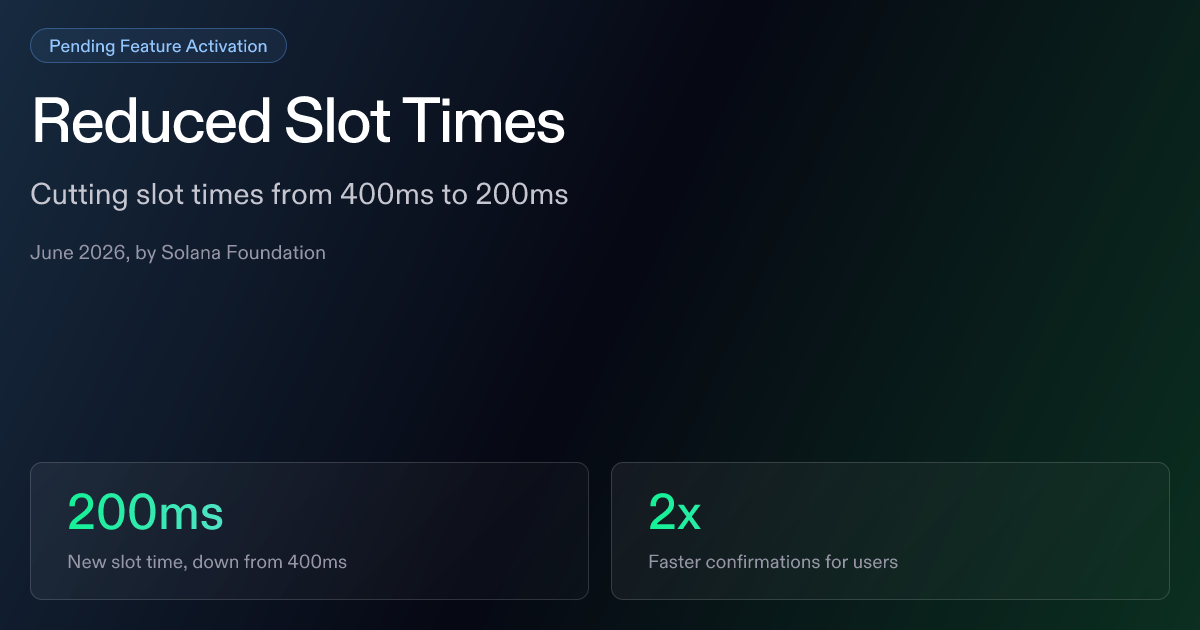
What Actually Changes for Users and Validators
The primary benefit is lower latency. When the blockchain advances more rapidly through slots, confirmation thresholds expressed in slot counts are reached faster in real time. That matters for traders, DeFi protocols, and any application sensitive to settlement speed.
The validator leadership window also shifts. Solana normally assigns four consecutive slots to the same leader: at the previous 400 ms target, that meant roughly 1.6 seconds; at 350 ms, the window drops to approximately 1.4 seconds.
Epochs shrink too. They remain composed of 432,000 slots, but at 350 ms their theoretical duration drops from roughly 48 hours to 42 hours. Shorter epochs mean staking rewards and validator schedule rotations happen more frequently.
Faster Slots Do Not Automatically Mean More Throughput
This is the most important distinction in the upgrade. Producing slots more frequently does not necessarily increase the total amount of work the network can process each second by the same proportion.
SIMD-0525 proportionally adjusts certain per-slot work limits. The primary goal is to reduce time between slots, not to automatically expand the blockchain's overall computational capacity.
Upgrades designed to increase Solana's throughput follow separate development paths. Slot time and throughput are not synonyms, and conflating the two leads to overstated expectations.
 solana-foundation
Next Stop: 300 ms, Then the Long Road to 200
350 milliseconds is only the first step. The roadmap laid out by SIMD-0525 follows this sequence:
400 ms → 350 ms → 300 ms → 250 ms → 200 ms.
Each reduction is activated separately so developers can observe network behavior before proceeding. The next target is 300 ms, though no activation date for mainnet has been announced yet.
Solana has officially reduced its slot time for the first time since its inception
— Jacob Creech (@jacobvcreech) August 21, 2026
We're in a new era of 350ms
Next stop, 300ms pic.twitter.com/GItTzfL6vB
This upgrade should also not be confused with Alpenglow. Alpenglow targets a dramatic reduction in finality time by overhauling the consensus mechanism itself, while SIMD-0525 operates on a different layer: the target duration of each slot.
The Bigger Picture
Moving from 400 to 350 ms may look incremental on paper. In practice, it marks the start of a broader shift in how fast Solana's operational rhythm runs, and it's the first time the network has touched this parameter since launch.
If the full roadmap completes, slot targets will be cut in half from their original value, landing at 200 ms. For now, the concrete reality is straightforward: 350 milliseconds is already the new mainnet target, while 300 ms and 200 ms remain future milestones. Watch the Solana Foundation's upgrade announcements for the 300 ms activation window, which will signal whether the network is absorbing the current change without instability.