


PNC Bank launched a pilot program on November 9, 2026, allowing eligible Corporate and Institutional Banking clients to receive USDC payments on the Ethereum network through Coinbase infrastructure, with automatic one-to-one conversion into U.S. dollars deposited directly into their PNC account. Businesses collect stablecoin payments without ever holding stablecoins. PNC has not disclosed participant numbers, transaction volumes, fees, or eligibility criteria.
This article is based on PNC's official press release and reporting by The Block. The Reuters article was not directly accessible; it is cited here through Bitcoin.com News and The Block, which reproduce its content.
How the USDC Payment Pilot Works
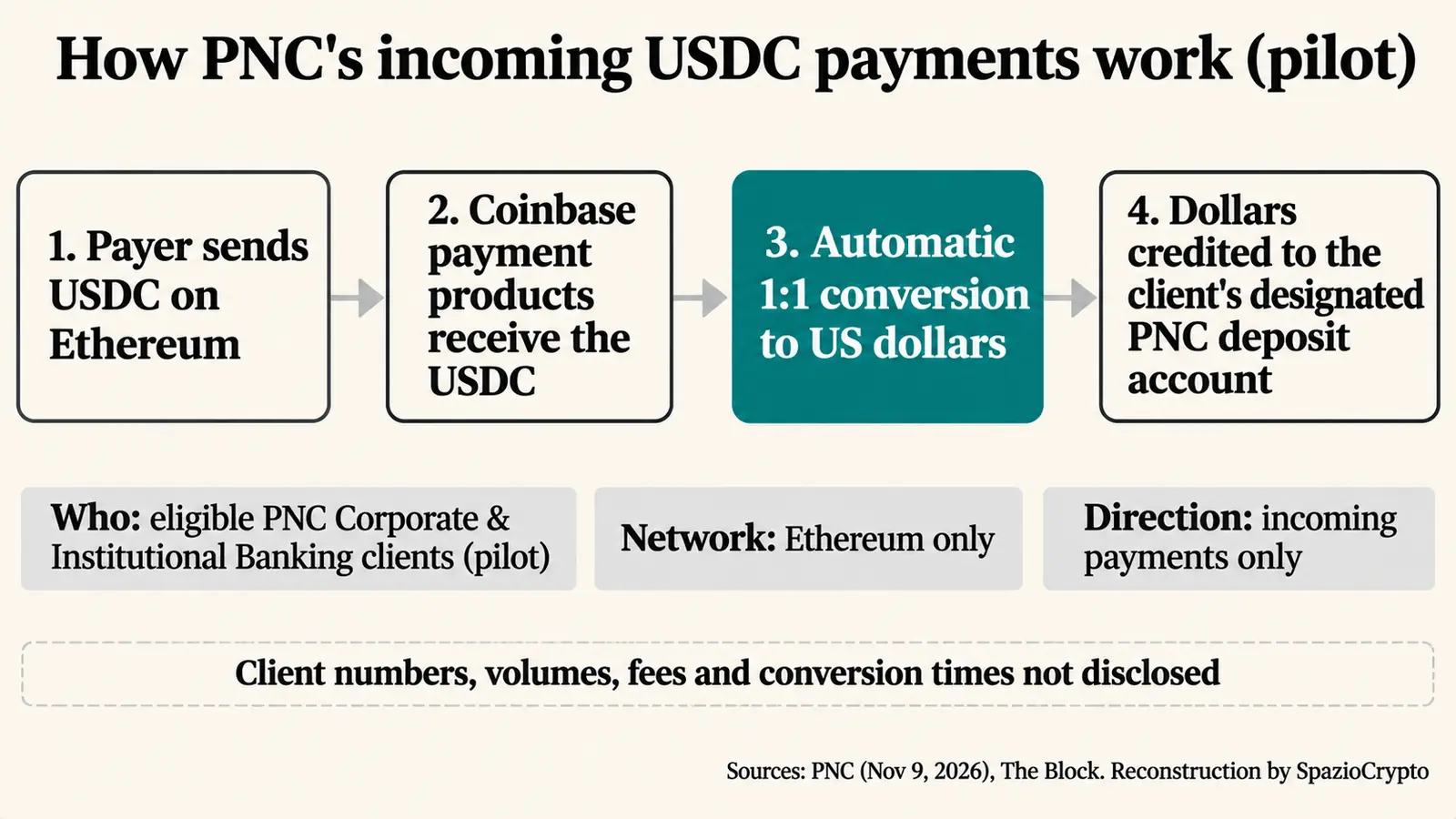
The mechanics are straightforward. A supplier or trading partner sends payment in USDC, Circle's dollar-pegged stablecoin. Those funds arrive on the Ethereum network via Coinbase's payment products, which provide the underlying infrastructure. Coinbase converts them to dollars at a one-to-one rate, and PNC deposits the resulting dollars into the client's designated account. The business sees only dollars, in its existing account, with its existing bank.


The official announcement covers only incoming payments: no sending USDC, no holding stablecoins in a business account. Conversion timing and fees are not specified. Ethereum is the only network mentioned. According to PNC's press release, the benefits include faster access to funds and greater efficiency in international payments. For a detailed breakdown of why stablecoins are gaining traction in B2B cross-border payments specifically, the cost and speed comparison with traditional wire transfers is worth examining independently.
A Pilot, Not a Full Product
The scope here deserves a close read. The service is available in limited form, restricted to eligible clients in a pilot program, and PNC's press release does not explain what “eligible” means in practice. Tom Lang, who leads treasury management products and operations at PNC, told Reuters (as reported by Bitcoin.com News) that the goal is “to test and learn with our clients.”
In the official release, Lang notes that clients are constantly seeking new ways to interact and transact with customers, suppliers, and partners. Alec Lovett, who heads infrastructure products at Coinbase, said stablecoins are modernizing how businesses move money, making payments faster, more efficient, and more global. Neither statement comes with supporting numbers: no client count, no volume target, no pilot duration.
PNC and Coinbase: Eighteen Months of Incremental Steps
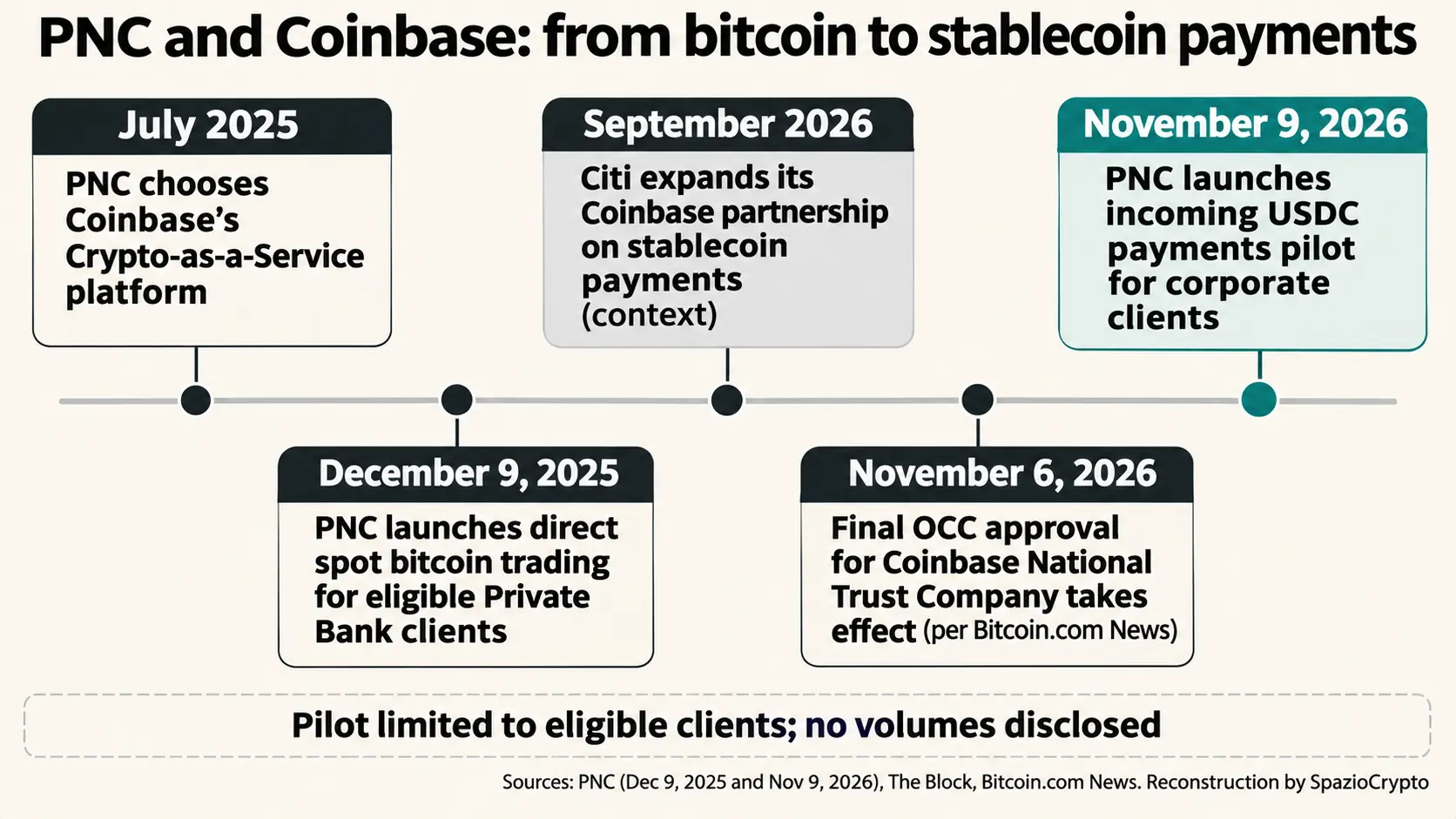
This isn't the first move the two have made together. In July 2025, PNC adopted Coinbase's Crypto-as-a-Service platform. By December 2025, PNC said it had become the first major U.S. bank to offer direct bitcoin trading to eligible Private Bank clients, according to its own press release. The partnership has now shifted from private wealth into corporate payments.
The timing also lines up with another development. According to Bitcoin.com News, the OCC (the Office of the Comptroller of the Currency, which supervises nationally chartered U.S. banks) granted Coinbase National Trust Company its final authorization, effective November 6. This followed the conditional approval from April. The license covers custody and fiduciary services, not retail deposits or lending.
U.S. Banks Are Entering Stablecoins Through the Side Door
PNC isn't alone in this approach. In September 2026, Citi expanded its collaboration with Coinbase to connect fiat and stablecoin payments, letting institutional clients accept stablecoins and convert them to dollars. According to The Block, Coinbase is also working with Moov to bring stablecoin acceptance to systems used by over 1,000 community banks and credit unions.


The pattern is consistent across these deals: the bank remains the client's primary point of contact, Coinbase handles the crypto layer, and stablecoins never appear on the business's balance sheet. It sits between two routes that U.S. banks are exploring simultaneously: accepting third-party stablecoins like USDC, as PNC does, or building their own tokenized deposits on shared networks.
What This Means for Circle and USDC
For Circle, every banking channel that accepts USDC expands the stablecoin's reach. But immediate dollar conversion means those USDC don't stay in circulation within business accounts: they become dollars as soon as they arrive. This is the same dynamic visible in Circle's Q3 2026 results, where transaction volumes grew 49% year-over-year while average circulating supply rose only 8%, according to Circle's quarterly report. More movement, not necessarily more USDC held in place.
What About Europe and MiCA?
In the EU, USDC is MiCA-compliant and circulates through authorized providers. The PNC model (bank as the client-facing layer, crypto partner handling conversion) is one that European banks could replicate without directly touching stablecoins. The European Central Bank and national regulators including the Bank of England have flagged concerns about stablecoins competing with bank deposits. PNC's approach sidesteps that tension: immediate conversion keeps the money inside the banking system.
PNC USDC Payments: What Is and Is Not Confirmed
What is confirmed, and what isn't
- Confirmed: From November 9, eligible PNC Corporate and Institutional Banking clients can receive USDC on the Ethereum network via Coinbase payment products; amounts are converted one-to-one into dollars and credited to the PNC account.
- Not disclosed: Number of participating clients, transaction volumes, fees, conversion timing, eligibility criteria, pilot duration, and any expansion timeline.
- To watch: Outbound USDC payments, additional networks beyond Ethereum, and whether other major U.S. banks replicate the model.
The Bigger Picture
This is SpazioCrypto's editorial read, stated as such: major U.S. banks are entering stablecoins through the service entrance. They're not issuing them, not custodying them for clients, not putting them into accounts. They accept them and immediately turn them into dollars. It's the most cautious way to offer businesses a channel their international partners already use, without altering the client relationship or touching the bank's balance sheet.
The real shift will come when one of these banks allows businesses to send in stablecoins, not just receive them. Four signals are worth tracking: the first pilot metrics from PNC, if the bank chooses to publish them; expansion beyond the initial eligible client pool and beyond the Ethereum network; fee comparisons with international wire transfers, which will show whether the cost advantage is genuine; and what the other major U.S. banks do next, following Citi and PNC.