

As of November 10, 2026, issuers and acquirers enrolled in Visa's stablecoin settlement program can choose the Monad blockchain to settle their obligations with the network. The announcement came from the Monad Foundation, with a statement from Visa included in the press release. Visa's stablecoin settlement on Monad concerns the relationship between financial institutions and Visa: it doesn't introduce MON token payments for consumers, and nothing changes at the point of sale.
This report draws on the Monad Foundation press release, The Block, Unchained, Visa's April 29 press release, and FXC Intelligence's summary of Visa's October 27 earnings call.
🌐 @Visa is expanding stablecoin settlement to Monad
— Monad (@monad) November 10, 2026
Participating issuers and acquirers can now settle Visa obligations in stablecoins on the Monad blockchain pic.twitter.com/WLiY9H8Hic
Visa's Stablecoin Program: Scale and Scope
The program works like this: instead of settling with Visa exclusively through bank wires, issuing banks and acquirers can settle in stablecoins on one of the approved blockchains. Traditional card settlement follows a five-business-day cycle on banking rails, as the Foundation's press release notes, while stablecoins can move funds on weekends and public holidays. As of April 29, Visa counted nine networks: Avalanche, Ethereum, Solana, and Stellar, plus Arc, Base, Canton, Polygon, and Tempo added that same day.
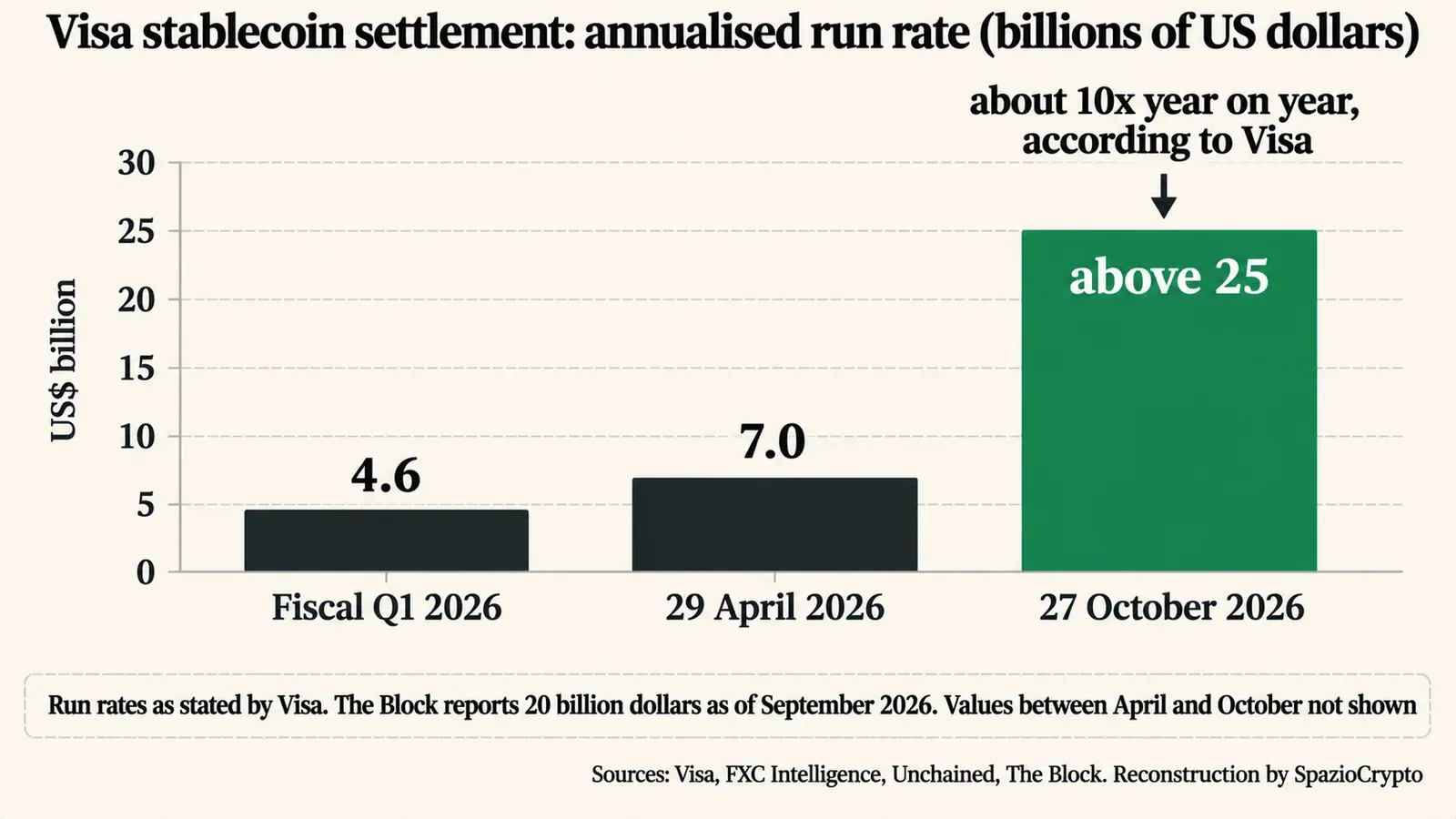
Volumes have grown fast. In April, Visa reported an annualized run rate of $7 billion and over 130 stablecoin-linked card programs in more than 50 countries, according to the company's press release. By October 27, CEO Ryan McInerney said on an earnings call, as reported by Unchained and FXC Intelligence, that the run rate had surpassed $25 billion, ten times higher than a year earlier. The Block puts the figure at $20 billion as of September. On Monad's addition, Visa spoke through Dan Roesbery, vice president for on-chain partnerships, stating the goal is to give partners “the flexibility to settle on the networks that best meet their needs.” Unchained notes that no standalone Visa press release accompanied the announcement.
Monad: The New Rail
Monad is an Ethereum Virtual Machine-compatible Layer 1 blockchain. Its mainnet launched on November 24, 2025, according to The Block, following a MON token sale on Coinbase. The Monad Foundation, an independent organization funding network research and development, claims 10,000 transactions per second, blocks every 400 milliseconds, finality in 800 milliseconds, and over 200 validators across more than 30 countries. These are figures from the Foundation itself, not independent audits.
EVM compatibility carries real practical weight: institutional tools already deployed on compatible networks can be extended to Monad without being rewritten. That's the same pattern by which stablecoins already operate across multiple chains, as seen with USDC on Cosmos' Noble network.
Issuers and Acquirers: What Changes, What Doesn't
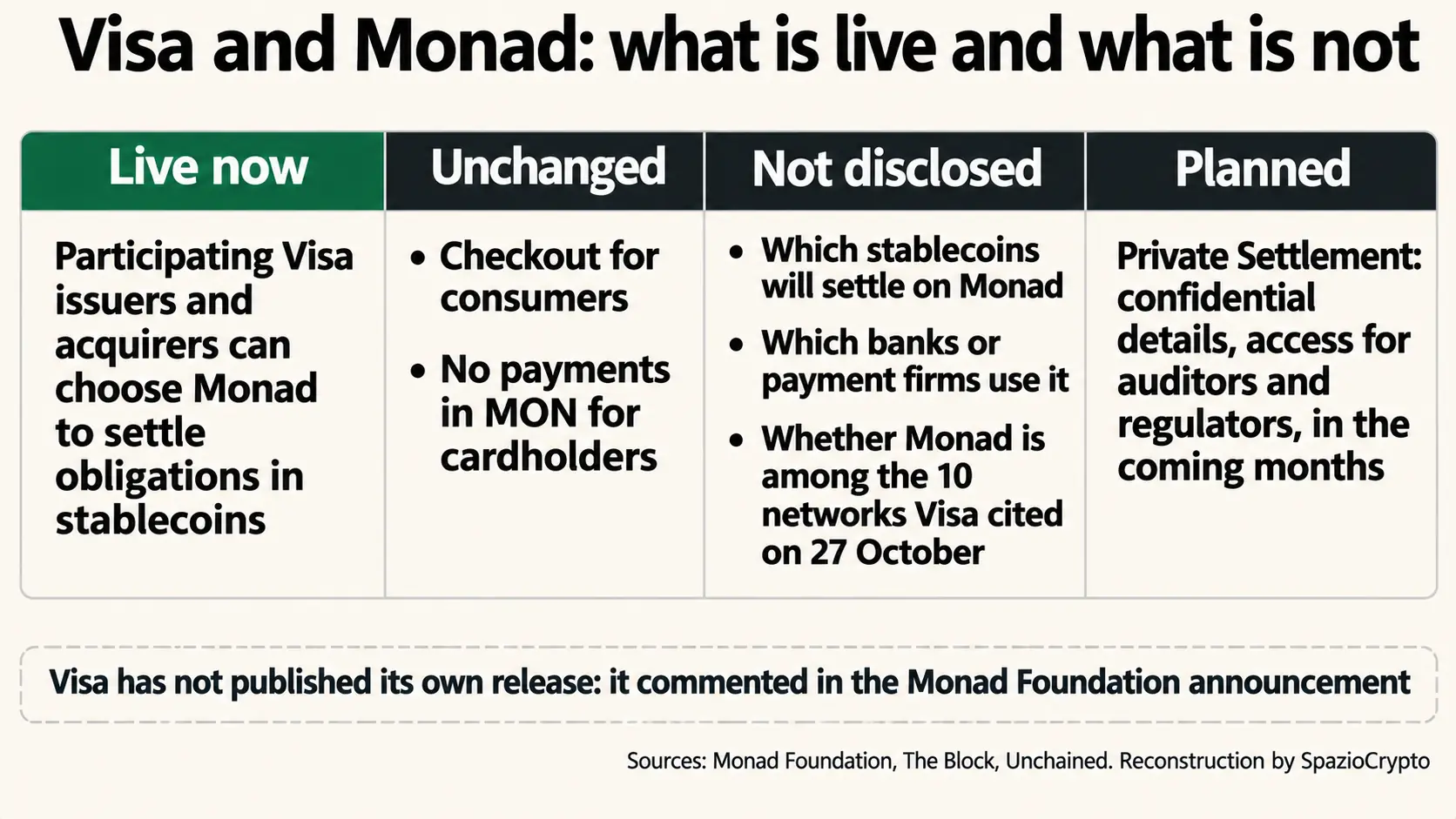
The scope needs reading carefully. What changes is the option, for program participants, to designate Monad as a settlement network. The cardholder experience doesn't change. Neither does the way merchants accept payments. The press release doesn't specify which stablecoins will be used on Monad, and it names no banks or payment companies already live on the network. On October 27, McInerney referred to ten supported blockchains without listing them, leaving it unclear whether Monad is included in that count.
On currencies, the broader picture is known. According to McInerney's October 27 earnings call, Visa accepts five stablecoins for settlement: USDC, USDG, EURC, PYUSD, and SBC. Tether's USDT is not on the list, a distinction explored in depth in our comparison of USDT and USDC. Circle, the issuer of USDC and EURC, is extending its reach, bringing USDC to 40 emerging markets.
Private Settlement: A Commitment, Not Yet a Feature
The most significant piece is announced but not live. Private Settlement, according to the Foundation, will allow banks and institutions to keep commercial transaction details confidential while sharing them with auditors and regulators when required. The feature is designed to run natively on-chain, so private operations remain connected to the same liquidity pool. It will reach Visa partners “in the coming months,” with no specific date given.
Keone Hon, co-founder and CEO of the Monad Foundation, said the next phase will depend on institutions' ability to keep sensitive flows private without leaving open networks, as reported by The Block. The confidentiality question isn't new for Visa: in June, The Block reported that Visa and Brale tested SBC stablecoin settlement on Canton, with a focus on transaction data visibility controls.
Regulators, Europe, and MiCA
For a European institution, the central question is which stablecoin to use. Circle obtained MiCA compliance for USDC and EURC in July 2024, and from July 1, 2025, USDG is issued within the EU by Paxos Issuance Europe, supervised by the Finnish Financial Supervisory Authority. Wirex, as reported by Payment Expert, claims to have been the first to settle with Visa in EURC within the EU. Trust remains the market's weak point, as illustrated by scams impersonating exchanges and regulators.
In the UK, the Financial Conduct Authority is developing its own stablecoin regime under the Financial Services and Markets Act 2023. For US-based institutions, the GENIUS Act is shaping the federal stablecoin framework. Neither the FCA nor any US regulator has a named participant in the sources reviewed. No institution operating under US or UK oversight is named among Visa's Monad participants in any source consulted.
Visa and Monad: What's Confirmed and What's Not
What is confirmed, what isn't
- Confirmed: issuers and acquirers in the Visa program can settle in stablecoins on Monad from November 10, 2026, with a Visa statement in the Foundation's press release; no change for consumers.
- Unspecified: which stablecoins will be used on Monad, which banks or payment companies are already live on the network, whether Monad is among the ten networks Visa cited on October 27.
- To watch: the launch of Private Settlement and its access rules for auditors and regulators, the first named participant, Visa's data in the next quarterly earnings report.
The Bigger Picture
Our editorial read, stated as such: for Visa, blockchains are becoming interchangeable rails. McInerney said as much, describing Visa as network- and stablecoin-neutral. The value sits in the network rules and client relationships, while competing blockchains vie to be selected as settlement infrastructure. The same dynamic is playing out beyond card networks, from the World Money project across 150 countries to issuers adapting stablecoins to new US legislation, as seen with Tether's two stablecoin strategy.
The second theme is privacy. Competition between settlement networks is shifting from raw speed to the ability to protect commercial data while keeping it accessible to auditors and regulators, in line with AML compliance requirements. Four signals are worth tracking: the launch date and access rules of Private Settlement, the first bank named on Monad, the stablecoin selected, and Visa's figures in the next quarterly earnings call.