

Tether closed the third quarter of 2026 with $1.5 billion in net operating profit and a reserve buffer that nearly doubled. According to the report published on October 30 and verified by the accounting firm BDO, assets stood at $191.45 billion and liabilities at $183.50 billion as of September 30: the difference, $7.95 billion, is the margin that protects USDT holders. At the end of June it was $4.11 billion. That puts Tether’s Q3 2026 reserves back close to their March levels, but to understand why, you have to look at bitcoin more than at profits.
We read Tether’s press release and BDO’s report with the reserves schedule in full, and compared them with the end-of-June data reported by CoinDesk and with Cointelegraph’s reconstruction. The figures in this article are those of the BDO report, unless otherwise stated.

What did BDO certify, and what did it not?
The document is signed by BDO Advisory Services, in Milan, on October 30. It is an ISAE 3000 reasonable assurance engagement: the highest level of verification under that standard, which is still not the same as audited financial statements. BDO says so explicitly. Its conclusion covers the reserves report and the totals of assets and liabilities at 23:59 on September 30, and nothing else.
Left out are the transactions of the preceding and following months, the notes to the report, on which the auditor expresses no opinion, and how the valuations would hold up under extraordinary market conditions. It is a snapshot taken at a precise moment, not a film of the quarter. The report contains no qualifications and refers to a pending civil lawsuit in New York linked to bitcoin prices in 2017 and 2018, for which nothing has been set aside because the outcome cannot be estimated.
Where is the $191 billion?
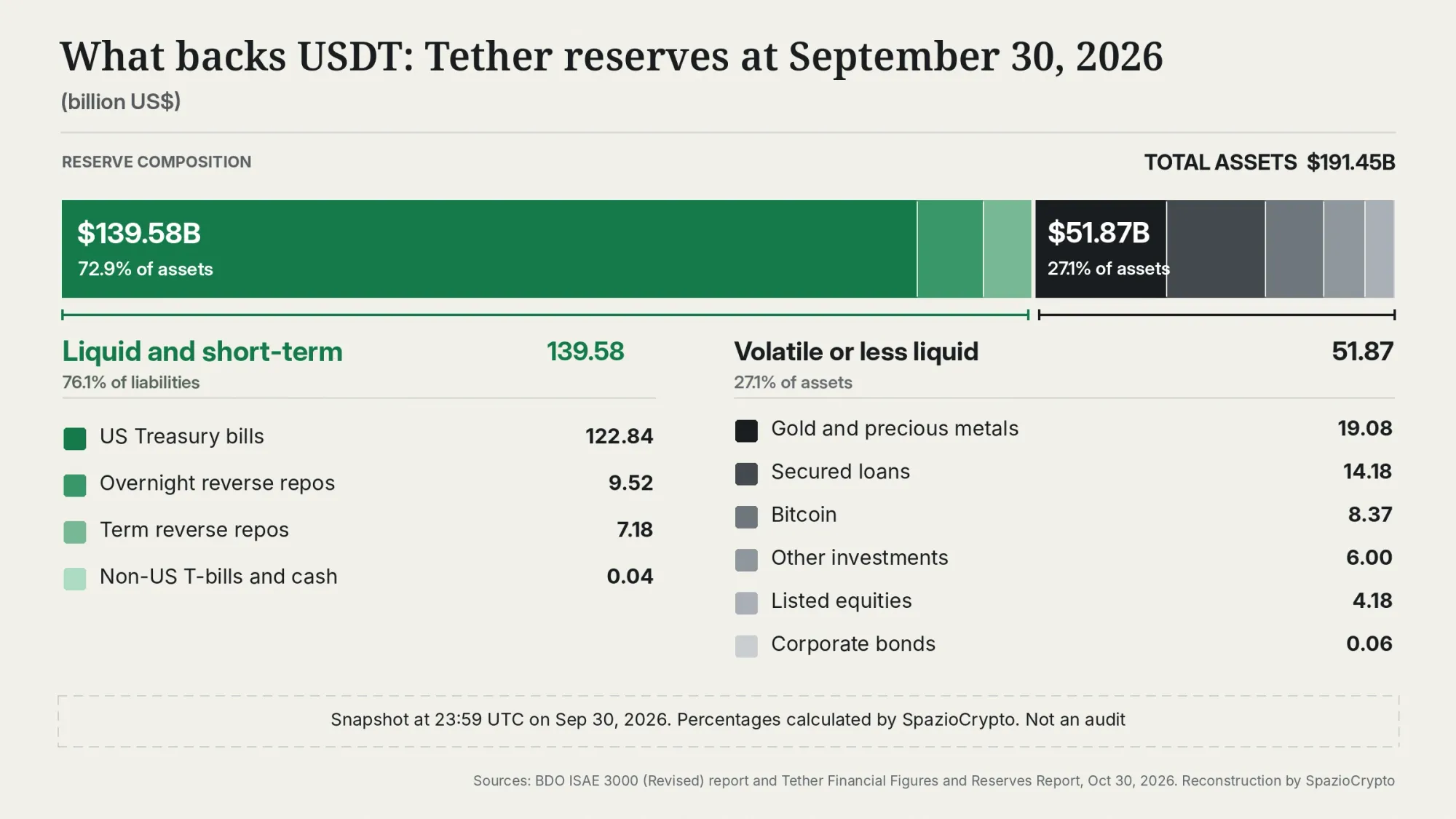
The largest share sits in short-term US government debt: $122.84 billion in T-bills. Adding $9.52 billion in overnight repurchase agreements brings the total to the $132.4 billion that Tether reports as its direct and indirect exposure to US debt. On top of that come $7.18 billion in term repos, small holdings of non-US T-bills and cash. The most liquid assets total $139.58 billion, equal to 76.1% of liabilities. That figure is our own calculation.
The rest consists of assets whose value can swing: $19.08 billion in gold and precious metals, $14.18 billion in secured loans, $8.37 billion in bitcoin, $6.00 billion in other investments, $4.18 billion in listed equities and $64 million in corporate bonds. Together they are worth $51.87 billion, or 27.1% of total assets, again by our own calculation. Readers who want a refresher on how the backing mechanism works will find the basics in our stablecoin guide.
Why has the buffer nearly doubled?
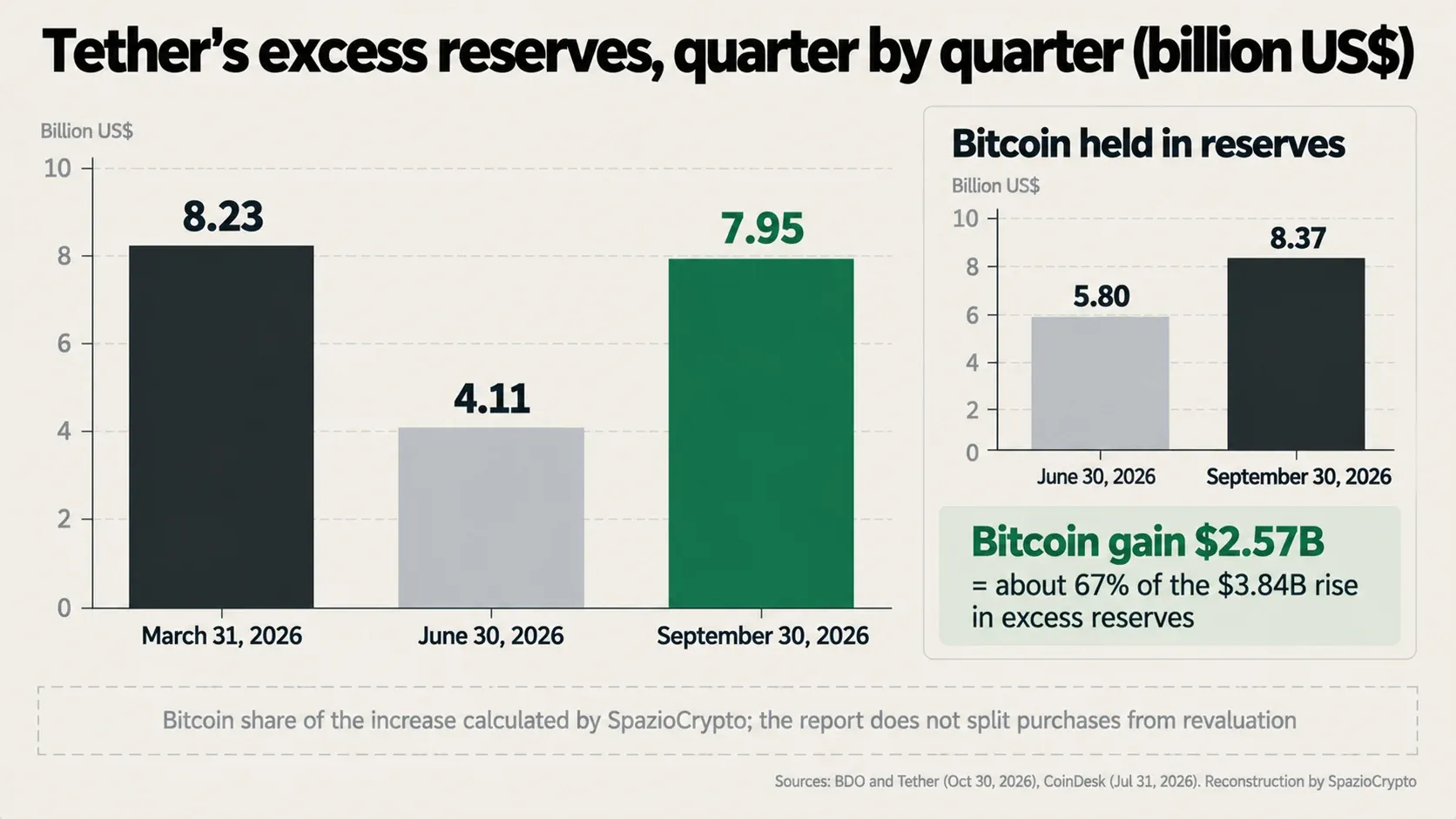
Three months ago we described the opposite path: between March and June the excess had fallen from $8.23 billion to $4.11 billion, mainly because of the drop in gold and bitcoin, as we wrote when analyzing second-quarter profit and the halved reserves. In the third quarter the film ran in reverse. The excess rose by $3.84 billion, while liabilities barely moved, going from $183.64 billion to $183.50 billion.
The main push came from bitcoin, whose value in the reserves went from about $5.8 billion at the end of June to $8.37 billion at the end of September. That is $2.57 billion more, roughly 67% of the increase in the buffer. This is our own, indicative calculation, because the report does not say how many bitcoins Tether holds today, nor does it distinguish between purchases and revaluation. Gold rose slightly, from $18.84 billion to $19.08 billion, based on the June figures reported by CoinDesk. Profit did the rest.
How solid is a $7.95 billion buffer?
The excess amounts to 4.3% of liabilities. For a stablecoin this is a key measure, because it shows how much the assets can lose before the tokens in circulation are no longer fully covered. The catch is that this margin depends precisely on the most volatile assets. If bitcoin fell 30% and everything else stayed flat, Tether would lose about $2.5 billion, a third of the buffer. This is our own scenario and purely indicative.
It is the same issue that led S&P, at the end of 2025, to downgrade its assessment of USDT’s stability to the lowest level on its scale, citing the share of bitcoin, gold and loans in the reserves. The quarter just ended shows both sides of that choice: when prices rise, the buffer swells; when they fall, as in the spring, it thins.
Where do the profits come from?
According to the press release, most of the income comes from interest on T-bills and repos. In the first nine months of 2026 net operating profit came to $4.5 billion, with the third quarter in line with the second. The model is simple: USDT holders earn no interest, while Tether invests the reserves in securities that do pay it, as we explained when looking at how Tether and Circle earn billions.
Paolo Ardoino, the chief executive, writes in the press release that Tether’s responsibility is to make sure USDT stays reliable when people need it most. According to Cointelegraph, which cites a post by Ardoino, USDT users have passed 700 million. Cointelegraph also notes that in August Tether announced its first full set of financial statements audited by KPMG, without, however, making the documents public.
What about Europe and Italy?
USDT is not authorized under MiCA, the EU regulation on crypto-assets, and regulated service providers in Europe have had to stop offering it. On August 31 Revolut, for example, closed its last window for European users. For people in Italy who hold USDT on non-European platforms or in self-custody, the BDO report remains the most detailed source on the quality of the backing, with the limits of a snapshot taken on a single date.
Tether’s reserves as of September 30 at a glance
What is confirmed and what is not
- Confirmed: assets of $191.45 billion, liabilities of $183.50 billion and an excess of $7.95 billion as of September 30, with reasonable assurance from BDO on the reserves report; $1.5 billion in profit for the quarter and $4.5 billion over nine months, as reported by Tether.
- Not disclosed: the number of bitcoins and tonnes of gold held as of September 30, the breakdown of other investments and the KPMG-audited financial statements announced in August.
- To watch: the price of bitcoin and gold in the fourth quarter, the end-of-December report and the progress of USAT, Tether’s stablecoin for the US market.
The bigger picture
Our reading, which we flag as such: Tether has become a hybrid between a money market fund and an investor. Three quarters of its assets resemble the reserves of a cautious fund, while the other quarter is a portfolio betting on gold, bitcoin and loans. Profit is stable and predictable; the buffer is not, because it depends on the prices of assets that Tether chooses to hold. Its US strategy already separates the two worlds, with USAT built for the rules of the GENIUS Act and USDT for the rest of the world.
There are four concrete signals to watch. The value of bitcoin at the end of December, which will show whether the buffer holds or starts shrinking again. The share of volatile assets in the next report, currently 27%. The publication of the KPMG financial statements, which would cover what a single-date verification cannot. And the trend in liabilities: after nine months at around $184 billion, USDT circulation is no longer growing.