

Fifteen Bitcoin mining companies, spanning hardware manufacturers, mining pools. Other sector operators, have committed to building and maintaining integrations with Tether's Mining Development Kit (MDK). The open-source software is how the USDT issuer plans to give a common interface to mining-site hardware across brands. The announcement came on October 24 at the Plan ₿ Forum in Lugano, with signatories including ASIC producers Bitmain, MicroBT. Canaan, alongside pools Foundry and F2Pool. Tether's stated goal is for a single application or AI agent to command machines from different manufacturers without a separate integration for each. These are commitments, not completed integrations: stable version 1.0 is expected by the end of 2026.

This article draws on Tether's October 24 press release, the MDK launch announcement of April 27, the project's official page, and the public GitHub repository. We also referenced The Block's reporting on MiningOS and the Canaan partnership. Pool data comes from mempool.space, read on October 25; the block-share calculations are our own.
The Signatories: Machine Makers and Pool Operators
The press release names fifteen companies without categorizing them: ACME Swisstech, Bitdeer, Bitmain, Canaan, Elektron Energy, EMCD, F2Pool, Foundry Digital, Heatbit, Luxor Technology, MicroBT, OCEAN, Proto by Block, SpiderPool, and Stratum V2. Sorting by primary business, the first group covers hardware manufacturers: Bitmain, MicroBT, Canaan, Bitdeer (which also designs its own ASICs), and Proto (Block's mining hardware project). The second group is the pools: Foundry, F2Pool, Luxor, OCEAN, SpiderPool, and EMCD. The remaining entities have distinct profiles. Stratum V2 is a communication protocol between miners and pools. Heatbit makes home heaters that mine Bitcoin. ACME Swisstech and Elektron Energy round out the list.

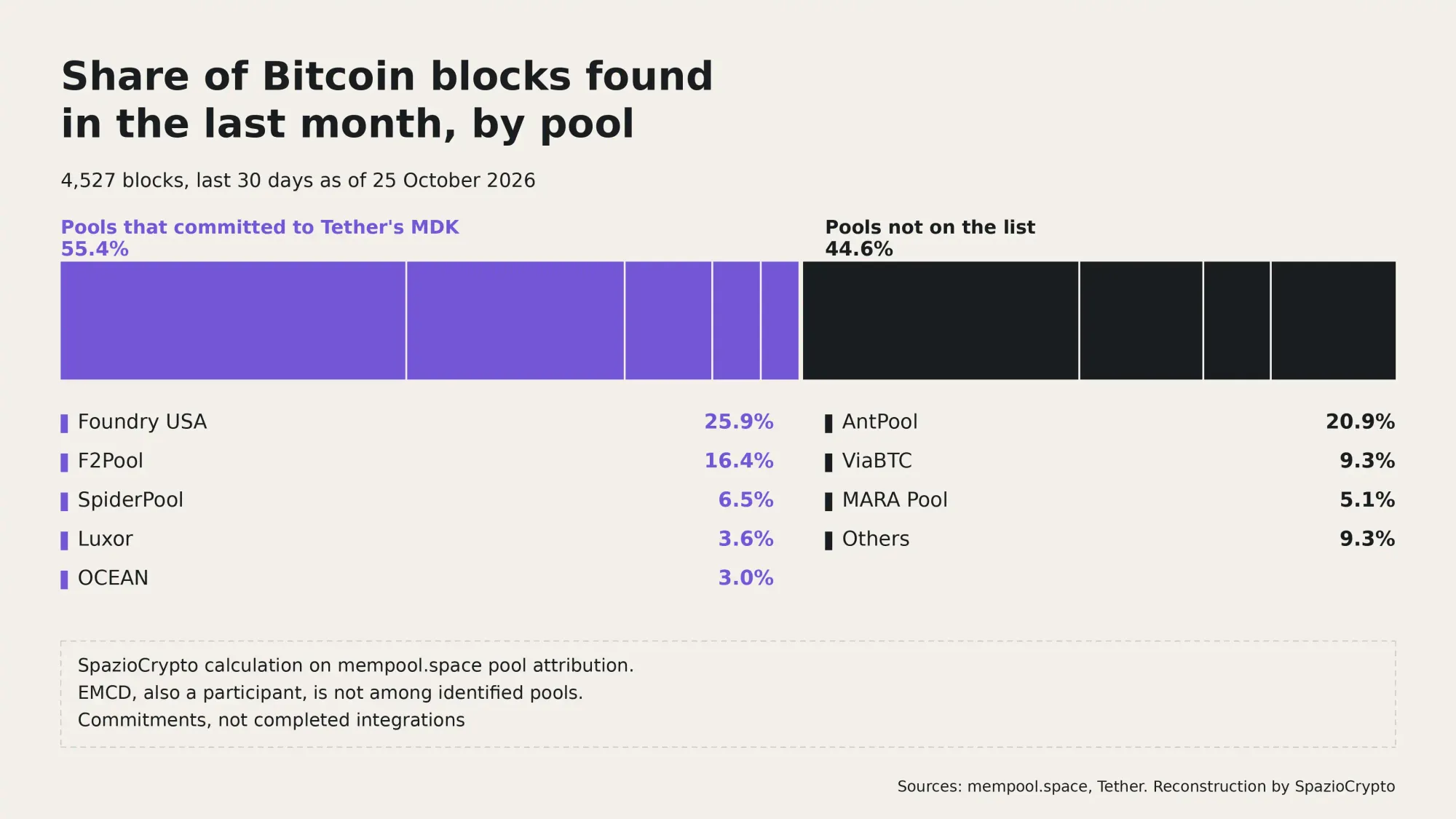
Pool weight is best measured in blocks found. According to mempool.space data read on October 25, Foundry USA found 1,171 of the 4,527 blocks mined in the past month, F2Pool 742, SpiderPool 296, Luxor 165, and OCEAN 135. Combined, those five pools account for 2,509 blocks, or 55.4% of the total, per our own calculation. The figure is indicative: mempool.space attributions depend on the identification tags pools embed in blocks, and EMCD does not appear among identified pools. Notable absentees from the signatory list include AntPool (linked to Bitmain) at 20.9% of blocks, ViaBTC at 9.3%, and MARA Pool at 5.1%.
The Commitment: One Worker per Signatory
Each signatory takes on a specific obligation: build and maintain an MDK Worker, which the press release defines as “a translation layer that connects its hardware, mining pool, or system to MDK.” The public codebase describes three levels. Workers convert each manufacturer's proprietary protocols into MDK's common protocol. The Kernel receives data and sends instructions. The Gateway exposes an interface to which applications and dashboards connect. According to Tether, each company exposes only the functions it chooses through the same open interface, while retaining control of its own systems.
The stated benefit targets developers above all. According to the press release, anyone building an application, a monitoring system, or an AI agent can do so once on MDK, without adapting it for every manufacturer and every pool. The repository includes an MCP server (based on the Model Context Protocol, which AI agents use to connect to external tools) and a component library for dashboards. Among the Worker categories the documentation cites as examples are Bitdeer's site platforms and the pool interfaces for OCEAN and F2Pool.
Tether's Role: Code, License, and the QVAC Agent
The project remains Tether's. The repository is published under the company's GitHub organization with an Apache 2.0 license, which allows anyone to use, modify, and redistribute the code for commercial purposes. As a first demonstration, the press release highlights the QVAC mining agent. QVAC is Tether's AI platform, and the company states it “already operates directly on MDK.” Neither the agent's specific tasks nor the sites where it runs are disclosed.
Tether CEO Paolo Ardoino framed the initiative around a structural shift, saying in a statement released on October 24: “We are entering a period where software will increasingly run physical infrastructure, rather than simply reporting on it.” He added that this “doesn't work at scale if every machine speaks a different language.” The logic connects directly to the machine economy Ardoino has long articulated, where autonomous robots and AI agents transact in USDT. The project is backed by a company that reported approximately $1.5 billion in operating profit in Q2, according to Tether's own financial disclosures.
Tether's MDK Gains Broad Industry Backing to Accelerate the Next Generation of Bitcoin Mining Automation
, Tether (@tether) October 24, 2026
Learn more: https://t.co/DrkOJ2G2mK
The Timeline: From MiningOS to Version 1.0
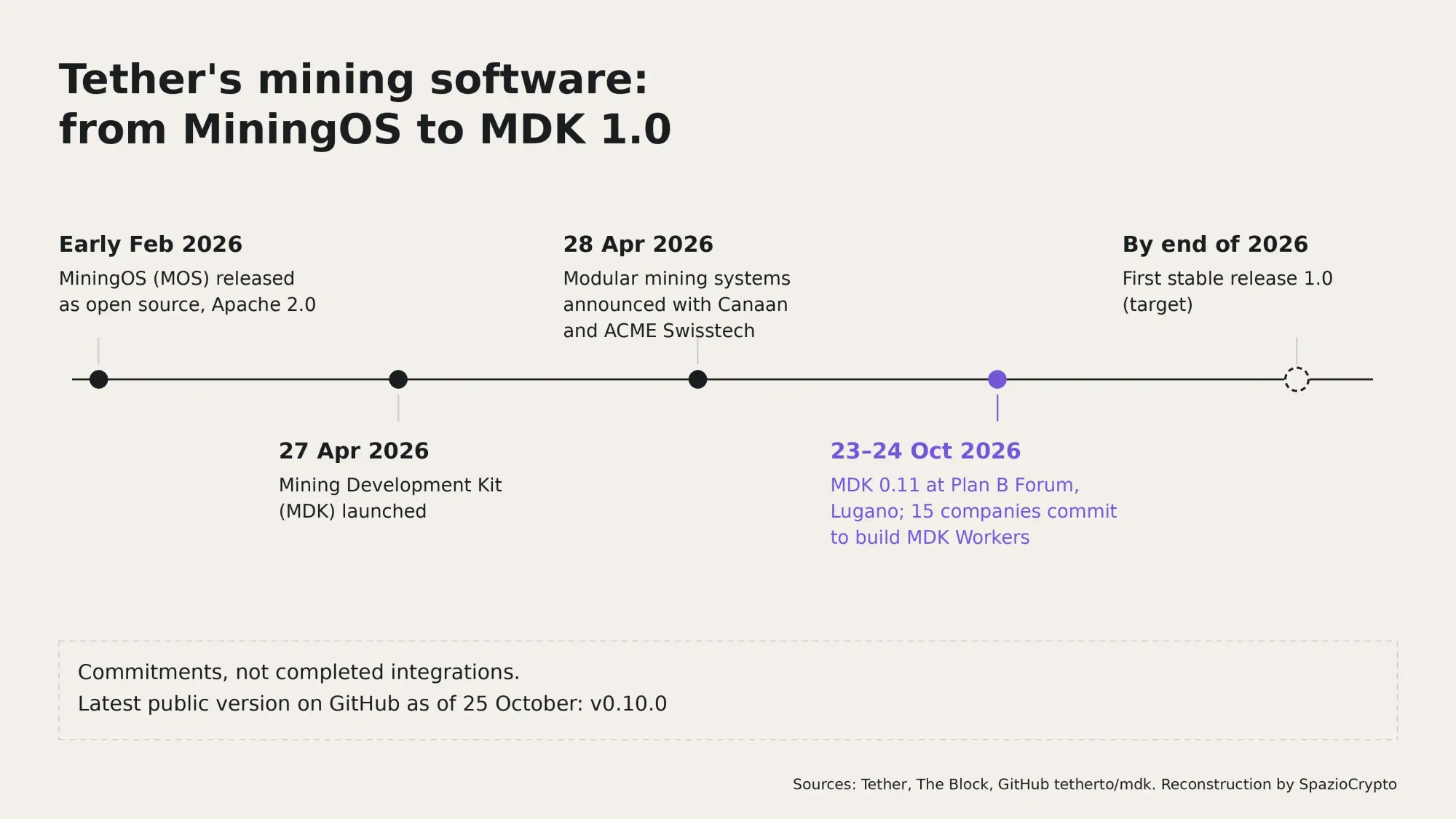
MDK is the latest step in a roadmap that began in February. Early that month, Tether released MiningOS (MOS), its open-source operating system for managing and automating mining sites, under an Apache 2.0 license, as The Block reported on February 3. On April 27, Tether launched MDK as the development foundation on which MOS and other applications would be built. The following day, according to The Block, Tether announced a collaboration with Canaan and ACME Swisstech on modular mining systems. On October 23 and 24, at the Plan ₿ Forum in Lugano, MDK moved to version 0.11. Version 1.0, the first stable release, is scheduled before the end of 2026.
There's a gap between the announcements and the actual code worth keeping in mind. As of October 25, the public repository listed version 0.10.0 as the latest release, while the press release references version 0.11 for the Lugano forum. Tether is inviting developers to test integrations and build Workers ahead of the 1.0 release, but no deadlines are given for individual signatories.
What the Announcement Leaves Unanswered
The press release describes commitments to build and maintain integrations. It does not specify which Workers are already ready or when each company will deliver theirs. None of the fifteen signatories is quoted directly, and the announcement gives no account of how the standard will be governed: who decides protocol changes, and under what rules. No financial arrangements between Tether and the participating companies are disclosed.
Tether's own position in the sector adds another layer. Per an SEC filing cited by The Energy Mag, entities linked to Tether held 19.7% of Class A shares in Bitdeer as of June, one of the signatories. The Block reported in April an 8.2% stake in Antalpha, a mining finance firm tied to Bitmain, alongside a modular hardware project involving Canaan and ACME Swisstech, both also on the list. These are disclosed relationships, not irregularities. It's our reading that they carry weight when asking who will, over time, control a standard meant to be shared.
What Changes for Operators, Manufacturers, and Developers
For operators, the promise is less dependence on proprietary manufacturer software and more automation across sites. Tether had positioned MiningOS as an alternative to the closed, vendor-controlled software stack, as reported by The Block, in a sector that this year endured falling hashrate and compressed margins. For manufacturers, exposing certain functions through a Worker means joining a shared ecosystem while choosing what to make accessible. Our reading is that this compromise is precisely what makes the commitment acceptable even for direct competitors like Bitmain, MicroBT, and Canaan.
For developers, the shift is a single unified interface replacing many fragmented ones. There's also a dimension the announcement doesn't address. Software that doesn't merely read data but actively commands machines, and can be directed by AI agents, puts the focus squarely on permission security and liability when something goes wrong. That's our reading, but it applies directly to anyone who decides to hand an AI agent control over an industrial mining site.
Tether MDK: What's Confirmed and What Isn't
What is confirmed, what is not
- Confirmed: commitment from 15 companies announced by Tether on October 24; one MDK Worker to be built and maintained by each; public code under Apache 2.0 license; QVAC agent already running on MDK per Tether; version 0.11 announced at the Plan ₿ Forum and version 1.0 expected before end of 2026.
- Not specified: which integrations are already live, per-company deadlines, standard governance rules, financial arrangements, statements from signatories, specific tasks assigned to the QVAC agent.
- To watch: the 1.0 release, the first Workers published by ASIC manufacturers, possible participation by AntPool, ViaBTC, and MARA Pool, and real-world deployment of AI agents at live mining sites.
The Bigger Picture
It's our reading that Tether's presence in mining is shifting from capital to software. After equity stakes in sector companies and hardware projects, MDK targets the layer that determines how machines are managed, and an interface adopted by manufacturers and pools can carry more influence than any single mining site. It's also a different approach to combining mining and artificial intelligence: many miners are converting their facilities into AI data centers, while Tether is proposing to bring AI inside the management of mining operations themselves.
The signals to watch are specific. First: the 1.0 release before year-end. Then, the first Workers from Bitmain, MicroBT, and Canaan appearing in the public repository. The governance rules for the standard will matter too, as will whether the pools currently absent, starting with AntPool, eventually join. For a sector built around an open network like Bitcoin, the real test is whether MDK becomes a genuinely shared language or remains the tool of a single actor.