

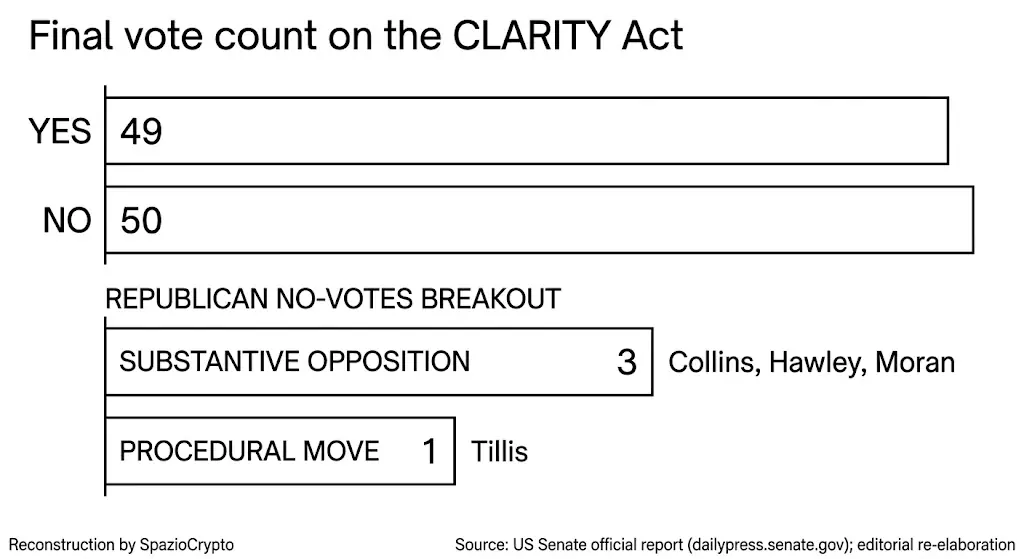
The U.S. Senate failed to advance the CLARITY Act on Wednesday, falling well short of the 60-vote cloture threshold required to bring the landmark crypto market structure bill to a full floor vote. The final tally, according to the official Senate record, stood at 49 in favor and 50 against, with one senator absent. For a sector that spent more than a year in negotiations, the failed cloture vote on the CLARITY Act marks a serious legislative setback.
Before drawing firm conclusions, though, a key nuance changes the picture significantly. The breakdown of the “no” votes is not as straightforward as the headline number suggests.
The Vote Breakdown and Why It Matters
All Democratic senators voted against cloture, joined by four Republicans. At first glance, four Republican defections looks like a significant fracture within the majority. The reality is more layered. Three of those four Republicans, representing Maine, Missouri, and Kansas, opposed the bill on substantive grounds. The fourth, the senator from North Carolina, voted “no” for a purely procedural reason that has nothing to do with his position on the legislation.
That same morning, the North Carolina senator had publicly stated his intention to vote in favor of cloture, saying he was satisfied with the ethics provisions negotiated with the White House. His “no” at the roll call was a technical maneuver: under Senate rules, a member who votes with the prevailing side can later file a motion to reconsider, keeping the door open for a future attempt. He confirmed this publicly, writing that the result is not the end of the legislative road but a procedural step aimed at preserving options. Calling the CLARITY Act “definitively dead,” as several outlets rushed to do, misreads the mechanics of what happened.
What Went Wrong in the Final Hours
According to multiple accounts, bipartisan negotiations broke down sharply in the hours immediately before the vote, when a last-minute staff-level discussion on ethics provisions ended without a final agreement. Several Democratic senators who had spent months working on the compromise text still voted against, a clear signal that the unresolved dispute over ethics rules, specifically those tied to President Trump and his family’s substantial crypto holdings, remains the bill’s most intractable political obstacle.
Reactions from the industry were blunt. The chief executive of one of the largest publicly traded crypto companies described the outcome with a single word: it “hurts.” A Republican congressional aide, speaking anonymously, told reporters the bill was effectively dead for this legislative session, a view that directly contradicts the North Carolina senator’s own assessment. One of the major digital asset management firms called the result “not the outcome we hoped for,” while noting that the sector continues to make progress through existing regulatory agencies.
The Vote at a Glance
What actually happened. Source: U.S. Senate, Reuters, The Block, 2026
- The result: 49 yes, 50 no. 60 votes were needed; the bill fell 11 short.
- The nuance: only 3 Republicans opposed on substance. The fourth voted no for procedural reasons only.
- Not necessarily over: a motion to reconsider remains available, but the path forward in 2026 is now extremely narrow.
Prediction Markets Called It Weeks Ago
The outcome confirms what prediction markets had been signaling for some time. As SpazioCrypto reported in our analysis ahead of Wednesday’s vote, the bill’s probability of passing, as priced by prediction markets, had collapsed from 82% in February to just 16% at the start of September. The Senate’s outcome validates that skepticism: aggregating the expectations of thousands of participants, those markets had correctly identified the political difficulty of assembling 60 votes well before senators entered the chamber.
It’s a useful reminder of how predictive these instruments can be when read carefully, often more reliable than the stated optimism of a bill’s own sponsors. The lead senator behind the drafting effort had herself warned, just before the vote, that a failure could effectively end the current push after more than a year of negotiations. That warning now reads as an accurate forecast.
How Markets Reacted
The failed vote had an immediate effect on prices. According to Reuters, Bitcoin and the major crypto-linked equities sold off in the hours following the result, a movement consistent with market disappointment at the absence of the regulatory clarity the sector had been counting on. During the Asian overnight session, Bitcoin showed signs of stabilization, while Ether remained slightly in the red. The episode illustrates how closely Washington’s legislative calendar now tracks with digital asset prices, with a growing link between institutional capital flows into Bitcoin and the political decisions that shape the regulatory environment around it.
The Bigger Picture for U.S. Crypto Regulation
The failure of this procedural vote reveals something deeper about the state of American crypto policy. After more than a year of negotiations, over 126 agreed amendments, and a complex mediation process spanning multiple Senate committees, the industry finds itself starting over, or at minimum waiting for a more favorable political window that, in all likelihood, won’t open before the next legislative session begins.
Two lessons stand out. First, the distinction between the North Carolina senator’s procedural “no” and the substantive opposition of his three Republican colleagues is a reminder that in both politics and financial markets, reading past the simplified headline is what separates informed analysis from noise. Second, the ethics dispute over the Trump family’s crypto holdings has proven capable of unraveling months of bipartisan work in the final hours before a vote. That obstacle is nowhere near resolved. Whatever happens in the weeks ahead, U.S. crypto regulation will continue to be written one vote at a time. For broader context on the assets at the center of this debate, SpazioCrypto’s guide on what cryptocurrencies are remains a useful starting point.