


The Federal Reserve has set out, in the Federal Register of September 29, the first operational rules under which federally supervised U.S. banks can become legal stablecoin issuers. The Fed's GENIUS Act proposals move well beyond the statute's general text: they define the precise banking procedure by which a Fed-supervised institution can obtain authorization to issue tokenized dollars through a subsidiary. Stablecoins stop being a crypto product here and become a fully regulated banking activity.
On September 24, the Fed published two distinct proposals, later formalized in the Federal Register five days later. Each addresses a different layer of the framework, and together they complete the third of three parallel regulatory tracks established by the GENIUS Act, signed into law in July 2025.
The Two Fed Proposals: What They Actually Require
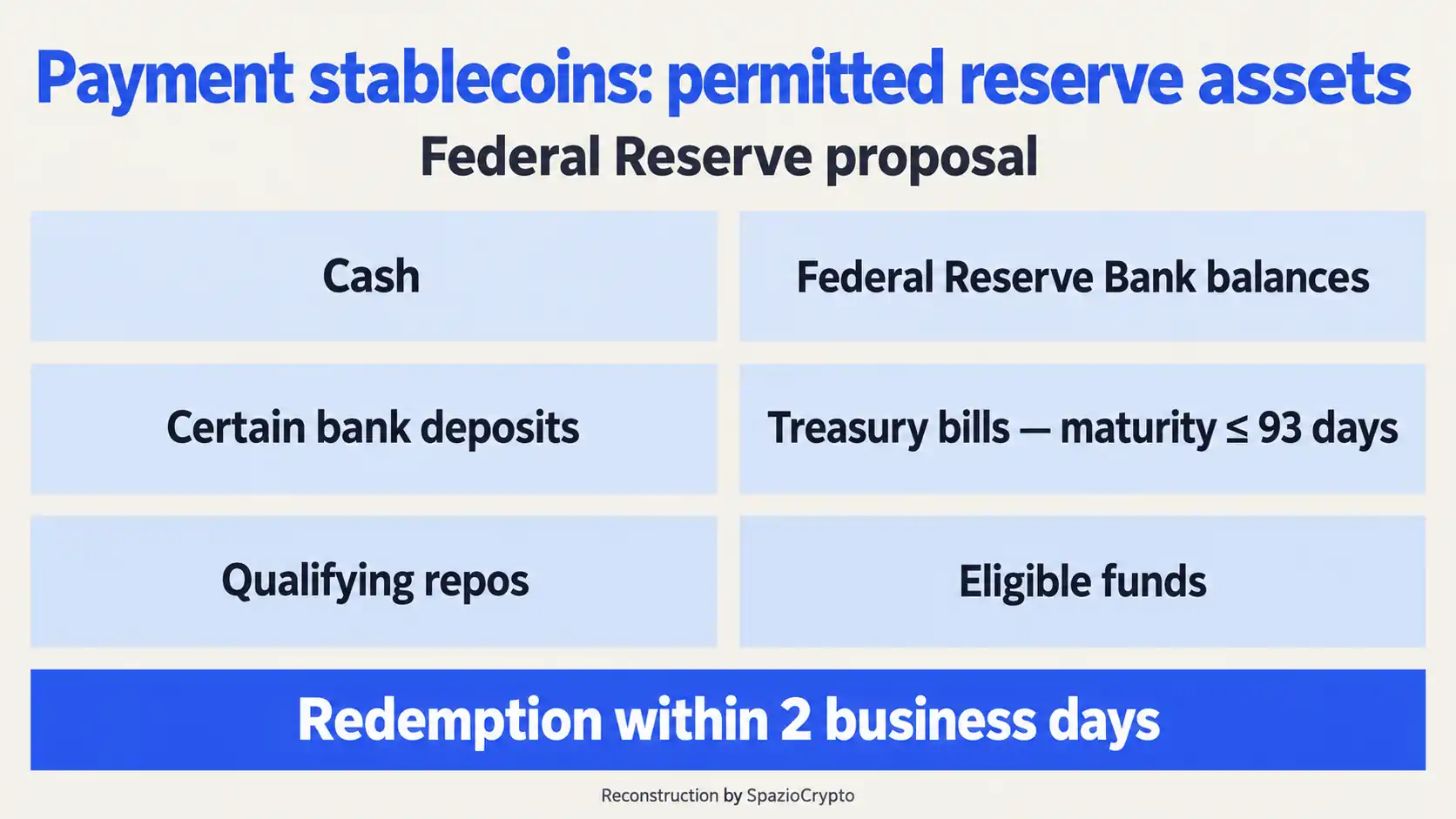
The first proposal covers prudential requirements for Fed-supervised issuers: reserves, capital adequacy, risk management, custody arrangements, and permitted activities. The central requirement is a strict 1:1 backing rule. Every stablecoin dollar issued must be fully backed by permitted reserve assets, which include cash, balances held at Federal Reserve Banks, certain bank deposits, U.S. Treasury securities maturing within 93 days, qualifying repurchase agreements, and eligible money market funds. Tokenized versions of these same assets are also permitted in certain circumstances.
Reserve assets must be held separately from the issuer's other assets at all times. Redemptions to users must generally occur within two business days, according to the proposal text published in the Federal Register. If reserve value falls below the required coverage threshold, the issuer must notify the Fed immediately. In cases of persistent capital shortfall, the issuer could be required to liquidate reserves and fully redeem all outstanding stablecoins in circulation.
The second proposal defines the approval process itself. Under the GENIUS Act, only an entity designated as a Permitted Payment Stablecoin Issuer (PPSI) may legally issue a payment stablecoin in the United States. For state-chartered banks under Fed supervision, this means any subsidiary seeking PPSI status must first obtain approval from the Federal Reserve Board. The applicant files with its regional Federal Reserve Bank, submitting a detailed business plan and the rationale supporting the request. Once a materially complete application is received, the Fed has 120 days to render a decision. Denied applicants retain the right to appeal, including through an oral or written hearing.
The Consortium Question: Where Regulation Meets the Real Market
One detail inside the second proposal stands out, because it connects the regulatory procedure directly to a market development already underway. The Fed explicitly requested public comment on whether a single approval application could cover multiple banks participating in a consortium, rather than requiring each institution to file separately.
This procedural question is not abstract. A consortium of 21 U.S. financial institutions, including Bank of America, Citi, and Goldman Sachs, has already committed to forming a joint venture to issue a shared stablecoin, as reported by Bloomberg and Reuters. The Fed asking specifically how to handle consortium applications suggests the regulator is already designing the framework around real-world scenarios, not theoretical edge cases.
The Two Proposals at a Glance
Source: Federal Reserve, Federal Register, 2026
- Proposal 1: 1:1 reserves, segregated custody, redemption within 2 business days.
- Proposal 2: PPSI approval process, 120-day decision window, right of appeal.
- The open question: the Fed asks whether one application can cover an entire bank consortium.
Three Regulators, Three Parallel Tracks
The GENIUS Act splits stablecoin oversight across three federal regulators depending on the issuer's charter type. The Office of the Comptroller of the Currency covers nationally chartered banks and their subsidiaries. The Federal Deposit Insurance Corporation covers state-chartered banks not in the Federal Reserve System. The Fed itself covers state-chartered member banks. The OCC had already published its own analogous proposal earlier in 2026. The Fed's September 24 action completes the third track, closing the regulatory triangle the GENIUS Act established.

A Federal Reserve official stated, in comments published alongside the September 24 press release, that the proposals represent an important step in implementing the GENIUS Act, while acknowledging that further work remains before stablecoins become genuinely reliable payment instruments. The regulatory path is far from finished.
How This Fits the Bigger Picture of Tokenized Dollars
This proposal belongs to a sequence of institutional developments that have accelerated in 2026, but it addresses a distinct layer that earlier news hadn't reached. SoFi's bank-issued stablecoin SoFiUSD and the expanded partnership between Citi and Coinbase showed tokenized money moving inside existing payment infrastructure. The Clearing House and Quant network demonstrated how major banks are building shared rails for tokenized deposits.
The Fed's proposals don't address how tokenized money moves. They address who is legally permitted to create it. That distinction matters enormously. Watching the pipes through which digital dollars flow is one thing; watching who gets the license to turn on the tap is another question entirely.
What This Means for the U.S. Stablecoin Market
These proposals mark a clear maturation point for the U.S. stablecoin sector. Not long ago, the central question was whether payment stablecoins would ever receive comprehensive federal regulation. Today the question has shifted to which specific banking procedure an institution must follow to obtain issuer authorization. That shift in framing mirrors transitions other innovative financial products have gone through when moving from experimentation to full regulatory legitimacy.
Two signals are worth watching from this point forward. First, the Fed's explicit request for comment on consortium applications indicates the regulator is already anticipating a market dominated by multi-bank alliances rather than standalone issuers. Second, the public comment period now open before final rule adoption gives the banking sector a genuine window to shape the details of a framework that will define how the tokenized dollar enters the U.S. financial system for years ahead. Investors and institutions tracking this space should monitor the comment period closely: the final rules will likely differ from these drafts, and the differences will matter. For a grounding in what stablecoins are and how they work, our stablecoin guide covers the fundamentals.