

Polymarket's international prediction market is now accessible through Talos's institutional order management system, effective November 19. According to DeFi Rate, the platform settled $5.3 billion in notional contract volume in October alone. The integration is open to eligible clients outside the United States, and Talos calls it the first time an on-chain prediction market has entered a professional trading infrastructure of this kind. Three key pieces, though, remain announcements: U.S. client access, block trading, and broker distribution.
The Numbers Behind the Deal
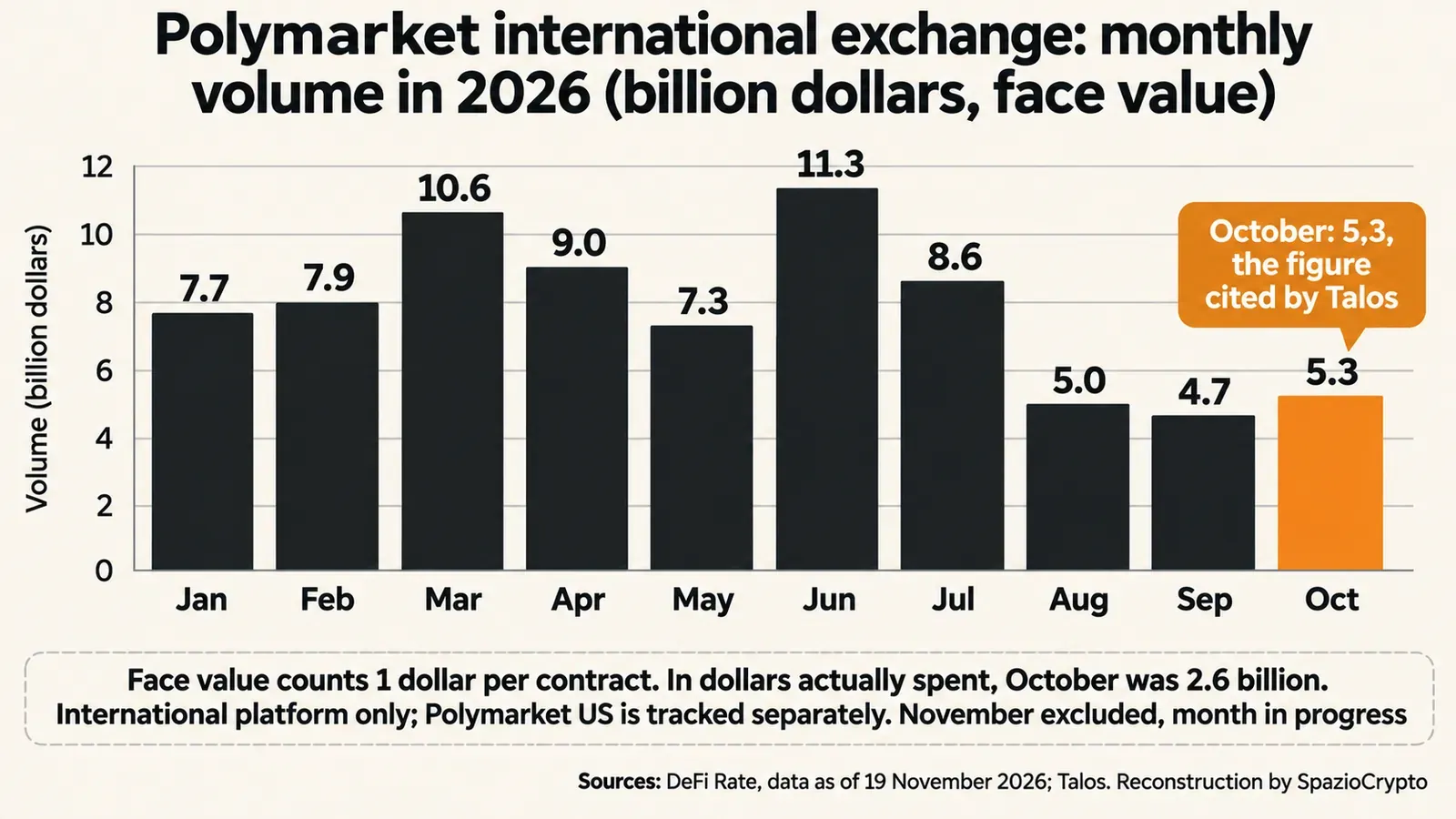
According to DeFi Rate's volume tracker, updated November 19, Polymarket's international market has cleared $80.3 billion in notional value year-to-date in 2026. The notional count values every contract at one dollar, the payout for a correct outcome, regardless of the actual purchase price. In dollars actually spent, October figures at $2.6 billion.
The monthly series is far from linear. June leads the year at $11.3 billion, with March close behind at $10.6 billion. September pulled back to $4.7 billion, and October reached $5.3 billion, roughly 47% of June's peak by our calculation. These figures cover the international platform only: Polymarket US, the CFTC-regulated exchange, is counted separately.
On the Talos side, the company surpassed $1 trillion in cumulative notional volume through its platform in Q3 2026, per its quarterly summary published October 26. That document does not specify when the count starts or how many clients are on the system.
What Changes for an Institutional Desk
For a fund or trading desk, the difference is operational. Polymarket contracts now sit inside the same environment used for digital assets generally: the same order types, the same execution algorithms, the same risk controls, and a unified position view alongside the rest of a portfolio. If you're new to the instrument, our guide to prediction markets covers the fundamentals.
The technical complexity lies in steps that a traditional desk doesn't ordinarily handle. Polymarket matches orders off-chain and settles on Polygon. Each market issues separate YES and NO tokens, transactions are signed with session keys, and gas fees are confirmed on-chain after every execution. Per the official announcement, Talos handles all of these steps within its workflow and reconciles fees directly from the on-chain ledger.
Session keys are temporary authorizations that let a system sign transactions without exposing the master key each time, a concept familiar to anyone who has thought through self-custody, exchange custody, and wallet security. Liquidity is also moving to a native format: in April, Polymarket announced the transition to Polymarket USD, a token backed one-to-one by USDC, according to Cointelegraph.
“Polymarket prices have become a benchmark for how markets read real-world events,” said Daniel Packham, Head of Provider Network at Talos, in the November 19 press release. Packham added that on-chain settlement makes Polymarket “a distinct source of liquidity” on event contracts.
What's Still Missing
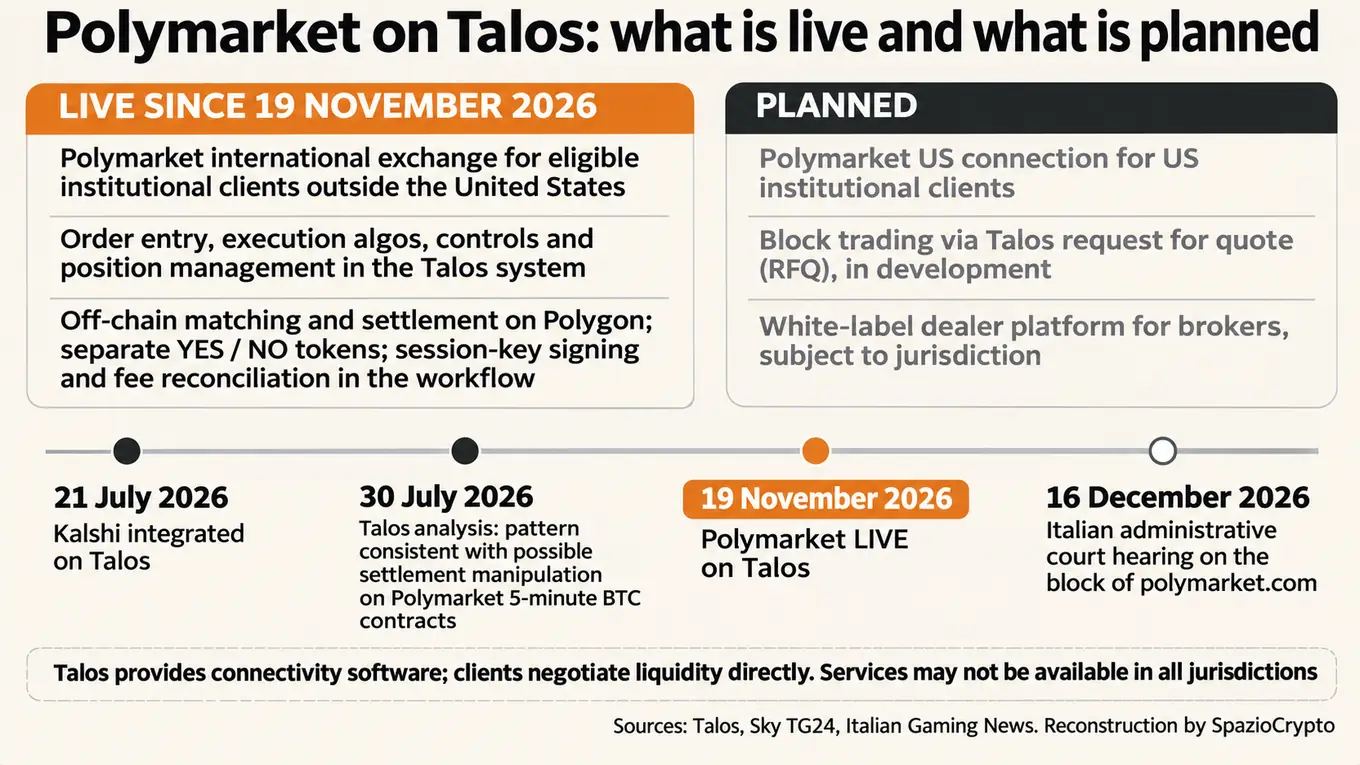
Three elements remain planned rather than live. First: the connection to Polymarket US, the CFTC-regulated exchange, for U.S. institutional clients, a development we tracked in our coverage of Polymarket's return to the U.S. market. Second: block trading via Talos's request-for-quote system, still in development. Third: a white-label platform allowing brokers and intermediaries to offer event contracts to their own clients, subject to jurisdictional rules.
The press release also sets explicit limits. Talos provides software connectivity tools, not pre-negotiated liquidity provider agreements: clients handle those relationships directly. Services may not be available in all jurisdictions. Talos also clarifies that event contracts are financial instruments traded on regulated venues, not wagers.
The Kalshi Precedent
Polymarket isn't the first prediction market venue on Talos. In July, the company announced an integration with Kalshi, the CFTC-regulated exchange offering dollar-settled contracts, with execution algorithms and block trading via RFQ already in place. The claim Talos makes now is specifically about an on-chain market, not prediction markets as a category.
On July 30, Talos's quant team published an execution cost analysis. That same document described an order pattern “consistent with possible manipulation tied to settlement” of Polymarket's five-minute Bitcoin contracts (our translation). It's an observation, not a proven finding, and it comes from the same firm that is now bringing Polymarket to its institutional clients.
Price integrity concerns are not new in this sector: we covered a related case in our piece on insider trading on Trump speech contracts.
The Regulatory Knot
Infrastructure is moving faster than regulation. In Europe, according to the Financial Times as cited by Agipronews on September 23, Polymarket is pushing to be treated as a financial platform under the MiFID directive rather than under national gambling laws. To make that case, Polymarket has met with ESMA, the European Commission, and the UK's FCA.
Responses so far run in the opposite direction. The FCA has called the binary options ban for retail clients appropriate, citing the speculative and gambling-adjacent nature of these contracts. Gaming authorities in the UK, France, Germany, and Italy are all requesting local licenses, and ESMA has warned that prediction markets are “rife with insider trading.”
In the United States, the boundary between finance and gambling remains contested, extending into the relationships between operators and problem gambling associations, as seen in the Kalshi-NCPG case.
The Italian Situation
In Italy, the regulatory outcome is already provisional. On July 10, Italy's Agenzia delle Dogane e dei Monopoli (ADM) listed polymarket.com on its registry of sites to be blocked, at position 3659, and the site went dark on July 27. On August 5, the Lazio Administrative Court (TAR del Lazio) rejected an urgent suspension request, according to Sky TG24. We documented the full sequence in our piece on Polymarket's block in Italy.
The substantive hearing at the TAR del Lazio is scheduled for December 16. Lottomatica, Sisal, Snai, and Eurobet have all intervened in support of the ADM, according to Italian Gaming News. The Talos integration targets institutional clients outside the United States, and the press release does not list the specific countries where the service is available.
Polymarket on Talos: What's Confirmed, What Isn't
A concise breakdown of the current state:
- Confirmed: From November 19, Polymarket's international market is tradable through the Talos system for eligible institutional clients outside the United States, with execution algorithms, risk controls, and position management; Talos handles Polygon settlement, YES/NO tokens, session keys, and fee reconciliation.
- Not disclosed: The specific countries where the service is available, the number of clients participating, expected volumes, and timelines for the three planned components.
- To watch: The connection to Polymarket US, block trading and the broker platform, November and December volumes, and the TAR del Lazio hearing on December 16.
The Bigger Picture
Our read, stated as such: the institutionalization of prediction markets is arriving before regulatory clarity does. A desk outside the United States can already trade probabilities on elections, interest rates, or technology outcomes using the same tools it uses for Bitcoin. In Europe, financial regulators and gambling authorities haven't yet agreed on what these contracts actually are.
The development to track isn't just capital arriving. It's the transformation of probabilities into data points and exposures that enter multi-asset strategies, a process already underway with Polymarket signals distributed by ICE since February 11. With volumes well below June's peak, the real test is whether institutional access brings new liquidity or simply redistributes existing flow. Three signals will tell: November and December volume figures, the timeline for Polymarket US on Talos, and the December 16 court decision in Rome.
Sources
Talos: press release on Polymarket (November 19, 2026), Kalshi integration (July 21, 2026), execution cost analysis (July 30, 2026), and Q3 summary (October 26, 2026). Data: DeFi Rate, Polymarket volumes (updated November 19, 2026).