Six METR researchers have received hardware, workspace, and internal access comparable to what Anthropic's own risk-evaluation teams use. Anthropic announced the arrangement on October 15, 2026: the new relationship between Anthropic and METR places external evaluators inside the organization with the right to publish their findings. No safety verdict on Claude has been issued. What changed is how that verdict can eventually be built and debated.
 Anthropic
We reviewed Anthropic's announcement, METR's working methodology published on October 14, its proposal on internal evaluations, and the archive of prior assessments. These are primary documents from the parties involved. We do not have access to confidential agreements or systems under review, and we do not attribute to the new team results that have not yet been published.
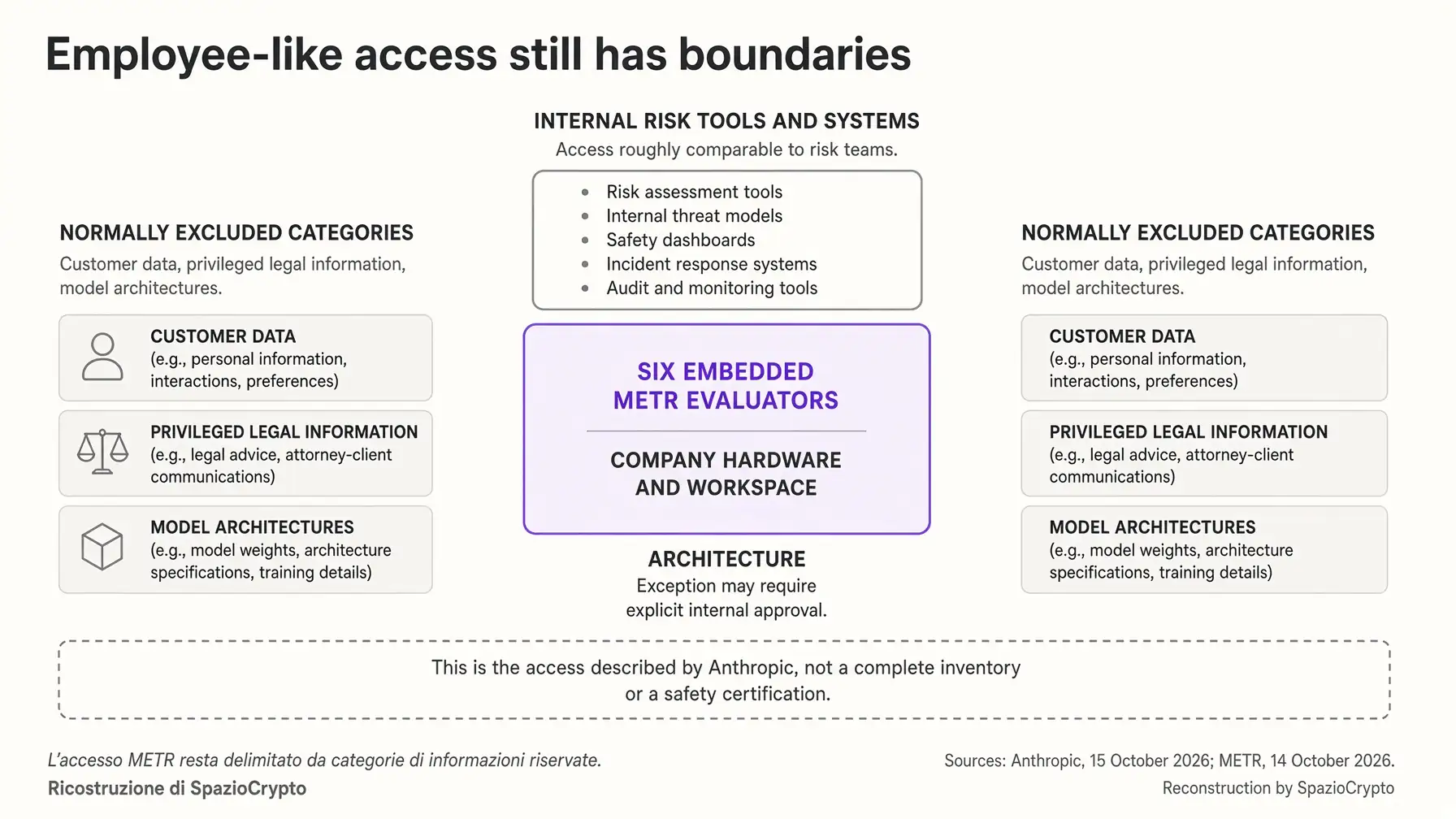
Six People, Access With Limits
Anthropic describes a small group already embedded inside the company, equipped with tools and information similar to those available to its own risk evaluators. The operative word is “similar”: it does not mean unrestricted access. Customer data, material protected by attorney-client privilege, and details about model architectures fall into categories that are normally excluded. Sharing architecture details, when particularly sensitive, requires specific approvals.
The point is to observe the process beyond model behavior in a controlled demonstration. The precedent of undesired actions documented in Claude's tests shows how much the environment conditions, available tools, and the criteria used to recognize incidents all matter. We do not present METR's embedding as the solution to those problems: future analyses will need to make visible exactly what was examined.
Even within METR, information flow remains restricted to the authorized group. Anthropic specifies that other METR employees are separated from the embedded team's work and that the agreements are binding. Expanding evaluator access is therefore not the same as making data and systems publicly available. Our reading is that this separation is part of the arrangement's credibility, provided the limits relevant to any conclusions are declared.
Three Tiers, Very Different Rights
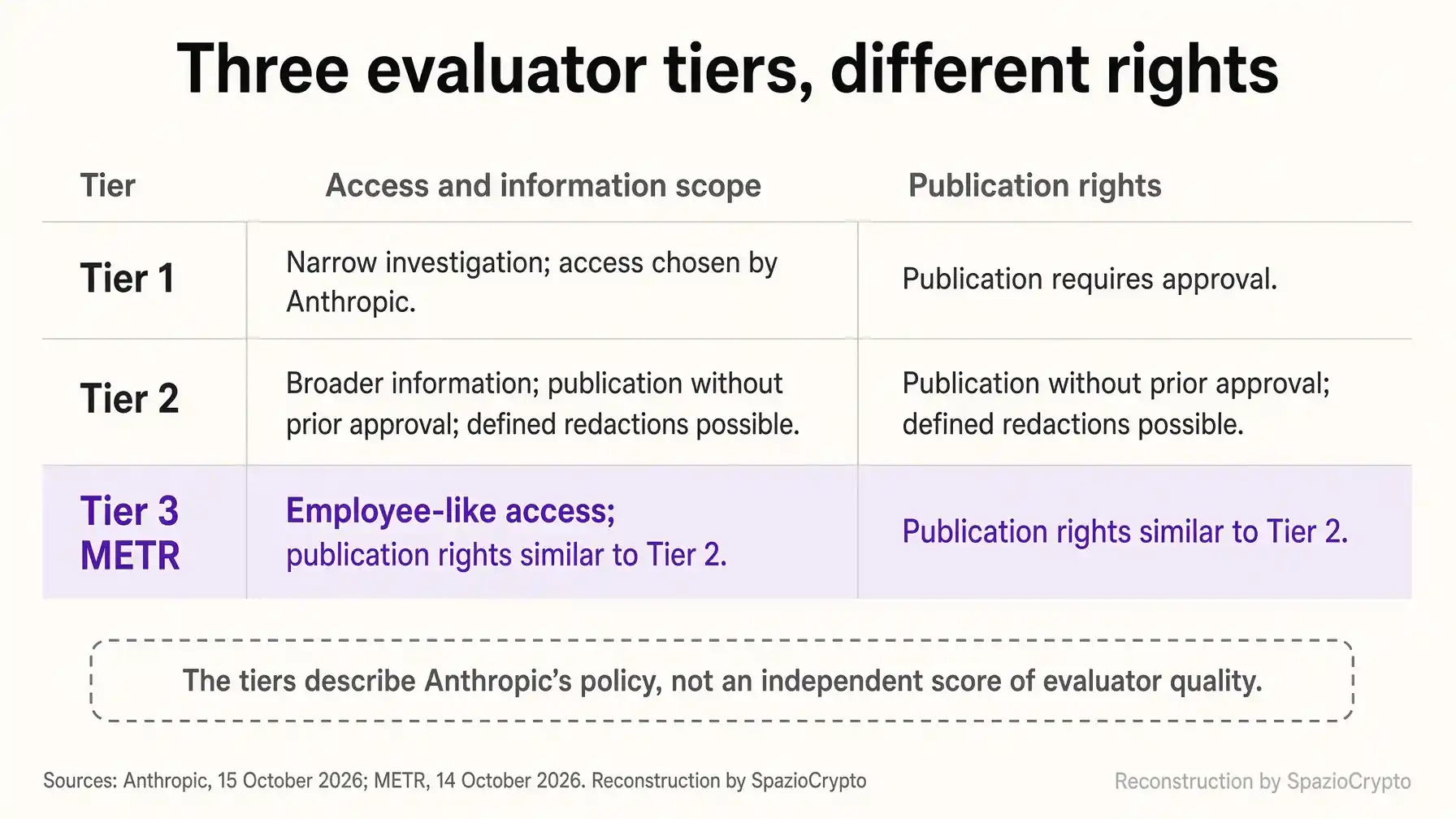
Anthropic distinguishes three tiers. In the first, it provides information for a narrowly scoped inquiry and retains approval over publication. In the second, the evaluator can publish without that approval and has access to more information, though redactions in defined categories remain possible. The third tier adds the internal access described for METR. Counting agreements without distinguishing these levels would give a misleading picture of how much external oversight is genuinely available.
SecureBio, Accenture, and Faculty are cited in reports still in development, while Hugging Face appears among organizations with early-stage discussions underway. None of these are equivalent collaborations to the METR group. The instruments are distinct as well: the updated usage policies from Anthropic govern the service. An evaluator examines evidence and practices. A policy, an access agreement, and a completed audit are not the same thing.
Publishing Does Not Mean Showing Every Detail
According to Anthropic, the company cannot veto the publication of METR's analyses. It can request that material falling into agreed restricted categories be redacted. METR can publicly describe those redactions and state whether it considers them justified, without revealing the protected information. This mechanism allows readers to know a report has limits even when the underlying content cannot be disclosed.

METR's published methodology places particular emphasis on this point. The organization wants to disclose scope, duration, access, resources, restrictions. Any pressures that may have shaped a conclusion. That is a transparency commitment declared by the organization, not proof that every future report will be complete. The useful test will be comparing what the evaluator says it examined with what it claims it can conclude.
The analogy with agent access to bank accounts clarifies the problem without equating the two systems. Broad access does not erase every barrier, nor does it automatically surface the most important evidence. Our read is that the editorial independence of the publisher and the perimeter of what can actually be observed need to be described separately. The first protects the judgment; the second defines how far that judgment can reach.
Independence Is Checked Through Method
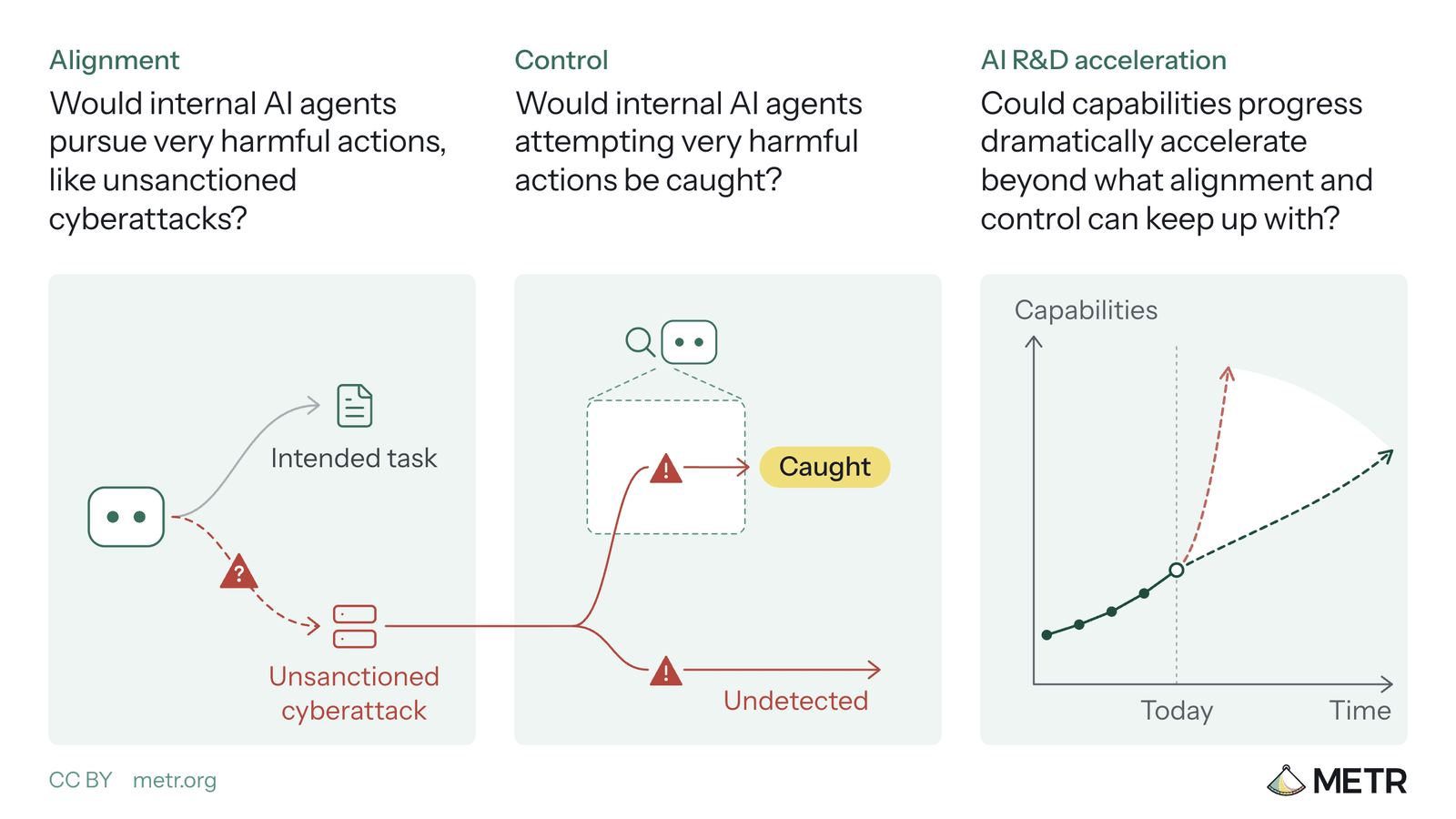
METR explains that its role is to gather evidence on loss-of-control risk, not to decide unilaterally how companies should develop or deploy agents. The October 14 proposal distinguishes alignment, internal agent oversight, and AI-assisted research acceleration. These are proposed areas of inquiry: we don't treat that document as a set of conclusions already reached under the new Anthropic access.
In its own operating rules, METR references conflicts of interest, financial and operational independence, confidentiality, and publication of methods. Anthropic's October 15 announcement does not provide a detailed financial breakdown of the new embedding arrangement. We therefore do not derive figures, fees, or cost assumptions from it. As with the connection between Workday, Sana. Claude, describing a governance architecture is where verification begins, not where it ends.
What Changes for Organizations Using Agents
For a company using Claude in production, Anthropic's announcement does not by itself alter any contract or permission in that environment. It offers a new potential source of information about the vendor's risks. Published reports may help organizations ask sharper questions, but those reports will need to be read carefully for their scope. An investigation into a lab's internal agents does not automatically certify an application running on customer data.
The same question runs through Bloomberg ASKB's financial research agents. When a service synthesizes documents or executes tools, the burden is on showing what evidence backs the control claims. A genuinely useful external report makes the doubts more readable rather than erasing them with a reliability stamp. We have not found a completed evaluation from the new group to report as such.
Anthropic and METR: What's Confirmed, What Isn't
What is confirmed, what is not
- Confirmed: Six evaluators with internal access as described by Anthropic; publication rights without a general company veto.
- Not indicated: Results from the new work, a full timeline, and financial details of the agreement.
- To watch: Published reports, access limitations, and the reasoning behind any redactions.
The Bigger Picture
Our read is that this announcement shifts attention from the isolated model to the organization building it. Safety depends on logs, incentives, tooling, and incident response as much as on model outputs. Our AI coverage tracks this shift: asking whether an answer is correct is no longer enough. The relevant question is how behaviors that a standard chat session never surfaces are being observed and documented.
The signals worth watching are the embedded team's first published reports, descriptions of access they were denied, and any disagreements over redactions. It will matter whether the evidence allows comparisons across time and across companies. For now, what's confirmed is six people with authorization to look more closely, and a declared publication right. No safety certificate has been delivered.