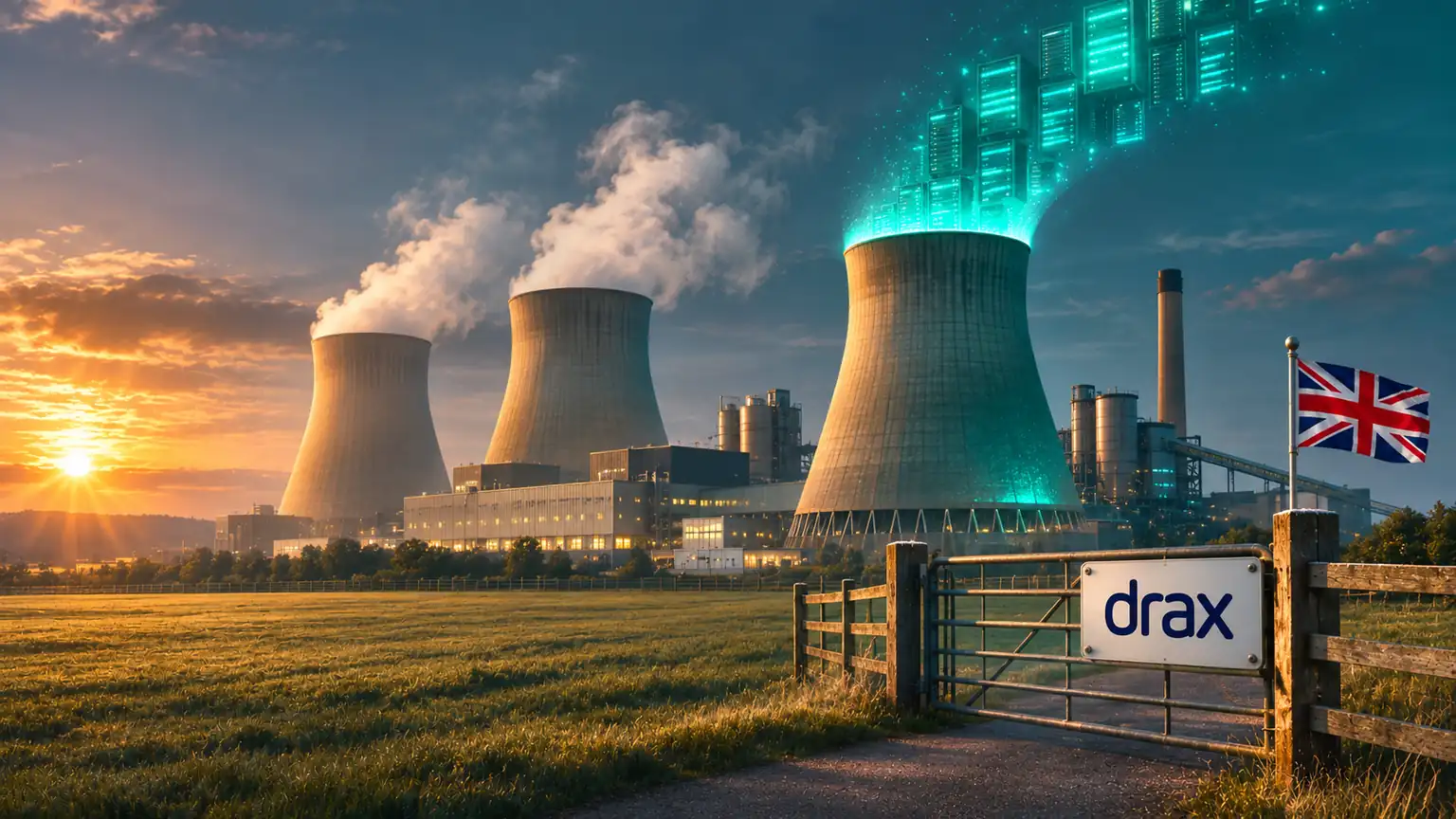


Google has agreed to guarantee Anthropic's obligations under a 20-year, roughly $19 billion contract with TeraWulf, the former Bitcoin miner now building the Justified campus in Hawesville, Kentucky for the AI laboratory. The arrangement, disclosed in a Form 8-K filed with the SEC on November 4, 2026, reframes what it means to finance infrastructure at the intersection of crypto mining and artificial intelligence.
The filing includes the credit support agreement, a press release announcing the deal, and confirmation that TeraWulf has signed a definitive engineering, procurement, and construction (EPC) contract with Fluor Enterprises. The financial logic here matters more than the headline number: Google is not investing capital in the campus. Google is lending its credit rating to Anthropic's contract, and that guarantee is precisely what allows TeraWulf to approach lenders seeking billions in long-term project debt. A prestigious tenant becomes a bankable project.
What the SEC Filing Actually Says
The credit support agreement has five parties: Raylan Data LLC (the special-purpose vehicle acting as landlord); TeraWulf Inc. (guarantor of the landlord's obligations); Justified Datapower LLC (land owner); Anthropic PBC (tenant); and Google LLC. The mechanism is not a standard surety bond.
If Anthropic fails to pay rent or enters insolvency proceedings, the landlord must notify Google before terminating the lease. Google then has a 30-day cure period to choose between two paths: assume the lease in place of Anthropic by signing a novation agreement and paying current rents, or allow the contract to lapse by paying a termination fee.
That termination fee is sized against the project debt the landlord expects to incur for each building. It can be reduced to reflect actual debt outstanding but never increased, and it is paid directly into a dedicated account governed by a separate financial support agreement with the project lenders. After payment, Google may elect to receive an ownership stake in the landlord entity equal to the ratio of the fee paid to the total development and construction cost.
Google also holds cure rights: it can remedy an Anthropic default by paying amounts owed, with Anthropic required to reimburse Google at a 5% premium. Google is not obligated to exercise those rights. The primary source is the credit support agreement filed as Exhibit 10.1 of the Form 8-K.
The TPU Clause and the Rating Trigger
Two specific provisions reveal more about Google's strategic calculus than any press release could. The first is a timing lock: for six years from the effective date of the support (which coincides with the activation of the last data hall), Google cannot choose the termination option and is treated as automatically assuming the lease, unless an “Equipment Capacity Trigger” fires. That trigger activates when the TPU Pods installed in the buildings are capable of consuming less than 50% of the tenant's critical power.
Read plainly: if the buildings fill with Google accelerators, the guarantee functions as a de facto commitment to assume the lease. If they don't fill, Google retains a paid exit. No filed document explicitly states that Anthropic will deploy TPUs at Hawesville, but the clause is built entirely around that assumption.
The second provision is a sunset condition. The agreement terminates if Anthropic, a parent, or a subsidiary obtains and maintains an investment-grade rating from S&P, Fitch, or Moody's for at least three months, provided that within 30 days the rated entity issues a full guarantee of the lease in a form acceptable to the landlord. Google's guarantee is therefore a bridge instrument: it serves until Anthropic is creditworthy enough to stand alone. Several fields remain blank in the filed text, including the effective date, the termination fee cap, the precise rating threshold, and Schedule C-1 showing the fee trajectory over time. Google's maximum exposure is not public.
The July Contract: 401 MW and Twenty Years of Rent
The guarantee attaches to the lease signed on July 3, 2026, the announcement that sent WULF shares sharply higher. Under that agreement, Anthropic leased approximately 401 MW of critical IT load across three buildings at the Justified campus, with deliveries staggered from the second half of 2027 through the second quarter of 2028. Expected contractual revenue over the full term is approximately $19 billion, according to TeraWulf's corporate disclosures.
The proportions are worth fixing clearly: $19 billion spread across 20 years averages to under $1 billion per year, and these are future rents, not capital received upfront.
The November 4 press release, available on GlobeNewswire, notes that Alphabet's senior unsecured debt is rated AA+ by S&P and Aa2 by Moody's. That is exactly the rating TeraWulf wants to present to project finance lenders. CEO Paul Prager stated that the Anthropic leases were structured from the outset to address counterparty risk, financing costs, and capital requirements. CFO Patrick Fleury put it more directly: the cost of capital is fundamental to infrastructure development.
Not the First Time: The FluidStack Precedent and the Warrants
Google used the same framework in 2025, when it guaranteed FluidStack's obligations under hosting contracts with TeraWulf at the Lake Mariner campus in New York and with Cipher Mining in Texas. That earlier transaction had a notable difference: TeraWulf paid for the guarantee with warrants covering 73.58 million shares at $0.01, giving Google a potential stake of roughly 8% in the company. Cipher Mining ceded approximately 5.4%.
The Kentucky filing includes no warrants and no fees payable to Google. That shift signals a changed relationship: in 2025 Google was a financial investor charging for its name; in 2026 Google is Anthropic's principal financial backer, protecting its partner's computing capacity.
That earlier transaction was an early signal that Bitcoin miners could stage an infrastructure-driven rally, and it opened a wave of conversions that SpazioCrypto has tracked closely, from IREN's pivot from Bitcoin miner to AI infrastructure at $30 billion in data centers to operators selling BTC reserves to fund construction.
Fluor and the Construction Timeline
The second announcement on November 4 covers execution. TeraWulf converted the limited notice to proceed issued to Fluor in March 2026 into a full guaranteed maximum price EPC contract covering all three Justified buildings. Fluor's scope expands from preliminary engineering alone to full engineering, procurement, construction, testing, and commissioning, with defined delivery milestones, open-book cost reporting, and contractual performance protections.
The guaranteed maximum price is still being finalized as engineering and procurement advance. First ready-for-service deliveries are expected by the end of 2027, with phased completion through the second quarter of 2028. Prager noted that Fluor allows TeraWulf to scale execution without building a large internal engineering and construction organization. For a company that was running mining facilities two years ago, that's a candid admission: the competence now being purchased is not energy management but construction management.
TeraWulf has separately brought the Muskie campus in eastern Kentucky to 1 GW of contracted electrical capacity, and is converting part of the Lake Mariner mining infrastructure to high-performance computing.
Why This Matters: The Product Is the Contract, Not the Megawatts
The financial lesson of this transaction is clear. For a former miner, having energy, land, and a marquee tenant is not enough. A 20-year lease with a private company carrying no investment-grade rating, however highly valued, is not by itself collateral on which banks will lend at competitive rates. It becomes that collateral when an AA+ counterparty stands behind the tenant.
What TeraWulf is selling to lenders is a three-layer package: contracted energy, long-term lease, and Big Tech credit support. Prager captured the broader sector shift with one sentence: megawatts alone do not create shareholder value. That logic explains why miner valuations have decoupled from Bitcoin's price and hashrate, and why AI data center capital demand is reshaping the entire supply chain that SpazioCrypto tracks in its mining and AI coverage.
Bloomberg reported in July that TeraWulf was preparing a roughly $3.5 billion raise for the Kentucky campus with Morgan Stanley leading. No official document confirms the amount, lenders, or timeline as of the November 4 filing.
Limits to Keep in Mind
The market's reaction on November 4 was cool. WULF closed down approximately 4% on the day of the announcement, in a broadly negative session for the sector: Cipher Digital fell 18% and IREN dropped 9%, per Yahoo Finance data. Investors had partly priced in Google's backing, and the sector remains exposed to data center debt repricing.
Several points remain open. The $19 billion represents expected contractual revenue over 20 years, not cash received, and depends on the construction schedule holding. Google's maximum guarantee exposure is not disclosed. Google does not automatically become tenant or owner of the campus: that only occurs if Anthropic defaults, and only if Google elects or is contractually required to step in. Capacity and delivery dates remain subject to the construction, financing, and commissioning risks typical of a multi-hundred-megawatt project. The guarantee improves the project's credit profile but does not equal financial close, which TeraWulf still needs to negotiate. SpazioCrypto will follow the next steps, from the project debt announcement to the first 2027 deliveries, in its ongoing AI infrastructure coverage.