

Drax Power Station, the UK's largest electricity generator, is repositioning itself as an AI infrastructure hub. On November 3, Drax announced a partnership with Brookfield and Radiant, Brookfield's British AI infrastructure platform, to build AI data centre capacity at the Drax site in Yorkshire. The first phase targets up to 100 megawatts of capacity from Q1 2028, backed by an initial £2.5 billion investment. According to Reuters, the full project aims to exceed one gigawatt, and Brookfield estimates total investment could surpass £20 billion. Those figures come with caveats: planning permissions, a signed tenant, and a final investment decision are all still missing.
 sarahfirminger

The source material for this article draws on the official Drax press release, Reuters coverage as republished by Global Banking & Finance Review, and the London Stock Exchange regulatory announcement as cited by Yahoo Finance and ADVFN. Some links in those disclosures redirect to related rather than primary documents.
Who Does What
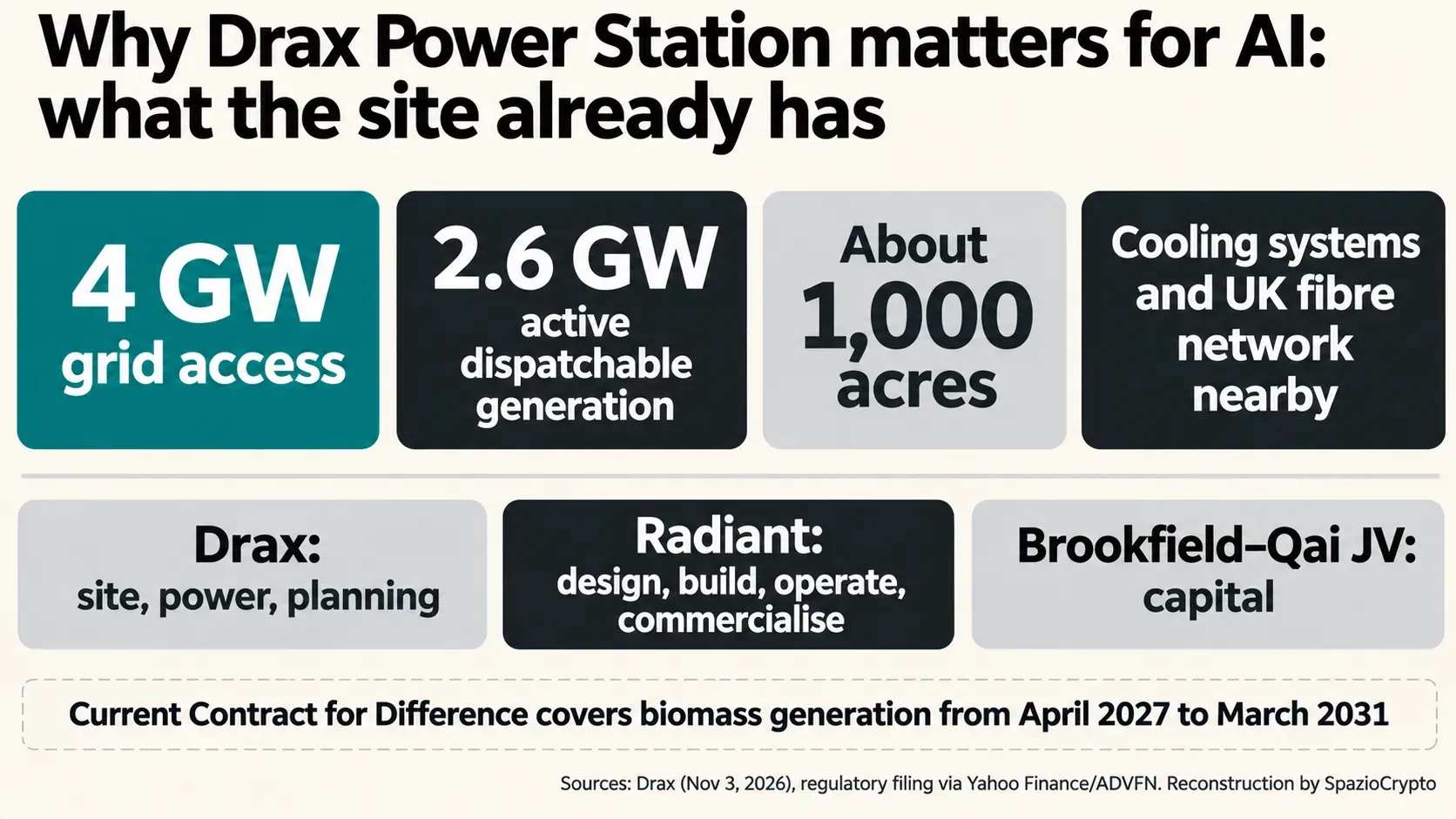
Drax provides the land and the energy, managing site access, power supply, and the planning process. Radiant designs, builds, operates, and commercialises the data centre. Capital comes from Brookfield through its joint venture with Qai, a Qatar-based technology company that, according to the official press release, operates under the Doha Investment platform. All three parties say they will jointly develop, deliver, and manage capacity on the site.
The site itself is the central selling point. According to Drax's own disclosure, it covers roughly 1,000 acres, carries 4 gigawatts of grid connection, has 2.6 gigawatts of active dispatchable generation, on-site cooling systems, and direct proximity to the UK fibre network. Drax CEO Will Gardiner said that, if built in full, it could become one of the largest data centres in the country.
 Reuters and Barnali Pal Sinha
Three Phases: What Is Actually Committed
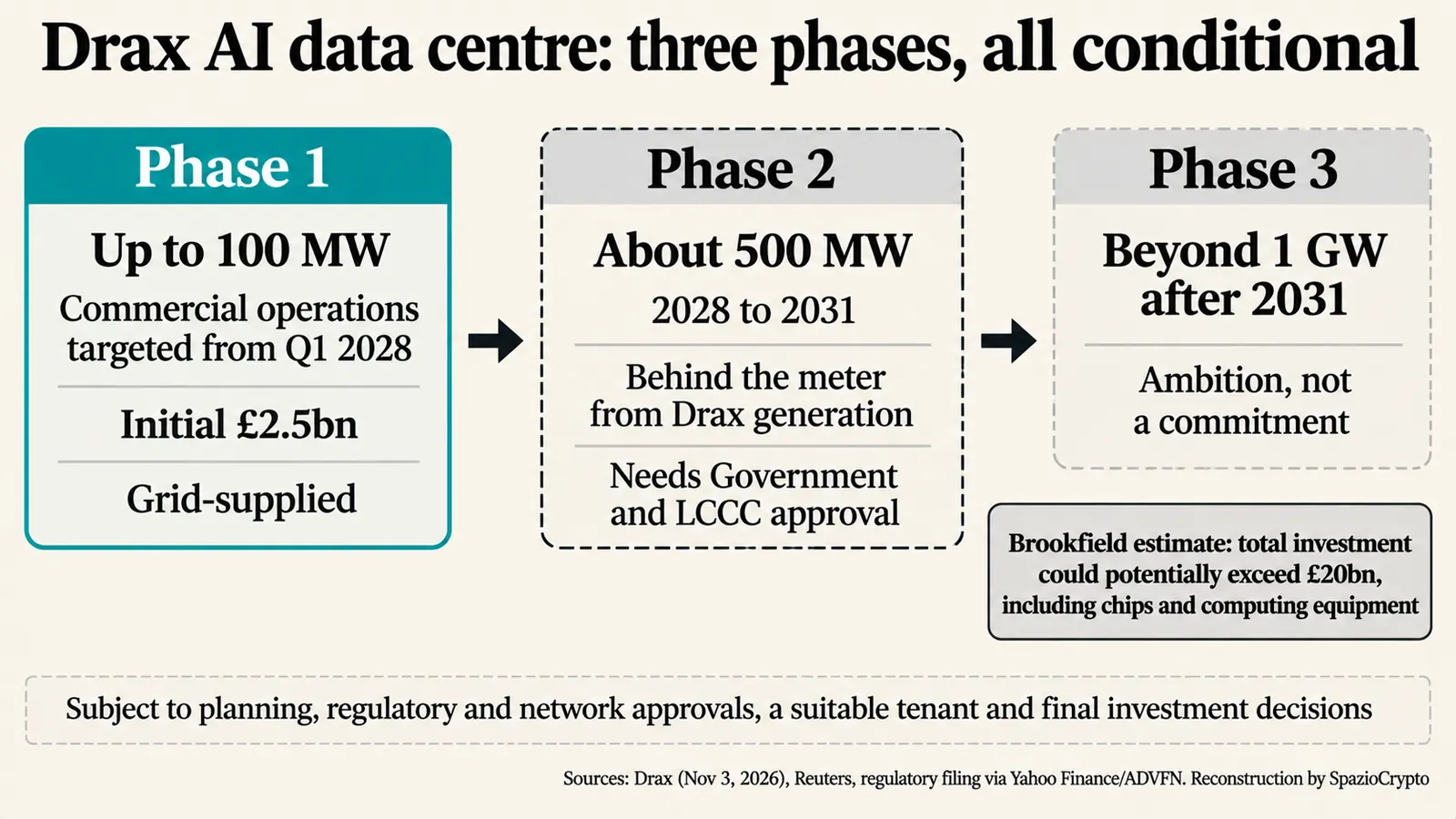
Phase one covers up to 100 megawatts, with commercial operations targeted from Q1 2028 and an initial investment of £2.5 billion. Per the regulatory announcement as cited by Yahoo Finance, it will be grid-fed and built on land already owned by Drax. Phase two targets around 500 megawatts between 2028 and 2031, powered directly by Drax's own generation. Phase three, planned after 2031, could push total capacity beyond one gigawatt. That last figure is an ambition, not a commitment.
The £20 billion headline deserves equal scrutiny. The press release frames it as a Brookfield estimate that the full project “could potentially exceed” that amount. According to the regulatory announcement as reported by Yahoo Finance, the figure includes compute chips and other hardware, not just construction costs. The only capital tied to a concrete decision right now is the £2.5 billion for phase one, and even that remains conditional.
The Conditions: Planning, Grid, Tenant
Drax states that phase one can proceed only if planning timelines are adequate, if regulatory and grid approvals are granted by the government and system operator, and if a suitable tenant is secured. No tenant has been named. According to Yahoo Finance, commercial agreements and a final investment decision are both outstanding. A public consultation is due to launch shortly, in November per the regulatory announcement, with formal planning to follow in the months ahead.
Phase two raises a more sensitive question. Per Yahoo Finance, the Contract for Difference Drax signed with the UK government in November 2025 covers approximately 6 terawatt-hours per year of biomass generation from April 2027 to March 2031, and includes a mechanism by which Drax can request that up to 500 megawatts be redirected toward a data centre. That redirect requires approval from the government and the Low Carbon Contracts Company, the public body that administers these contracts. Drax stresses that its supply security and system service obligations remain unchanged.
Why a Power Station Makes Sense for AI
In a market where securing a new grid connection can take years, a site with 4 gigawatts of existing access and its own dispatchable generation carries real weight for anyone building data centres. It's the same bottleneck we explored in our piece on AI's growing energy appetite, and it explains why the binding constraint on AI infrastructure investment is often political and logistical rather than financial. Our read, stated as such, is that Drax is marketing a genuinely rare package: land, grid access, and controllable generation in a single location. The industry calls this “powered land,” and right now supply is thin.
Drax isn't alone in this pivot. Bitcoin miners are following the same path, converting sites and grid connections into AI data centres. In Europe, Google tied a data centre investment to the survival of a nuclear plant, as seen with the Loviisa nuclear facility in Finland. The thread connecting all of these moves is the global race for AI infrastructure, where energy access and capital matter as much as chips.
Markets, Government, and Open Questions
The stock market responded positively. According to market data reported by Yahoo Finance, Drax shares rose more than 8% on November 3. The government welcomed the deal: Science, Innovation and Investment Minister Chris McDonald called it a strong vote of confidence in the UK. Local MP Keir Mather said he wants to work with Drax to ensure the plan protects existing power station jobs.
Environmental concerns remain. Reuters reported that some experts worry that if the data centre were powered by biomass, emissions could be high, given the wood burned and the CO2 released. Drax says it is targeting low-emission power, drawing on both its own generation and the grid. The companies have also announced a voluntary community fund, separate from any planning obligations.
Context: A Power Station Rebuilding Its Horizon
Tying data centres to existing generation assets follows the same logic driving major tech groups toward nuclear power. Drax's current contract runs to March 2031, and phase two of the data centre extends to exactly that date. For Drax, the project could become an activity that continues beyond that horizon. The announcement says nothing about what happens to biomass generation after 2031. Brookfield speaks of hundreds of preserved jobs and new employment across Yorkshire. Those are stated outcomes that depend entirely on the project being built.
Drax Data Centre at a Glance
What is confirmed, what is not
- Confirmed: Partnership announced November 3 between Drax, Brookfield, and Radiant, with capital from the Brookfield-Qai joint venture; phase one up to 100 MW from Q1 2028 with £2.5 billion in initial funding; site carries 4 GW of grid access and 2.6 GW of generation capacity.
- Not disclosed: The tenant, the financial terms for Drax, the final investment decision, and what happens to generation after March 2031.
- To watch: The November public consultation, grid and government approvals for phase two, and the announcement of a tenant.
The Bigger Picture
Our read, stated as editorial opinion, is that the value of a power station is changing in nature. For decades, Drax sold electricity. Now it's trying to sell the ability to use that electricity immediately, at a site that already has land, grid access, and controllable generation in one place. That's a concrete advantage in a market where grid connection is the scarcest resource. It's also a bet that ties the plant's future to a sector that still has no announced customer, and that reopens the biomass emissions debate.
Three signals are worth tracking. First: the outcome of the public consultation and planning process for phase one. Second: whether the government and the Low Carbon Contracts Company approve the 500-megawatt redirect in phase two. Third, and most consequential: the name of the tenant. Without one, the £20 billion figure remains a Brookfield estimate, not a project.