

Moonshot AI, the Chinese company behind the Kimi models, has published the weights of Kimi K3.1 Pro on Hugging Face. Its flagship model had until now been available only through an API. Why it matters: anyone with the infrastructure can download it and run it on their own servers, without going through the company's systems. But the licence is not entirely free. Model-as-a-service providers with more than $20 million in aggregate revenue over twelve months must sign a separate agreement with Moonshot before using it commercially.

We read the model card and the full text of the licence in the official repository, both consulted on November 5. The report dating the release of the weights to November 4 and Kimi's announcement post on X would not open with our tools: the date is provided by our newsroom. We did not run the model, and the comparisons with other systems cited here are Moonshot's own claims.
Releasing the model weights of Kimi K3.1 Pro: https://t.co/tJXcYUeSCj
, Kimi.ai (@Kimi_Moonshot) November 4, 2026
We'll keep advancing open intelligence. pic.twitter.com/BbWCJUYYSQ
What kind of model is Kimi K3.1 Pro?
According to the model card, Kimi K3.1 Pro is an open-weights, multimodal model designed to work as an agent. It uses a mixture-of-experts architecture, in which only part of the network is activated for each token: 104 billion active parameters out of 2.8 trillion in total, with 896 experts, 16 of which are selected per token. It handles a context of about one million tokens, reads text and images, and has an adjustable reasoning level that is set to maximum by default.
To get a sense of the scale, picture a huge library where only a few shelves are consulted for each question: it is faster than a library where everything gets read, but it is still enormous to house. The weights are distributed in a compressed 4-bit format trained specifically for that precision. The card lists vLLM, SGLang and TokenSpeed as inference engines, but does not say how many GPUs are needed or how large the files are. Our own reading is that this remains a model within reach of data centres, not of a single server.
What do Moonshot's comparisons show?
The card sets Kimi K3.1 Pro against Anthropic's Claude Opus 5.5 and OpenAI's GPT-6 Astra. On Moonshot's figures, the model leads on some coding and research tests, such as DeepSWE (75.5 versus 74.2 and 74.1), BrowseComp (92.1 versus 90.8 and 91.5) and HLE-Full with tools (70 versus 67.7 and 57.2). It trails on others, such as HLE-Diamond (39.4 versus 60.9 and 65.8), OSWorld and ExploitBench.
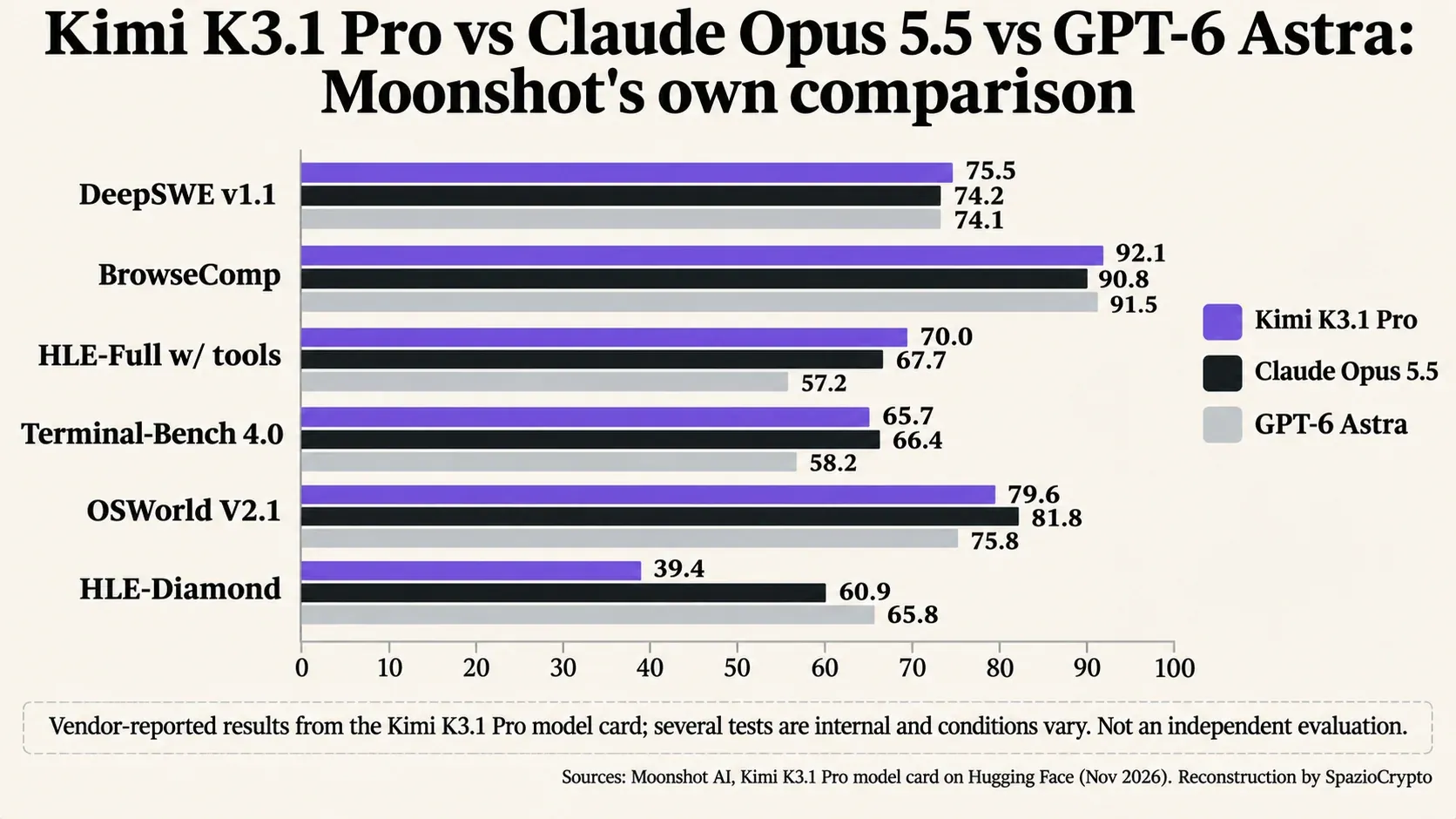
These numbers should be taken for what they are. Several tests are internal to Moonshot, some of the other models' scores come from third-party reports, and testing conditions vary from one benchmark to the next: on Terminal-Bench, for example, Kimi was evaluated using the Claude Code environment. These are the company's own comparisons, not an independent check of the newly released weights, and they say nothing about how the model will perform on the infrastructure of whoever downloads it.
What does the licence allow?
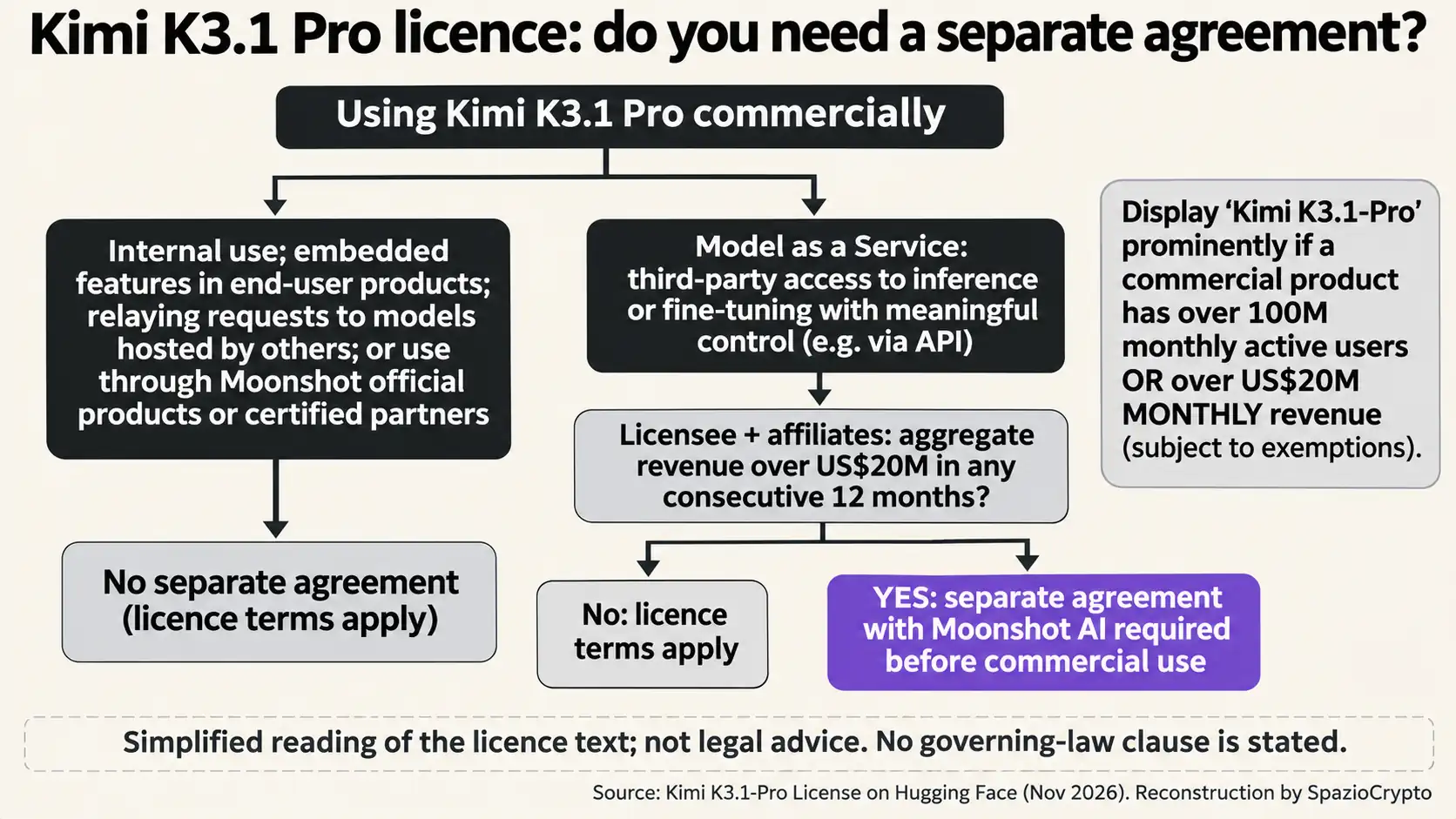
The licence opens with the wording of the most permissive licences: permission is granted “free of charge, to any person”, and it covers the weights, the code and the documentation. The turning point is the clause on models as a service, meaning anyone who gives third parties access to inference on or training of the model, for example through an API. If the aggregate revenue of the licensee and its affiliates exceeds $20 million over twelve consecutive months, a separate agreement with Moonshot is required before any commercial use.
 Artificial Analysis
There are exemptions. The rule does not apply to end-user products in which the model's capabilities are built only into specific features, to those who simply forward requests to models hosted by others, to internal use, or to use through Moonshot's official products or its certified partners. A second obligation concerns attribution: products with more than 100 million monthly active users, or above a $20 million threshold, must prominently display the name Kimi K3.1-Pro in their interface. The licence does not specify a governing law.
Who really stands to gain?
For a company or public body that wants to use the model in-house, the licence is generous: internal use is exempt and data never has to leave its own servers. For a startup building a product with the model embedded in some features, the road is open. The restriction hits the large inference resellers, the cloud providers and the platforms that sell access to models as a service: precisely the players that, as the arrival of OpenAI's models on Google Cloud shows, control distribution today.
It is a business model that is spreading among Chinese labs. MiniMax, too, has bet on a mix of low prices and weights released at a later stage, while DeepSeek has open-sourced a prototype agent for working on GitHub. Open weights become a channel for spreading the model, while the biggest revenues remain tied to deals with those who resell it at scale.
What about Italy?
For an Italian company, a model with downloadable weights means being able to run it on servers in Europe while keeping control over data and configuration, a sensitive issue since supervisory authorities warned that EU finance depends on foreign artificial intelligence. The limits are twofold. The first is infrastructure, because a model of this size requires computing capacity that few organisations have, and projects such as the sovereign AI platform from TIM and NVIDIA are still under construction.
The second is regulatory. Anyone integrating a general-purpose model into a service has to reckon with the AI Act, and anyone distributing it as a service above the $20 million threshold has to negotiate the terms of use with a Chinese company. Having the weights in-house brings technical autonomy, not contractual autonomy: for the big operators, Moonshot still has the final say.
Kimi K3.1 Pro at a glance
What is confirmed and what is not
- Confirmed: weights published in the official Hugging Face repository; 2.8 trillion parameters, 104 billion of them active, and a context of about one million tokens; a separate agreement with Moonshot for model-as-a-service providers above $20 million in aggregate revenue over twelve months; exemptions for internal use and embedded features.
- Not specified: hardware requirements and file size; the law governing the licence; independent evaluations of the published weights.
- What to watch: the first independent tests; which cloud providers and platforms sign agreements with Moonshot; the model's arrival at European providers.
The bigger picture
Our reading, which we flag as such: Kimi K3.1 Pro shows that “open weights” no longer means “no strings attached”. The licence leaves widespread use free, that of companies running the model in-house and of startups embedding it, and sets up a toll booth at the entrance to the most lucrative market, that of the large inference providers. It is a middle path between the closed model and the truly free one, and other labs could follow it. Even in the race to cut model costs, as with GPT-6.1 Terra and computer-using agents, the real contest is over distribution.
There are three signals to watch. The first is independent testing of the published weights, which will show whether the model card's numbers hold up outside Moonshot's labs. The second is which cloud providers and inference platforms sign the commercial agreement the licence requires, and on what terms. The third is whether European providers offer the model on infrastructure inside the EU, making it accessible even to those without the means to run it themselves.